Nevada Workers Compensation 2026: New Rates, New Payroll Cap, Full Guide
Quick Answer
- It’s legally required: nearly every Nevada employer with at least one employee must carry workers’ comp coverage.
- Cost depends on payroll and industry, but the payroll cap used to calculate premiums nearly triples on October 1, 2026.
- No open claim deadline for employers, but injured workers must report within 7 days and file within 90 days.
If you’re researching Nevada workers’ compensation insurance, here’s the headline you need: the state’s payroll cap for calculating premiums has been frozen at $36,000 since 1999, and that changes October 1, 2026.
This affects every Nevada employer with at least one employee, especially those paying above $36,000 a year to any worker. The Nevada Division of Industrial Relations confirmed the new cap at $98,433.60 per employee for policies issued or renewed on or after that date.
This article covers what’s legally required, current 2026 benefit rates, the new payroll cap under Senate Bill 317, and what happens if coverage lapses. One detail worth knowing upfront: several online calculators are currently showing outdated or mismatched 2026 benefit figures, and we’ll show you the actual DIR-certified number.
The Facts
| Program | Nevada Industrial Insurance Act, NRS Chapters 616A through 616D and 617 |
| Status | Mandatory statewide, new payroll cap takes effect October 1, 2026 |
| FY2026 Max Average Weekly Wage | $1,262.94, effective July 1, 2025, certified under NRS 616A.065 |
| Max Average Monthly Wage | $8,202.80 (150% of AWW multiplied by 4.33) |
| New Payroll Cap (Oct 1, 2026) | $98,433.60 per employee per year, replacing the flat $36,000 cap unchanged since 1999 |
| Claim Filing Deadlines | Report to employer within 7 days (Form C-1), file claim within 90 days (Form C-4) |
| Regulator | Nevada Division of Industrial Relations (DIR), Workers’ Compensation Section |
| Proof Needed | Form C-1 notice, Form C-4 claim, Form C-3 employer report |
Is workers compensation insurance legally required in Nevada?
Yes. Nevada law requires nearly every employer with at least one employee to carry workers’ compensation insurance or qualify as self-insured.
This requirement comes from NRS Chapter 616A, the backbone of the state’s no-fault workplace injury system. There’s no small-business exemption based on headcount, one employee is enough to trigger the requirement.
Corporate officers, LLC managers, and most standard employees all generally fall under coverage requirements, though officers and LLC managers are subject to a separate payroll cap rule discussed later in this article.
Key confirmed facts:
- Governing law: NRS Chapters 616A through 616D, and Chapter 617 for occupational disease
- Coverage required starting with an employer’s first employee
- Regulated by the Nevada Division of Industrial Relations
Who provides workers compensation insurance in Nevada?
Nevada employers buy workers’ compensation coverage from private carriers licensed in the state, rather than through a single state fund.
Nevada used to run a monopolistic state insurance system decades ago, but that system was privatized around 1999 and 2000. Today, employers choose from multiple private licensed carriers, or they can pursue self-insurance or join an association of self-insured employers if they meet state requirements.
Key Takeaway: Nevada requires nearly every employer with at least one employee to carry coverage, purchased from a private licensed carrier rather than a state-run fund.
How much does workers compensation insurance cost in Nevada in 2026?
Cost depends on your industry classification, total payroll, and claims history, and a major 2026 change directly affects how much of your payroll counts toward that calculation.
For years, Nevada capped the payroll used in premium calculations at a flat $36,000 per employee, regardless of actual salary. That meant a worker earning $150,000 a year only contributed $36,000 toward the employer’s premium math.
Starting October 1, 2026, under Senate Bill 317, that fixed cap is replaced by a floating cap tied to the state’s maximum average monthly wage. For fiscal year 2026, that new cap is set at $98,433.60 per employee per year, nearly triple the old limit.
Not yet determined for your specific business: your exact premium, since it depends on your industry classification code, payroll, and experience rating. Request a quote from a licensed Nevada carrier for an actual number.
What is the 2026 Nevada maximum compensation rate?
Nevada’s certified maximum Average Weekly Wage for fiscal year 2026 is $1,262.94, effective July 1, 2025, as confirmed directly by the Division of Industrial Relations.
This figure matters because Nevada law caps the average monthly wage used to calculate injured worker benefits at 150% of that statewide average weekly wage, multiplied by 4.33. That calculation produces the Maximum Average Monthly Wage of $8,202.80.
We want to flag something directly here, since it’s a real source of confusion online. Several third-party workers’ comp calculators currently display different 2026 figures, some showing a maximum weekly benefit near $1,044 and others near $1,068.74. Neither matches the DIR’s own certified FY2026 average weekly wage of $1,262.94.
| Source | Figure Shown | Match to Official DIR Data |
|---|---|---|
| Nevada DIR official memo | $1,262.94/week (AWW) | Official, certified |
| Third-party calculator sites | $1,044 to $1,068.74/week | Does not match DIR’s FY2026 figure |
Reality Check: No official Nevada workers’ comp calculation should be trusted over the Division of Industrial Relations’ own published memo. If a calculator’s number doesn’t match the DIR’s certified average weekly wage, treat it with caution and check the DIR site directly.
What is Nevada’s new workers compensation payroll cap under SB 317?
Nevada’s new floating payroll cap, effective October 1, 2026, replaces the flat $36,000 annual cap that had been in place since 1999.
Under Senate Bill 317, the cap is now tied to 12 times the state’s maximum average monthly wage, updated every January 1. For the current cycle, that produces a cap of $98,433.60 per employee per year.
What this means in practice:
- Employers with high-earning employees will see more of that payroll counted toward premiums.
- The change primarily affects industries like construction, healthcare, and technology with above-average wages.
- Corporate officers and LLC managers remain under the old $36,000 cap rule, per NRS 616B.624.
- Insurance agents began receiving lists of affected renewal policies roughly 120 days before each renewal date.
- The next scheduled payroll cap update is expected January 1, 2027.
Key Takeaway: Nevada’s workers’ comp payroll cap nearly triples to $98,433.60 per employee starting October 1, 2026, though corporate officers and LLC managers stay under the old $36,000 cap.
How to get workers compensation insurance in Nevada
Getting covered involves a few clear steps, whether you’re a new employer or renewing an existing policy under the new payroll cap rules.
- Determine your industry classification code for rating purposes.
- Calculate your estimated annual payroll, factoring in the new October 2026 cap if applicable.
- Request quotes from carriers licensed to write workers’ comp in Nevada.
- Compare voluntary market rates before assuming you need alternative options.
- Update payroll figures with your carrier before your policy renews, especially if it renews after October 1, 2026.
- Confirm your policy meets Nevada’s statutory minimum requirements.
- Keep proof of coverage on file for your business records.
How to file a workers compensation claim in Nevada
Filing a Nevada workers’ comp claim follows a strict, deadline-driven process built around a few key forms.
- Report the injury to your employer within 7 days using Form C-1.
- Seek medical treatment, where the treating physician completes part of Form C-4.
- File the completed C-4 claim form with the insurer within 90 days of the accident.
- Your employer must then submit Form C-3 within 6 working days of receiving the medical report.
- The insurer must accept or deny your claim within 30 days of notification.
- If denied, you generally have 70 days from the mailing date to appeal.
Key Takeaway: Nevada gives injured workers only 7 days to notify their employer and 90 days to file a formal claim, so acting quickly protects your right to benefits.
What are the deadlines to report an injury and file a claim in Nevada?
Nevada law sets a 7-day deadline to notify your employer and a 90-day deadline to file your formal claim with the insurer.
The 7-day notice requirement comes from NRS 616C.015, using Form C-1. The 90-day claim filing deadline comes from NRS 616C.020, using Form C-4, and for occupational diseases, that 90-day window generally starts from when you knew or should have known the condition was work-related.
| Deadline | Form | Statute |
|---|---|---|
| Notify employer | 7 days | Form C-1, NRS 616C.015 |
| File formal claim | 90 days | Form C-4, NRS 616C.020 |
| Insurer decision | 30 days after notice | NRS 616C.065 |
| Appeal a denial | 70 days from mailing | NRS 616C.345 |
Missing the 90-day window doesn’t automatically end your claim. NRS 616C.025 allows limited exceptions, though Nevada courts generally interpret those narrowly.
What happens if your Nevada workers comp claim is denied?
If your claim is denied, you generally have 70 days from the mailing date of the insurer’s determination to file a notice of contested claim with the Nevada Department of Administration Hearings Division.
That appeal window comes from NRS 616C.345. Missing it can seriously limit your options, so calendar the date the moment you receive a denial notice.
Think of this appeal step like disputing a denied insurance claim on a car repair: you generally get one clear window to formally push back, and missing it can mean starting from a much weaker position.
What are the penalties for not having workers compensation insurance in Nevada?
Nevada employers who fail to maintain required workers’ compensation coverage face financial charges, potential business shutdown orders, and possible criminal prosecution.
Under NRS 616D.200, the state’s Administrator can charge an uninsured employer the full amount of premiums that would have been owed for up to six years, plus interest. The Administrator can also order an immediate stop-work order under NRS 616D.110 until the employer secures coverage.
Confirmed penalty structure:
| Violation | Consequence |
|---|---|
| Uninsured employer, back premiums | Up to 6 years of owed premiums plus interest |
| First criminal offense | Misdemeanor |
| Serious bodily harm or death while uninsured | Category C felony, 1 to 5 years prison, $1,000 to $50,000 fine |
| Second offense within 7 years | Automatic Category C felony |
| Ongoing noncompliance | Possible order to cease business operations |
Separately, some reporting describes administrative fines up to $15,000 for lapses in coverage and up to $1,000 per occurrence for late required filings, though we recommend confirming current administrative fine amounts directly with the DIR.
What happens if you’re hurt and your employer is uninsured in Nevada?
If your employer lacks required coverage, you can seek benefits through Nevada’s Uninsured Employers’ Claim Account (UECA).
Under NRS 616C.220, the UECA is designed to give injured workers the same range of compensation and benefits they’d receive if their employer carried proper insurance. The Division of Industrial Relations’ Workers’ Compensation Section administers this account specifically to protect workers caught in this situation.
Additionally, an uninsured employer loses the legal protection of the state’s exclusive remedy system, meaning the injured worker may also be able to pursue a separate civil lawsuit against the employer for the full extent of damages.
What is the current status of Nevada’s payroll cap change in 2026?
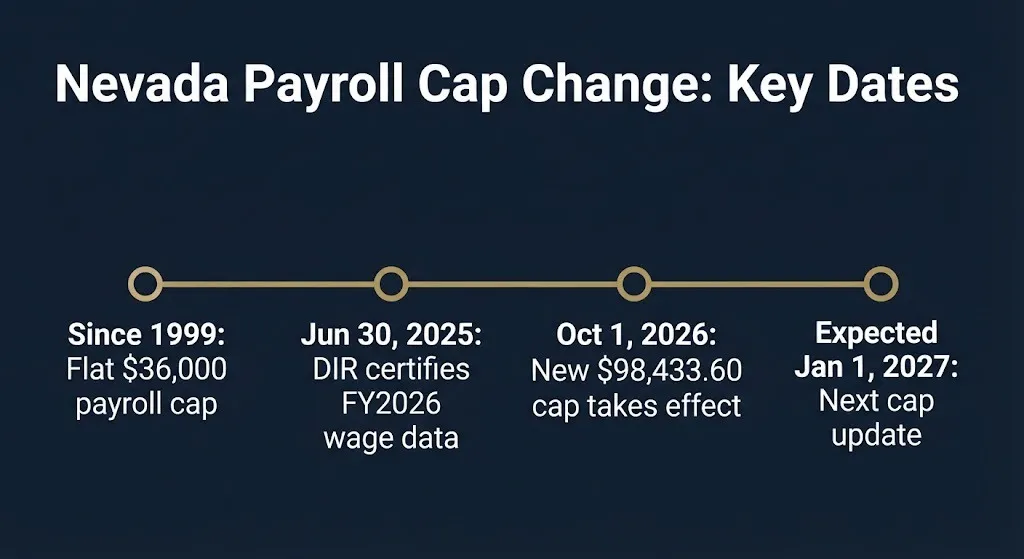
As of August 2026, Nevada’s new payroll cap is confirmed and scheduled to take effect October 1, 2026, with the next scheduled update expected January 1, 2027.
The Division of Industrial Relations set the maximum average monthly wage at $8,202.80 for the relevant period, producing the $98,433.60 annual per-employee cap. Insurance agents have been receiving lists of affected renewal policies roughly 120 days ahead of each renewal date to help employers prepare.
Confirmed 2026 timeline:
- June 30, 2025: DIR certifies FY2026 maximum average weekly wage at $1,262.94
- 2026: NCCI and DIR confirm the new $98,433.60 payroll cap for the cycle
- October 1, 2026: New floating payroll cap takes effect for new and renewing policies
- January 1, 2027: Next scheduled payroll cap update expected
Which employers must carry workers compensation insurance in Nevada?
Virtually every Nevada employer with one or more employees must carry workers’ compensation coverage, with very limited exceptions.
This includes standard private employers, along with corporate officers and LLC managers, who remain subject to their own $36,000 payroll cap rule under NRS 616B.624 even after the broader SB 317 changes take effect.
Employers typically required to carry coverage:
- Any private business with at least one employee
- Corporations, including their officers
- LLCs, including managers under the separate capped rule
Who is exempt from Nevada workers compensation requirements?
Nevada’s coverage requirement applies broadly, and true exemptions are narrow, generally limited to specific independent contractor relationships and certain sole proprietors without employees.
Because misclassifying a worker as an independent contractor can carry the same risks as failing to carry coverage entirely, employers should confirm any contractor classification carefully rather than assuming it’s automatically exempt.
Why did Nevada change its workers compensation payroll cap?
Nevada changed its payroll cap because the old $36,000 limit, frozen since 1999, no longer reflected modern wages in industries like construction, healthcare, and technology.
By capping premium-eligible payroll at a low, outdated figure, the old system also limited the pool of funds available to cover high-value claims, since injured workers’ benefits are calculated using related wage figures. Moving to a floating cap tied to the state’s maximum average monthly wage is designed to keep the system’s funding aligned with actual wage growth going forward.
Who regulates workers compensation in Nevada?
The Nevada Division of Industrial Relations, specifically its Workers’ Compensation Section, regulates the state’s workers’ comp system, alongside data support from the Department of Employment, Training and Rehabilitation.
DETR’s Employment Security Division certifies the state’s average weekly wage figures each year. The DIR then uses that figure to calculate the maximum average monthly wage under NRS 616A.065, publishes updated compensation memos, and oversees employer compliance, including the Uninsured Employers’ Claim Account.
What happens next
October 1, 2026: New floating payroll cap of $98,433.60 per employee takes effect for new and renewing Nevada workers’ comp policies.
Ongoing through late 2026: Insurance agents continue notifying employers with policies renewing after October 1 to update payroll figures ahead of time.
Expected January 1, 2027: Nevada’s next scheduled payroll cap update, based on updated average monthly wage data.
Expected mid-2027: DIR typically certifies the next fiscal year’s average weekly wage figure for benefit calculations.
Frequently Asked Questions
Do all Nevada employers need workers compensation insurance?
Yes, nearly every employer with at least one employee must carry it.
This includes corporations, their officers, and LLCs with managers.
True exemptions are narrow and mainly involve independent contractor relationships.
What is Nevada’s new workers comp payroll cap for 2026?
The new payroll cap is $98,433.60 per employee per year, effective October 1, 2026.
It replaces the previous flat $36,000 cap, unchanged since 1999.
Corporate officers and LLC managers remain under the old $36,000 cap rule.
How long do I have to report a workplace injury in Nevada?
You must notify your employer within 7 days using Form C-1.
You then have 90 days to file your formal claim, Form C-4, with the insurer.
Missing these deadlines can jeopardize your right to benefits.
What happens if my employer doesn’t have workers comp insurance in Nevada?
You can seek benefits through the state’s Uninsured Employers’ Claim Account.
The employer can face back-premium charges, fines, and possible criminal penalties.
You may also be able to pursue a separate civil lawsuit against the employer.
What is Nevada’s maximum workers comp wage rate for 2026?
The certified fiscal year 2026 maximum average weekly wage is $1,262.94.
That produces a maximum average monthly wage of $8,202.80 under state law.
Some third-party calculators currently show different, unmatched figures.
How long does my employer’s insurer have to accept or deny my claim?
The insurer must accept or deny your claim within 30 days of notification.
This deadline is set under NRS 616C.065.
If denied, you generally have 70 days to file an appeal.
Who administers Nevada’s workers compensation system?
The Nevada Division of Industrial Relations, through its Workers’ Compensation Section.
DETR’s Employment Security Division certifies the underlying wage data used for benefit caps.
Contact the DIR directly for current forms, memos, and compliance questions.
If you’re an employer with a policy renewing after October 1, 2026, update your payroll figures with your carrier now to avoid a surprise at audit. If you’re an injured worker, calendar your 7-day and 90-day deadlines the moment an accident happens.
The number to remember for 2026: Nevada’s workers’ comp payroll cap jumps to $98,433.60 per employee, effective October 1, 2026.