Haiti TPS Lawsuit: 2026 Status, Settlement, and What Comes Next
Quick Answer
- The Haiti TPS lawsuits are real, consolidated in federal courts in California and New York, challenging DHS actions on TPS designations and terminations.
- There is no financial settlement. These lawsuits seek immigration status relief, not money damages.
- Current TPS holders must re-register by the deadlines posted on the USCIS Federal Register notice for the most recent extension period.
If you hold Haiti TPS or believe you should qualify, the outcome of these lawsuits directly affects whether you can stay and work in the United States. This is not a class action with a payout. It is a legal fight over immigration status. That distinction matters, and it is one many websites get wrong.
What this article covers: every verified detail about the Haiti TPS litigation as of July 2026, including which cases are active, what the current TPS designation windows mean, whether you can still apply, and what changes may come next. One surprising verified detail: the U.S. Court of Appeals for the Ninth Circuit is currently weighing whether the Trump-era termination of Haiti TPS violated the Administrative Procedure Act, and the administration’s position on that appeal has shifted twice since the 2024 election.
The Facts
| Case | Saget v. Trump (E.D.N.Y.), Ramos v. Nielsen (N.D. Cal.), NAACP v. DHS (D. Mass.) |
| Status | Active litigation; preliminary injunctions in place |
| Fund Size | Not applicable (equitable relief only, no monetary damages) |
| Est. Per Person | No financial payout |
| Claim Deadline | Re-registration deadline: varies by Federal Register notice period |
| Administrator | Not applicable |
| Proof Needed | Haitian nationality, continuous residence in the U.S. since the designation date |
Is the Haiti TPS Lawsuit Real or a Scam?
Yes, the Haiti TPS lawsuits are real federal cases. They are not scams, and they are not settlement class actions. They are civil rights and administrative law challenges filed by individual TPS holders and advocacy organizations against the Department of Homeland Security. The goal is to prevent the termination of Haiti’s TPS designation and to compel DHS to extend or redesignate the program.
Multiple cases have been filed since 2018. The most prominent include Saget v. Trump in the Eastern District of New York, filed by Haitian TPS holders and the NAACP Legal Defense Fund, and Ramos v. Nielsen in the Northern District of California, filed by TPS holders from Haiti, El Salvador, Sudan, and Nicaragua. These cases were consolidated for certain pre-trial motions and have produced multiple injunctions that preserved TPS for hundreds of thousands of people.
The lawsuits argue that the Trump administration’s decisions to terminate TPS for Haiti and other countries were motivated by racial animus and violated the Administrative Procedure Act. Evidence cited in the complaints includes statements by former President Trump referring to Haiti and African nations in derogatory terms during a 2018 Oval Office meeting.
In April 2024, the Ninth Circuit heard oral arguments in Ramos. A ruling is pending as of July 2026. In the Saget case, the district court issued a preliminary injunction in 2019 that remains in effect, preventing DHS from terminating Haiti TPS while the litigation proceeds. The Biden administration has not sought to lift that injunction.
If someone contacts you claiming you can get a cash settlement from a Haiti TPS lawsuit, that is false. These cases seek to preserve immigration status, not to recover money. Never pay anyone who tells you otherwise.
Key Takeaway: The Haiti TPS litigation is genuine and ongoing in federal court. It is a fight over legal immigration status, not a settlement with a payout. Anyone asking for money to “file your TPS lawsuit claim” is running a scam.
Haiti TPS Status in 2026: What Is the Current Designation?
Haiti’s TPS designation is currently active through August 3, 2027. This follows a series of extensions and redesignations that have kept the program running despite the litigation over its termination.
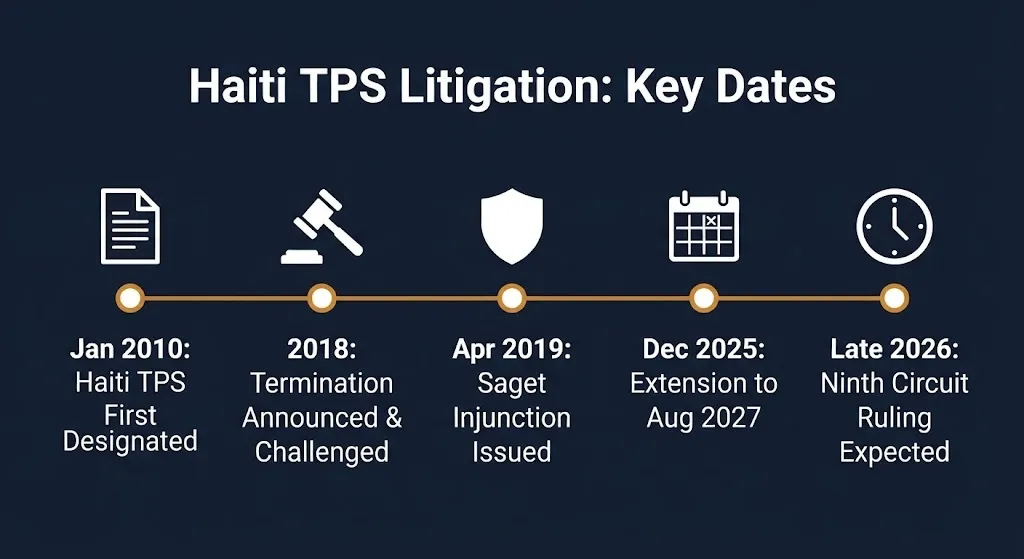
Here is the timeline of Haiti TPS designations since the program was first established. The original designation came in January 2010 after the catastrophic earthquake that killed an estimated 220,000 people. It was extended multiple times through 2017. In November 2017, then-acting DHS Secretary Elaine Duke announced that Haiti TPS would terminate effective July 22, 2019. That termination was challenged in Saget v. Trump.
In January 2018, then-DHS Secretary Kirstjen Nielsen announced she was vacating Duke’s decision and conducting a new review. In February 2018, Nielsen confirmed the termination with an effective date of July 22, 2019. That decision was challenged in both Saget and Ramos.
Federal district courts issued nationwide preliminary injunctions blocking the termination. Those injunctions remain in place. In May 2021, Secretary Alejandro Mayorkas designated Haiti for TPS for 18 months, through February 3, 2023. This was a new designation based on extraordinary and temporary conditions in Haiti, including political instability and violence. Subsequent 18-month extensions have pushed the current expiration to August 3, 2027.
The most recent extension was announced in December 2024 and published in the Federal Register in early 2025. It covers approximately 150,000 current Haiti TPS beneficiaries.
Key Takeaway: Haiti TPS is active through August 3, 2027, under the Biden administration’s successive redesignations. The litigation over the 2018 termination attempt continues but does not threaten current TPS holders as long as the new designations remain in effect.
Who Is Covered Under the Haiti TPS Designation?
The current Haiti TPS designation covers Haitian nationals who can demonstrate continuous residence in the United States since a specific date set by each redesignation or extension. Understanding which group you fall into determines your next steps.
For the most recent extension, eligible individuals must have been continuously residing in the United States since June 3, 2024. They must also have been continuously physically present since August 4, 2024. These are the key dates published in the Federal Register notice.
There are also people covered under earlier designation windows. If you were granted TPS under the 2010 earthquake designation and have maintained your status through re-registration, you remain covered. If you were granted TPS under the 2021 redesignation for ongoing extraordinary conditions, you remain covered as long as you have re-registered during each extension period.
People who entered the United States after the continuous residence cutoff date for the most recent designation may not qualify. The cutoff dates are strict. If you arrived after June 3, 2024, you are not eligible under the current designation, though you may qualify if a future redesignation sets a later date.
Certain criminal convictions can disqualify you from TPS. These include any felony and two or more misdemeanors committed in the United States. The rules are detailed in the Immigration and Nationality Act. If you have any criminal history, do not assume you are ineligible without consulting an immigration attorney.
Reality Check: TPS is not a path to a green card on its own. It is a temporary protection from deportation with work authorization. Many TPS holders have lived in the U.S. for over a decade, renewing every 18 months, without a path to permanent residency. The litigation seeks to prevent wrongful termination of TPS, not to change TPS into a permanent status. That distinction trips up many people who read headlines and assume they are about to become permanent residents.
How Does the TPS Re-Registration Process Work in 2026?
Re-registration is the process by which current TPS holders renew their status and work authorization during each extension period. It is not optional. If you fail to re-register during the window specified in the Federal Register notice, you can lose your TPS status.
Here are the steps for re-registering when a new extension is announced.
- Find the Federal Register notice for your country’s most recent TPS extension on the USCIS website.
- Note the re-registration period start and end dates. These are typically a 60-day window.
- Complete Form I-821, Application for Temporary Protected Status. You can file online through your USCIS account or by mail.
- Complete Form I-765, Application for Employment Authorization, even if you do not plan to change jobs. This updates your work permit.
- Pay the filing fees or submit Form I-912 for a fee waiver. As of 2026, the I-821 fee is $50 and the I-765 fee is $410 for a total of $460, though fee waiver eligibility exists.
- Include supporting documents: a copy of your current TPS approval notice, a copy of your current EAD, and proof of Haitian nationality such as a passport or birth certificate.
- Submit the complete package before the re-registration deadline. USCIS will send a receipt notice and, typically within 6 to 9 months, an updated EAD.
If USCIS automatically extended your existing EAD while your renewal is pending, you can continue working. The automatic extension is typically printed on your receipt notice. Show that to your employer.
Do not wait until the last week of the registration period. USCIS processing times can stretch to several months. A late filing can result in a gap in your employment authorization, even if the late filing is eventually accepted for good cause.
What Is the Latest Haiti TPS News and Update for 2026?
Several developments in 2025 and 2026 have shifted the Haiti TPS legal and policy landscape. Here is what has happened and what it means for current and prospective TPS holders.
In December 2025, DHS published the Federal Register notice extending Haiti TPS through August 3, 2027. The 60-day re-registration window ran from January 2026 through March 2026. If you missed that window, you may still file late with an explanation of good cause, but late filing is not guaranteed to be accepted.
In March 2026, the Ninth Circuit panel in Ramos v. Nielsen issued a tentative order requesting supplemental briefing on whether the 2025 extension moots the plaintiffs’ claims regarding the 2018 termination. Both sides submitted briefs in May 2026. The court has not yet ruled.
In April 2026, a coalition of 18 state attorneys general filed an amicus brief in the Saget case arguing that the preliminary injunction should remain in place because conditions in Haiti continue to deteriorate. The brief cited the State Department’s own travel advisories and the United Nations’ humanitarian reports on gang violence and food insecurity affecting over 5 million Haitians.
In June 2026, USCIS announced a new policy memo clarifying that TPS holders who travel abroad on an approved advance parole document do not abandon their TPS status upon return. This resolved a long-standing ambiguity that had deterred many TPS holders from traveling.
In the broader political context, the 2024 election has introduced uncertainty. The incoming administration’s posture on TPS extensions has not been fully articulated, and advocacy groups are preparing for potential litigation if any attempt is made to curtail the August 2027 expiration.
Key Takeaway: The Haiti TPS designation is secure through August 3, 2027, but the Ninth Circuit’s pending ruling and the political transition create uncertainty beyond that date. TPS holders should re-register on time and consider consulting an immigration attorney about longer-term options.
Can New Applicants File for Haiti TPS in 2026?
This depends on when you arrived in the United States. The answer is not a simple yes or no, and getting it wrong can lead to a denied application and wasted fees.
If you are a Haitian national who entered the United States on or before June 3, 2024, and have remained continuously resident since then, you may be eligible to file an initial TPS application under the current designation. You must file during the registration period for the most recent extension or demonstrate good cause for late filing.
If you entered the United States after June 3, 2024, you are not eligible under the current designation. The continuous residence date is a hard cutoff. No exceptions are made for people fleeing escalating violence if they arrived after the cutoff.
If you are a Haitian national currently in the United States without lawful status, and you arrived before the cutoff, TPS may be available to you even if you entered without inspection. TPS waives certain inadmissibility grounds, though criminal bars still apply.
If you are outside the United States, TPS does not provide a way to enter. TPS is only available to individuals already in the United States at the time of designation. It is not a visa and does not authorize entry.
Here is a simple eligibility checklist for new Haiti TPS applicants.
- Haitian national or person who last habitually resided in Haiti.
- Continuously residing in the United States since June 3, 2024.
- Continuously physically present in the United States since August 4, 2024.
- Not convicted of a felony or two or more misdemeanors in the United States.
- Not subject to other criminal or security bars under the Immigration and Nationality Act.
Key Takeaway: The June 3, 2024, continuous residence date is the gatekeeper. If you arrived before that date, you may file. If you arrived after, you do not currently qualify. An immigration attorney can evaluate whether any exceptions apply to your specific situation.
What Legal Challenges Are Still Active Against Haiti TPS?
Three significant cases continue to shape Haiti TPS policy as of July 2026. Understanding each one helps you follow what could happen to your status.
Ramos v. Nielsen, now captioned Ramos v. Mayorkas, is the broadest challenge. Filed in 2018 in the Northern District of California, it challenges the termination of TPS for Haiti, El Salvador, Sudan, and Nicaragua. The plaintiffs argue the terminations violated the Administrative Procedure Act and were motivated by racial animus. The Ninth Circuit heard oral arguments in April 2024 and the case remains under submission. The preliminary injunction preventing termination of Haiti TPS under this case remains in effect.
Saget v. Trump, now captioned Saget v. Biden, was filed in the Eastern District of New York in 2018 specifically by Haitian TPS holders. Judge William F. Kuntz II issued a nationwide preliminary injunction in April 2019. That injunction remains in place. The government has not moved to dissolve it, and the Biden administration’s successive redesignations have effectively superseded the termination that Saget challenged. The case is stayed pending the Ninth Circuit’s decision in Ramos.
NAACP v. DHS was filed in the District of Massachusetts in 2020 by the NAACP on behalf of its Haitian-American members. The complaint challenges the TPS termination process and the application of certain inadmissibility bars to TPS applicants. This case remains in discovery as of mid-2026, with a trial date not yet set.
A fourth case worth watching is a new challenge filed in February 2026 in the Southern District of Florida. A group of Haitian nationals who arrived after the June 3, 2024 cutoff has sued DHS, arguing the cutoff date is arbitrary and that conditions in Haiti worsened significantly between mid-2024 and early 2026. This case is in its earliest stages, and no ruling on class certification or preliminary relief has been issued.
What Happens If Haiti TPS Is Terminated?
The litigation over the 2018 termination was precisely about answering this question. If a future administration terminates Haiti TPS, the legal framework established by Ramos and Saget will determine what protections remain.
Under current law, when TPS is terminated, beneficiaries revert to the immigration status they held before receiving TPS. For many, that means returning to undocumented status unless they have obtained another lawful status during the TPS period. Work authorization ends when the TPS-based EAD expires.
The preliminary injunctions in Ramos and Saget mean that the 2018 termination cannot take effect while those injunctions remain in place. Any new termination attempt would likely face immediate legal challenge and a request for a new injunction.
If the Biden administration’s successive redesignations remain in effect, the earliest Haiti TPS could expire is August 3, 2027. A future administration could decline to extend beyond that date. It could also attempt to terminate the designation early, though that would almost certainly trigger litigation.
People with TPS should explore whether they have alternative paths to permanent status. Some TPS holders may qualify for adjustment of status through a family petition, an employer petition, or asylum. TPS itself does not lead to a green card, but having TPS does not prevent you from applying for other forms of relief if you meet the eligibility criteria.
Key Takeaway: As of July 2026, Haiti TPS is secure through August 3, 2027. The 2018 termination is blocked by federal injunctions. The real inflection point comes when the August 2027 extension approaches its expiration date. If you hold TPS, the next 12 months are the window to explore longer-term immigration options.
What Happens Next: Timeline Through 2028
Below is the expected sequence of events based on the current litigation docket, statutory deadlines, and Federal Register notices.
- Late 2026: Ninth Circuit expected to issue its ruling in Ramos v. Mayorkas on whether the 2018 termination was lawful.
- Early 2027: DHS expected to announce whether it will extend Haiti TPS beyond August 3, 2027. This decision typically comes 60 to 90 days before expiration.
- Spring 2027: If an extension is announced, a new Federal Register notice will publish with updated registration deadlines and continuous residence dates.
- August 3, 2027: Current Haiti TPS designation expires unless extended or redesignated.
- Late 2027 to Early 2028: If TPS is not extended, litigation challenging the termination will likely intensify. New preliminary injunction motions would be filed within days.
- 2028: Depending on court rulings and administrative actions, Haiti TPS could be active, terminated but enjoined, or fully terminated. The Saget and Ramos injunctions provide a legal backstop only if the courts find the termination was unlawful.
Frequently Asked Questions
Is there a cash settlement from the Haiti TPS lawsuit?
No. The Haiti TPS lawsuits seek to preserve immigration status, not recover money.
There is no settlement fund, no claims administrator, and no payout. Anyone promising you money from this litigation is lying.
Can I still apply for Haiti TPS in 2026?
You can file an initial application if you have been continuously residing in the United States since June 3, 2024.
If you arrived after that date, you do not currently qualify.
What is the deadline to re-register for Haiti TPS?
The re-registration deadline for the most recent extension was in March 2026.
You may still file late if you can demonstrate good cause. Late filings are accepted at USCIS discretion.
Does Haiti TPS lead to a green card?
No. TPS is a temporary status that does not provide a direct path to permanent residency.
You may qualify for a green card through a separate family petition, employer petition, or asylum application.
Can I travel outside the U.S. with Haiti TPS?
You can travel if you obtain an approved advance parole document from USCIS before departing.
A June 2026 USCIS policy memo confirmed that TPS holders who return on advance parole do not abandon their TPS status.
What happens to my TPS if I have a criminal record?
A felony conviction or two or more misdemeanors committed in the United States disqualifies you from TPS.
Other criminal or security bars may also apply. Consult an immigration attorney before filing if you have any criminal history.
How much are the TPS application fees?
The total fee for Form I-821 and Form I-765 is $460 as of 2026.
You may qualify for a fee waiver by filing Form I-912 with evidence of financial hardship.
Where can I find official Haiti TPS updates?
The USCIS TPS page and the Federal Register are the official sources.
Beware of unlicensed immigration consultants who charge for information that is free on the USCIS website.
The Haiti TPS litigation is a court fight over whether the government can lawfully terminate protection for tens of thousands of people who have built lives in the United States. No money is at stake in these cases. What is at stake is the right to stay, to work, and to remain with family.
If you hold Haiti TPS, your immediate obligation is clear: confirm your re-registration is current, check the USCIS website for any updates on the August 2027 expiration, and speak with a licensed immigration attorney about whether you have a path to permanent status independent of TPS. The court rulings coming in late 2026 will matter. So will the Federal Register notice expected in early 2027. Your job right now is to stay informed and stay in status.