Texas Workers Compensation Verification 2026: How to Check Coverage and Prove Non-Subscriber Status
Quick Answer
- Is it required? No. Most Texas private employers can legally opt out of workers’ compensation coverage.
- How to verify? Check TDI’s subscriber database, certified self-insurer list, and non-subscriber registry separately.
- Key deadline? Non-subscribers must file DWC Form-005 annually between February 1 and April 30.
If you were hurt on the job in Texas and assumed your employer had workers’ compensation insurance, you may be wrong. Texas is the only state in the country where most private employers can choose not to carry coverage. That single fact changes everything about your legal rights after a workplace injury.
The Texas Department of Insurance, Division of Workers’ Compensation (DWC) provides official verification tools. But the process has a critical catch: you must check coverage as of the date of your injury, not the current date. An employer that has coverage today may not have had it when you were hurt.
This article walks through the exact verification steps, the difference between subscribers and non-subscribers, what happens when an employer has no coverage, and the reporting deadlines that apply to both workers and employers.
What is Texas workers compensation verification?
Texas workers compensation verification is the process of confirming whether an employer carried workers’ compensation insurance on the specific date of a work-related injury. The Texas Department of Insurance (TDI) provides official tools for this, and the answer determines your legal options.
Texas law does not require most private employers to carry workers’ compensation insurance. An employer that buys coverage is called a “subscriber.” An employer that opts out is a “non-subscriber.”
The distinction matters because subscribers are generally immune from negligence lawsuits by injured employees. Non-subscribers lose that immunity. If your employer is a non-subscriber and you can prove negligence, you can sue for damages that go far beyond workers’ comp benefits.
Government entities are different. All Texas governmental entities, including public schools, utilities, cities, and counties, must have workers’ compensation coverage.
How do you verify Texas workers compensation coverage in 2026?
You verify Texas workers compensation coverage by searching the specific TDI database that matches the employer’s coverage type. There is no single search that covers all employers.
The Texas Department of Insurance provides four separate verification resources:
| Coverage Type | Verification Resource |
|---|---|
| Licensed insurance carrier | TXCOMP NCCI website |
| Certified self-insured | Texas Certified Self-Insurers list |
| Governmental self-insured | Contact the entity directly or DWC |
| Non-subscriber | Texas Open Data Portal – Non-Subscriber |
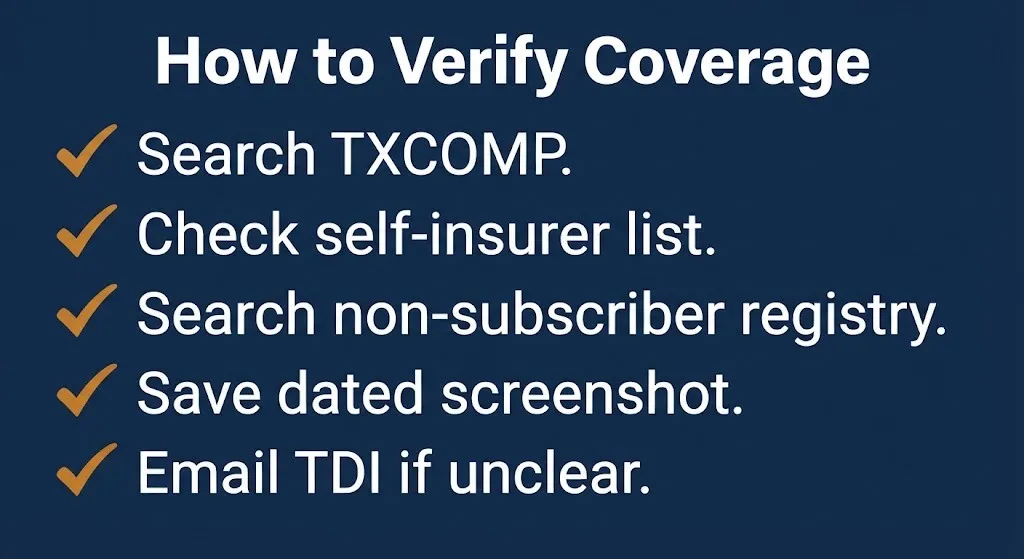
For coverage through a licensed carrier, the TXCOMP system allows public access to non-confidential workers’ compensation information. You search by employer name and can verify coverage dates.
If you cannot determine coverage through these databases, email the DWC coverage verification unit at [email protected]. Include the employer’s name, physical address, and date of injury. A DWC representative responds within one business day.
Key Takeaway: Always verify coverage as of the injury date. Current coverage does not prove coverage existed on the day you were hurt.
What is a Texas non-subscriber employer?
A Texas non-subscriber is a private employer that has chosen not to carry workers’ compensation insurance coverage. Non-subscribers are legal in Texas, but they must notify employees and file annual reports with the state.
An estimated 82,260 private employers were non-subscribers in 2016, the most recent year with published DWC estimates. The actual number today is likely higher.
Non-subscribers lose important legal protections. They cannot use three common-law defenses in a negligence lawsuit:
- The injured employee’s own negligence caused the injury
- A fellow employee’s negligence caused the injury
- The injured employee knew of the danger and voluntarily accepted it
This means if you sue a non-subscriber employer and prove even slight negligence, the employer cannot argue that you were partly at fault. The Texas Supreme Court has affirmed that non-subscribers lose these defenses under Labor Code § 406.033.
Non-subscribers with five or more employees must also report work-related injuries, occupational diseases, and fatalities to DWC using DWC Form-007.
How do you prove an employer is a Texas non-subscriber?
You prove an employer is a Texas non-subscriber by obtaining date-specific verification from TDI and checking the registered non-subscriber database. A DWC Form-005 filing is strong evidence, but it is not conclusive on its own.
Start with the TDI coverage-verification page and search for the employer’s workers’ compensation coverage as of the injury date. Use the employer’s exact legal name and physical address, because a trade name may differ from state records.
Save a dated screenshot or printout of your search results. If the results conflict or the employer’s name is unclear, request written verification from the DWC coverage verification unit.
A DWC Form-005 is the form non-subscribers file to report they have no coverage. But an employer’s failure to file does not make it a subscriber. It just means the employer may face administrative penalties.
Registered non-subscriber information is published through the Texas Open Data Portal. Absence from the non-subscriber list does not prove the employer was insured, because filing compliance is imperfect.
What are the notice requirements for Texas employers?
Texas employers must notify employees of their workers’ compensation coverage status both in writing and by posting a notice in the workplace. The requirements differ for subscribers and non-subscribers.
For non-subscribers, the written notice to new employees must be provided at the time of hire. The posted notice must be in English, Spanish, and any other language common to the workforce.
For subscribers, the written notice must include a specific statement about the employee’s right to retain common-law rights. The employee must notify the employer in writing within five days of hire if they wish to retain that right.
When coverage changes, the employer must notify employees within 15 days. This applies whether coverage is obtained, terminated, or canceled.
An employer who fails to comply with these notice requirements commits an administrative violation.
Reality Check: Many workers assume they are covered because their employer never told them otherwise. Texas law does not require employers to volunteer that information beyond the posted notice and written notice at hire. Check the databases yourself before relying on an assumption.
What are the key deadlines for injured workers in Texas?
Injured workers in Texas face two critical deadlines: 30 days to report the injury to the employer and one year to file a formal claim with DWC.
The 30-day reporting deadline requires you to tell your employer about the injury within 30 days of the date it occurred or the date you knew it was work-related. Missing this deadline can result in loss of benefits.
The one-year deadline applies to filing DWC Form-041, Employee’s Claim for Compensation. You must return this form to DWC within one year from the date of injury or illness.
For occupational illnesses that develop over time, the clock starts from the date you knew or should have known the condition was connected to your job.
Other important deadlines include:
- 90 days to dispute an impairment rating
- 10 days to challenge a denial of a request to change your treating doctor
- 45 days to request an Independent Review Organization review of a medical necessity denial
A delayed tax refund eventually arrives. A missed workers’ compensation deadline can end your claim permanently.
How do you appeal a denied Texas workers compensation claim?
You appeal a denied Texas workers compensation claim by requesting a Benefit Review Conference (BRC) through the DWC. The BRC is a mediation-style meeting where a DWC officer helps both sides resolve disputes.
If the BRC does not resolve the dispute, the next step is a Contested Case Hearing before an Administrative Law Judge (ALJ). The ALJ listens to evidence and issues a decision.
For medical necessity disputes specifically, the process starts with an Independent Review Organization (IRO). If the carrier denies treatment your doctor recommends, you or your provider can request IRO review. The IRO decision can be appealed by requesting a medical hearing within 20 days.
The Office of Injured Employee Counsel (OIEC) provides free help to injured workers without attorneys. Contact OIEC at 866-393-6432, extension 44186.
If you want to hire an attorney, the State Bar of Texas can provide referrals at 800-252-9690.
What reporting requirements apply to Texas non-subscribers?
Texas non-subscribers must file DWC Form-005 annually and report workplace injuries if they have five or more employees. The annual reporting window runs from February 1 to April 30.
The DWC Form-005, Employer Notice of No Coverage or Termination of Coverage, must be filed each year the employer remains a non-subscriber. It must also be filed within 30 days of hiring the first employee, unless that date falls within the February 1 to April 30 window.
Non-subscribers with five or more employees must report work-related injuries, occupational diseases, and fatalities using DWC Form-007. The report must be filed by the seventh day of the month following the month in which the injury or death occurred.
Failure to file these forms can result in administrative penalties. As of 2016, only about 35 percent of non-subscribers were in compliance with the DWC Form-005 filing requirement, up from 12 percent in 2014.
What happens next in the Texas workers compensation verification process?
The verification process depends on what you find. Here is the expected sequence for each scenario.
If the employer is a subscriber: File DWC Form-041 within one year. Report the injury to your employer within 30 days. The insurance carrier handles medical and income benefits.
If the employer is a non-subscriber: You may have the right to sue for negligence. Document everything. Consult a Texas personal injury attorney about non-subscriber claims.
If the employer’s status is unclear: Email [email protected] with the employer name, address, and injury date. Expect a response within one business day.
Expected 2026-2027: DWC continues implementing staff changes and a new AI Innovation and Integration program to modernize operations.
Frequently Asked Questions
Does Texas require workers compensation insurance?
No. Texas is the only state where most private employers can choose not to carry workers’ compensation insurance. Governmental entities must have coverage, but private employers are not required to provide it.
How do I check if my employer has workers comp in Texas?
Check the TDI coverage verification page. Search TXCOMP for licensed carrier coverage, the certified self-insurer list for self-insured employers, and the Texas Open Data Portal non-subscriber list for employers without coverage. Always verify as of your injury date.
What is a Texas non-subscriber employer?
A non-subscriber is a Texas employer that has chosen not to carry workers’ compensation insurance. Non-subscribers must notify employees and file DWC Form-005 annually. They lose common-law defenses if sued for negligence by an injured employee.
Can I sue my employer if they don’t have workers comp in Texas?
Yes. If your employer is a non-subscriber, you can sue for negligence and recover damages including medical expenses, lost wages, pain and suffering, and potentially punitive damages. The employer cannot use your own negligence as a defense.
How long do I have to report a work injury in Texas?
You must report the injury to your employer within 30 days of the date it occurred or the date you knew it was work-related. You have one year to file DWC Form-041 with the Division of Workers’ Compensation.
What is DWC Form-005?
DWC Form-005 is the Employer Notice of No Coverage or Termination of Coverage. Non-subscribers must file it annually between February 1 and April 30, and within 30 days of hiring their first employee.
What happens if my employer is a non-subscriber and I get hurt?
If your employer is a non-subscriber and you can prove negligence, you may recover full damages in a civil lawsuit. This includes pain and suffering, which are not available through the workers’ compensation system. Consult a Texas personal injury attorney.
The Bottom Line for Texas Workers Compensation Verification
Texas workers compensation verification comes down to one question: was your employer a subscriber or non-subscriber on the date you were hurt? The answer determines whether you receive capped workers’ comp benefits or can sue for full damages in civil court.
The verification tools are free and public. Check TXCOMP for carrier coverage, the certified self-insurer list, and the non-subscriber registry. If the results are unclear, email TDI’s coverage verification unit with your injury date.
The single most important deadline is the 30-day reporting requirement. Report your injury to your employer in writing today. If you miss that window, the insurance carrier can deny your claim regardless of how serious your injury is.