Workers Compensation Insurance Audit in 2026: What It Is, Why You Owe More, and How to Fight Back
Quick Answer
- A workers’ comp audit is not an IRS investigation; it reconciles your estimated premium against actual payroll and class codes.
- Most audits result in additional premium owed, driven by misclassification, overtime errors, or uncovered subcontractors .
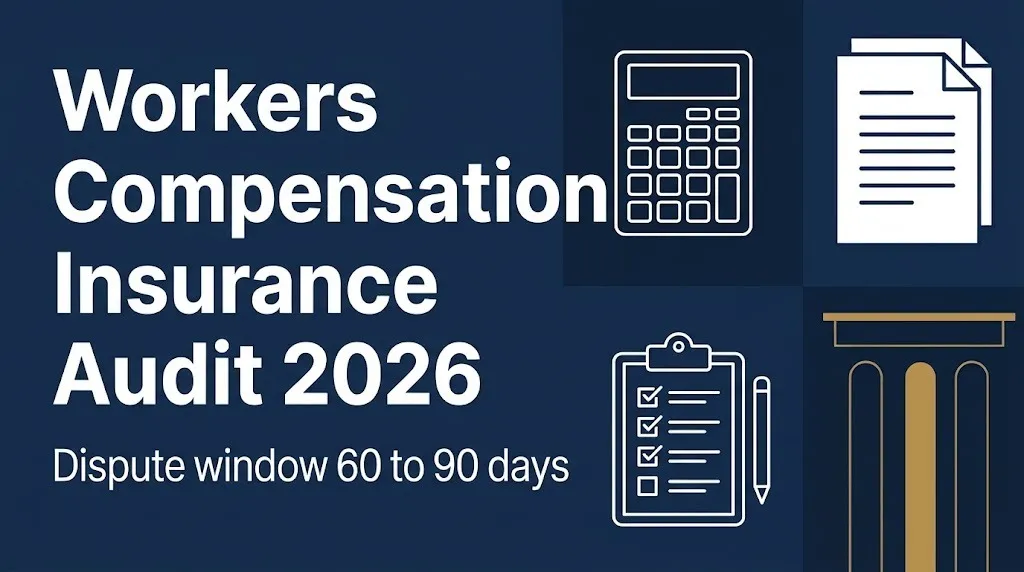
- You typically have 60 to 90 days after the final audit statement to file a formal dispute .
You are searching for workers compensation insurance audit because a letter arrived, the number on it is higher than you expected, and you want to know whether you actually owe it. The short answer is that this is a standard part of every workers’ comp policy, not a penalty or an accusation . Your carrier priced your policy on projected payroll at the start of the term, and the audit trues that estimate up against what you actually paid people . If the estimate was low, you owe the difference. If it was high, you get a refund.
The numbers are not small. One 2026 lawsuit shows a single Dallas company facing $311,479 in additional premium after two audit cycles . Another shows Zurich pursuing $1.1 million from two California staffing firms after post-cancellation audits . Most audits do not reach those figures, but the pattern is consistent: audits come back higher more often than they come back lower, and the gap almost always traces to paperwork you could have fixed before the auditor arrived .
This article explains what the audit actually checks, the three mistakes that drive most surprise bills, how the appeal process works, and the deadline that matters if you decide to fight the number.
The Facts
| Item | What to Know |
|---|---|
| What It Is | End-of-policy reconciliation of estimated premium against actual payroll |
| Who Gets Audited | Almost every workers’ comp policy; premium is based on estimated payroll |
| Audit Formats | Mail, phone, online portal, or on-site inspection |
| Common Outcomes | Additional premium, credit or refund, or no change |
| Dispute Window | Typically 60 to 90 days after the final audit statement |
| Noncompliance Risk | Audit Noncompliance Charge up to two times estimated annual premium |
Is a Workers Compensation Insurance Audit Legit or a Scam?
A workers’ compensation insurance audit is a legitimate, standard policy requirement, not a scam. Your policy contract includes a premium audit provision that gives the carrier the right to examine your payroll records, tax filings, and subcontractor certificates after the policy period ends . The audit exists because workers’ comp premium is calculated by multiplying payroll by a rate per $100 of payroll, and payroll changes throughout the year as you hire, lay off, and pay overtime . The initial premium is an estimate. The audit sets the final number.
The scam risk is not the audit itself. It is the “audit help” services that charge fees to manage a process you can handle yourself with organized records. The auditor is not looking for fraud. They are verifying that your reported payroll matches your tax filings and that your employees are classified under the right code . If your records are clean, the audit is a paperwork exercise. If they are messy, the auditor applies conservative assumptions, and those assumptions cost you money .
Key Takeaway: A workers’ comp audit is a contract term, not a penalty, and the best defense is records you already have.
How Much Extra Premium Can a Workers Compensation Audit Add?
A workers’ compensation audit can add thousands to hundreds of thousands of dollars in additional premium, and the 2026 court record shows the range. The Hartford’s suit against Unifeye Vision Partners seeks $311,479 after audits for policy periods running from April 2022 through April 2024 . Zurich’s suit against two California staffing firms seeks $1,139,007 across two policies, including a post-cancellation audit of $1,059,255 .
Those are litigation outliers, not typical results. Most audits produce smaller adjustments, but the direction is consistent. A 2026 guide notes that most businesses land in the “owe additional premium” category the first time they go through the process, simply because preparation was incomplete . The most common drivers are employee misclassification, failure to separate overtime premium from regular pay, and subcontractors without valid certificates of insurance .
| Cause of Additional Premium | How It Happens |
|---|---|
| Misclassification | Office staff coded under field labor class codes |
| Overtime not separated | Full overtime pay included instead of straight-time only |
| Uncovered subcontractors | Sub payroll added to your base when no COI is on file |
| Owner/officer payroll | Full salary included when exclusion was not elected in writing |
Not yet determined for your specific policy until the auditor reconciles your payroll against your 941s and state unemployment returns.
Key Takeaway: The audit bill is almost never random; it traces to a classification or documentation gap you can identify before the auditor finds it.
Reality Check: No legitimate auditor demands payment before reviewing your records, and no one needs to pay a third-party “audit defender” to handle a process your insurance broker can walk you through. The audit is free, the appeal is free, and the only real cost is the premium adjustment itself.
What Does a Workers Compensation Audit Actually Check?
A workers’ compensation audit checks three things: payroll volume, employee classification, and subcontractor coverage . Payroll volume is the easiest part. The auditor compares your payroll registers against your quarterly 941 federal returns and your state unemployment filings. If your payroll register shows one number and your tax filings show another, the auditor uses the higher figure unless you can explain the gap .
Classification is where most of the money moves. Workers’ comp premium is calculated by multiplying payroll by a class code rate. A clerical office code might be priced under $0.30 per $100 of payroll, while a roofing code can exceed $30 per $100 . That is a hundredfold difference on the same dollar of payroll. The auditor verifies that each employee’s assigned class code matches their actual job duties, not their job title .
Subcontractor coverage is the fastest-growing source of audit surprises. If you paid a 1099 worker who does not carry their own workers’ comp coverage, the auditor adds that income to your payroll base and applies the highest-rated class code that fits the work they performed . The fix is a certificate of insurance collected before the work begins, not after .
How Do You Prepare for a Workers Compensation Insurance Audit?
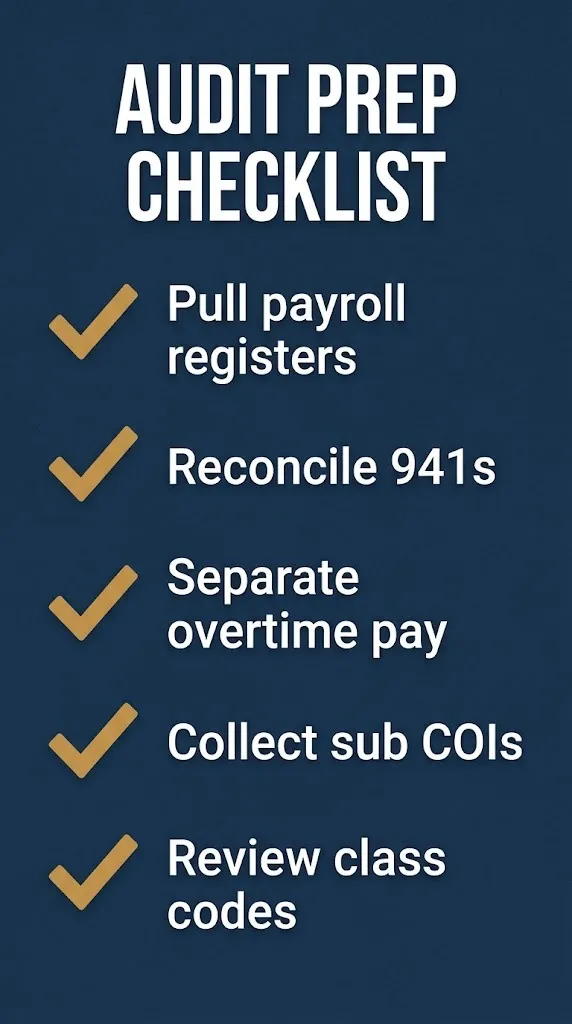
You prepare for a workers’ compensation audit by running a self-audit roughly two months before the official review, pulling the same records the auditor will request, and fixing the gaps before they become findings . The single most effective step is reconciling your payroll register against your 941s and state unemployment returns before the auditor does it for you. If those numbers do not match, you want to know why first.
Here is the document set the auditor will ask for:
- Payroll registers for the full policy period, by employee and by pay period .
- Quarterly 941 federal returns and state unemployment filings .
- W-2s and W-3 transmittal for the calendar year .
- Certificates of insurance for every subcontractor used during the policy period .
- Overtime records that separate straight-time from premium pay .
- Owner and officer compensation records with any exclusion election documented .
- Job descriptions for any employee whose duties could fall under more than one class code .
Organize everything in one folder, physical or digital, so you can respond to auditor requests within 24 hours . Designate one point of contact to speak with the auditor. Limiting who answers questions reduces the risk of inconsistent answers that trigger deeper scrutiny .
Key Takeaway: A clean audit is a paperwork outcome, not luck, and the self-audit window is your only chance to fix errors before they cost you.
What Happens If You Ignore a Workers Compensation Audit?
Ignoring a workers’ compensation audit triggers consequences that are more expensive than the audit itself. The carrier can apply an Audit Noncompliance Charge of up to two times your estimated annual premium in states that have approved the rule . The carrier must make two attempts to obtain the records and notify you of the charge before applying it, but once those attempts are documented, the charge is valid .
Beyond the charge, noncompliance can lead to policy cancellation and a coverage lapse. A lapse complicates your next renewal and can leave you uninsured for a period when an injury could occur . In assigned risk pools, an employer that refuses an audit remains ineligible for coverage until the audit is allowed, even if the noncompliance charge has been paid .
The South Carolina Supreme Court addressed a related issue in a case where a carrier tried to cancel a renewal policy based on the insured’s alleged noncompliance with an audit of the prior policy. The court found the policies were separate contracts and the noncompliance did not justify cancellation of the new policy . That case turns on specific facts and state law, but it illustrates that audit disputes can escalate into coverage fights that no business wants.
How Do You Dispute a Workers Compensation Audit Result?
You dispute a workers’ compensation audit result by filing a written appeal with your carrier within the deadline stated in your final audit statement, typically 60 to 90 days after you receive it . The appeal should identify each disputed line item, explain the error, and attach the supporting records: payroll registers, certificates of insurance, and documentation showing the correct class code for each employee .
The most winnable appeals involve three categories. Overtime misallocation is first, because many states exclude the overtime premium portion from audit payroll, and carriers sometimes include the full amount . Clerical payroll errors are second, including employees coded under the wrong class or owner payroll included without the proper exclusion form. Subcontractor payments incorrectly added to your base are third, usually because a certificate of insurance existed but was not in the file the auditor reviewed .
Here is the dispute sequence:
- Request an itemized breakdown of every line in the audit report before you respond .
- Review each line against your payroll records and certificates of insurance.
- Identify the specific class code or payroll entry you are disputing.
- Gather the records that prove the correct classification or exclusion.
- Submit a written appeal to your carrier within the stated deadline.
- Keep copies of everything you send and note the date you sent it.
Key Takeaway: The appeal is free and the record is on your side if you kept your certificates and overtime splits, so do not pay a bill you can prove is wrong.
What Happens Next
Immediate: Locate your audit notice and confirm the audit format, deadline, and records requested.
Within days: Pull payroll registers, 941s, state unemployment returns, and every subcontractor certificate of insurance.
Before the audit: Run a self-audit and fix classification or overtime errors you can document.
After the final statement: Review every line; if the number is wrong, file a written appeal within 60 to 90 days .
If you ignore it: Expect an Audit Noncompliance Charge of up to two times estimated premium and possible policy cancellation .
Frequently Asked Questions
What triggers a workers compensation insurance audit?
Almost every workers’ comp policy is audited at the end of the policy period because the premium is based on estimated payroll. A policy with large payroll swings or subcontractor use may get an on-site audit .
How far back can a workers comp audit go?
The audit covers the policy period stated in your policy, typically one year. Carriers can also conduct audits after cancellation, as the Zurich case shows with a post-cancellation audit of over $1 million .
Can I refuse a workers compensation audit?
You can refuse, but the carrier can apply an Audit Noncompliance Charge of up to two times your estimated annual premium and cancel your policy .
What is an audit noncompliance charge?
It is a premium charge applied when an employer refuses to provide audit records, calculated by multiplying an ANC basis by a multiplier that can reach two times estimated annual premium .
How long do I have to dispute a workers comp audit?
Typically 60 to 90 days after you receive the final audit statement, though the exact deadline is stated in your policy and audit documents .
What is the most common reason for additional premium after an audit?
Employee misclassification and uncovered subcontractors are the top drivers, followed by overtime included at the full rate instead of straight-time only .
Does a workers comp audit affect my future premiums?
Yes. The audit establishes your final premium for the expiring policy, and carriers use the audited payroll to set the estimate for your renewal .