Egg Donor Compensation 2026: What Donors Are Paid, What the Law Allows, and What to Know Before You Apply
Quick Answer
- Egg donor compensation typically ranges from $6,000 to $15,000 per cycle, depending on the agency and your experience.
- The money is legally framed as compensation for your time, discomfort, and inconvenience, not as payment for eggs.
- You may qualify if you meet age, health, and genetic screening requirements set by the clinic or agency.
You are considering egg donation. You saw an ad promising thousands of dollars. You want to know if the money is real, how much you can actually earn, and what the process involves.
The money is real. The process is demanding. The compensation is not a paycheck. It is a payment for your time, your discomfort, and the medical procedures you undergo. The law treats it that way for a reason.
This article explains the verified facts about egg donor compensation. What you can earn. What the law allows. What the process requires. And what no one tells you before you sign up.
The Facts
| Fact | Verified Value |
|---|---|
| Typical Compensation Range | $6,000 to $15,000 per cycle |
| First-Time Donor Range | $6,000 to $10,000 |
| Experienced Donor Range | $10,000 to $15,000 or more |
| Legal Framework | Voluntary reimbursement, not wages |
| Screening Process | Medical, genetic, psychological |
| Time Commitment | 2 to 3 months per cycle |
Is egg donor compensation real?
Yes. Egg donors in the United States are paid. The payments are legal and widespread. The amounts vary by agency, location, and donor qualifications.
The compensation is not a salary. It is not taxable wages in most cases, though you should consult a tax professional. The money is described as reimbursement for your time, discomfort, and the inconvenience of the medical process.
The American Society for Reproductive Medicine, the main professional body, has issued guidance on donor compensation. The guidance says payments should be based on the time and burden involved, not on the value of the eggs themselves. That distinction matters legally and ethically.
Key Takeaway: The money is real and legal. It is not a paycheck. It is compensation for what you go through.
How much do egg donors make in 2026?
The typical range is $6,000 to $15,000 per completed cycle. First-time donors usually earn $6,000 to $10,000. Experienced donors who have completed successful cycles may earn $10,000 to $15,000 or more.
Some agencies offer higher amounts for donors with specific traits, such as advanced degrees, certain ethnic backgrounds, or proven fertility. Those higher amounts are not universal. They depend on demand.
Here is a verified breakdown by donor type:
| Donor Type | Typical Compensation |
|---|---|
| First-time donor | $6,000 to $10,000 |
| Repeat donor | $10,000 to $15,000 |
| High-demand traits | $15,000 to $20,000 or more |
| Known donor to family | Often lower or unpaid |
The amounts are per cycle, not per egg. You receive the full compensation after the egg retrieval procedure is complete.
Is egg donation compensation taxable?
The tax treatment is not uniformly settled. Many donors treat the compensation as non-taxable because it is framed as reimbursement for pain and suffering, not income. Others report it as taxable income to be safe.
The Internal Revenue Service has not issued specific guidance on egg donor compensation. Tax professionals disagree. Some advise reporting. Some do not.
You should consult a tax professional before deciding how to handle the income. Do not rely on an agency’s advice. The agency is not your tax advisor.
What does the egg donation process involve?
The process is medical and time-consuming. It starts with an application and screening. If you pass, you begin hormone injections. The injections stimulate your ovaries to produce multiple eggs.
The injections last about two weeks. You visit the clinic frequently for blood tests and ultrasounds. The egg retrieval is a minor surgical procedure, usually done under sedation.
The full commitment is 2 to 3 months from application to retrieval. The time includes screening, the stimulation cycle, and recovery.
Here is the typical timeline:
- Application and initial screening.
- Medical, genetic, and psychological evaluation.
- Legal contract signing.
- Hormone stimulation cycle, about two weeks.
- Frequent clinic visits for monitoring.
- Egg retrieval procedure.
- Recovery and compensation payment.
Key Takeaway: The money is not free. It compensates you for a real medical process with real risks and real time commitments.
What are the requirements to become an egg donor?
The requirements are strict. Agencies and clinics screen for health, genetics, and psychological stability. Not everyone who applies is accepted.
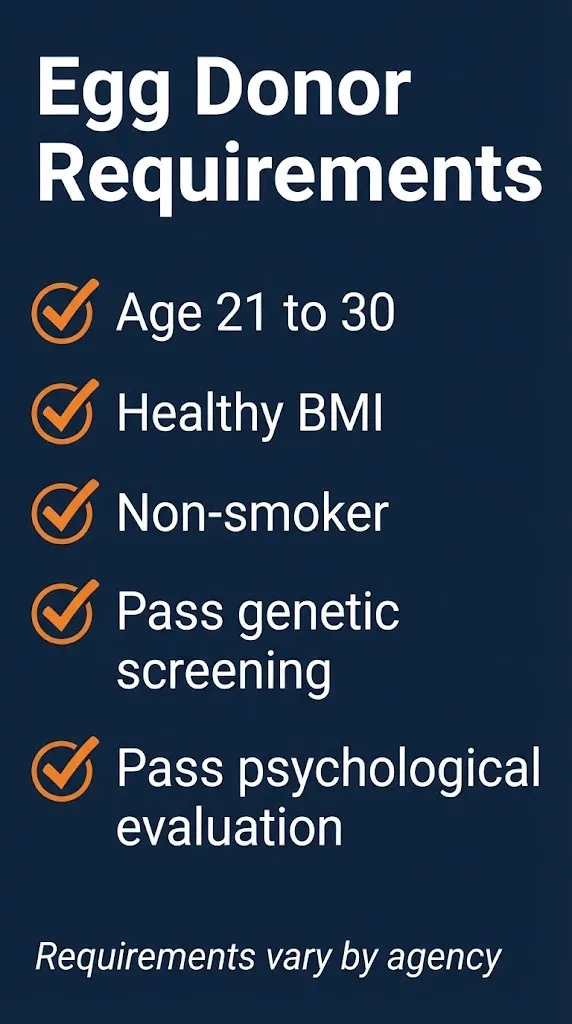
Common requirements include:
- Age between 21 and 30, sometimes up to 34.
- Healthy body mass index, usually under 28.
- Non-smoker and no recreational drug use.
- No significant genetic disorders in your family history.
- Regular menstrual cycles.
- Willingness to undergo medical and psychological screening.
- Willingness to commit to the full process.
- Some agencies require a college degree or current enrollment.
The requirements vary by agency. Some are more flexible. Some are stricter.
What are the risks of egg donation?
The process is generally safe, but it is not risk-free. The hormone injections can cause side effects including bloating, mood changes, and abdominal discomfort.
The most serious risk is ovarian hyperstimulation syndrome, called OHSS. The condition occurs when the ovaries respond too strongly to the hormones. Mild cases are common. Severe cases can require hospitalization.
The egg retrieval procedure carries the usual surgical risks: bleeding, infection, and reaction to anesthesia. Serious complications are rare but real.
You should receive full informed consent before starting. The clinic should explain every risk. If it does not, ask.
Key Takeaway: Egg donation is a medical procedure. The compensation compensates you for accepting those medical risks.
How do I find legitimate egg donor opportunities?
Use established agencies and fertility clinics. They advertise openly. Their screening processes are thorough. Their contracts are detailed.
Be wary of ads that promise unusually high compensation with minimal screening. A legitimate program wants healthy, informed donors. A suspicious program wants fast sign-ups.
Here is how to find legitimate opportunities:
- Search for fertility clinics in your area.
- Ask about their egg donor program.
- Review the agency’s credentials and history.
- Read the donor contract carefully.
- Ask about the screening process and timeline.
- Confirm the compensation amount in writing.
- Consult an independent lawyer if you have concerns.
You are not required to use the first agency you find. Compare programs.
What does the law say about egg donor compensation?
The law does not set a national price for egg donation. Compensation is determined by the market and guided by professional standards.
The key legal principle is that you cannot sell body parts for profit. That is why the compensation is framed as reimbursement for time and inconvenience. The eggs themselves are not being sold.
Some states have additional rules. A few states restrict or regulate egg donation in specific ways. Most do not. The process is generally legal across the country.
The contract you sign is legally binding. It covers compensation, confidentiality, and your rights regarding any resulting embryos. Read it before you sign.
What happens if I experience complications?
The clinic should provide medical care for complications related to the donation process. The extent of that coverage should be in your contract.
Ask before you sign. What happens if you develop OHSS? Who pays for treatment? What if you need hospitalization? The answers should be written, not verbal.
A legitimate program will have clear policies. If the program cannot answer these questions, do not proceed.
Can I donate eggs multiple times?
Yes, in most cases. Many programs allow repeat donations. The American Society for Reproductive Medicine recommends a lifetime limit, usually around six cycles.
Repeat donors often receive higher compensation because they have proven fertility and understand the process. The higher rate is a market response, not a legal requirement.
Each cycle carries the same medical risks. The decision to repeat should be medical and personal, not purely financial.
Is egg donation the same as surrogacy?
No. Egg donation is providing eggs. Surrogacy is carrying a pregnancy. The two are different processes with different legal arrangements and different compensation structures.
A surrogate carries a pregnancy for someone else. Surrogate compensation is typically higher, often $40,000 to $60,000 or more. Egg donation compensation is lower because the time commitment and physical burden are different.
Do not confuse the two. If an ad promises surrogacy-level money for egg donation, it is misleading.
Key Takeaway: Egg donation and surrogacy are different. The compensation, the process, and the legal consequences are not the same.
How do I protect myself as an egg donor?
Protect yourself by reading the contract. Ask questions. Get independent legal advice if you can. Do not rely on the agency’s explanation alone.
Here is the protection checklist:
- Read every page of the donor contract.
- Ask about the compensation amount and timing.
- Ask about medical coverage for complications.
- Ask about your legal rights regarding resulting embryos.
- Ask about confidentiality and anonymity.
- Get the answers in writing.
- Consult an independent lawyer if anything is unclear.
- Do not proceed until you are comfortable.
You are not obligated to donate. You can walk away before signing.
Reality Check
No legitimate egg donor program will ask you to pay a fee to apply. You should not pay for screening, application, or placement. The program pays those costs. If someone asks you to send money to become an egg donor, it is a scam. Legitimate programs pay you, not the other way around.
What Happens Next
| Timeline | Expected Stage |
|---|---|
| Now | Research agencies and clinics |
| Month 1 | Application and initial screening |
| Month 1 to 2 | Medical and psychological evaluation |
| Month 2 | Legal contract signing |
| Month 2 to 3 | Stimulation cycle and retrieval |
| After retrieval | Compensation payment |
This timeline is typical. Some programs move faster or slower.
Frequently Asked Questions
How much do egg donors get paid?
Typically $6,000 to $15,000 per cycle, depending on experience and demand.
Is egg donor compensation taxable?
The tax treatment is unclear. Consult a tax professional.
What are the requirements to become an egg donor?
Age 21 to 30, healthy BMI, non-smoker, and passing medical, genetic, and psychological screening.
Is egg donation safe?
It is generally safe but carries risks including OHSS and surgical complications.
Can I donate eggs more than once?
Yes, with a recommended lifetime limit of about six cycles.
Do I have to pay to become an egg donor?
No. Legitimate programs pay you. You should not pay any fees.
What is the difference between egg donation and surrogacy?
Egg donation is providing eggs. Surrogacy is carrying a pregnancy. The compensation and process differ.
How long does the egg donation process take?
About 2 to 3 months from application to retrieval.
The Money Is Real. The Process Is Serious.
Egg donor compensation is not a get-rich-quick scheme. It is payment for a real medical process with real time commitments and real risks. The money is legal. The process is demanding. The decision is personal.
Read the contract. Ask the hard questions. Know what you are signing. Then decide.