Real Estate Commission Lawsuit 2026: Settlements, Payouts, and What Home Sellers Need to Know
Quick Answer
- The NAR settlement is real and paying eligible home sellers from a $418 million fund, with average payouts in the hundreds to low thousands.
- Home sellers who paid a commission between 2013 and 2024 may qualify, but claim deadlines vary by settlement and some have passed.
- New real estate commission lawsuits are still being filed in 2026, targeting brokerages that have not yet settled.
You have probably seen headlines about the real estate commission lawsuits. Maybe you sold a home and heard you might get money back. The core of these cases is simple: sellers sued the real estate industry claiming they were forced to pay inflated commissions. The industry is now paying billions to settle. Some checks are already in the mail.
This article maps every major real estate commission settlement and active lawsuit as of mid-2026. What surprises most sellers is that there is not just one case. There are at least seven major settlements and more lawsuits still being filed. Your eligibility depends on which brokerage handled your sale.
The Facts
| Detail | Verified Information |
|---|---|
| Lead Case | Burnett v. National Association of Realtors (Sitzer-Burnett) |
| NAR Settlement Fund | $418 million |
| Court | U.S. District Court, Western District of Missouri |
| NAR Settlement Status | Final approval granted; claims being paid |
| Other Major Settlements | Anywhere Real Estate, RE/MAX, Keller Williams, HomeServices of America, Compass, Douglas Elliman |
| Total Industry Settlements | Over $1 billion combined |
| Per Person Payout | Varies by settlement and claim volume; typically $200 to $5,000 |
| Claim Deadlines | Most passed by mid-2025; some still open into late 2026 |
| Settlement Administrator (NAR) | JND Legal Administration |
| Proof Required | Settlement-specific; generally proof of home sale and commission paid |
Is the Real Estate Commission Lawsuit Real?
Yes. The real estate commission lawsuits are not only real, they are the most significant antitrust litigation against the U.S. housing industry in decades. The lead case, known as Sitzer-Burnett, went to trial in 2023 and resulted in a $1.8 billion jury verdict against the National Association of Realtors and several major brokerages. That verdict triggered a wave of settlements.
The NAR agreed to pay $418 million to settle claims nationwide. That settlement received final court approval and is now distributing payments to eligible home sellers. Several other brokerages settled separately. Keller Williams paid $70 million. Anywhere Real Estate, formerly Realogy, paid $83.5 million. RE/MAX paid $55 million. HomeServices of America settled for $250 million. Compass paid $57.5 million. Douglas Elliman paid $7.75 million.
Combined, the real estate industry has committed over $1 billion to resolve these commission-fixing claims. Payments are flowing. If you sold a home and paid a buyer agent commission during the covered periods, you may have money waiting.
These are not scams. The settlements are administered by established class action administrators, primarily JND Legal Administration and Kroll Notice Media. Notices went out by mail and email. The claims process is standard for antitrust class actions.
Key Takeaway: The real estate commission settlements are among the largest antitrust resolutions in U.S. history, with over $1 billion committed and payments actively being distributed.
How Much Will I Get From the Real Estate Commission Settlement?
Payouts vary widely. Most eligible home sellers can expect to receive between a few hundred and several thousand dollars. The exact amount depends on which settlement you fall under, how many claims were filed, and the commission you paid.
The NAR settlement fund of $418 million is being divided among millions of eligible sellers nationwide. Early reports from claimants who have received payments indicate checks ranging from roughly $200 to over $5,000. Sellers who paid higher commissions and sold more expensive homes tend to receive larger payments.
Here is a breakdown of the major settlement funds and what that means for payouts:
| Settlement | Fund Size | Payout Range (Estimated) |
|---|---|---|
| NAR | $418 million | $200 to $3,500 |
| HomeServices of America | $250 million | $300 to $5,000 |
| Anywhere Real Estate | $83.5 million | $150 to $2,000 |
| Keller Williams | $70 million | $200 to $3,000 |
| Compass | $57.5 million | $200 to $2,500 |
| RE/MAX | $55 million | $150 to $2,000 |
| Douglas Elliman | $7.75 million | $100 to $1,500 |
These ranges are estimates based on fund size, estimated class size, and reported payments. Your actual payout may be higher or lower. The formula generally works like this: the settlement fund is reduced by attorney fees, typically 25 to 33 percent, and administrative costs. The remainder is divided among valid claims. More claims mean smaller individual payouts.
If you sold multiple homes during the class period, you may receive multiple payments or a single larger payment. If you sold through a brokerage that participated in multiple settlements, you might only qualify under one, depending on the release terms.
How to File a Real Estate Commission Settlement Claim
Filing a claim depends on which settlement covers your home sale. Some claim deadlines have passed. Others remain open. Here is what you need to know.
For the NAR settlement, the claims process is active but the initial deadline passed in May 2025. If you missed it, you may still qualify if you did not receive notice or can demonstrate good cause. Contact the settlement administrator, JND Legal Administration, directly.
For broker-specific settlements, deadlines vary. Some are still accepting claims in mid-2026. Here are the general steps:
- Determine which brokerage handled your home sale and when the sale closed.
- Visit the official settlement website for that brokerage. Each settlement has its own administrator.
- Locate the claim form on the site. Most offer online filing with a confirmation receipt.
- Gather your proof. You typically need the closing statement or settlement statement showing the commission you paid.
- Fill out the claim form completely. Include your contact information, sale date, property address, and commission amount.
- Submit before the deadline. Late claims are almost never accepted.
- Save your claim confirmation number. Print or screenshot it for your records.
- Wait for payment. Processing can take months after the claim deadline passes.
Do not pay anyone to file for you. Third-party claim filers charge fees for a service you can do yourself in 15 minutes. The forms are straightforward. The administrator provides a helpline if you get stuck.
Key Takeaway: Filing is free and straightforward. You need your closing statement and 15 minutes. Never pay a third party to submit a settlement claim for you.
What Brokerages Have Settled the Real Estate Commission Lawsuits?
Seven major real estate entities have settled the commission lawsuits as of July 2026. Each settlement covers home sellers who used that brokerage or its affiliated agents during a specific time period.
The settled parties include:
- National Association of Realtors (NAR): $418 million. Covers most MLS-listed sales where a buyer agent commission was paid.
- HomeServices of America: $250 million. Covers sellers who used Berkshire Hathaway HomeServices, Long Realty, and other HomeServices affiliates.
- Anywhere Real Estate: $83.5 million. Covers Coldwell Banker, Century 21, Sotheby’s International Realty, and other Anywhere brands.
- Keller Williams: $70 million. Covers sellers who used Keller Williams agents.
- Compass: $57.5 million. Covers Compass-represented sellers.
- RE/MAX: $55 million. Covers sellers who used RE/MAX agents.
- Douglas Elliman: $7.75 million. Covers Douglas Elliman-represented sellers.
Each settlement has its own class period. Most cover sales between 2013 and 2024, but the exact dates differ. Some settlements cover specific MLS regions. Others are national in scope.
If your brokerage is not on this list, it may still be fighting the lawsuits. Dozens of smaller brokerages and MLS organizations remain as defendants in active cases. More settlements are likely in late 2026 and 2027.
Who Is Eligible for the Real Estate Commission Settlement?
Eligibility depends on three things: when you sold your home, which brokerage you used, and where the property was located. The broadest eligibility comes from the NAR settlement.
You may be eligible under the NAR settlement if:
- You sold a home listed on an MLS during the covered period.
- You paid a commission to the buyer’s agent or buyer’s brokerage.
- The sale closed between the dates specified in the settlement.
- The property was in a jurisdiction covered by the settlement.
The NAR settlement covers a nationwide class. Most broker-specific settlements also cover broad geographic areas. Some are national. Some are limited to specific states or MLS regions.
Here is a general eligibility checklist:
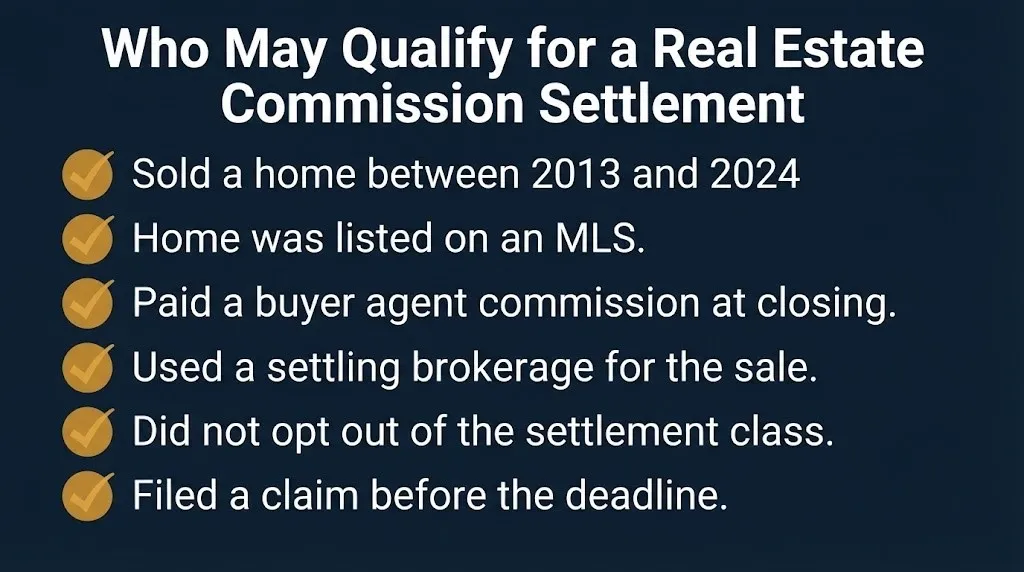
- You sold a home during the applicable class period, typically 2013 to 2024.
- The home was listed on a multiple listing service.
- You paid a buyer agent commission at closing.
- You did not opt out of the settlement class.
- You file a claim by the applicable deadline.
Renters and buyers are generally not eligible for these settlements. The cases focused on seller-paid commissions. If you only bought a home, you likely do not qualify for a payment.
Key Takeaway: Home sellers who paid a buyer agent commission on an MLS-listed sale between roughly 2013 and 2024 are the core eligible group across most settlements.
What Is the MLS Class Action Lawsuit About?
The MLS class action lawsuits challenge the way real estate commissions have been structured for decades. At the center is the “cooperative compensation rule,” also known as the Participation Rule or the buyer broker commission rule.
Under this rule, when a seller listed a home on an MLS, they had to offer a commission to the buyer’s agent. Plaintiffs argued this amounted to price-fixing. They claimed sellers were forced to pay both sides of the commission, inflating costs by billions of dollars annually. The standard commission of 5 to 6 percent, split between the listing agent and buyer agent, became the target.
The lawsuits argued that in a competitive market, buyers would pay their own agents directly. Sellers would only pay their listing agent. Commissions would be lower. Home prices would adjust downward. The jury in the Sitzer-Burnett trial agreed, returning a $1.8 billion verdict that was automatically trebled under antitrust law.
The verdict did not stand as a final judgment because the parties settled before appeals concluded. But the settlements achieved what the verdict signaled: a dismantling of the mandatory commission offer rule. NAR changed its rules effective mid-2024 to eliminate the requirement that sellers offer compensation to buyer agents.
Reality Check: If someone contacts you claiming you can get tens of thousands of dollars from a real estate settlement, be skeptical. Average payouts are in the hundreds to low thousands. No settlement guarantees a specific dollar amount. File only through the official settlement administrator.
What Is the New Real Estate Lawsuit in 2026?
New real estate commission lawsuits continue to be filed in 2026. These cases target brokerages and MLS organizations that did not settle the initial wave of litigation. They also expand the legal theories beyond seller-paid commissions.
One significant new case filed in early 2026 targets several regional MLS organizations in the Southeast that have resisted rule changes. The plaintiffs argue those MLSs are still enforcing policies that effectively require sellers to subsidize buyer agent commissions. The case seeks damages and injunctive relief.
Another new lawsuit takes aim at buyer agent compensation from a different angle. Filed in California, it argues that even after the NAR rule changes, large brokerages are steering buyers toward homes that offer higher commissions. The case alleges the new practices are just as anticompetitive as the old rules.
A third new filing in Illinois targets a consortium of mid-sized brokerages that the plaintiffs claim are colluding through informal agreements rather than formal MLS rules. The case relies on internal communications obtained during discovery in the earlier cases.
None of these new cases have reached a settlement yet. They are in early litigation stages. Motions to dismiss are pending. If they survive dismissal and get certified as class actions, they could lead to additional settlement funds for sellers in 2027 or 2028.
The broader implication of these new lawsuits is clear. The commission litigation is not over. It is evolving.
Key Takeaway: The real estate commission litigation is expanding, not winding down. New lawsuits target non-settling brokerages and allege ongoing anticompetitive practices.
How Has the Real Estate Commission Lawsuit Changed the Industry?
The lawsuits have already transformed how real estate commissions work in the United States. The changes are not theoretical. They are in effect right now and affect anyone buying or selling a home.
The most significant change is the elimination of the mandatory buyer agent commission offer on MLS listings. Since mid-2024, NAR-affiliated MLSs can no longer require sellers to offer compensation to buyer agents. Sellers can still offer it voluntarily. Many do. But it is no longer a condition of listing on the MLS.
Buyer agent compensation is now negotiated differently. Buyers increasingly sign representation agreements that specify what their agent will be paid. Some buyers pay their agents directly. Some negotiate that the seller covers the cost as part of the purchase offer. The old model, where the seller unilaterally set and paid both commissions, is fading.
Several other industry practices are shifting:
- Commission rates are declining in some markets as competition increases.
- Flat-fee and discount brokerage models are gaining market share.
- Some buyers are choosing to go unrepresented to save on commission costs.
- Listing agreements are being rewritten to clarify that seller offers of buyer agent compensation are optional.
- Home prices in some markets are adjusting to reflect lower transaction costs, though the effect is uneven.
These changes are still unfolding. The Department of Justice has signaled it will continue to scrutinize industry practices even after the settlements. Further regulatory action is possible.
What Is the Status of the Real Estate Commission Lawsuit in 2026?
The overall status of the real estate commission litigation in mid-2026 is mixed. Settlements from the first wave are paying out. New cases are being filed. Industry practices are changing. Here is a case-by-case status summary:
| Case | Status as of July 2026 |
|---|---|
| NAR (Burnett) | Settled, approved, paying claims |
| HomeServices of America | Settled, paying claims |
| Anywhere Real Estate | Settled, paying claims |
| Keller Williams | Settled, paying claims |
| Compass | Settled, claims processing |
| RE/MAX | Settled, claims processing |
| Douglas Elliman | Settled, claims processing |
| New regional MLS cases | Active litigation, motions to dismiss pending |
| Buyer steering cases | Active litigation, discovery phase |
| DOJ investigation | Ongoing, no public action in 2026 |
The settlement payouts are the most actionable part for consumers. If you sold a home through a settling brokerage, check your mail and email for notices. Contact the settlement administrator if you think you missed a deadline.
The active cases could take years to resolve. If they settle, new claims processes will open. There is no action for sellers to take on those cases yet.
Key Takeaway: The first wave of settlements is paying out. The second wave of lawsuits is just beginning. Sellers should check their eligibility for existing settlements now while watching for new ones.
How Do I Know If I Am Part of the Real Estate Settlement?
You are likely part of one or more settlement classes if you sold a home through a settling brokerage during the covered period. The best way to confirm is to check the official settlement websites.
Start by identifying the brokerage you used when selling your home. Then check whether that brokerage is on the settled list. If it is, visit the settlement website for that specific brokerage. Each settlement has a lookup tool or a contact form.
You can also check your records for a settlement notice. Notices were mailed and emailed to potential class members using address information from MLS records and brokerage transaction databases. If you moved after selling your home, you may not have received the notice.
If you cannot find a notice but believe you qualify, contact the settlement administrator directly. For the NAR settlement, that is JND Legal Administration. For other brokerages, check the specific settlement website for contact information.
Do not rely on third-party websites that promise to check your eligibility for a fee. They use the same public information you can access yourself. The official settlement administrators provide free lookup tools.
What Happens Next
The real estate commission litigation will continue to evolve through late 2026 and into 2027. Here is the expected timeline:
- Mid to Late 2026: Remaining settlement payments continue to process. NAR, HomeServices, and other settled parties issue payments to eligible sellers.
- Late 2026: Courts rule on motions to dismiss in the new regional MLS cases. If cases survive, discovery begins.
- Early 2027: Possible settlement talks in the new cases. Class certification motions may be filed.
- Mid 2027: If new settlements are reached, preliminary approval and notice programs launch.
- Late 2027 or 2028: New claims periods could open for sellers covered by the second wave of settlements.
The DOJ investigation remains a wild card. The Department of Justice has been actively investigating real estate commission practices since 2020. It could bring enforcement actions or issue new regulations that further reshape the industry.
For home sellers, the immediate priority is checking eligibility for existing settlements. Deadlines have passed for some, but not all. Even if the main deadline has passed, you may have options if you never received notice.
Frequently Asked Questions
How do I know if I qualify for the real estate commission settlement?
You likely qualify if you sold a home through a settling brokerage and paid a buyer agent commission.
Check the official settlement website for the brokerage you used.
Most covered periods run from 2013 to 2024, but dates vary by settlement.
When will I get my real estate settlement check?
Many checks have already been mailed in 2025 and early 2026.
Additional distributions are ongoing through late 2026.
Exact timing depends on which settlement covers your sale and when you filed your claim.
What if I sold my home without a realtor?
You likely do not qualify for the commission settlements.
The cases involve commissions paid to buyer agents through MLS-listed sales.
For sale by owner transactions without a buyer agent commission are generally not covered.
Can I file a claim if my brokerage has not settled?
No. Claims are only available against brokerages and organizations that have settled.
If your brokerage is still fighting the lawsuits, there is no claims process yet.
You may become eligible if your brokerage settles in the future.
Is the $1.8 billion verdict being paid to sellers?
No. The jury verdict was against NAR and several brokerages, but the parties settled before judgment was entered.
The $1.8 billion figure was replaced by the individual settlement amounts.
Sellers receive payments from the settlement funds, not the original verdict.
Do home buyers get anything from these settlements?
Generally no. The settlements compensate home sellers who paid buyer agent commissions.
Buyers did not directly pay those commissions at closing.
Some cases may expand eligibility, but none have yet.
What proof do I need to file a claim?
A closing statement or settlement statement showing the commission paid is the standard requirement.
Your name, property address, sale date, and commission amount must be verifiable.
Some settlements accept less documentation if transaction records are available from the brokerage.
Are real estate commissions going away completely?
No. Commissions still exist but are now more negotiable.
Sellers are no longer required to offer buyer agent compensation on MLS listings.
The market is shifting toward buyers paying their own agents or negotiating commission coverage.
If you sold a home between 2013 and 2024, check your eligibility now. Visit the official settlement website for the brokerage you used. If you find a claim deadline still open, file immediately. Keep your closing statement accessible. The money allocated to these settlements belongs to sellers. The only way to lose it is by not claiming it.