How to Start a Class Action Lawsuit in 2026: Step-by-Step Legal Process and Requirements
Quick Answer:
- You cannot file a class action alone. You need a lawyer experienced in class litigation.
- Class certification requires common legal claims, a large group, and a representative plaintiff.
- There is no filing fee shortcut. Most class lawyers work on contingency, meaning no upfront cost.
A class action lawsuit starts when one or more plaintiffs file a complaint on behalf of a larger group with similar claims. The named plaintiff acts as the class representative.
You become a class member by meeting the class definition, not by filing a separate lawsuit. Most class members join automatically unless they opt out.
This guide covers the legal process, requirements, costs, timelines, and common mistakes for starting a class action in 2026. One surprising fact: the average class certification decision takes 18 to 36 months after the initial filing.
The Facts
| Case | Not a single case. Process applies to proposed class actions broadly. |
| Status | Governed by Rule 23 of Federal Rules of Civil Procedure and state equivalents |
| Fund Size | Not applicable until settlement or judgment |
| Est. Per Person | Varies by damages, class size, and settlement terms |
| Claim Deadline | Set by court order after settlement approval |
| Administrator | Appointed after settlement approval |
| Proof Needed | Varies by case type. Receipts, account records, or employment documents may be required |
Is It Legal to Start a Class Action Lawsuit Without a Lawyer?
No, you cannot file a class action lawsuit without a lawyer.
Courts require class counsel who can fairly and adequately represent the class. A layperson cannot meet that standard under Rule 23 of the Federal Rules of Civil Procedure.
You may file a small claims case or an individual lawsuit without an attorney. A class action is different. It is complex, involves multiple parties, and requires court certification.
Your lawyer must demonstrate experience in class litigation. Courts review the attorney’s qualifications, resources, and track record before appointing class counsel.
Think of it like needing a licensed pilot for a commercial flight. You can fly a small personal drone alone, but an airliner requires certified professionals.
How Do You Start a Class Action Lawsuit Against a Company?
Starting a class action against a company begins with hiring a plaintiff-side class action attorney to evaluate your claim.
The attorney will review your evidence, research existing cases, and determine whether your situation meets class certification requirements. That review is free in most cases.
You then become the named plaintiff. Your lawyer drafts a complaint naming the company, describing the unlawful conduct, and defining the proposed class.
The complaint gets filed in federal or state court. The company then responds, and discovery begins before any certification hearing.
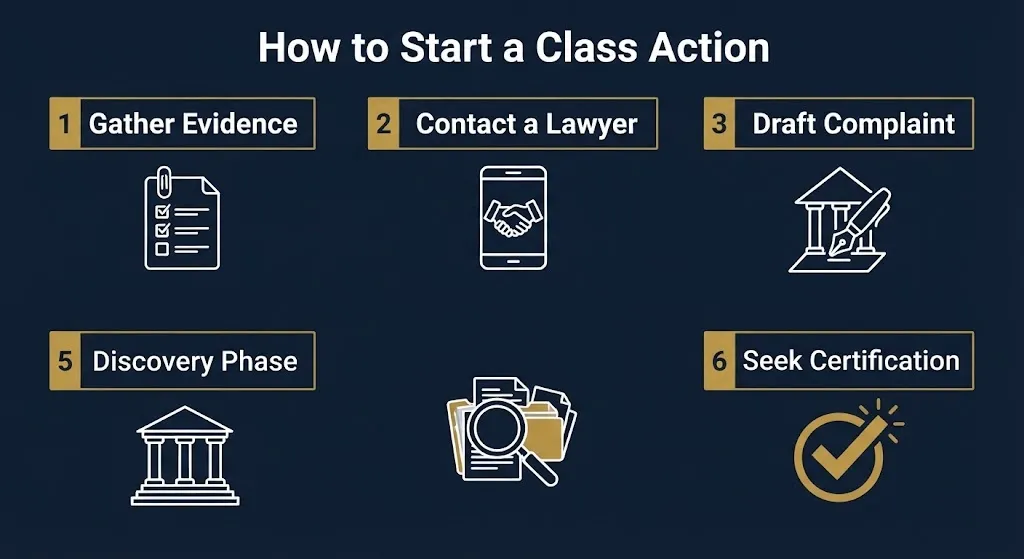
Step-by-step filing process:
- Gather all records: receipts, contracts, emails, account statements.
- Contact a class action lawyer for a free case review.
- Sign a representation agreement if the lawyer accepts your case.
- Your lawyer drafts and files the class action complaint.
- The court issues a summons to the defendant company.
- The defendant files an answer or motion to dismiss.
- Your lawyer conducts discovery and moves for class certification.
Key Takeaway: You need a lawyer, evidence, and a legal claim that affects many people similarly. The process starts with a free case evaluation.
How Much Does It Cost to Start a Class Action Lawsuit?
You typically pay nothing upfront to start a class action lawsuit.
Class action attorneys work on a contingency fee basis. The lawyer advances court costs, expert fees, and filing expenses during the litigation.
If the case wins or settles, the attorney receives a court-approved percentage of the recovery. That percentage usually ranges from 20 to 40 percent depending on case complexity and stage.
If the case loses, you owe nothing. The attorney absorbs the loss. That risk-sharing arrangement is why lawyers screen class action cases carefully.
Court filing fees vary by jurisdiction. Federal filing fees for civil cases were $405 as of 2024. Your lawyer pays those fees on your behalf.
Cost comparison table:
| Cost Item | Who Pays Upfront | Who Pays After Win |
|---|---|---|
| Attorney fees | No one | Deducted from recovery |
| Court filing fees | Attorney | Attorney |
| Expert witnesses | Attorney | Deducted from recovery |
| Deposition costs | Attorney | Deducted from recovery |
| Class notice expenses | Attorney, later reimbursed from fund | Deducted from settlement |
Key Takeaway: You do not pay out of pocket. The attorney risks their own money for a share of the eventual recovery.
How Do Class Action Certification Requirements Work?
Class certification is the court process that officially allows a lawsuit to proceed as a class action.
Rule 23 of the Federal Rules of Civil Procedure sets the standard. The proposed class must meet four requirements: numerosity, commonality, typicality, and adequacy of representation.
Numerosity means the class is so large that individual lawsuits would be impractical. Courts have certified classes with as few as 21 members but generally expect at least 40.
Commonality requires that class members share common legal or factual questions. Typicality means the named plaintiff’s claims are typical of the class. Adequacy means the named plaintiff and class counsel can protect class interests.
There are also category-specific requirements. A damages class under Rule 23(b)(3) must show common questions predominate over individual ones. An injunction class under Rule 23(b)(2) requires uniform relief for all members.
Rule 23 certification checklist:
- Numerosity: 40 or more class members generally expected.
- Commonality: Shared legal claim like breach of contract or consumer fraud.
- Typicality: Your damages mirror those of other class members.
- Adequacy: Your lawyer has class action experience and resources.
- Predominance: Common evidence outweighs individual proof.
Reality Check: You may have a valid claim and still fail certification. Certification is procedural, not about who is right or wrong. A court can deny certification and leave you with only an individual case.
How Do You File a Class Action Lawsuit Step by Step?
Filing a class action lawsuit involves eight distinct steps from initial consultation through trial or settlement.
The process can take two to five years. Most class actions settle after certification or after the defendant loses a motion to dismiss.
You are not required to personally attend every hearing. Your class counsel handles most court appearances while you participate in discovery and possibly testify.
The named plaintiff’s responsibilities include preserving evidence, answering interrogatories, sitting for deposition, and staying informed about case developments.
How to file a class action lawsuit, step by step:
- Contact a class action attorney for a free evaluation.
- Provide all relevant documents and communications.
- The attorney investigates your claim and potential class size.
- Your lawyer drafts and files the complaint in court.
- The defendant responds or moves to dismiss.
- Discovery proceeds with documents and depositions.
- Your lawyer files a motion for class certification.
- The court certifies or denies the class.
The timeline from filing to certification averages 18 to 36 months. Settlement talks often begin after certification, but many cases settle earlier.
What Types of Claims Qualify for Class Action Treatment?
Class actions work best for claims involving identical conduct affecting many people in small amounts.
Common qualifying claims include consumer fraud, defective products, wage and hour violations, data breaches, and unlawful fees.
Courts have certified class actions over deceptive advertising, undisclosed service charges, unpaid overtime, and privacy violations. The common thread is systematic conduct affecting a definable group.
Claims requiring individualized proof of injury are poor candidates. A court may deny certification if each class member would need separate trials on damages or reliance.
Claims most likely to qualify:
- Wage theft: unpaid overtime, off-the-clock work, misclassification
- Consumer fraud: false advertising, hidden fees, bait-and-switch pricing
- Defective products: same defect affecting thousands of buyers
- Data breaches: negligent security exposing customer information
- Unlawful charges: bank overdraft fees, subscription renewals without consent
Key Takeaway: The best class action claims involve uniform harm from a single policy or product defect.
How Long Does It Take to Start and Certify a Class Action Lawsuit?
The average class action takes two to five years from filing to final resolution.
Certification alone typically requires 18 to 36 months after the complaint is filed. Discovery and motion practice consume most of that time.
Cases involving government investigations or parallel criminal proceedings can take longer. The Volkswagen emissions class action took roughly five years from filing to settlement approval.
You should expect a long timeline. A class action is not a quick payout. It is a multi-year legal process with no guaranteed outcome.
Timeline comparison by case type:
| Case Type | Typical Duration |
|---|---|
| Consumer fraud class action | 2 to 4 years |
| Wage and hour class action | 3 to 5 years |
| Defective product class action | 3 to 6 years |
| Data breach class action | 2 to 4 years |
| Securities class action | 3 to 5 years |
What Is the Difference Between a Class Action and a Mass Tort?
A class action treats all members as one group with one lawsuit and one outcome.
A mass tort involves many individual lawsuits consolidated for pretrial proceedings but resolved separately. Each plaintiff in a mass tort keeps their own claim and recovery.
Class actions require certification under Rule 23. Mass torts use multidistrict litigation procedures under 28 U.S. Code Section 1407.
Class members have limited control. Mass tort plaintiffs retain individual representation and can accept or reject settlement offers individually.
Courts choose between these structures based on whether common issues predominate. Mass torts often involve personal injuries with varying severity. Class actions typically involve uniform economic harm.
Comparison table:
| Feature | Class Action | Mass Tort |
|---|---|---|
| One lawsuit | Yes | No, many lawsuits |
| Certification required | Yes | No |
| Individual control | Low | High |
| Typical claims | Consumer fraud, wage theft | Defective drugs, toxic exposure |
| Settlement structure | Single settlement for all | Individual settlements |
Key Takeaway: Class actions work for uniform small-dollar claims. Mass torts work for personal injuries with varying severity.
How Do You Find a Class Action Lawyer?
You find a class action lawyer through state bar referrals, legal aid networks, or direct outreach to established plaintiff-side firms.
Most class action attorneys offer free case evaluations. You can submit your story online or by phone without paying a consultation fee.
Look for lawyers who have served as lead counsel in certified class actions. Ask about their track record, case outcomes, and resources for complex litigation.
Avoid any lawyer who asks you to pay upfront fees for a class action case. Legitimate class counsel work on contingency.
Where to look:
- State bar association lawyer referral services
- National plaintiff-side firms with class action practice groups
- Nonprofit legal organizations such as Public Justice or the National Consumer Law Center
- Existing class action notices naming lead counsel
Can You Start a Class Action If You Signed an Arbitration Clause?
Probably not. An arbitration clause with a class action waiver typically blocks class litigation.
The U.S. Supreme Court has upheld class action waivers in arbitration agreements. That means you may be forced into individual arbitration instead.
Some courts have refused to enforce arbitration clauses found to be unconscionable. But those cases are rare.
Your class action attorney will review any agreement you signed before filing. If an arbitration clause exists, the lawyer may challenge its enforceability or proceed individually.
This is the single biggest barrier to starting class actions in 2026. Many consumer contracts now include mandatory arbitration provisions.
Key Takeaway: An arbitration clause with a class waiver may prevent you from starting or joining a class action. Have a lawyer review your contract first.
What Happens After a Class Action Is Certified?
After certification, the court orders notice to all reasonably identifiable class members.
The notice explains the lawsuit, the class definition, the right to opt out, and the binding effect of any judgment or settlement.
Discovery then continues toward trial or settlement. Most certified class actions settle before trial.
If the case settles, the court must approve the settlement as fair, reasonable, and adequate. Class members receive notice of settlement terms and can object or opt out.
After final approval, a claims administrator processes claims and distributes payments. That can take another six to eighteen months.
Post-certification stages:
- Class notice sent to potential members.
- Class members decide to stay in or opt out.
- Discovery and expert reports continue.
- Settlement negotiations or trial preparation.
- Preliminary settlement approval hearing.
- Final approval hearing and claim period.
- Claims administrator distributes payments.
Reality Check: A certified class action does not guarantee a payout. Many certified classes settle for less than the original demand, and some lose at trial.
What Happens Next in Class Action Litigation in 2026?
Several federal rule changes and Supreme Court decisions could affect class action practice in 2026.
The Supreme Court has agreed to review at least one case involving class action standing. The outcome could limit who can serve as a class representative.
Congress has considered but not passed new limits on class action litigation. No new federal class action reform law has been enacted as of early 2026.
State courts continue to provide alternatives for consumer claims. California, New York, and Illinois remain active venues for class action filings.
Expected developments:
| Date | Development |
|---|---|
| 2026 | Supreme Court decision expected on class standing |
| 2026 | New state consumer privacy class actions likely |
| 2026 to 2027 | Increased class actions over AI-related consumer harms |
| TBD | Potential federal arbitration reform legislation |
| TBD | New claims administrator rules from the FTC |
Frequently Asked Questions
Can I start a class action lawsuit by myself?
No, you cannot start a class action lawsuit without a lawyer.
Courts require qualified class counsel to represent the group.
Your role would be the named plaintiff, but an attorney must file the case.
How much money do you need to start a class action?
You need no money upfront to start a class action.
Class attorneys advance costs and work on contingency.
You pay only if the case wins, through a court-approved fee.
How do I know if my claim qualifies for a class action?
Your claim may qualify if the same conduct affected many people in the same way.
A class action attorney can evaluate numerosity, commonality, and typicality.
Free consultations are standard.
What is the minimum number of people for a class action?
Courts generally expect at least 40 class members.
Some courts have certified classes with as few as 21 members.
The exact threshold depends on the jurisdiction and case type.
Can I join an existing class action instead of starting one?
Yes, you may join an existing class action automatically if you meet the class definition.
You do not need to file anything to join.
You can opt out if you prefer to sue individually.
How long do class action lawsuits take to settle?
Most class actions take two to five years to resolve.
Certification alone can take 18 to 36 months.
Complex cases may take longer.
Do class action lawyers take all cases?
No, class action lawyers reject most cases they review.
They look for strong claims, large class size, and collectable damages.
A rejection does not mean your claim is invalid, only uneconomical for class treatment.
What happens if I lose a class action lawsuit?
If you are a class member and the class loses, you receive nothing.
You cannot file the same claim again individually after a class judgment.
Named plaintiffs do not owe attorney fees in contingency cases.
The decision to start a class action involves real risks and a long timeline. Gather your documents, consult a qualified lawyer, and ask about certification prospects before committing.
The single most important date is the filing deadline imposed by the statute of limitations. Do not wait. Missing that deadline bars your claim forever.