Average Car Accident Settlement in Colorado 2026: Real Numbers, Not Marketing Spin
Quick Answer
- Is it legit? Yes. Colorado car accident settlements are real, but the “average” varies wildly by injury severity and insurance coverage.
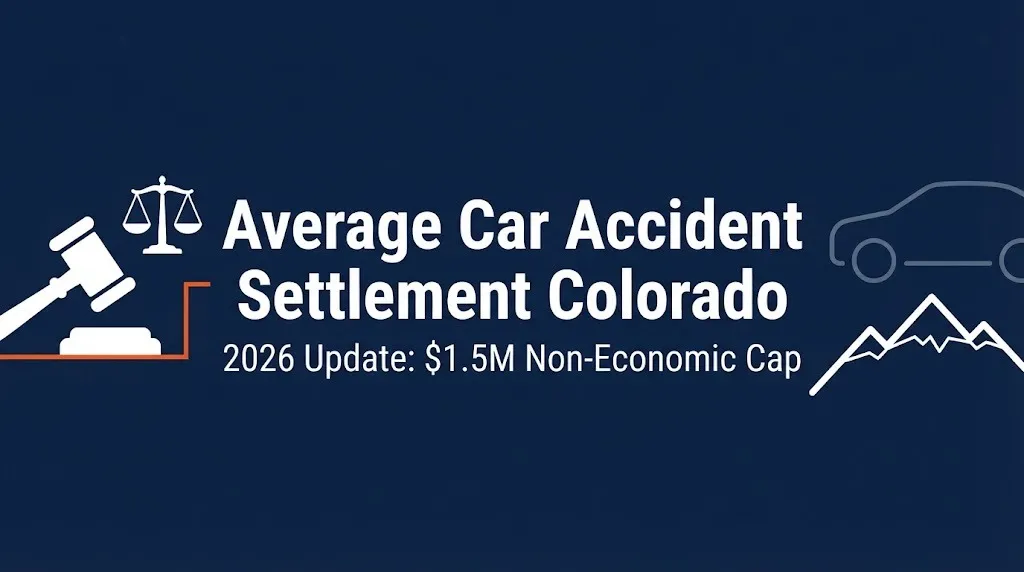
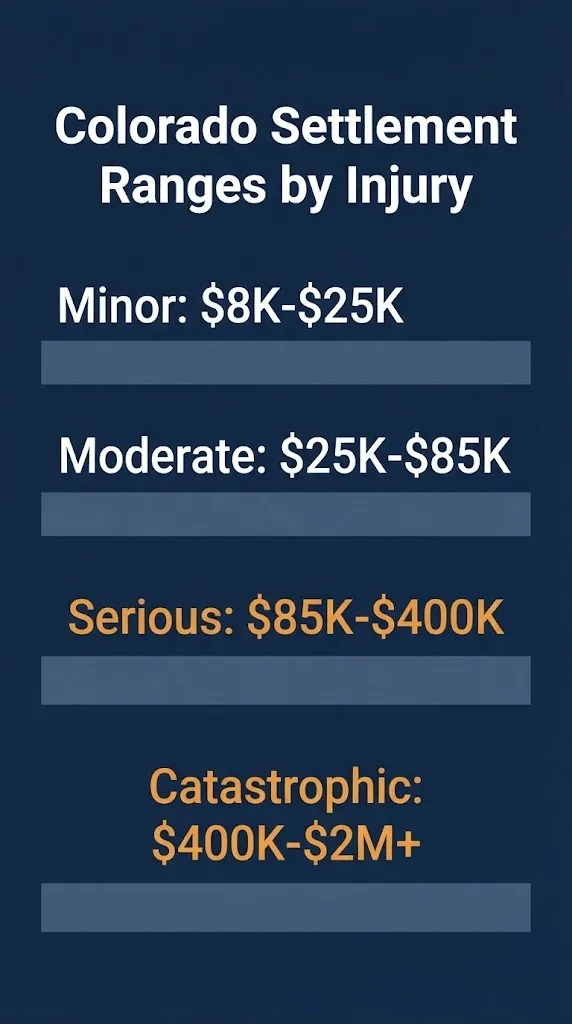
- How much? Minor cases: $8,000 to $25,000. Moderate: $25,000 to $85,000. Serious: $85,000 to $400,000. Catastrophic: $400,000+.
- Key deadline? You have three years from the crash date to file a lawsuit under C.R.S. § 13-80-101.
If you search for the average car accident settlement in Colorado, you’ll find a dozen law firm websites giving you a dozen different numbers. That’s not an accident. It’s marketing. The honest answer is that no single average exists because no two crashes are identical.
Here’s what the data actually shows. National insurance figures put the average bodily injury claim at roughly $28,287 in 2024 . Colorado-specific ranges from settlement data show minor injury cases settling between $8,000 and $25,000, moderate cases between $25,000 and $85,000, serious cases between $85,000 and $400,000, and catastrophic cases exceeding $400,000 . The Colorado non-economic damages cap jumped from $250,000 to $1.5 million for cases filed after January 1, 2025 . That change matters more than any “average” you’ll find online.
This article breaks down what actually drives settlement values in Colorado, the real payout tiers by injury severity, how the state’s comparative fault rule slashes your recovery if you’re partly to blame, and the deadlines that can kill your claim entirely.
The Facts
| Case Type | Personal injury claims under Colorado law, not a single class action |
|---|---|
| Status | Ongoing. No universal settlement fund exists. |
| Fund Size | Not applicable. Each claim is separate. |
| Est. Per Person | $8,000 to $2M+ depending on injury severity and coverage |
| Claim Deadline | 3 years from crash date (C.R.S. § 13-80-101). 2 years for wrongful death. |
| Administrator | Not applicable. Claims handled through insurers or litigation. |
| Proof Needed | Medical records, police report, wage loss documentation, fault evidence |
Is There an Average Car Accident Settlement in Colorado?
There is no reliable average car accident settlement in Colorado. Any website that gives you a single number is selling you something.
The range is too wide. A fender-bender with mild whiplash might settle for $5,000. A crash that leaves someone paralyzed could settle for $2 million or more. Averaging those two cases produces a number that helps nobody .
What you can use are ranges. Colorado settlement data shows these tiers :
| Injury Severity | Typical Settlement Range | Common Scenarios |
|---|---|---|
| Minor | $8,000 to $25,000 | Soft tissue, whiplash, no surgery, short treatment |
| Moderate | $25,000 to $85,000 | Fractures, herniated discs, physical therapy |
| Serious | $85,000 to $400,000 | Surgery, traumatic brain injury, extended recovery |
| Catastrophic | $400,000 to $2M+ | Paralysis, permanent disability, wrongful death |
Denver cases trend higher than statewide averages. The 2nd Judicial District court backlog creates pressure on insurers to settle before trial, and Denver’s higher cost of living inflates medical bills and lost wage calculations .
Key Takeaway: Colorado car accident settlements range from a few thousand dollars for minor injuries to millions for catastrophic harm. The “average” is a marketing fiction. Your case value depends on your specific damages.
How Much Can You Get for a Car Accident in Colorado?
Your car accident settlement in Colorado equals your economic damages (medical bills, lost wages, property damage) plus non-economic damages (pain, suffering, emotional distress), reduced by your percentage of fault. Economic damages are uncapped. Non-economic damages are capped at $1.5 million for cases filed after January 1, 2025 .
Here’s how the math works in practice:
Economic damages are documented losses. These include:
- Emergency room and hospital bills
- Surgery, physical therapy, and medication costs
- Future medical care needs
- Lost income and reduced earning capacity
- Vehicle repair or replacement
Non-economic damages cover the human cost. These include:
- Pain and suffering
- Emotional distress
- Loss of enjoyment of life
- Scarring and disfigurement
- Loss of consortium for spouses
Insurance companies often calculate non-economic damages using a multiplier, typically 1.5 to 4 times your economic losses, based on injury severity .
The old $250,000 cap was a ceiling that many serious injury victims hit. The new $1.5 million cap gives room for catastrophic cases to recover meaningful compensation for non-economic harm .
How Does Colorado’s Comparative Fault Rule Affect Your Settlement?
Colorado uses modified comparative negligence under C.R.S. § 13-21-111. You can recover damages if you’re less than 50% at fault, but every percentage point of fault reduces your recovery proportionally. At exactly 50% fault, you collect nothing .
Here’s what that looks like on a $100,000 claim:
| Your Fault % | Case Value | Actual Recovery |
|---|---|---|
| 0% | $100,000 | $100,000 |
| 10% | $100,000 | $90,000 |
| 25% | $100,000 | $75,000 |
| 40% | $100,000 | $60,000 |
| 49% | $100,000 | $51,000 |
| 50%+ | $100,000 | $0 (barred) |
Insurance adjusters know this rule and use it aggressively. Even a weak argument that you were 25% at fault cuts your settlement by a quarter .
Colorado’s seatbelt statute provides one protection. Under C.R.S. § 42-4-237(7), seatbelt non-use is not admissible as evidence of negligence or comparative fault in a civil action. Defense attorneys may try to introduce it through other means, but the statute is clear .
Reality Check: No one texts you settlement money first. Filing a claim with an insurance company is always free. Third-party “claim helpers” charging fees to negotiate your settlement are unnecessary. You can file directly with the insurer or hire an attorney on contingency.
What Damages Can You Recover After a Colorado Car Accident?
You can recover economic damages, non-economic damages, and in limited cases, punitive damages after a Colorado car accident. Economic damages are uncapped. Non-economic damages are capped at $1.5 million. Punitive damages require proof of willful and wanton conduct .
Economic damages include everything with a receipt or invoice: ambulance bills, ER visits, surgery, hospital stays, physical therapy, medication, future medical treatment, medical equipment, lost income, reduced earning capacity, vehicle repair or replacement, and other out-of-pocket expenses .
Non-economic damages cover losses without a price tag: pain and suffering, mental distress, physical limitations, scarring, disfigurement, inconvenience, and loss of enjoyment in life .
Punitive damages are different. Colorado caps them at an amount equal to the compensatory damages awarded, effectively doubling the total recovery if the claim succeeds. The court must grant permission to add a punitive damages claim under C.R.S. § 13-25-127(2), which requires showing a reasonable likelihood of proving willful and wanton conduct at trial .
Insurance policies typically do not cover punitive damages. Collection may depend on the at-fault driver’s personal assets. But the threat of a punitive award often drives substantially higher compensatory settlements, especially in drunk driving cases .
How Do You File a Car Accident Claim in Colorado?
Filing a car accident claim in Colorado starts with gathering evidence and submitting a demand to the at-fault driver’s insurance company. If the insurer refuses to pay fairly, you can file a lawsuit in Colorado district court before the three-year deadline .
Here are the steps:
- Get medical care immediately. Your health comes first, and medical records establish your damages.
- Report the accident to police. Colorado law requires reporting crashes involving injury, death, or significant property damage.
- Document everything. Take photos of vehicle damage, the scene, and your injuries. Collect witness names and contact information.
- Notify your own insurer. Even if you weren’t at fault, your policy may provide MedPay or UM/UIM coverage.
- Gather medical records and bills. Track every provider, every treatment, and every dollar spent.
- Document lost wages. Keep pay stubs and a log of missed work days.
- Send a demand letter. Your attorney or you can submit a settlement demand with supporting evidence.
- Negotiate or file suit. If the insurer won’t offer fair value, file a complaint and summons in court before the deadline.
The discovery process follows. Both sides exchange evidence, including medical records, witness statements, and accident reconstruction reports. Most cases settle during discovery .
What Is the Statute of Limitations for Car Accidents in Colorado?
The statute of limitations for car accidents in Colorado is three years from the date of the accident under C.R.S. § 13-80-101. For wrongful death claims, it’s two years from the date of death. Missing the deadline bars your claim entirely .
The three-year window is a notable exception to Colorado’s standard two-year limit for most personal injury claims. It applies to bodily injury, property damage, and uninsured/underinsured motorist claims .
Critical exceptions shorten or change the deadline:
- Claims against government entities: You must provide written notice of claim within 182 days of the injury under the Colorado Governmental Immunity Act .
- Wrongful death: Two years from the date of death under C.R.S. § 13-80-102 .
- Vehicular homicide hit-and-run: Four years if the defendant committed vehicular homicide and left the scene .
- Minors: The clock may pause until the minor turns 18, but recent Colorado Supreme Court rulings clarify this is not automatic tolling. A minor who turns 18 during the ordinary limitations period must file within the ordinary period or within two years of their 18th birthday, whichever is later .
Engaging in settlement negotiations does not pause the statute of limitations. The clock keeps running even while you await an offer .
What Is the Average Wrongful Death Settlement in Colorado?
There is no average wrongful death settlement in Colorado, but the non-economic damages cap for fatal accidents is $2,125,000 for claims filed on or after January 1, 2025. That’s a significant increase from the prior limit .
Wrongful death damages include funeral and burial costs, loss of income and benefits, loss of household services, emotional anguish and grief, loss of companionship and consortium, and in extraordinary cases, punitive damages. A survival action can separately recover the decedent’s medical expenses and lost earnings before death .
Who can file a wrongful death claim in Colorado:
- Surviving spouse (has exclusive right in the first year after death)
- Children
- Parents
- Siblings, if the deceased had no spouse, heirs, parents, or designated beneficiary
The two-year deadline is strict. Evidence in fatal crash cases starts disappearing in weeks, not years. Insurers move fast to lock in low settlements before families talk to lawyers .
What Happens Next After a Colorado Car Accident Claim?
Immediately: Get medical care, report the crash, and document everything. Evidence disappears fast.
Within 182 days (government claims): If a government vehicle or employee was involved, you must file written notice of claim within 182 days.
Within 1-2 years: Most cases settle or move toward mediation. Insurers often make low initial offers, expecting you to accept quickly.
Within 3 years: You must file a lawsuit before the statute of limitations expires under C.R.S. § 13-80-101.
Within 2 years (wrongful death): Families must file wrongful death claims within two years of the death, not the crash date.
Frequently Asked Questions
What is the average car accident settlement in Colorado?
There is no single average. Typical ranges run from $8,000 for minor injuries to $400,000 or more for catastrophic harm. The specific facts of your crash determine your case value.
How long do I have to file a car accident lawsuit in Colorado?
You have three years from the date of the accident to file a lawsuit under C.R.S. § 13-80-101. For wrongful death claims, the deadline is two years from the date of death.
What if I was partly at fault for the accident?
Colorado uses modified comparative negligence. You can still recover if you’re less than 50% at fault, but your settlement is reduced by your percentage of fault. At 50% or more, you recover nothing.
What is the non-economic damages cap in Colorado?
For car accident cases filed after January 1, 2025, the non-economic damages cap is $1.5 million. For wrongful death claims, it’s $2,125,000.
How much does a car accident lawyer cost in Colorado?
Most Colorado car accident lawyers work on contingency. You pay nothing upfront, and the attorney takes a percentage of the settlement. If there’s no recovery, you owe nothing.
Can I get punitive damages after a car accident in Colorado?
Yes, but only if you prove willful and wanton conduct, such as drunk driving. The court must grant permission to add a punitive damages claim. Punitive damages are capped at an amount equal to the compensatory damages awarded.
What if the at-fault driver has no insurance?
Approximately 19.7% of Colorado drivers are uninsured . If you’re hit by an uninsured driver, your own uninsured motorist coverage becomes the primary recovery source. Colorado requires insurers to offer UM/UIM coverage.
Do I need a lawyer to settle my car accident claim?
You don’t need a lawyer, but unrepresented victims often receive lower settlements. Studies show people who work with an attorney recover significantly more, sometimes three times more, than those who handle claims alone .