TikTok Lawsuit 2026: Settlement Status, Payouts, and Who Qualifies
Quick Answer
- The TikTok lawsuit is real. It covers a closed 2022 data privacy settlement and an active youth mental health mass tort, not one single case.
- There is no open payout you can claim right now. TikTok’s mental health settlements are confidential, individual, and not run through a public claims administrator.
- The next real deadline to watch is the October 2026 bellwether trial dates in the California JCCP 5255 proceeding, where new verdicts could shape future settlement values.
If you got a text or saw a headline claiming you can “claim your TikTok settlement” in 2026, that message is almost certainly about a different, older case, or it’s a scam. Here’s what’s actually confirmed.
TikTok and parent company ByteDance settled three individual youth addiction cases in August 2026, days before they were set to go to trial in Los Angeles. Those settlements are confidential, and no payout figures were released.
This affects two very different groups: families with teens who say TikTok’s design harmed their mental health, and the roughly 1.2 million people who already filed in TikTok’s older $92 million data privacy case. That 2022 settlement closed its claim window back on March 1, 2022, and no new filings are possible.
This article breaks down every active piece of TikTok litigation in 2026: the mental health mass tort, the school district settlements, the government COPPA case, and the closed privacy settlement. One detail most coverage skips: TikTok’s per-district payout in the Breathitt County case worked out to roughly the same as $5,000 per enrolled student across the district’s six schools.
The Facts
| Case | In re: Social Media Adolescent Addiction/Personal Injury Products Liability Litigation (MDL 3047) and JCCP 5255 “Social Media Cases” |
| Status | Active mass tort; TikTok settled its own bellwether cases but the broader litigation continues against Meta and Google |
| Fund Size | No common fund. Confidential individual settlements plus a proposed $400 million DOJ/COPPA penalty (not consumer payouts) |
| Est. Per Person | Not yet determined. TikTok’s settlements are sealed, and no per-claimant formula has been made public |
| Claim Deadline | No open consumer claim form exists. The 2022 privacy settlement deadline (March 1, 2022) has permanently passed |
| Administrator | Not applicable. These are individually negotiated attorney settlements and pending litigation, not administered class funds |
| Proof Needed | For new mental health claims: documented use, diagnosed harm, and an attorney-filed case in MDL 3047 or JCCP 5255 |
Is the TikTok Lawsuit Real or a Scam?
Yes, the TikTok lawsuit is real, but it’s actually several separate legal actions, not one case with one payout. The confusion is understandable given how many headlines use the same three words.
There are three tracks currently relevant in 2026. First, a closed 2022 data privacy class action that already paid out and is not accepting new claims. Second, an active mental health and addiction mass tort with thousands of pending individual cases. Third, a government COPPA enforcement case brought by the DOJ and FTC that would result in a penalty paid to the U.S. Treasury, not to consumers.
Key fact: if you receive a text, email, or social media DM saying you can “confirm your TikTok settlement” by clicking a link and entering banking details, that is not how any of these three tracks work. None of them currently has an open consumer-facing claim portal.
The mental health mass tort is the one still growing. As of July 2026, more than 2,893 cases sat in the federal MDL alone, on top of roughly 3,300 cases coordinated in the California JCCP.
Genuine settlement notices come from your own attorney if you already filed a case, from the settlement administrator listed on official court dockets, or from verified news coverage naming the actual court and case number. A stranger texting you first is the biggest red flag.
How Much Money Can You Get From the TikTok Lawsuit?
The honest answer for most people asking this in 2026 is not yet determined, because the active mental health litigation has no shared settlement fund and no per-person formula.
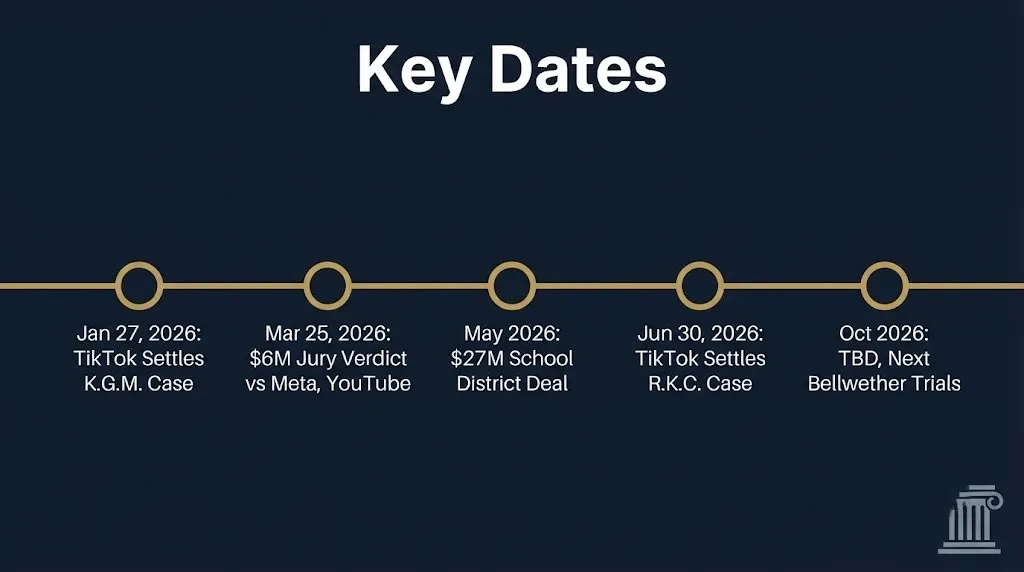
TikTok has resolved its individual bellwether cases through confidential settlements, meaning specific dollar figures were not disclosed in the K.G.M. case (settled January 27, 2026), the R.K.C. case (settled June 30, 2026), or the trio of teen cases settled in August 2026. Attorneys involved confirmed the terms are sealed.
What is public is the school district track, which gives a partial window into TikTok’s settlement posture. In the Breathitt County School District case out of Kentucky, records obtained under the state’s open records law showed the following breakdown from the $27 million total settlement.
Breathitt County School District Settlement (May 2026)
| Company | Amount Paid |
|---|---|
| Meta | $9 million |
| Snap | $8 million |
| ByteDance (TikTok) | $8 million |
| Alphabet (YouTube) | approximately $2.01 million |
That case involved a single school district, not individual injured teens, and the money goes to the district’s mental health programs, not to families directly. More than 1,300 other school districts have filed similar suits, with the next bellwether trial expected in February 2027.
Key Takeaway: TikTok has already paid tens of millions to settle bellwether cases, but every one of those settlements is confidential or district-level, so no individual family has a confirmed per-person payout figure to point to yet.
Reality Check
No legitimate settlement fund will text you first asking for your bank account or a processing fee. Filing a claim in an actual class settlement is always free, and a “claim helper” charging you money to file paperwork is not necessary for any TikTok-related case. If a case truly resolves with individual payouts, notice comes through the court, your attorney, or the official settlement administrator, never a cold text demanding immediate action.
Do I Qualify for the TikTok Lawsuit?
You may qualify for the active mental health litigation if a minor in your care used TikTok regularly and developed diagnosed harm such as anxiety, depression, an eating disorder, body dysmorphia, or self-harm behavior that a medical or mental health professional has documented.
This is not a class action you passively join. It’s individual litigation, meaning each family typically needs a personal injury attorney to file a case in either the federal MDL 3047 (Northern District of California, Judge Yvonne Gonzalez Rogers) or the California state JCCP 5255 (Los Angeles Superior Court, Judge Carolyn B. Kuhl).
Courts in this litigation have allowed claims to proceed under product liability and defective design theories rather than content-moderation theories, which is what let plaintiffs get around Section 230 protections that normally shield platforms from lawsuits over user posts.
Who is generally being considered for these cases:
- Minors who used TikTok, Instagram, YouTube, or Snapchat regularly, often starting before age 13
- Families who can point to a mental health diagnosis or documented harm tied to platform use
- School districts that can show increased counseling, absenteeism, or crisis-response costs
- State attorneys general pursuing consumer protection claims, separate from personal injury claims
If you don’t fit these categories, for example, if you’re an adult without a documented mental health diagnosis tied to TikTok use, you likely don’t have an active claim path in this specific litigation as of now.
What Is the TikTok Mental Health Lawsuit About?
The TikTok mental health lawsuit alleges the company intentionally engineered addictive features, like infinite scroll and autoplay, knowing they would harm the psychological wellbeing of children and teens.
Plaintiffs, including individual families and more than 1,300 school districts, argue TikTok and rival platforms designed their products to maximize screen time regardless of the mental health cost. Alleged harms include anxiety, depression, eating disorders, body dysmorphia, and suicidal ideation.
The litigation groups TikTok with Meta (Instagram and Facebook), Google (YouTube), and Snap as co-defendants, since most plaintiffs used multiple platforms. That’s part of why TikTok’s individual settlements have moved case-by-case rather than through one industry-wide fund.
Key entities named across the litigation:
- TikTok Inc. and parent company ByteDance Inc.
- Meta Platforms, Inc. (Instagram, Facebook)
- Google LLC / Alphabet Inc. (YouTube)
- Snap Inc. (Snapchat)
TikTok and its co-defendants have consistently denied wrongdoing, even while settling individual cases. Settling is not an admission of liability under the terms disclosed so far.
What Happened in the January 2026 TikTok Trial Settlement?
TikTok settled the K.G.M. v. Meta bellwether case on January 27, 2026, the same day jury selection was scheduled to begin in Los Angeles Superior Court.
Snap had already settled its portion of the same case a week earlier, on January 20. That left Meta and Google as the only defendants who actually went to trial. On March 25, 2026, a Los Angeles jury found Meta and Google liable, awarding $6 million in combined damages: $3 million compensatory (split 70/30 between Meta and Google) and $3 million punitive.
The court later denied Meta and Google’s motion for a new trial, and the verdict stands as the first jury decision of its kind in this litigation. Meta has filed an appeal.
Timeline of the first bellwether case:
- January 20, 2026: Snap settles confidentially
- January 27, 2026: TikTok settles confidentially, jury selection begins for remaining defendants
- February 10, 2026: Trial proceedings begin against Meta and Google
- March 25, 2026: Jury returns $6 million verdict against Meta and Google
- Post-verdict: Meta’s motion for new trial denied; appeal filed
By settling early, TikTok avoided having its own conduct evaluated by a jury in this particular case, unlike Meta and Google.
What Happened With the Second Bellwether Trial in 2026?
TikTok settled again in the second California bellwether case, R.K.C. v. Meta et al., on June 30, 2026, following Google’s own settlement with the same plaintiff earlier that month.
That left only Meta scheduled to face a jury in that specific case, with trial set for July 27, 2026. In July 2026, the plaintiff ultimately dismissed his remaining claims against Meta for no payment, after having already settled with Google, TikTok, and Snap.
This pattern, TikTok and other co-defendants settling early while claims against Meta proceed further, has repeated across multiple bellwether cases in 2026. It’s a notable trend: TikTok appears to be prioritizing avoiding public jury findings over litigating the underlying facts.
Key Takeaway: TikTok has settled every bellwether case brought against it so far in 2026 rather than let a jury rule on its specific conduct, a strategy that has kept the actual settlement terms out of public view.
What Are the August 2026 TikTok Settlements About?
In early August 2026, TikTok finalized agreements to settle three additional upcoming trials, resolving claims from teens ranging in age from 15 to 18 who alleged the platform’s addictive design caused serious mental health harm.
Plaintiffs’ attorneys Joseph VanZandt of Beasley Allen and Emily Jeffcott of Morgan & Morgan confirmed the cases were “resolved in principle,” subject to a finalized written agreement. The alleged injuries in these three cases included anxiety, depression, eating disorders, and self-harm.
These settlements let TikTok avoid additional bellwether trials that had been scheduled in the Los Angeles court system. The teens’ claims against Meta, YouTube, and Snapchat, however, remain active, with trial dates still expected around October 2026.
As with every prior TikTok settlement in this litigation, the financial terms were not disclosed, and neither side confirmed an admission of liability.
What Is the Status of the TikTok MDL 3047 Case?
MDL 3047, formally titled In re: Social Media Adolescent Addiction/Personal Injury Products Liability Litigation, is the federal coordination proceeding handling TikTok mental health claims nationwide.
It sits in the U.S. District Court for the Northern District of California, Oakland Division, before Judge Yvonne Gonzalez Rogers, with discovery matters overseen by Judge Peter H. Kang. As of July 2026, over 2,893 cases were pending in this MDL, making it one of the fastest-growing multidistrict litigations currently active.
MDL 3047 coordinates pretrial work only: shared discovery, expert depositions, and threshold legal motions. It does not itself decide individual cases; those get remanded back to their home districts for trial once pretrial issues resolve, or resolved through bellwether trial results and settlement talks.
What MDL 3047 covers:
- Individual personal injury claims from minors and young adults
- School district claims for mental health program costs
- Claims against Meta, Google/YouTube, Snap, and TikTok/ByteDance jointly
Because this is an MDL and not a single class action, there is no unified claim form. Each plaintiff has their own case, filed by their own attorney, seeking their own damages.
What Is JCCP 5255 and How Is It Different From the MDL?
JCCP 5255, officially “Social Media Cases,” is California’s state-court version of the same litigation, running in parallel to the federal MDL but on its own separate track.
JCCP stands for Judicial Council Coordination Proceeding, a mechanism under California Code of Civil Procedure section 404 that groups similar cases filed in different counties before one judge. Judge Carolyn B. Kuhl presides in Los Angeles County Superior Court, overseeing roughly 3,300 coordinated cases.
JCCP 5255 has moved faster than the federal MDL and delivered the country’s first jury verdict in this type of case: the $6 million K.G.M. verdict against Meta and Google in March 2026. Judge Kuhl has three more bellwether trials reported to begin in late October 2026.
MDL 3047 vs. JCCP 5255 at a glance:
| MDL 3047 | JCCP 5255 | |
|---|---|---|
| Court | U.S. District Court, N.D. Cal. | Los Angeles Superior Court |
| Judge | Hon. Yvonne Gonzalez Rogers | Hon. Carolyn B. Kuhl |
| Case type | Federal, cases from across the U.S. | California state-filed cases |
| Cases pending (2026) | Approx. 2,893 | Approx. 3,300 |
| First verdict reached | Not yet | Yes, $6M, March 2026 |
How Do I File a TikTok Mental Health Claim?
You generally need a personal injury attorney to evaluate and file an individual case in either MDL 3047 or JCCP 5255, since there is no public claim form for this litigation.
- Gather documentation showing your child’s TikTok use, including account creation date and approximate age when use began.
- Collect medical or mental health records showing a diagnosis linked to the alleged harm.
- Consult a personal injury or mass tort attorney who handles social media addiction cases.
- Have the attorney determine whether your case fits the federal MDL or the California JCCP based on where you filed or reside.
- File the complaint through your attorney, naming the relevant platforms as defendants.
- Participate in discovery if requested, which may include providing app usage data or additional records.
- Track your case status through your attorney, since these are individual claims, not a shared settlement fund with a public tracker.
Because these are personal injury claims, not a consumer class action, timing and eligibility depend heavily on your state’s statute of limitations for personal injury or product liability claims. That clock generally starts running from when the harm was discovered, not necessarily from when the TikTok use began.
Is the $92 Million TikTok Data Privacy Settlement Still Open?
No, the $92 million TikTok data privacy settlement closed its claims process on March 1, 2022, and it is not accepting any new claimants in 2026.
This settlement, formally In re: TikTok, Inc. Consumer Privacy Litigation, MDL No. 2948, resolved allegations that TikTok collected biometric and personal data, including faceprints and voiceprints, without proper consent. A federal judge in Illinois granted final approval in August 2022.
Roughly 1.2 million valid claims were filed before the deadline, with individual payouts ranging from $27.84 to $167.04 depending on residency and claim type. Illinois residents received a larger share due to that state’s Biometric Information Privacy Act.
If you’re seeing new activity from this settlement in 2026, here’s what it actually means:
- Small supplemental payments as low as $0.91 went out in late 2025, representing leftover fund distribution to people who already filed
- These are not new claims, just final cleanup payments to prior claimants
- If you never filed by March 1, 2022, you cannot retroactively join this settlement
- A separate 2024 court ruling clarified this settlement does not cover newer claims about TikTok’s in-app browser data collection
Key Takeaway: if a message tells you to “claim your TikTok settlement money” in 2026, it is not describing the $92 million privacy case, since that door closed more than four years ago.
What Is the DOJ and FTC’s TikTok Children’s Privacy Case?
The Department of Justice and FTC sued TikTok and ByteDance in August 2024 for violating the Children’s Online Privacy Protection Act (COPPA) by collecting data from children under 13 without parental consent.
The complaint, filed in the Central District of California, alleged TikTok allowed children to bypass its age gate and continued gathering personal data despite a prior 2019 consent order requiring compliance. TikTok reviewers reportedly spent only five to seven seconds per account deciding whether a user was underage.
Reports in 2026 pointed to a proposed $400 million settlement between TikTok and the DOJ, though this figure has drawn public criticism. Child advocacy group Fairplay argued the maximum COPPA penalty of $53,000 per violation means $400 million reflects only about 8,000 violations, far below the millions of under-13 accounts advocates say likely existed.
Important distinction: this is a government enforcement case. Any penalty paid would go to the U.S. Treasury, not to individual families, so this case does not create a consumer payout even if finalized.
This is TikTok’s second COPPA-related penalty. The company (then operating as Musical.ly) paid a then-record $5.7 million FTC fine back in 2019 for similar violations, before the 2024 case alleged it hadn’t actually fixed the underlying problem.
What Happens Next in the TikTok Litigation?
- October 2026 (expected): Three more bellwether trials scheduled in JCCP 5255 before Judge Kuhl, testing claims against remaining defendants.
- October 2026 (expected): Trials in the parallel federal social media addiction litigation involving Meta and Snapchat continue in the Los Angeles court system.
- Late 2026 (expected): Further individual TikTok settlements are likely if the company continues its pattern of resolving cases before trial.
- February 2027 (expected): The next school district bellwether trial is scheduled, following the Breathitt County settlement.
- Ongoing: The proposed $400 million DOJ/COPPA settlement remains subject to court approval, with terms still not finalized as of this writing.
Nothing in this litigation currently points toward a single, industry-wide consumer settlement fund. Each track, individual injury claims, school district claims, and government penalties, is moving on its own separate timeline.
Frequently Asked Questions
Is there a TikTok settlement I can file a claim for right now?
No, there is currently no open consumer claim form for any active TikTok litigation.
The 2022 data privacy settlement closed in March 2022, and the ongoing mental health litigation is individual case-by-case litigation, not a class action with a shared fund.
How much is the TikTok lawsuit settlement worth per person?
Not yet determined for the active mental health litigation, since TikTok’s settlements are confidential and don’t disclose per-person amounts.
The closed 2022 privacy settlement paid between $27.84 and $167.04 per valid claim, but that window is permanently shut.
Can I still join the TikTok class action lawsuit?
The only finished TikTok class action was the 2022 data privacy case, and its claim deadline has passed.
The current mental health litigation is structured as individual personal injury lawsuits in an MDL, meaning you’d need to file your own case through an attorney rather than “join” an existing class.
Why did TikTok keep settling instead of going to trial?
TikTok has settled every bellwether case it faced in this litigation in 2026, avoiding jury findings on its specific conduct.
Analysts note this lets the company resolve claims privately while Meta and Google, which did not settle in the K.G.M. case, faced a jury and lost.
What is the difference between MDL 3047 and JCCP 5255?
MDL 3047 is the federal coordination proceeding in the Northern District of California; JCCP 5255 is California’s parallel state-court proceeding in Los Angeles.
Both handle similar TikTok mental health claims, but JCCP 5255 has moved faster and delivered the first jury verdict in March 2026.
Did TikTok admit any wrongdoing in its settlements?
No, TikTok and its co-defendants have consistently denied liability, even in cases where they settled before trial.
None of the disclosed settlement agreements reviewed so far include an admission of fault.
Is the $400 million TikTok settlement money I can claim?
No, the proposed $400 million settlement is between TikTok and the Department of Justice over COPPA violations, and it would be paid as a penalty, not distributed to consumers.
That settlement remains pending and has been publicly criticized as too small relative to the alleged scope of violations.
How do I know if a TikTok settlement text or email is a scam?
Legitimate settlement notices come from the court, your own attorney, or an official settlement administrator named in public court records, never a stranger asking for bank details by text first.
Since no open TikTok consumer claim form exists right now, any message claiming otherwise should be treated with suspicion.
If you or a family member believe TikTok’s design contributed to a documented mental health harm, the realistic next step is consulting a personal injury attorney about filing in MDL 3047 or JCCP 5255, not searching for a claim form. Everyone else should treat “TikTok settlement” messages with skepticism until they can verify the source.
The single most reliable marker right now: the next bellwether trials are expected in October 2026, and no industry-wide consumer payout has been confirmed as of this writing.