Red Bull Gives You Wings Lawsuit 2026: Settlement Status, Claim Details, and What Happened
Quick Answer
- The original Red Bull settlement was real. It paid $10 cash or $15 in Red Bull products to eligible claimants.
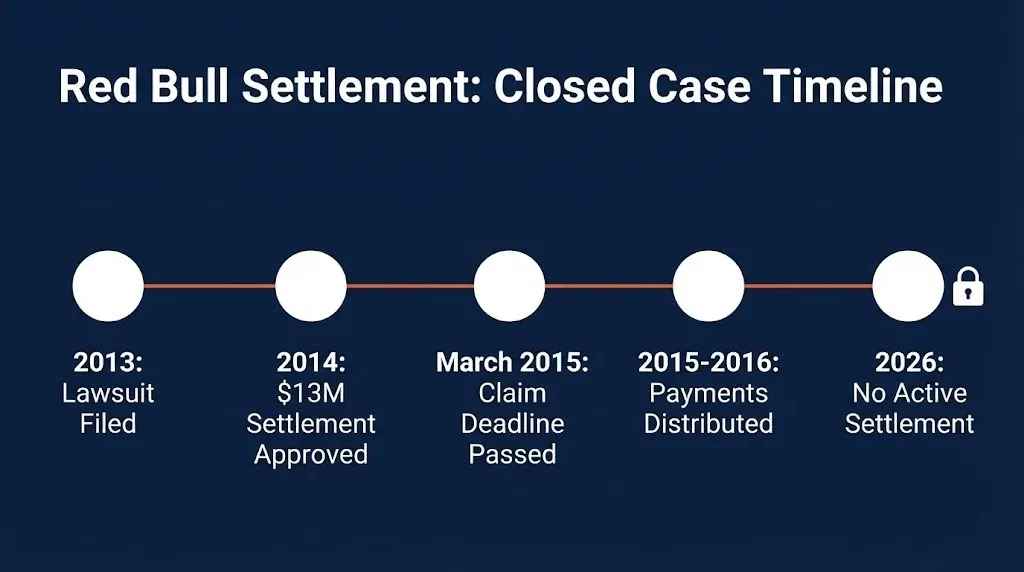
- The claim deadline was March 2, 2015. That deadline passed over a decade ago. No new claims are accepted.
- There is no active Red Bull lawsuit or settlement in 2026. Sites offering claim forms are recycling old news.
If you searched for the Red Bull lawsuit because you heard you could get money, you are seeing outdated information circulating on social media or clickbait sites. The case everyone remembers settled in 2014. Payments went out. The file is closed.
This article explains what the original lawsuit was about, who got paid, how much they received, and why you are still seeing ads about it in 2026. It also covers the separate false advertising cases that followed and whether any new litigation exists.
The Facts
| Case | Careathers v. Red Bull North America, Inc. |
| Court | U.S. District Court, Southern District of New York |
| Settlement Fund | $13 million |
| Per-Person Payout | $10 cash or $15 in Red Bull products |
| Claim Deadline | March 2, 2015 (closed) |
| Status | Settled, paid, and closed |
| Administrator | Not active |
| Proof Needed | No proof required at time of filing (now closed) |
Was the Red Bull Class Action Settlement Real?
Yes. The Red Bull settlement was absolutely real. It was not a scam. It was a certified class action that paid out millions of dollars to consumers.
The case, officially called Careathers v. Red Bull North America Inc., was filed in 2013 in the Southern District of New York. The plaintiff, Benjamin Careathers, alleged that Red Bull’s marketing slogan “Red Bull gives you wings” along with claims about improved performance and concentration constituted false advertising.
The lawsuit argued that Red Bull’s marketing implied the drink provided benefits beyond caffeine alone, and that those benefits were not scientifically substantiated. Red Bull denied any wrongdoing but agreed to settle to avoid the cost and uncertainty of litigation.
The settlement was approved in 2014. Claims were accepted through early 2015. Payments followed. The case is long closed.
Key Takeaway: The settlement happened. It paid real money. It also ended over a decade ago. Anyone telling you there is a current Red Bull claim form is recycling news from 2014.
Why Did People Sue Red Bull?
The lawsuit was about marketing claims, not product safety. The plaintiff argued that Red Bull’s advertising implied functional benefits the drink could not deliver.
The core allegation focused on the slogan “Red Bull gives you wings.” The complaint argued this was not just puffery or playful branding. It was a specific performance claim about energy, alertness, and enhanced physical and mental function.
The lawsuit also challenged broader marketing language. Red Bull had for years claimed its product “vitalizes body and mind” and improved concentration, reaction speed, and endurance. The plaintiff argued these claims lacked scientific support beyond what any caffeinated beverage provides.
Red Bull’s defense was that its marketing constituted permissible puffery, which is exaggerated or hyperbolic language that no reasonable consumer takes literally. The company maintained that its ingredients, including caffeine, taurine, and B vitamins, do provide energy benefits.
The settlement did not require Red Bull to change its slogan. The company still uses “Red Bull gives you wings” in its advertising today.
How Much Did the Red Bull Settlement Pay?
The settlement provided two options for class members: a $10 cash payment or $15 worth of free Red Bull products.
The total settlement fund was $13 million. That covered cash payments, product vouchers, attorney fees, administrative costs, and notice expenses.
Here is how the payout structure worked.
| Option | Value | Requirements |
|---|---|---|
| Cash payment | $10 | Submit claim form by March 2, 2015 |
| Red Bull products | $15 worth (choice of 15 cans or 4 four-packs) | Submit claim form by March 2, 2015 |
| No proof of purchase required | N/A | None. Claim was based on self-attestation. |
The cash option was limited by the fund size. If claims exceeded the available cash, the amount would be reduced pro rata. In practice, the volume of claims was so high that the cash option was eventually capped, and some claimants received less than $10 or were shifted to the product option.
The product option was effectively unlimited. Red Bull agreed to provide product vouchers to all eligible claimants who selected that option. There was no cap on product claims.
Who Was Eligible for the Red Bull Settlement?
The settlement class included anyone in the United States who purchased at least one Red Bull product between January 1, 2002, and October 3, 2014.
There was no minimum purchase amount. One can was enough. You did not need receipts. You did not need to prove you saw the advertising. You simply attested that you bought a Red Bull during the class period.
The class was broad. It covered every flavor, every size, and every variety sold under the Red Bull brand during that 12-year window. Energy shots and Red Bull Editions were included. Sugar-free was included.
Minors who purchased Red Bull were included, though a parent or guardian had to file the claim on their behalf.
People who purchased Red Bull outside the United States were not included. The settlement applied only to U.S. purchases and U.S. residents.
Reality Check: The claims period for this settlement ended on March 2, 2015. It is now 2026. No late claims are accepted. No exceptions. No second filing window. No reopened settlement. If you see a website that says “Red Bull settlement claims now open” or “file your Red Bull claim today,” it is either an old page that was never taken down or a deliberate scam. The settlement administrator’s website was taken offline years ago. The case is closed.
The Original Red Bull Lawsuit Claim Form: How Did It Work?
The claim form was famously simple. It was one of the easiest class action claim forms ever distributed in a consumer case.
Filing a claim required no proof of purchase. You did not need to upload receipts. You did not need to provide a credit card statement showing a Red Bull purchase. You simply filled in your name, address, and email, checked a box attesting that you bought a Red Bull during the class period, and selected cash or product.
The simplicity was both a feature and a problem. It made the settlement accessible to millions of people. It also meant the claims volume was enormous. The settlement became one of the most widely claimed consumer class actions in history.
The claim form was available online through the official settlement website. It took roughly two minutes to complete. This ease of filing is part of why the Red Bull settlement remains so memorable and why people still search for it years later.
Today, no claim form exists. The settlement website has been deactivated. Any site offering a Red Bull claim form in 2026 is not affiliated with the real settlement.
Are There Any New Red Bull Lawsuits in 2026?
No major class action lawsuits against Red Bull are active in 2026. The company faces periodic false advertising challenges and labeling disputes, but none have produced a new consumer settlement with a claim form.
Red Bull has been sued multiple times since the original “wings” settlement. Most cases have focused on different aspects of its marketing. Some have been dismissed. Some have settled on an individual basis. None have produced the kind of mass consumer settlement that generated widespread claim filing.
One area of ongoing legal attention involves Red Bull’s labeling of ingredients and its use of the term “energy” in marketing. Competitors and consumer groups have occasionally challenged these claims, but no certified class action has emerged.
The company also faces the same regulatory scrutiny as other energy drink makers regarding caffeine content, marketing to minors, and health disclosures. These are regulatory matters, not consumer class actions with claim forms.
If a new settlement is announced, this page will be updated. As of August 2026, no such settlement exists.
Is There a Red Bull False Advertising Class Action in 2026?
No active false advertising class action against Red Bull has been certified or settled in 2026.
Since the original 2014 settlement, several false advertising lawsuits have been filed against Red Bull and other energy drink companies. Most have targeted specific claims: natural ingredients, sugar content, health benefits, and comparison to coffee or soda.
A few cases have survived motions to dismiss and entered discovery. But none have reached the stage of a certified class with a claims process. These cases remain in litigation and may settle or go to trial in future years.
One case filed in California alleged that Red Bull’s marketing of its sugar-free and zero-calorie products misled consumers about the use of artificial sweeteners. That case did not produce a consumer settlement. It was resolved on terms that were not publicly disclosed.
Another case in New York challenged Red Bull’s use of the phrase “premium ingredients” in connection with products containing synthetic taurine rather than naturally derived taurine. That case was dismissed.
The pattern is clear: Red Bull faces litigation regularly, but the mass consumer class action with the simple claim form has not been repeated.
What Is the Difference Between the Red Bull Wings Lawsuit and Other Energy Drink Cases?
The Red Bull settlement stands apart because of its reach and simplicity. Most energy drink lawsuits are smaller, more complex, or focused on health rather than marketing.
Lawsuits against Monster, Rockstar, Bang, and 5-Hour Energy have generally alleged health harms: cardiac events, strokes, seizures, and deaths allegedly linked to excessive caffeine consumption. These are personal injury cases, not consumer fraud class actions. They require proof of injury and causation.
Other false advertising cases against energy drink companies have produced settlements, but none with the no-proof claim model that made the Red Bull settlement go viral. Most require receipts, proof of purchase, or are limited to specific products purchased during narrow time windows.
The Red Bull case succeeded in part because the class was enormous and the claim process was frictionless. That combination is rare. Most class action administrators now require at least some form of verification, precisely because the Red Bull experience showed what happens when you do not.
Why Am I Seeing Red Bull Lawsuit Ads in 2026?
You are seeing ads because the Red Bull settlement is a proven traffic driver. It generates clicks. It generates ad revenue. It generates leads for law firms and marketing companies.
The ads you see fall into a few categories. Some are clickbait articles on ad-supported websites that republish old settlement news with misleading headlines implying the claims process is open. They make money from display ads served to you while you read.
Some are law firm lead generation campaigns. They use the Red Bull name to attract people searching for class action settlements, then pivot to screening you for other mass tort cases like Camp Lejeune, Roundup, or hernia mesh. Red Bull is the bait.
Some are outright scams. They collect your personal information under the guise of filing a claim, then use or sell that data. They may ask for your Social Security number, bank account details, or a processing fee. A real settlement never asks for these things on an intake form.
The ads persist because the economics work. Search volume for “Red Bull lawsuit” remains high. People remember the case. They wonder if there is a new one. Advertisers exploit that curiosity.
What Is the Red Bull “Wings” Slogan Status Today?
Red Bull still uses the slogan “Red Bull gives you wings.” The 2014 settlement did not require the company to stop.
The settlement terms focused on monetary compensation, not injunctive relief. Red Bull agreed to pay $13 million. It did not agree to change its advertising. The slogan remains the centerpiece of the brand’s global marketing.
This is common in consumer class action settlements. Defendants typically settle to avoid litigation costs while denying liability and preserving their existing marketing practices. The settlement is a business decision, not an admission of guilt.
In the years since the settlement, Red Bull has expanded the “wings” concept into a broader brand identity. The slogan appears in television commercials, social media campaigns, event sponsorships, and packaging. The lawsuit did not clip the wings. It paid a toll and kept flying.
What Should You Do If You See a Red Bull Settlement Ad in 2026?
Treat every Red Bull settlement ad with skepticism. The original case is closed. No new case is active.
Do not provide personal information to a website promising a Red Bull payout. Do not pay a fee to file a Red Bull claim. Do not click links in text messages about Red Bull settlements.
If a settlement is real, it will appear on a court-approved settlement administrator’s website with a .gov or .com domain clearly tied to the case name. It will be reported by established legal news outlets. It will not arrive via a pop-up ad or an unsolicited text.
You can verify the status of any class action settlement by checking the federal court docket through PACER or by searching the website of a trusted legal news publisher. This page will also be updated if a legitimate new settlement emerges.
Frequently Asked Questions
Is the Red Bull class action lawsuit still open?
No. The settlement was approved in 2014 and the claim deadline was March 2, 2015.
No new Red Bull class action settlement is active in 2026.
How much did people get from the Red Bull settlement?
Eligible claimants received $10 cash or $15 in free Red Bull products.
The total settlement fund was $13 million. No proof of purchase was required.
Can I still file a Red Bull claim form?
No. The claims period ended on March 2, 2015. No late claims are accepted.
Any site offering a Red Bull claim form in 2026 is not legitimate.
Why did Red Bull get sued?
The lawsuit alleged that “Red Bull gives you wings” and related marketing made unsubstantiated performance claims.
Red Bull denied wrongdoing but settled for $13 million.
Is Red Bull changing its slogan because of the lawsuit?
No. Red Bull still uses “Red Bull gives you wings.” The settlement did not require a change.
The company paid the settlement without admitting liability.
Are there new lawsuits against Red Bull in 2026?
No major class action settlements against Red Bull are active.
Individual lawsuits and smaller regulatory matters exist, but no new consumer claim form is available.
How do I know if a Red Bull settlement ad is a scam?
If the ad says claims are open, asks for payment, or requests your SSN, it is a scam.
Real class action notices come from court-approved administrators, not pop-up ads.
What was the official Red Bull settlement website?
The official site was energydrinksettlement.com. It was taken offline years ago.
No active settlement website exists for Red Bull in 2026.
The Red Bull “gives you wings” lawsuit was real. It paid $10 cash or $15 in product to millions of people who bought a Red Bull between 2002 and 2014. The claim deadline passed on March 2, 2015. The file is closed. The administrator’s website is gone.
If you saw an article or ad in 2026 suggesting you can still claim money from a Red Bull settlement, you are looking at outdated information or a scam. Bookmark this page. If a legitimate new Red Bull class action settlement is announced, the details will be here, verified and current. Until then, the wings have flown.