Mielle Lawsuit 2026: Claim Status, Allegations, and What Consumers Should Know
Quick Answer:
- The Mielle Organics lawsuit is real, with multiple proposed class actions filed over alleged hair loss and scalp injuries.
- No payout amount has been determined because no settlement or verdict exists yet.
- There is no claim deadline. Consumers can still retain counsel or gather documentation if they believe they were affected.
If you searched “Mielle lawsuit” after seeing social media posts about hair loss or scalp damage, you are not alone. The claims have circulated widely since late 2024.
The lawsuits allege that certain Mielle Organics products, particularly the Rosemary Mint line, caused hair breakage, hair loss, and scalp irritation in some consumers. The company has denied the allegations.
This article covers what is verified in court records, what remains unproven, and what affected consumers should do now. One detail most coverage omits: no plaintiff has won a judgment, and the science linking specific ingredients to the alleged harm remains contested.
The Facts
| Case | Multiple proposed class actions against Mielle Organics |
| Status | Early litigation, motions pending |
| Fund Size | Not yet confirmed |
| Est. Per Person | Not yet determined |
| Claim Deadline | Not set |
| Administrator | Not yet appointed |
| Proof Needed | Purchase records, photos, medical documentation |
Is the Mielle Organics Lawsuit Legit?
The Mielle Organics lawsuit is legitimate and active in federal court as of January 2026, but it is not a settled case with guaranteed payouts.
Multiple proposed class action complaints have been filed against Mielle Organics LLC and its parent company, Procter & Gamble. P&G acquired Mielle in early 2023.
The cases were consolidated or transferred into a multidistrict litigation proceeding in the U.S. District Court for the Northern District of Illinois. Court records show the litigation is in early procedural stages.
The core allegation across complaints is that certain Mielle products caused hair loss, breakage, and scalp irritation after use. Plaintiffs claim the company failed to warn consumers about potential risks.
Mielle Organics has denied the allegations. The company states its products are safe when used as directed and that independent testing supports their quality.
Social media amplified the claims. Thousands of consumers posted videos and photos describing hair damage they attribute to Mielle products. Those posts are not evidence in court, but they helped drive the litigation.
The difference between social media claims and a legal case matters. A court will require expert testimony, scientific evidence, and specific proof linking products to injuries. That process takes years.
Key Takeaway: The lawsuit is real and active, but it is in early stages with no admission of liability and no settlement offer.
What Is the Mielle Lawsuit About?
The Mielle lawsuit alleges that certain Mielle Organics hair care products caused hair loss, breakage, scalp burns, and other injuries in consumers.
The complaints focus primarily on products containing rosemary oil, mint oil, and other essential oils. The Rosemary Mint Scalp & Hair Strengthening Oil is the most frequently named product.
Plaintiffs claim that the concentration of essential oils in certain products is too high for some users. They allege the company knew or should have known about the risk of irritation and hair loss but failed to warn consumers.
Some complaints also allege mislabeling. Plaintiffs argue that claims like “strengthening” and “healthy hair” misleadingly suggest the products are safe for all hair types when some consumers experienced the opposite.
The legal theories include negligence, product liability, breach of warranty, and consumer protection violations. Different complaints frame the claims differently depending on state laws.
Not every Mielle product is named in the litigation. The allegations focus on specific lines rather than the entire brand catalog.
The case sits within a broader wave of consumer lawsuits against beauty and personal care brands. Similar cases have been filed against other hair care companies in recent years with mixed results.
Who Is Mielle Organics?
Mielle Organics is a Black-owned hair care company founded in 2014 by Monique and Melvin Rodriguez.
The company built its reputation on products formulated with natural ingredients for textured hair. The Rosemary Mint line became a viral sensation on social media platforms, especially TikTok.
Procter & Gamble acquired Mielle Organics in early 2023. The acquisition expanded P&G’s reach into the textured hair care market and brought Mielle products to mass retailers nationwide.
The acquisition matters legally. Plaintiffs added P&G as a defendant, arguing the parent company bears responsibility for the products sold under the Mielle brand after the acquisition closed.
Mielle Organics continued to operate as a separate brand within P&G’s beauty portfolio. The company maintains that its formulations did not change following the acquisition.
The brand’s rise and the timing of the lawsuits created a narrative that some consumers found suspicious. Online discussions questioned whether the formula changed after the P&G deal. Mielle has stated the formulas remained consistent.
The company’s response to the allegations has been firm. Public statements deny any connection between Mielle products and the reported hair loss.
Key Takeaway: Mielle Organics is now owned by Procter & Gamble, and both entities are named in the litigation.
How Much Could the Mielle Lawsuit Pay Per Person?
No per-person payout amount has been determined for the Mielle lawsuit because no settlement or verdict exists as of January 2026.
You may see social media posts or advertisements speculating about payout amounts. Some mention figures ranging from $50 to several thousand dollars. Those numbers are speculation, not court-approved figures.
If a settlement is eventually reached, individual amounts would depend on several factors: the severity of the alleged injury, the strength of medical documentation, the length of product use, and the total number of eligible claimants.
A class action settlement typically distributes a common fund among all approved claimants. Administrative costs and attorney fees are deducted first. The remaining amount is divided based on the settlement terms.
In product liability class actions with cosmetic products, payouts often range from a few dollars to a few hundred dollars per claimant. Cases involving documented medical injuries may pay more.
The reality is that class action settlements rarely make individual consumers whole. The purpose is to compensate a large group efficiently, not to provide large windfalls.
Do not make financial decisions based on a potential Mielle payout. There is no guarantee of any recovery, and the litigation is years from resolution.
Reality Check: No one can guarantee you a specific payout from the Mielle lawsuit. Any service or individual that promises a set amount is misleading you. Filing a claim in a class action is free, and you never need to pay an upfront fee.
Who May Qualify for a Mielle Lawsuit Claim?
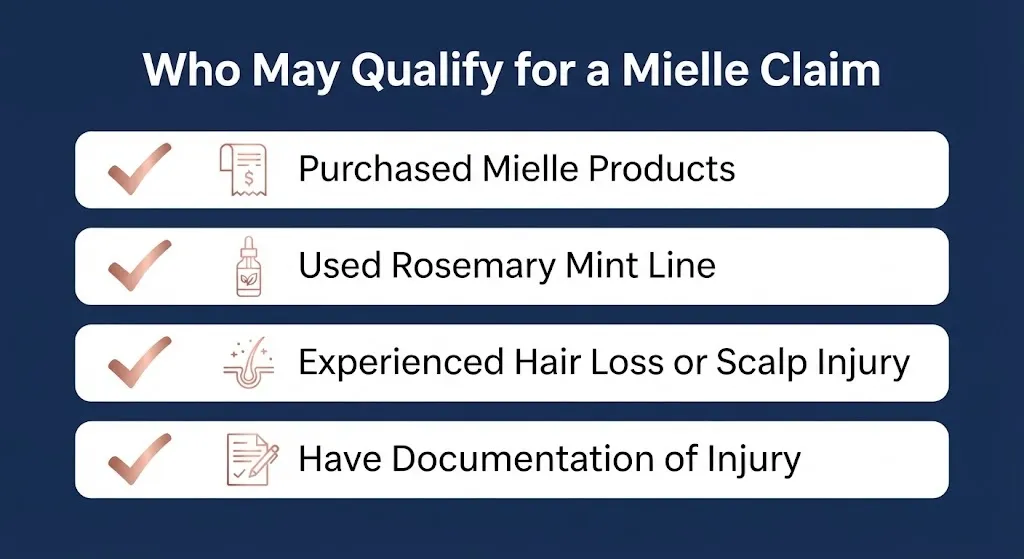
You may qualify to participate in the Mielle lawsuit if you purchased certain Mielle Organics products and experienced hair loss, scalp injury, or other documented harm after use.
The key eligibility factors are straightforward. You must have purchased the product. You must have used the product. You must have experienced a documented injury that you attribute to the product.
Purchase documentation matters. Receipts, order confirmations, bank statements showing the purchase, or loyalty program records all help establish that you bought the product.
Injury documentation is critical. Photos of hair loss or scalp damage, medical records from dermatologist visits, and contemporaneous notes about when symptoms appeared all strengthen a claim.
The specific products matter. Not every Mielle product is named in the litigation. The complaints focus primarily on the Rosemary Mint line and certain other products containing essential oils.
Timing may matter if a future settlement establishes a class period. Most proposed classes cover purchases within a specific date range, typically the years when the alleged harm was reported.
If you experienced mild irritation that resolved quickly, your claim may be worth less than someone with documented, ongoing hair loss requiring medical treatment.
The comparison to a store return without a receipt fits here. You can explain what happened, but documented proof makes your claim far stronger.
Key Takeaway: Purchase records plus documented injury are the two essential factors for any future claim.
How to File a Mielle Lawsuit Claim
You cannot file a Mielle lawsuit claim yet because no settlement exists and no claims process is open as of January 2026.
What you can do now is preserve your rights and your evidence. Here is the step-by-step process:
- Gather purchase records showing when and where you bought Mielle products.
- Collect photos or videos documenting your hair loss or scalp condition.
- Obtain medical records from any dermatologist or physician you consulted.
- Write a dated note describing which products you used, when symptoms began, and what you experienced.
- Monitor the official court docket for the multidistrict litigation.
- Retain a product liability attorney if you want to pursue an individual claim.
- Keep remaining product containers or packaging in case future testing is required.
The process is similar to preparing for a warranty claim. You need proof of purchase, proof of the problem, and documentation of your attempt to address it.
Do not send your only copies of records to anyone. Keep originals and provide copies only when a formal claims process opens.
Be wary of any website or service that claims you can file a claim now. No administrator has been appointed, and no claim form exists.
What Is the Latest Update on the Mielle Lawsuit in 2026?
The latest Mielle lawsuit update as of January 2026 is that the litigation remains in preliminary stages with motions to dismiss pending.
The cases were consolidated for pretrial proceedings in federal court. Consolidation streamlines discovery and avoids conflicting rulings across multiple courts.
The defendants, Mielle Organics and Procter & Gamble, have filed motions challenging the legal sufficiency of the complaints. These motions argue that the plaintiffs have not stated valid legal claims.
A ruling on the motions to dismiss has not been issued as of January 2026. If the motions are granted in full, the cases could end. If denied, the litigation moves into discovery.
Discovery is the phase where both sides exchange documents, internal communications, and expert reports. This phase typically takes one to two years in complex product liability cases.
No class certification hearing has been scheduled. Class certification is required before any class action settlement can be finalized.
No trial date exists. The case is years away from any jury decision.
Key Takeaway: The litigation is in early procedural stages with no settlement, no class certification, and no trial date.
Is There a Mielle Organics Class Action Settlement?
There is no Mielle Organics class action settlement as of January 2026.
The proposed class actions have not been certified as class actions. The court has not approved any settlement. No settlement fund exists.
This is important because social media and some websites may suggest otherwise. Any post claiming a settlement exists is incorrect as of the current date.
A class action settlement requires multiple steps. The parties must negotiate terms. The court must preliminarily approve the settlement. Notice must go to class members. A final approval hearing must occur. Only then does a claims process open.
None of those steps have occurred in the Mielle litigation. The case has not reached the point where settlement negotiations would typically begin.
If a settlement is eventually reached, you will receive notice if you are a class member who purchased products during the class period. The notice will explain how to file a claim, the deadline, and the potential payout.
Until then, the best action is to preserve documentation and monitor the case. You do not need to sign up anywhere or pay anyone to protect your rights.
Key Takeaway: No settlement exists, and any claim to the contrary is false as of January 2026.
What Products Are Named in the Mielle Lawsuit?
The Mielle lawsuit primarily names the Rosemary Mint Scalp & Hair Strengthening Oil and related Rosemary Mint line products.
Other products mentioned in some complaints include the Rosemary Mint Strengthening Shampoo, Rosemary Mint Strengthening Conditioner, and certain leave-in treatments from the same line.
The common thread across named products is the presence of rosemary oil and mint oil. These essential oils are the ingredients plaintiffs claim caused irritation, scalp damage, and hair loss.
Not every Mielle product is named. The brand produces a wide range of products, including deep conditioners, curl creams, and styling gels. Most of those products are not named in the litigation.
The focus on essential oil concentrations is significant. Essential oils are known irritants at certain concentrations. The question in litigation is whether Mielle’s formulations exceeded safe levels and whether warnings were adequate.
Mielle has stated that its products contain safe concentrations of essential oils. The company points to safety testing and its track record of sales as evidence that most consumers use the products without problems.
The legal issue is not whether most users are fine. It is whether a foreseeable subset of users faced risks that should have been disclosed.
Why Did Mielle Change Its Formula?
Mielle Organics has stated that it did not change its formula following the Procter & Gamble acquisition.
This question persists in online discussions because many consumers reported changes in product texture or effects after the acquisition closed in early 2023. Some consumers attributed those changes to a reformulation.
Mielle and P&G have publicly denied any formula changes. The company states that manufacturing moved to P&G facilities but the formulations remained the same.
The allegations in the lawsuit do not center on a formula change. The complaints focus on the product formulations as they existed at the time of purchase, regardless of whether they changed over time.
The legal significance of a formula change would matter if plaintiffs could prove the product became more dangerous after the acquisition. No complaint has made that specific claim as a central theory.
The perception of formula changes is common in consumer product litigation, especially after acquisitions. Perception, however, is not proof. The court will rely on manufacturing records and ingredient documentation.
Key Takeaway: Mielle denies changing its formula, and the lawsuits do not primarily allege a post-acquisition formula change.
Can I Sue Mielle for Hair Loss?
You may sue Mielle for hair loss if you can document that you used the product and that it caused your specific injury.
Individual lawsuits are separate from the class action litigation. You do not need to wait for the class action to resolve to pursue your own claim, but individual litigation is expensive and time-consuming.
A product liability claim requires proof of several elements. You must show the product was defective or unreasonably dangerous. You must show you used the product as directed. You must show the product caused your injury. You must show you suffered damages.
The causation element is often the hardest to prove. Hair loss has many potential causes, including genetics, stress, hormonal changes, medications, and other hair care products. Proving that Mielle specifically caused your hair loss requires medical evidence.
A dermatologist can sometimes provide an opinion on causation. That opinion may or may not hold up in court, depending on the strength of the underlying science.
The statute of limitations applies. In most states, you have two to three years from the date you discovered the injury to file a product liability claim. The exact deadline depends on your state.
Consult an attorney if you are considering individual litigation. Most product liability attorneys offer free consultations and work on contingency.
What Are the Symptoms Reported in the Mielle Lawsuit?
The symptoms reported in the Mielle lawsuit include excessive hair shedding, breakage, scalp burns, scalp irritation, and thinning hair.
Plaintiffs describe hair loss that began shortly after using Mielle products, particularly the Rosemary Mint oil. Some report clumps of hair falling out during washing or styling.
Scalp symptoms include burning, itching, redness, and flaking. Some plaintiffs report open sores or scalp tenderness that required medical treatment.
The severity varies significantly. Some plaintiffs report mild shedding that resolved after discontinuing use. Others report ongoing hair loss requiring dermatological intervention and, in some cases, hair restoration treatments.
Photographic evidence submitted with complaints shows varying degrees of hair thinning. These photos are part of the court record but have not been independently verified by medical experts.
The defense will likely argue that other factors explain the reported symptoms. Stress, hormonal changes, postpartum shedding, traction alopecia from tight styles, and other product use are all potential alternative causes.
The medical evidence in the case will ultimately determine whether the reported symptoms can be linked to Mielle products specifically.
Key Takeaway: Reported symptoms range from mild irritation to significant hair loss, and causation remains the central disputed issue.
What Happens Next in the Mielle Lawsuit?
Here is the expected timeline for the Mielle litigation based on the current posture and standard product liability progression:
Early to Mid 2026: Court rules on pending motions to dismiss.
Late 2026: If the case survives dismissal, discovery begins.
2027: Discovery continues, including document production and expert reports.
2027 to 2028: Class certification motion filed and argued.
2028 or later: If class certification is granted, settlement negotiations may begin. If denied, individual cases may proceed separately.
This timeline is an estimate, not a court schedule. Product liability class actions routinely take three to five years from filing to resolution.
The single most important thing you can do now is preserve your evidence and monitor the official court docket. Do not wait for a settlement announcement to start gathering documentation.
Frequently Asked Questions
Is the Mielle lawsuit real?
Yes, the Mielle lawsuit is real with multiple proposed class actions filed in federal court.
What products are in the Mielle lawsuit?
The Rosemary Mint Scalp & Hair Strengthening Oil and related Rosemary Mint line products are the primary focus.
How do I join the Mielle lawsuit?
You cannot join yet because no class has been certified and no claims process exists.
Did Mielle change its formula after P&G bought it?
Mielle denies changing its formula after the Procter & Gamble acquisition.
How much will I get from the Mielle settlement?
No amount has been determined because no settlement exists as of January 2026.
Do I need a lawyer for the Mielle lawsuit?
You do not need a lawyer to participate in a future class action, but individual claims may benefit from representation.
What proof do I need for a Mielle claim?
Purchase records, photos of hair loss or scalp damage, and medical records strengthen any future claim.
Is there a deadline to file a Mielle claim?
No claim deadline exists because no settlement or claims process has been established.
If you believe a Mielle product caused your hair loss or scalp injury, gather your purchase records and medical documentation now. Keep the evidence safe.
The most important fact to remember: no settlement exists, no claim deadline has been set, and no one can guarantee you a payout. Preserve your proof and monitor the official court docket.