NEC Lawsuit Update 2026: Baby Formula Claims, Settlement Status, and What Parents Should Know
Quick Answer
- The NEC lawsuit is real, consolidated in federal multidistrict litigation against Abbott and Mead Johnson.
- No settlement fund exists yet; individual payouts are not determined pending bellwether trial outcomes.
- No claim deadline applies until a settlement is approved or a specific case resolves.
NEC lawsuits are real and active in 2026. The litigation targets the makers of cow’s milk-based formulas given to premature infants in neonatal intensive care units. Parents allege those formulas caused or contributed to necrotizing enterocolitis, a devastating intestinal disease that can be fatal.
If your premature baby received Similac or Enfamil in a hospital NICU and later developed NEC, you may have a claim. The litigation is not a class action. It is consolidated as multidistrict litigation, which means each family’s case remains individual but shares pretrial discovery. No settlement has been announced. No payout schedule exists.
This article explains the verified status of the NEC litigation as of August 2026: who is being sued, what the science shows, how these cases work, what to expect for timing, and how to evaluate whether your family may qualify. One fact that surprises many parents: the litigation does not target consumer formula sold in stores. It is limited to formula fed to hospitalized premature infants.
The Facts
| Case | In re: Abbott Laboratories, et al., Preterm Infant Nutrition Products Liability Litigation |
| Status | Active multidistrict litigation in federal court, discovery ongoing |
| Fund Size | Not applicable; no global settlement exists |
| Est. Per Person | Not determined; bellwether trial outcomes expected to shape values |
| Claim Deadline | No deadline; individual cases filed by retained counsel |
| Administrator | None appointed |
| Proof Needed | NICU medical records, formula administration records, NEC diagnosis confirmation |
Is the NEC lawsuit real or a scam?
The NEC lawsuit is real. It is one of the largest active product liability litigations in the United States. The cases are consolidated in the U.S. District Court for the Northern District of Illinois under multidistrict litigation, known as MDL. The MDL judge oversees discovery and bellwether trials.
The defendants are Abbott Laboratories and Mead Johnson. Abbott makes Similac. Mead Johnson makes Enfamil. Both companies deny the allegations. They argue their formulas are safe and that NEC has multiple causes.
What is a scam: any message, call, or website that promises you a guaranteed NEC settlement payout. No settlement exists. No one can guarantee payment. Legitimate law firms evaluate cases individually. They review medical records before telling you anything about claim strength.
You also should not pay upfront fees for an NEC case. Reputable firms handling this litigation work on contingency. They are paid only if the case resolves in the family’s favor.
The litigation is distinct from a class action. There is no single claim form. There is no administrator. Each family works with an attorney who files the case individually within the MDL framework.
Key Takeaway: The NEC litigation is real and court-supervised, but there is no settlement, no claim form, and no payout, and any promise otherwise is false.
How much is the NEC lawsuit worth per child?
No per-child settlement amount exists. The litigation has not produced a global settlement, and bellwether trial verdicts have not yet set a valuation benchmark. Any number you see online is speculation.
The first bellwether trial dates are scheduled for early 2027. Bellwether cases are test trials selected by both sides. Their outcomes influence settlement negotiations. If plaintiffs win large verdicts, settlement values rise. If defendants win, values fall.
In similar product liability litigation involving infant injuries, individual case values have ranged widely. Some cases settle in the low six figures. Cases involving severe NEC requiring multiple surgeries or resulting in death have the potential for substantially higher values. But those are historical comparisons, not predictions.
Here is what will drive any eventual payout.
| Factor | Impact on Case Value |
|---|---|
| Severity of NEC diagnosis | Higher severity raises value |
| Surgeries required | More surgeries raise value |
| Long-term complications | Short gut syndrome, developmental delays raise value |
| Wrongful death | Highest-value cases |
| Strength of medical causation evidence | Stronger causation raises settlement value |
| State law where filed | Some states have higher damage caps or none |
Do not base decisions on an online calculator or a law firm advertisement. Every case is different. The only meaningful valuation comes after a medical expert reviews your child’s NICU records.
Reality Check: No settlement fund has been created. No administrator is accepting claims. Third-party services charging fees to “register” you for the NEC lawsuit are unnecessary and potentially fraudulent.
What is the NEC lawsuit about in 2026?
The NEC lawsuit alleges that Abbott and Mead Johnson knew their cow’s milk-based premature infant formulas increased the risk of necrotizing enterocolitis but failed to warn parents, hospitals, and doctors. The claims focus on products used in NICUs, not standard consumer formula.
Necrotizing enterocolitis is a serious intestinal illness. It causes inflammation, infection, and death of bowel tissue. It primarily affects premature infants. The death rate is significant. Survivors often face lifelong complications including short bowel syndrome, feeding difficulties, and neurodevelopmental problems.
Multiple peer-reviewed studies have found an association between cow’s milk-based formula feeding and higher NEC rates in premature infants compared to exclusive human milk feeding. The litigation hinges on whether the companies had a duty to warn about that risk on product labels.
Both Abbott and Mead Johnson argue the science is not conclusive. They maintain that NEC has multifactorial causes, including prematurity itself. The companies also argue that formula is sometimes medically necessary when a mother cannot provide breast milk.
The MDL is resolving scientific disputes through expert testimony. That process is ongoing in 2026.
Key Takeaway: The core claim is failure to warn about a known NEC risk from cow’s milk-based formula in premature infants, and the science is the central battleground.
Who qualifies for an NEC baby formula lawsuit?
Qualification is determined case by case by a reviewing attorney. There is no court-approved class definition. There is no form to file. But the general criteria follow a consistent pattern across the litigation.
You may have a case if all of the following are true.
- Your child was born premature, generally before 37 weeks gestation.
- Your child received Similac or Enfamil cow’s milk-based formula in a hospital NICU.
- Your child developed necrotizing enterocolitis.
- The NEC diagnosis came after the formula feedings began.
- You have or can obtain the NICU medical records.
The strongest cases involve infants who received formula despite no documented medical necessity, or cases where parents were not told about the NEC risk. Cases involving donor breast milk availability are also significant.
What usually disqualifies a case: the child was full-term, the NEC diagnosis occurred before any formula feeding, the formula used was a different brand, or medical records do not support the timeline.
Time limits apply. Each state has a statute of limitations for product liability and wrongful death claims. Those deadlines vary. If your child died or was injured years ago, you may still have time depending on your state’s discovery rules and the child’s age. But delay can eliminate the claim.
How do I file an NEC lawsuit for my baby?
There is no court form. The process starts by contacting a law firm that handles NEC litigation. The firm reviews your child’s medical records and tells you whether the case is viable. Here is the typical sequence.
- Gather your child’s complete NICU medical records and discharge summaries.
- Contact a law firm with NEC MDL experience.
- Sign a medical records release so the firm can obtain records directly from the hospital.
- The firm’s medical expert reviews the records for formula exposure and NEC diagnosis.
- The firm files a complaint in the appropriate federal or state court.
- The case is transferred into the MDL if it meets the criteria.
- Discovery proceeds, and the case is prepared for a potential bellwether or settlement track.
The process is more like a store return without a receipt. You need the paperwork to prove what happened. Without medical records, the firm cannot evaluate the case.
Do not wait. Records can be lost. Hospitals may have retention policies. The sooner you request records, the better.
What is the NEC lawsuit update for 2026?
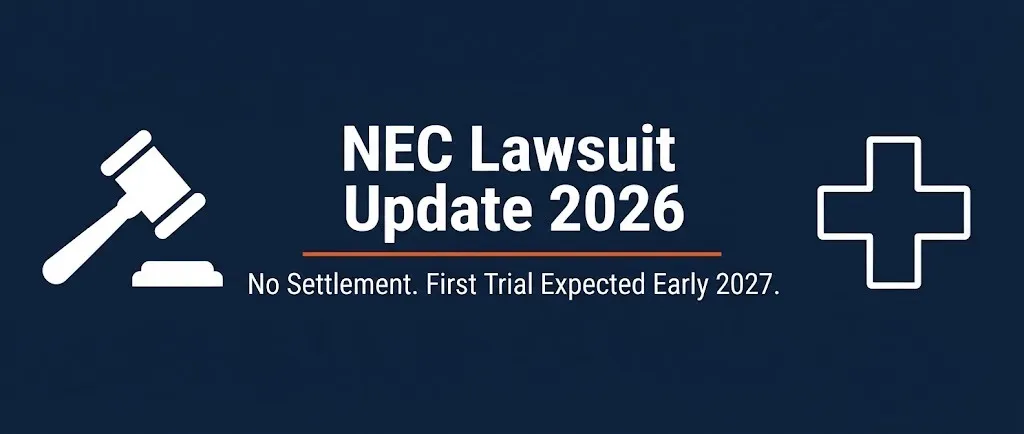
The NEC lawsuit update for 2026 is procedural progress without resolution. Discovery is active. Expert testimony is being prepared. Bellwether trial selections are finalized for early 2027.
The MDL judge has issued rulings on the admissibility of certain scientific evidence. Those rulings shape what plaintiffs and defendants can present at trial. The outcome of those evidentiary battles matters more than most news headlines suggest.
One development worth watching: the first trial date. The initial bellwether case is scheduled to begin in the first quarter of 2027. That date has moved before. It could move again. But it is currently on the court’s calendar.
Settlement talks have not produced a global resolution. Both sides have participated in mediation, but no agreement has been announced. Any settlement would require court approval and would likely include a claims process for eligible families. That process does not exist yet.
The litigation is also spawning related state court cases. Some families have filed outside the federal MDL. Those cases proceed on separate timelines and could resolve earlier or later than the MDL bellwethers.
Key Takeaway: The 2026 update is that discovery and expert disputes are active, bellwether trials are set for early 2027, and no settlement has been reached.
Why are Abbott and Mead Johnson being sued for NEC?
Abbott makes Similac. Mead Johnson makes Enfamil. Both companies produce cow’s milk-based formulas specifically marketed for premature infants. The lawsuits claim those products increase the risk of NEC and that the companies failed to warn consumers.
The legal claims include strict product liability, negligence, failure to warn, and wrongful death. Parents allege the companies knew or should have known about the NEC risk based on decades of published research. Some lawsuits cite internal company documents obtained in discovery.
A key allegation is that both companies aggressively marketed their premature infant formulas to hospitals and neonatologists. Plaintiffs claim that marketing downplayed the NEC risk and discouraged exclusive human milk feeding when donor milk was available.
The defendants deny wrongdoing. They argue their products are safe when used as directed. They also argue that prematurity itself, not formula, is the primary driver of NEC. The litigation will resolve which scientific interpretation the jury accepts.
There is no government recall of Similac or Enfamil tied to NEC. The FDA has not removed these products from the market. The litigation is a civil matter, separate from regulatory action.
When will NEC lawsuit payouts begin?
No payout date exists. Any estimate is premature. The bellwether trials in early 2027 are the next meaningful milestone. If those trials produce plaintiff verdicts, settlement pressure increases. If defendants win, settlement values may fall.
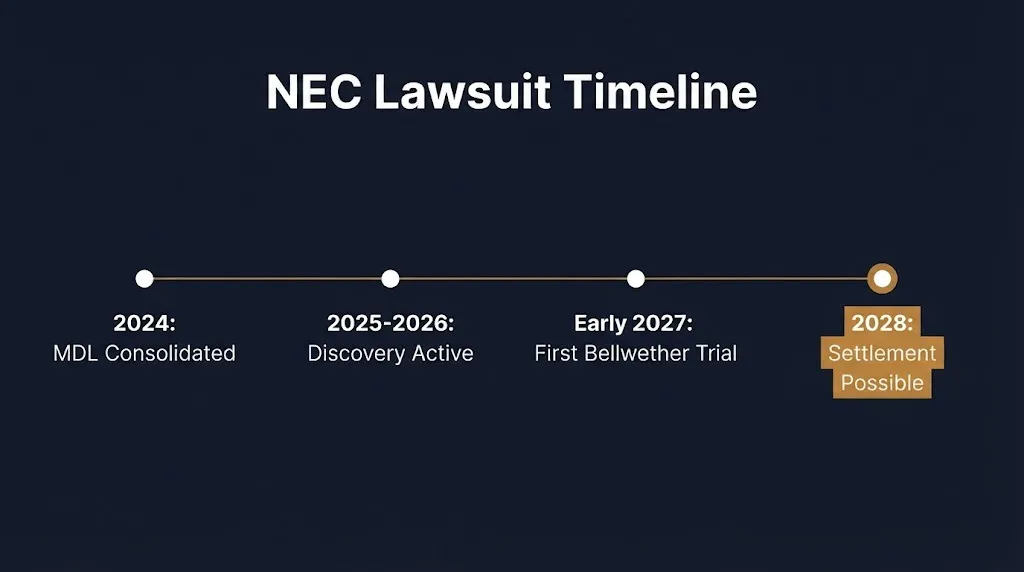
Even after a bellwether verdict, a global settlement could take six to eighteen months to negotiate and approve. If no global settlement occurs, individual cases continue through trial schedules, which can add years.
Here is a realistic timeline, assuming the bellwether outcomes favor plaintiffs.
| Milestone | Expected Timing |
|---|---|
| First bellwether trial | Early 2027 |
| Additional bellwether trials | 2027 |
| Global settlement negotiations | 2027 to 2028 |
| Court approval of any settlement | 2028 |
| Claims process opens | 2028 |
| Payments issued | 2028 to 2029 |
That timeline is not guaranteed. Litigation is unpredictable. But parents should not plan on any payment in 2026.
Key Takeaway: The earliest realistic payout window is 2028 or later, and that assumes bellwether verdicts favor plaintiffs and a global settlement follows.
Are NEC settlements taxable?
Any settlement or verdict amount may have tax consequences, depending on how the award is structured. Physical injury and wrongful death awards are generally not taxable under federal law. That includes compensation for medical expenses and pain and suffering.
But portions of an award labeled as punitive damages are taxable. Interest on a judgment is taxable. If part of a settlement covers lost wages, that portion may be taxable.
This is general information, not tax advice. Settlements involving minors often involve structured settlements that spread payments over years. The structure affects tax treatment. Parents should consult a tax professional or financial advisor before finalizing any resolution.
The point for now is that no payouts exist, so no tax liability exists. But the issue matters when the litigation eventually resolves.
What is the statute of limitations for an NEC lawsuit?
The statute of limitations varies by state. Most states allow two to three years from the date of injury for product liability claims. Wrongful death claims often have separate deadlines. But there are important exceptions.
For injured children, many states toll the statute of limitations until the child reaches the age of majority. That means a child injured as a premature infant may have until their late teens or early twenties to file a claim. Wrongful death claims for a child who died may have stricter deadlines.
Some states apply a discovery rule. The clock starts when the parent knew or should have known the formula contributed to the NEC. That could be years after the diagnosis, especially if no doctor mentioned the connection.
Do not guess about deadlines. State law is fact-specific. If you are considering a case, the only safe approach is to contact a qualified attorney now. Delay can create a statute of limitations defense that would otherwise not exist.
Key Takeaway: Statute of limitations deadlines vary by state and by the child’s age, and waiting to investigate can permanently bar a claim.
What should parents do now about the NEC litigation?
If you believe your child’s NEC diagnosis is linked to formula, take these steps.
- Request complete NICU medical records from the hospital where your child was born.
- Request records from any transfer hospital or pediatric surgical center.
- Write down your recollections: formula brands, dates, what doctors told you.
- Contact a law firm with NEC MDL experience for a free case evaluation.
- Do not sign any release from a formula company or hospital without legal review.
- Keep all correspondence, discharge papers, and insurance explanations of benefits.
The records are the case. Hospitals typically retain records for years, but not forever. Request them now.
This process is like a warranty claim. The manufacturer will ask for proof of purchase and proof of defect. Here, the medical records are the proof. The stronger the record trail, the stronger the claim.
What Happens Next
Late 2026: Expert discovery and pre-trial rulings continue.
Early 2027: The first bellwether trial is scheduled to begin.
2027: Additional bellwether trials may run throughout the year.
2027 to 2028: If bellwether outcomes favor plaintiffs, settlement negotiations intensify.
2028 to 2029: Any court-approved settlement would open a claims process and eventually issue payments.
These dates are estimates based on the current docket. They can change.
Frequently Asked Questions
Is there a class action for NEC baby formula?
No. The NEC litigation is a multidistrict litigation, not a class action. Each family’s case remains individual.
Do I need a lawyer for an NEC lawsuit?
Yes. These are complex product liability cases requiring medical experts. Reputable lawyers work on contingency.
What formula brands are involved in the NEC lawsuit?
The primary brands are Similac, made by Abbott, and Enfamil, made by Mead Johnson.
Can I file if my child died from NEC?
Yes, if the death is linked to formula exposure. Wrongful death claims are a significant part of the litigation.
Is there a deadline to join the NEC lawsuit?
There is no court-imposed deadline. But state statutes of limitations apply and vary. Contact a lawyer now.
Will the NEC lawsuit settle in 2026?
No settlement has been announced. The first bellwether trial is scheduled for early 2027.
What proof do I need for an NEC claim?
NICU medical records showing prematurity, formula administration, and an NEC diagnosis are essential.
Is the NEC lawsuit only for premature babies?
Yes. The litigation focuses on cow’s milk-based formula given to premature infants in NICUs.
The NEC litigation is real, active, and unresolved. No settlement exists in 2026. No payout is coming this year. The next major milestone is the first bellwether trial in early 2027. If your child was affected, the single most important action is to obtain the medical records now and seek a qualified evaluation. Time works against you in product liability cases. Records disappear. Witnesses retire. Deadlines pass. The families who act now are the ones positioned to recover if and when the litigation resolves.