Mesothelioma Class Action Lawsuit 2026: Why Most Cases Are Not Class Actions and What to File Instead
Quick Answer
- A mesothelioma class action is not the typical path; most cases are individual lawsuits, not class actions.
- No class-wide settlement fund or claim deadline exists for mesothelioma cases in 2026.
- Compensation depends on asbestos trust funds, individual lawsuits, or veterans benefits, not a class claim form.
The phrase mesothelioma class action lawsuit gets searched thousands of times a month. Most people using it believe there is a single lawsuit they can join, like a data breach or consumer settlement. That is not how mesothelioma litigation works. Mesothelioma cases are almost never certified as class actions. They are filed individually because each person’s exposure history, diagnosis, and damages are different.
There is no open class action settlement for mesothelioma in 2026. No claim form exists. No deadline is pending. If you saw an ad for a mesothelioma class action, it is likely misleading. The real money for victims comes from asbestos trust funds, individual lawsuits, and veterans benefit claims.
This article explains what actually exists in 2026: how asbestos trust funds work, how individual mesothelioma lawsuits are filed, what the average timeline looks like, and how to find the right path. One fact that surprises many families: there are over 60 active asbestos trust funds holding billions of dollars, and they have paid out tens of billions since the first trusts formed.
The Facts
| Case | No active mesothelioma class action; individual lawsuits and trust claims dominate |
| Status | Active individual litigation and trust claims, no class certification pending |
| Fund Size | No class fund; individual asbestos trust funds hold over $30 billion collectively |
| Est. Per Person | Varies widely; trust payouts can range from $7,000 to over $1 million depending on exposure and diagnosis |
| Claim Deadline | None globally; individual trust deadlines vary by trust |
| Administrator | Each trust has its own administrator; individual lawsuits handled by courts |
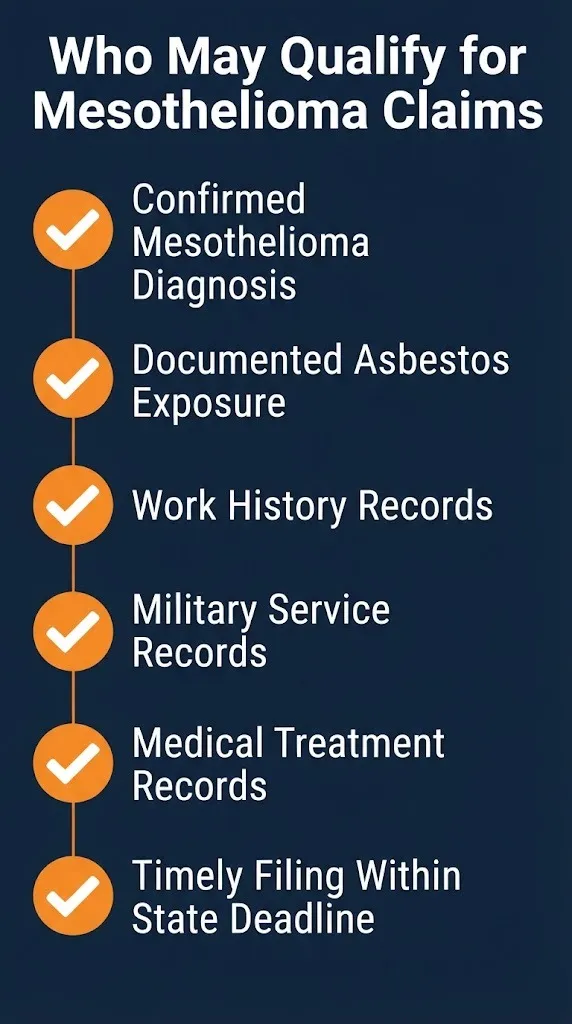
| Proof Needed | Medical records confirming mesothelioma, work history, exposure evidence |
Is there a mesothelioma class action lawsuit?
There is no active mesothelioma class action lawsuit accepting claims in 2026. Mesothelioma cases are not suited to class action treatment. Courts have repeatedly denied class certification in asbestos litigation because each plaintiff’s exposure history, medical condition, and damages are too different.
This is a critical fact. A class action works when thousands of people have nearly identical claims against one defendant. Mesothelioma is the opposite. One person may have worked with asbestos in a shipyard for 30 years. Another may have been exposed through a spouse’s work clothes. Their claims are not alike.

What exists instead: individual lawsuits filed in state and federal courts, claims against asbestos bankruptcy trusts, and claims through the Department of Veterans Affairs. None of these require a class action. None have a single claim form.
Some law firm advertising uses the phrase class action loosely. That is misleading. There is no court-certified mesothelioma class action in the United States right now.
Key Takeaway: Mesothelioma class actions are not the norm, and no court-certified class action currently exists, so ignore ads that suggest otherwise.
What is the difference between a class action and a mesothelioma lawsuit?
A class action bundles hundreds or thousands of similar claims into one case. One judge, one settlement fund, one claim form. Everyone gets a share, and individual differences rarely matter. That works for a data breach or a defective product with a uniform flaw.
A mesothelioma lawsuit is individual. Your name is on the complaint. Your exposure history is the evidence. Your medical records are the proof. The case is about your specific damages: medical bills, lost income, pain and suffering, and sometimes wrongful death.
Here is the practical difference.
| Feature | Class Action | Mesothelioma Lawsuit |
|---|---|---|
| One claim form for everyone | Yes | No |
| Individual medical review | No | Yes |
| Individual payout | Same or tiered for everyone | Based on your exposure and diagnosis |
| Time to resolve | Months to 2 years | 6 months to 2 years for trust claims; 1 to 3 years for lawsuits |
| Need for a lawyer | Optional | Highly recommended |
The comparison is like a store return without a receipt versus a warranty claim with full documentation. One is standardized. The other is fact-specific.
How much can you get from a mesothelioma claim in 2026?
There is no single answer. Mesothelioma compensation comes from multiple sources, and the amounts vary by source, exposure history, and the strength of the medical evidence. No lawyer can promise a specific number before reviewing your records.
Here is what published reports and trust records show for typical ranges.
| Source | Typical Range | Notes |
|---|---|---|
| Asbestos trust claims | $7,000 to $1 million or more | Depends on trust payment percentage and disease level |
| Individual lawsuit settlement | $1 million to $2.4 million average | Some cases resolve higher, some lower |
| Trial verdict | $2 million to $10 million or more | Juries award more, but trials are riskier |
| VA benefits | $3,000 to $3,800 monthly for 100% disability | Plus dependents and special monthly compensation |
These numbers are historical ranges, not guarantees. Each trust pays a percentage of the claim’s scheduled value. That percentage changes as the trust’s funds are depleted and replenished. Some trusts pay 50 percent of scheduled value. Others pay less than 10 percent.
The total value of a mesothelioma case depends on how many trusts you can claim against and whether you also have a lawsuit against a solvent company. Many victims file claims with 10, 20, or even 30 different trusts.
Reality Check: No legitimate lawyer will guarantee a settlement amount before reviewing your work history and medical records. Be skeptical of any ad promising a specific dollar figure.
What are asbestos trust funds?
Asbestos trust funds are pools of money set up by companies that filed for bankruptcy because of asbestos liability. When a company goes bankrupt, a court can require it to fund a trust to pay current and future asbestos victims. There are more than 60 active trusts in the United States.
These trusts are not government programs. They are private trusts with their own administrators, claim forms, and payment percentages. Each trust sets eligibility criteria based on exposure to that company’s products.
The trusts have paid out over $20 billion since the first major trusts formed in the late 1980s. The total remaining value across all trusts is estimated at more than $30 billion.
Filing a trust claim is different from filing a lawsuit. It is faster. Most trusts resolve claims in 6 to 18 months. There is no court hearing. You submit evidence of exposure and diagnosis. The trust reviews it and makes a payment offer.
The process is closer to an insurance claim than a trial. You provide documentation. The trust evaluates it. You receive a scheduled payment.
Key Takeaway: Asbestos trusts hold billions for victims and offer a faster, non-court path to compensation, but each trust has its own forms and deadlines.
How do I file a mesothelioma trust claim?
There is no single form. You file with each trust separately. The process is document-heavy but predictable. Here is the sequence.
- Obtain a confirmed mesothelioma diagnosis from a pathologist.
- Gather work history records: union cards, Social Security earnings, coworker affidavits.
- Identify which asbestos products and companies you were exposed to.
- Work with an attorney or claims service to match your exposure to the correct trusts.
- Complete each trust’s claim form with medical and exposure evidence.
- Submit the claim to each trust administrator.
- Wait for review and payment offer, typically 6 to 18 months.
- Accept or negotiate the payment.
The process is like filing multiple insurance claims. Each one requires separate paperwork. Each one has its own timeline. But the work is front-loaded. Once the evidence is assembled, it can be reused across many trusts.
Do I need a lawyer for a mesothelioma claim?
You are not legally required to have a lawyer. But the practical answer is yes. Mesothelioma claims involve complex medical evidence, decades-old work histories, and multiple legal jurisdictions. A lawyer with asbestos experience knows which trusts to file against and how to structure the evidence.
Most mesothelioma lawyers work on contingency. You pay nothing upfront. The lawyer receives a percentage, typically 25 to 40 percent, of any recovery. If there is no recovery, there is no fee.
Some people try to file trust claims without a lawyer. The forms are publicly available. But the payment percentage is the same whether you use a lawyer or not. The trust does not pay more because you filed alone. The risk is missing a trust or under-documenting exposure, which can cost more than the legal fee.
The comparison is like a tax return. You can do it yourself. But the cost of a missed deduction is often greater than the cost of professional help.
Key Takeaway: Contingency-fee lawyers handle mesothelioma claims with no upfront cost, and their knowledge of trust eligibility usually outweighs the fee.
What is the statute of limitations for mesothelioma lawsuits?
The statute of limitations varies by state. Most states allow 1 to 3 years from the date of diagnosis for personal injury claims. Wrongful death claims have separate deadlines, usually 1 to 3 years from the date of death.
Mesothelioma has a long latency period. The disease often appears 20 to 50 years after asbestos exposure. The law accounts for this. The clock starts at diagnosis, not at exposure. You cannot be barred from filing because your exposure happened decades ago.
But the clock starts at diagnosis, and it does not wait. If you delay filing after a diagnosis, the deadline can pass. Some states apply a discovery rule that extends the deadline if you reasonably did not know the disease was asbestos-related. Do not rely on that exception.
Here are common state deadlines for personal injury mesothelioma claims.
| State | Deadline from Diagnosis |
|---|---|
| New York | 3 years |
| California | 1 year |
| Texas | 2 years |
| Florida | 4 years |
| Pennsylvania | 2 years |
| Illinois | 2 years |
This is a sample, not a complete list. Your state’s law may differ. The only safe move is to contact a lawyer immediately after diagnosis.
How long does a mesothelioma lawsuit take in 2026?
Timelines vary. Trust claims resolve faster than lawsuits. A trust claim typically takes 6 to 18 months from submission to payment. A lawsuit takes longer.
Here is the typical lawsuit timeline.
| Stage | Timeframe |
|---|---|
| Case preparation and filing | 1 to 3 months |
| Discovery and depositions | 6 to 12 months |
| Settlement negotiations | 12 to 18 months |
| Trial, if no settlement | 2 to 3 years |
| Appeal, if any | 6 to 18 additional months |
Many mesothelioma lawsuits settle before trial. Defendants often prefer confidential settlements over jury verdicts. But some cases go to trial, especially when liability is disputed or the plaintiff’s exposure is less clear.
For victims with a terminal diagnosis, courts often expedite mesothelioma cases. Some states have special docket rules that move terminal illness cases to the front of the line. That can shorten the timeline to less than a year in some jurisdictions.
Who is most at risk for mesothelioma in 2026?
Mesothelioma is caused by asbestos exposure. The people most at risk today are those who worked with asbestos products before the 1980s, when regulations began limiting its use. The disease takes decades to appear, so cases diagnosed in 2026 usually stem from exposures in the 1960s, 1970s, and 1980s.
High-risk occupations include shipyard workers, insulation installers, pipefitters, boilermakers, electricians, construction workers, and automotive mechanics. Veterans, especially Navy veterans, have high rates because asbestos was used extensively on ships.
Secondary exposure is also documented. Wives who washed asbestos-laden work clothes have developed mesothelioma. Children exposed to dust brought home on a parent’s clothing have also been diagnosed.
Even today, asbestos is not fully banned in the United States. It remains in older buildings, and renovation or demolition work can still produce exposure if proper safety protocols are not followed. The 2026 risk is lower than the 1970s risk, but it is not zero.
Key Takeaway: The 2026 mesothelioma population is mostly older workers and veterans exposed decades ago, plus some secondary exposure cases from household contact.
Is there a class action for mesothelioma from talcum powder?
There is no certified class action for mesothelioma caused by talcum powder. The talc litigation against Johnson & Johnson and other companies has involved individual lawsuits, not class actions. Some of those cases settled individually or through multi-plaintiff resolutions, but no class settlement exists in 2026.
The talc litigation has its own history. Johnson & Johnson attempted to resolve talc claims through a bankruptcy maneuver. Courts rejected that approach. The litigation remains active through individual claims and some consolidated proceedings.
If you believe talcum powder caused your mesothelioma, you may have a case against the product manufacturer. That is an individual claim, not a class action. The evidence required includes proof of regular talc use, mesothelioma diagnosis, and medical causation evidence.
The talc cases are distinct from occupational asbestos cases. They involve different defendants and different exposure pathways. A lawyer with talc experience is essential.
What should a mesothelioma patient do first in 2026?
The first step is not legal. It is medical. Confirm the diagnosis and begin treatment. Nothing else matters before that. Once the diagnosis is established, take these steps.
- Get a pathology report confirming mesothelioma.
- Begin treatment with a mesothelioma specialist or major cancer center.
- Write down your complete work history, including employers, job sites, and years.
- List every product you remember using that may have contained asbestos.
- Gather union records, military records, or Social Security earnings statements.
- Contact a lawyer with asbestos experience for a free case evaluation.
- Do not sign any settlement offer or release from an employer or trust without legal review.
- Keep a symptom and treatment journal for medical and legal records.
The work history is the most valuable document you can create. Memory fades. Coworkers die. Records get lost. Write it down now.
What Happens Next
Within weeks of diagnosis: Meet with a specialist and document work history.
Within 1 to 3 months: Your lawyer gathers medical and exposure evidence.
Within 6 to 18 months: Trust claims are submitted and begin producing payments.
Within 1 to 2 years: Individual lawsuits may settle.
If no settlement: Trial dates are set, often expedited for terminal cases.
These timelines are estimates. Trust claims move faster. Lawsuits move slower. Starting early is the only variable you control.
Frequently Asked Questions
Is there a mesothelioma class action settlement in 2026?
No. There is no certified class action or class-wide settlement for mesothelioma in 2026.
Can I join a mesothelioma lawsuit without a lawyer?
You can file trust claims without a lawyer. But lawsuits require legal expertise, and contingency lawyers cost nothing upfront.
How much does it cost to file a mesothelioma claim?
Filing a trust claim costs nothing upfront. Lawyers work on contingency. There are no filing fees for most trust claims.
What is the average mesothelioma settlement?
Reported averages range from $1 million to $2.4 million for individual lawsuit settlements, but each case depends on exposure evidence and medical severity.
Can family members file for a deceased mesothelioma victim?
Yes. Wrongful death claims are available to spouses, children, and sometimes other dependents. Deadlines apply.
Are mesothelioma settlements taxable?
Personal injury settlements for physical injury are generally not taxable. But portions allocated to lost wages or punitive damages may be. Consult a tax advisor.
How many asbestos trusts are there in 2026?
There are more than 60 active asbestos bankruptcy trusts with over $30 billion in remaining assets.
Does the VA pay for mesothelioma?
Yes. Veterans with service-connected mesothelioma may qualify for disability benefits and VA healthcare. Monthly compensation can exceed $3,800 depending on dependents.
Mesothelioma is not a class action problem. It is an individual compensation puzzle with multiple pieces: trust claims, lawsuits, and veterans benefits. There is no single form. No single deadline. No single payout. The people who recover the most are the ones who document their work history early, file with every eligible trust, and let an experienced lawyer handle the rest. The clock starts at diagnosis. It never stops. If you or a family member has a confirmed diagnosis, the only wrong move in 2026 is waiting.