Arizona Workers Compensation 2026: Benefit Rates, Filing Deadlines, and What the Law Actually Covers
Quick Answer
- Arizona workers compensation is real and mandatory for nearly all employers with one or more employees.
- The 2026 maximum monthly benefit is $6,383.64, set by the Industrial Commission of Arizona.
- You must report a work injury within one year to preserve your right to benefits.
Workers compensation in Arizona is a state-mandated insurance system. It pays medical bills and a portion of lost wages when you get hurt or sick because of your job. The Industrial Commission of Arizona oversees the system. It sets benefit rates, resolves disputes, and enforces employer compliance.
The system covers nearly every worker in the state. If your employer has one or more employees, full-time or part-time, they must carry workers compensation insurance. There are narrow exceptions. Independent contractors, domestic workers in private homes, and some agricultural workers may fall outside the mandate.
This article covers the 2026 benefit rates, how to file a claim, what the law requires, and how long the process takes. One fact that surprises many workers: Arizona does not have a waiting period before wage benefits begin. Some states make you wait a week. Arizona pays from day one in most cases.
The Facts
| Case | Arizona workers compensation system, not a lawsuit |
| Status | Active statutory program administered by the Industrial Commission of Arizona |
| Fund Size | Not a fixed fund; benefits paid by employer insurance carriers |
| Est. Per Person | Varies by wage and disability level; 2026 max is $6,383.64 per month |
| Claim Deadline | 1 year to report injury to the Industrial Commission |
| Administrator | Industrial Commission of Arizona |
| Proof Needed | Medical records, accident report, wage documentation |
Is Arizona workers compensation insurance real or a scam?
Arizona workers compensation insurance is real and legally required. It is not a scam. It is not optional. The law says every employer with one or more employees must carry coverage. That includes part-time workers, seasonal workers, and most independent contractor arrangements that look like employment.
The Industrial Commission of Arizona is the state agency that runs the system. It is a real government body. It holds hearings, issues decisions, and investigates employers who fail to carry insurance. The commission has offices in Phoenix, Tucson, and other cities across the state.

The scam risk comes from third parties. Some companies offer to help workers file claims for a fee. That is unnecessary. Filing is free. The forms are public. You can file directly with the Industrial Commission or through your employer’s insurance carrier.
If an employer tells you they do not have workers compensation insurance, they are breaking the law. If they tell you not to file a claim, that is also illegal. Arizona law prohibits employers from discouraging workers from reporting injuries.
Key Takeaway: Arizona workers compensation is a mandatory state system, not a scam, and no worker should pay a third party to file a claim.
How much does Arizona workers compensation pay in 2026?
The maximum monthly benefit in Arizona for 2026 is $6,383.64. That amount is set by the Industrial Commission of Arizona and adjusted annually. The actual amount you receive depends on your average monthly wage before the injury.
Arizona uses a formula based on two-thirds of your average monthly wage, subject to the maximum. Here is how the math works for common wage levels.
| Average Monthly Wage | Two-Thirds Rate | What You Actually Get |
|---|---|---|
| $3,000 | $2,000.00 | $2,000.00 |
| $5,000 | $3,333.33 | $3,333.33 |
| $7,500 | $5,000.00 | $5,000.00 |
| $9,575.46 | $6,383.64 | $6,383.64 (cap) |
| $12,000 | $8,000.00 | $6,383.64 (capped) |
There is also a minimum benefit. For 2026, the minimum monthly benefit is $2,127.88, which is one-third of the maximum. If your calculated benefit falls below that, you get the minimum.
Wage replacement is not the only benefit. Arizona workers compensation also pays for all necessary medical care related to your injury. That includes doctor visits, surgery, physical therapy, prescriptions, and medical equipment. There is no copay and no deductible for approved care.
If your injury leaves you with a permanent impairment, you may receive a separate award. Arizona uses a scheduled impairment system based on the body part injured and the degree of permanent disability.
Reality Check: No one can guarantee a specific workers compensation settlement amount in Arizona. The formula is set by law, but your wage records and medical evidence control the final number. Be wary of anyone who promises a large payout before reviewing your file.
What is the Arizona workers compensation law?
The Arizona workers compensation law is found in Title 23 of the Arizona Revised Statutes. It has been on the books for decades. The law created a no-fault system. That means you do not have to prove your employer was negligent to collect benefits. You only have to prove the injury arose out of and in the course of employment.
The law is administered by the Industrial Commission of Arizona. The commission sets benefit rates, hears disputes, and enforces compliance. It also regulates workers compensation insurance carriers operating in the state.
The law requires employers to post notices explaining workers compensation rights. If your employer has not posted that notice, they are violating the law. The notice tells you how to report an injury and how to contact the Industrial Commission.
The law also protects you from retaliation. Employers cannot fire or punish you for filing a claim. If they do, you may have a separate legal claim for wrongful termination or retaliation.
The statute of limitations under Arizona law is one year. You have one year from the date of injury to file a claim with the Industrial Commission. If you miss that deadline, you may lose your right to benefits entirely.
Key Takeaway: Arizona law creates a no-fault workers compensation system, and the one-year filing deadline is the most important legal rule to remember.
How do I file a workers compensation claim in Arizona?
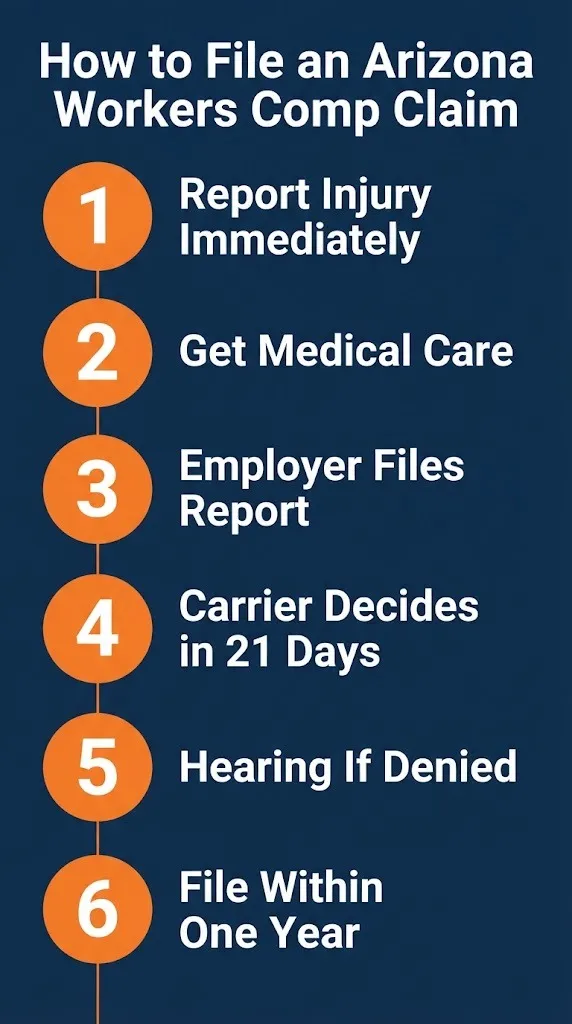
The process starts with reporting the injury to your employer. Arizona law requires you to report the injury immediately or as soon as reasonably possible. The formal claim must be filed with the Industrial Commission within one year.
Here is the sequence.
- Report the injury to your supervisor or HR department as soon as possible.
- Seek medical treatment. Tell the provider the injury is work-related.
- Your employer files a report with their insurance carrier and the Industrial Commission.
- The insurance carrier accepts or denies the claim within 21 days.
- If accepted, you begin receiving medical and wage benefits.
- If denied, you can request a hearing before an administrative law judge.
- The judge issues a decision after reviewing medical and employment evidence.
The filing process is like a warranty claim. The earlier you document everything, the smoother it goes. Delays create gaps in the record that insurers use to question whether the injury happened at work.
You do not file the initial claim form yourself in most cases. Your employer files the report. But you should confirm it was filed. If your employer refuses, you can file directly with the Industrial Commission.
What is the deadline for filing a workers compensation claim in Arizona?
The deadline is one year from the date of injury. That is the statute of limitations under Arizona law. It applies to all workers compensation claims, including occupational disease claims.
The clock starts on the date of the accident. For repetitive stress injuries or occupational diseases, the clock may start when you first knew the condition was work-related. But do not rely on that exception. The safest approach is to file as soon as you know something is wrong.
The one-year deadline is strict. If you file after one year, the Industrial Commission may dismiss the claim. There are narrow exceptions for cases where the employer failed to file a required report or where the injured worker was a minor.
Do not confuse the one-year deadline with the employer’s reporting requirement. Your employer must report the injury to their insurance carrier immediately. But your own claim with the Industrial Commission is the one that protects your rights.
The same deadline applies statewide. There are no city-specific rules. Phoenix, Tucson, Mesa, and every other Arizona city follow the same state law.
Key Takeaway: The one-year filing deadline starts on the date of injury, and missing it can permanently bar your claim.
How long does a workers compensation claim take in Arizona?
A straightforward accepted claim can begin paying benefits within a few weeks. Arizona law requires the insurance carrier to accept or deny the claim within 21 days of receiving notice. That is one of the faster statutory timelines in the country.
If the carrier denies the claim, the timeline stretches. A denied claim goes to a hearing before an administrative law judge at the Industrial Commission. The first hearing is typically scheduled within 30 to 60 days.
From injury to first hearing, expect 2 to 3 months if the claim is disputed. From hearing to decision, expect another 1 to 3 months. Appeals add 6 to 12 months.
Here is a typical timeline for a disputed Arizona workers compensation claim.
| Stage | Typical Timeframe |
|---|---|
| Injury and notice to employer | Day 0 |
| Carrier decision to accept or deny | 21 days |
| Request for hearing if denied | Within 30 days of denial |
| First hearing | 30 to 60 days |
| Judge’s decision | 2 to 4 months |
| Appeal to commission | 6 to 12 months |
The timeline is comparable to a delayed tax refund. You know the money is owed, but the process has fixed steps that cannot be skipped.
What if my workers compensation claim is denied in Arizona?
A denial is not the end of the case. It is the beginning of the dispute process. Arizona law gives you the right to request a hearing before an administrative law judge at the Industrial Commission.
Common reasons for denial include the employer’s claim that the injury did not happen at work, the carrier’s medical expert saying the condition is not work-related, or a dispute over whether you were an employee or an independent contractor.
If you receive a denial, you must act quickly. You have 90 days from the date of the denial to request a hearing. Missing that deadline can make the denial final.
At the hearing, the judge reviews medical records, witness statements, and the accident report. The judge can order the carrier to pay benefits retroactively to the date of the injury.
You do not need a lawyer to request a hearing. But a lawyer can help. Workers compensation attorneys in Arizona typically work on contingency. They get paid a percentage of your award, not upfront fees.
You have the right to appeal an unfavorable judge decision to the Industrial Commission. The appeal must be filed within 30 days of the judge’s written decision.
Key Takeaway: A denial starts a hearing process where a judge reviews the medical evidence, and the 90-day deadline to request a hearing is critical.
What is the difference between workers compensation and a lawsuit in Arizona?
Workers compensation is not a lawsuit. It is an administrative claims system. You do not sue your employer. You file a claim, and the Industrial Commission decides whether you get benefits.
A lawsuit is different. In a personal injury lawsuit, you sue a person or company for negligence. You have to prove fault. In workers compensation, fault does not matter. Even if you made a mistake that caused your injury, you can still collect benefits.
That is the trade-off. Workers give up the right to sue their employer for most work injuries. Employers give up the right to argue fault. The system is designed to be faster and less adversarial than court.
There is one exception. If a third party, not your employer or a co-worker, caused your injury, you can file a separate personal injury lawsuit against that third party while also collecting workers compensation. Common examples include a car accident while driving for work caused by another driver, or an injury on a construction site caused by a subcontractor’s negligence.
In Arizona, third-party claims are common in construction and trucking accidents. The workers compensation claim pays medical bills and wage replacement. The third-party lawsuit can pay pain and suffering, which workers compensation does not cover.
How much is a workers compensation settlement in Arizona?
Settlement amounts vary widely. There is no fixed average. A claim involving a minor injury with full recovery might settle for a few thousand dollars. A claim involving permanent disability can settle for hundreds of thousands of dollars.
Arizona allows two types of settlements. A full and final settlement closes the case entirely. It includes a lump sum for future wage loss and future medical care. Once approved, the case is closed. You cannot reopen it later.
The other type is a partial settlement. This resolves the wage replacement portion but leaves medical benefits open. You continue receiving medical care for the injury, but your weekly or monthly payments stop or are reduced.
Here are the factors that drive settlement value.
| Factor | Impact on Settlement |
|---|---|
| Severity of permanent impairment | Higher impairment means higher value |
| Average monthly wage | Higher wage means higher value |
| Age at time of injury | Younger workers often get more |
| Need for future surgery | Future medical costs increase value |
| Strength of medical evidence | Stronger evidence supports a higher settlement |
| Carrier’s risk tolerance | Some carriers settle faster than others |
No lawyer, judge, or website can tell you what your specific case is worth without reviewing your medical records and wage documents.
Key Takeaway: Arizona settlements are based on impairment, wages, and future medical needs, and a full and final settlement closes the case permanently.
Can I choose my own doctor for workers compensation in Arizona?
Arizona law gives you the right to choose your own treating physician, but with limits. The insurance carrier may have a preferred provider network. You are generally required to use a provider within that network for the initial treatment.
If you disagree with the carrier’s choice, you can request a change. The Industrial Commission can approve a different doctor if you show good cause. The process starts with a written request to the carrier or the commission.
The doctor must file reports with the Industrial Commission and the insurance carrier. The doctor’s opinions carry significant weight in determining your disability level and your return-to-work status.
If you are unhappy with your doctor, do not simply stop going. That can hurt your claim. Instead, request a change through the proper process. The commission takes requests for change of physician seriously.
Do undocumented workers qualify for workers compensation in Arizona?
Arizona law does not expressly bar undocumented workers from receiving workers compensation benefits. The Arizona workers compensation system applies to employees regardless of immigration status. The Industrial Commission has recognized that undocumented workers can file claims.
Employers are required to carry coverage for all employees, including undocumented workers. The commission does not require proof of immigration status to file a claim.
Undocumented workers face unique pressures. Some employers threaten to call immigration authorities if the worker files a claim. That is unlawful. It is also a violation of the employer’s duty under Arizona law.
If your employer lacks coverage entirely, you may still have a path to benefits through the Special Fund administered by the Industrial Commission. You can also file a lawsuit against the employer directly, which is not normally allowed against a covered employer.
Key Takeaway: Immigration status does not bar a workers compensation claim in Arizona, and the commission does not inquire about status.
What is the role of the Industrial Commission of Arizona?
The Industrial Commission of Arizona is the state agency that runs the workers compensation system. It is not a court. But it has the power to hold hearings, issue decisions, and order payments.
The commission’s administrative law judges hear disputes between injured workers and insurance carriers. The judges review medical evidence, wage records, and witness testimony. They issue written decisions that are binding unless appealed.
The commission also regulates insurance carriers. It ensures carriers comply with claim-handling rules and pay benefits on time. If a carrier violates the rules, the commission can impose penalties.
The commission maintains a public portal where you can check the status of your claim. You can also file forms electronically. The portal is free to use.
Hearings are held in Phoenix, Tucson, and other locations. Many hearings are now held by video conference, which makes it easier for injured workers to participate without traveling.
What Should Injured Workers in Arizona Do Right Now?
The most important actions happen in the first 48 hours after an injury. Do these steps in order.
- Report the injury in writing to your supervisor or HR department.
- Get medical treatment and tell the provider it is work-related.
- Take photos of the injury site and any visible injuries.
- Write down the names and contact information of any witnesses.
- Confirm your employer has filed the injury report with the Industrial Commission.
- Keep a copy of every document you submit or receive.
- Do not sign anything from the insurance carrier before reading it fully.
Documentation is everything. The more you write down now, the harder it is for the carrier to dispute the facts later. Memories fade. Witnesses move. Photos get deleted. Capture it all while it is fresh.
What Happens Next
Immediately: You report the injury and seek medical care.
Within 21 days: The carrier must accept or deny the claim.
Within 90 days of denial: You must request a hearing to challenge a denial.
Within 1 year: You must file your claim with the Industrial Commission to preserve your rights.
After treatment: You may negotiate a settlement or accept a scheduled impairment award.
The system works best for workers who file early, keep records, and respond to commission notices on time.
Frequently Asked Questions
Is workers compensation mandatory in Arizona?
Yes. Every employer with one or more employees must carry workers compensation insurance, with narrow exceptions for domestic workers and some agricultural workers.
Does workers compensation cover commuting to work in Arizona?
Usually not. Injuries during a normal commute are not covered. But travel between job sites during work hours is covered.
Can I be fired for filing a workers compensation claim in Arizona?
No. Retaliation for filing a claim is illegal under Arizona law. You may have a separate legal claim if you are terminated for filing.
How long do I have to report a work injury in Arizona?
You must report the injury to your employer immediately, and you must file a formal claim with the Industrial Commission within one year.
Does workers compensation pay full salary in Arizona?
No. It pays two-thirds of your average monthly wage, up to the 2026 maximum of $6,383.64 per month.
Can I sue my employer for a work injury in Arizona?
Usually not. Workers compensation is your exclusive remedy against your employer. Third-party claims against other responsible parties may be possible.
Is there a waiting period for Arizona workers compensation?
No. Arizona does not impose a waiting period before wage benefits begin. Benefits start from the date of disability in most cases.
What is the maximum workers compensation rate in Arizona for 2026?
The maximum monthly benefit is $6,383.64. The minimum is $2,127.88.
Workers compensation in Arizona is a system that rewards early reporting and good documentation. The 2026 benefit rates are set. The process is clear. The two numbers to remember are 21 days for the carrier decision and one year to file your claim. File early. Keep records. Use the Industrial Commission’s free tools. Those steps are within your control.