Chobani Lawsuit 2026: What’s Actually Happening in Court Right Now
Quick Answer
- The Chobani lawsuit isn’t one case. It’s several active lawsuits over yogurt labeling, and none has reached a settlement.
- No settlement fund or per-person payout is confirmed. Sites listing figures like $15 million or $25 to $500 per claim aren’t backed by court records.
- There’s no claim deadline right now, because no Chobani consumer case has reached the settlement stage as of mid-2026.
If you searched “Chobani lawsuit” because of a headline or a social post, here’s the direct answer. Chobani is currently defending a phthalates case that a judge just allowed to continue on April 6, 2026, after Chobani tried to get it thrown out.
That case, plus a newer 2026 protein labeling lawsuit and an older “natural ingredients” case, make up what people mean when they say “the Chobani lawsuit.” No unified class action settlement exists for any of them yet.
This article walks through each case with its real docket number, its real judge, and its real status. It also flags where other sites are reporting numbers that don’t trace back to any court filing or settlement notice.
The Facts
| Category | Detail |
|---|---|
| Case | Multiple active suits: Wysocki v. Chobani, LLC and Albrigo v. Chobani, LLC, plus a new 2026 protein claim |
| Status | Active litigation, no settlement reached in any consumer case |
| Fund Size | Not yet confirmed |
| Est. Per Person | Not yet determined |
| Claim Deadline | Not applicable, no settlement exists yet |
| Administrator | Not yet appointed |
| Proof Needed | Not applicable yet, save receipts in case a class opens later |
Is the Chobani Lawsuit Real?
Yes, the Chobani lawsuit is real, and it’s actually several real lawsuits filed in different federal courts. This isn’t a rumor or a scam text setup. Real plaintiffs filed real complaints, and real judges are ruling on them right now.
The most active case is Wysocki v. Chobani, LLC, Case No. 3:25-cv-00907-JES-VET, filed in the U.S. District Court for the Southern District of California. Plaintiff Amy Wysocki filed it on April 16, 2025, over phthalates allegedly found in Chobani’s plain Greek yogurt.
A second case, Albrigo v. Chobani, LLC, No. 3:24-cv-01418, targets Chobani’s “Zero Sugar” line over stevia and monk fruit extract labeling. A third, unrelated case was dismissed outright in 2025. A newer protein labeling case emerged in 2026.
None of these confirms scam claims circulating online about a “Chobani settlement” you can sign up for today. Key Takeaway: The Chobani lawsuit is genuine litigation, but it’s a collection of separate cases, not one master settlement.
Is There a Chobani Class Action Settlement Right Now?
No, there is no Chobani class action settlement right now, in any of the active cases. Every lawsuit involving Chobani’s yogurt labeling remains in the litigation phase as of July 2026.
That distinction matters. A lawsuit being “active” means it’s still working through motions, evidence, and possibly a trial. A settlement means the parties agreed to terms and a court approved them.
Several sites publish detailed settlement figures for a “Chobani lawsuit 2026,” including a specific total fund amount and a May 2026 claim deadline. None of those figures trace back to an official settlement website, a court docket, or an administrator notice.
Reality Check: No legitimate settlement administrator asks you to file a claim before a case is even certified as a class action. If a site or a text message offers you a Chobani payout right now, verify it against the actual court docket before submitting any personal information.
How Much Money Could I Get From the Chobani Lawsuit?
You can’t get a specific dollar amount right now, because no Chobani consumer case has reached a settlement. Any number you see quoted for “per person compensation” is not yet confirmed by court records.
Class action food-labeling settlements, when they do happen, typically follow a pattern:
| Stage | What Happens |
|---|---|
| Class certification | Court decides if the case can proceed as a group claim |
| Settlement negotiation | Parties negotiate a fund amount, if they choose to settle |
| Court approval | Judge reviews the deal for fairness at a final approval hearing |
| Claims period | Class members submit claim forms by a set deadline |
| Distribution | Checks go out after the claims deadline closes |
Chobani hasn’t reached the negotiation or approval stage in any active consumer case. Until a case clears class certification and a fund is announced, per-person payout is genuinely not yet determined.
Chobani Lawsuit Settlement Amount: What’s Confirmed vs. What’s Not
The confirmed fact is simple: no settlement amount exists for any current Chobani consumer lawsuit. Everything past that sentence is speculation dressed up as reporting.
Some competing articles cite a “$15 million” proposed settlement fund and a claim deadline of May 20, 2026. Searching court records, the official California Southern District docket, and legal news outlets turns up no matching filing for that figure.
Similar food-labeling class actions against other national brands have settled for a wide range, from a few million dollars to tens of millions, depending on class size. That’s useful context for expectations, not a Chobani-specific number.
Key Takeaway: Until an actual settlement notice appears on an official site, treat any specific dollar figure tied to “the Chobani lawsuit” as unverified.
How Do I Join the Chobani Lawsuit?
You don’t need to actively join right now, because none of the active Chobani cases has reached class certification. Most consumer class actions work by automatic inclusion once a class is certified.
If you bought a Chobani product covered by one of these cases, you’re generally considered part of the potential class automatically. You typically don’t need to file anything until a settlement or certification triggers a formal notice period.
Here’s what to do in the meantime:
- Save receipts, bank statements, or loyalty program records showing Chobani purchases.
- Note which specific products you bought (plain Greek yogurt, Zero Sugar, 20G Protein line).
- Avoid paying any third party claiming to “register” you for a fee.
- Check the official court docket periodically for status changes.
- Watch for an official notice by mail or email if a settlement gets approved.
- Do not respond to unsolicited texts claiming to process a Chobani payout.
How to File a Chobani Class Action Claim (Once One Opens)
You can’t file a claim yet, because no Chobani case has an open claims process as of mid-2026. This section explains the process for when, if ever, that changes.
If a settlement gets preliminary court approval in any of these cases, the process typically follows this pattern:
- The court approves a settlement and a claims administrator gets appointed.
- Class members get notified by mail, email, or published notice.
- A claim form goes live on an official settlement website.
- You submit the form along with any required proof of purchase.
- The administrator reviews claims after the deadline closes.
- Approved claimants receive payment after the final approval hearing.
Right now, no step of that process has begun for any Chobani consumer case. Bookmark the official court docket for whichever case applies to your purchases, rather than a third-party claims site.
Chobani Lawsuit 2026 Update: Latest Court Ruling
The biggest 2026 development is a ruling on April 6, 2026, letting the phthalates case against Chobani continue. U.S. District Judge James E. Simmons Jr. rejected most of Chobani’s attempt to dismiss the case.
Simmons ruled that plaintiff Amy Wysocki can continue her false advertising claims over phthalates allegedly found in Chobani’s plain Greek yogurt. He found her allegations detailed enough to survive Chobani’s argument that she lacked standing to sue.
The judge did side with Chobani on one narrower point, an omission-based claim, but let the core false advertising theory proceed. That means the case now heads toward discovery, not dismissal.
This directly contradicts older coverage claiming the case was headed for automatic dismissal after an August 2025 hearing. Key Takeaway: As of April 2026, the phthalates lawsuit against Chobani is moving forward, not winding down.
Chobani Yogurt Lawsuit: Phthalates Case Status
The Chobani yogurt lawsuit most people mean is Wysocki v. Chobani, LLC, over phthalate chemicals in “all natural” yogurt. It’s currently active and proceeding toward discovery in California federal court.
Wysocki bought Chobani’s nonfat plain Greek yogurt in San Marcos, California, in 2023. She claims she relied on the “Only Natural Ingredients” label and wouldn’t have bought it, or paid the same price, if she’d known about the phthalates.
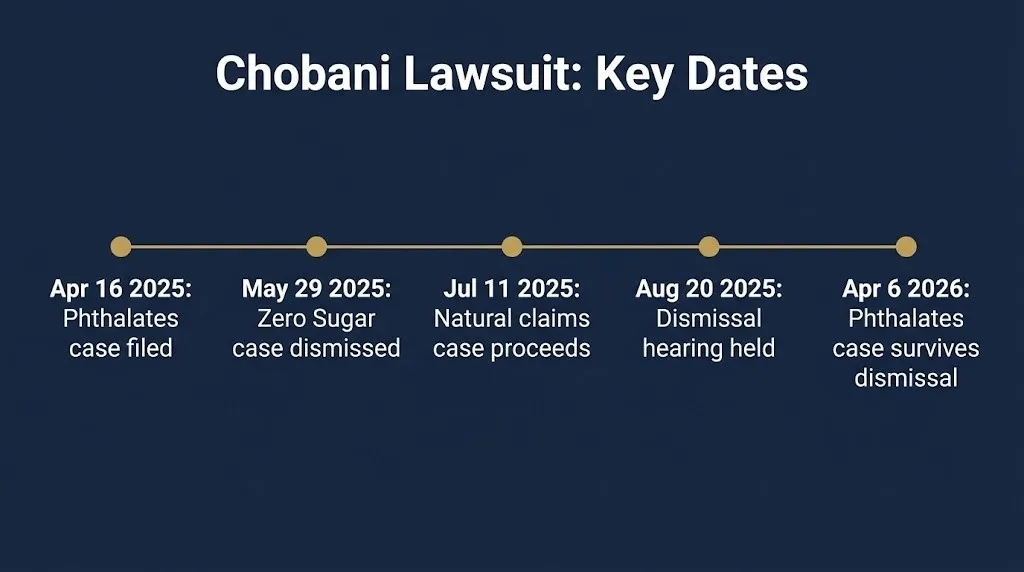
Here’s the case timeline as confirmed by the court docket:
- April 16, 2025: Wysocki files the complaint in the Southern District of California.
- June 2025: Chobani files a motion to dismiss.
- August 20, 2025: Judge Simmons holds a hearing and takes the motion under submission.
- April 6, 2026: Judge Simmons issues a written opinion, letting most claims proceed.
The case has not been certified as a class action, and no settlement exists. It’s now positioned for further litigation, potentially discovery and certification motions next.
Chobani Class Action Lawsuit: Zero Sugar and Natural Ingredients Cases
Two other Chobani class action cases exist beyond the phthalates case, and they’ve had very different outcomes. One was dismissed completely, and one survived.
Chobani’s “Zero Sugar” allulose case was dismissed with prejudice on May 29, 2025, in the U.S. District Court for the Northern District of Illinois. Judge John J. Tharp Jr. ruled that FDA guidance on allulose labeling preempts the state law claims, meaning the case cannot be refiled.
Separately, Albrigo v. Chobani, LLC, Case No. 3:24-cv-01418, challenges “natural” claims tied to stevia and monk fruit extract processing in Chobani’s yogurt line. Judge Benjamin J. Cheeks denied Chobani’s motion to dismiss that case on July 11, 2025, letting it proceed.
| Case | Product | Status |
|---|---|---|
| Wysocki v. Chobani | Plain Greek yogurt (phthalates) | Active, survived motion to dismiss April 2026 |
| Albrigo v. Chobani | Zero Sugar (stevia, monk fruit “natural” claims) | Active, survived motion to dismiss July 2025 |
| Allulose “Zero Sugar” case | Zero Sugar labeling | Dismissed with prejudice, cannot be refiled |
Chobani Cancer Lawsuit: What’s Actually Alleged
There is no confirmed “Chobani cancer lawsuit” alleging consumers developed cancer from its yogurt. The phthalates case discusses cancer risk only in the context of general chemical exposure research, not individual diagnoses tied to Chobani products.
Phthalates are a category of chemicals used to soften plastics, and some studies link long-term, high-dose exposure to hormone disruption and increased health risks broadly. The complaint against Chobani cites third-party testing, not a medical finding that any specific consumer got sick from the yogurt.
No regulatory agency, including the FDA, has confirmed unsafe phthalate levels in Chobani products. The FDA currently permits multiple phthalates in food-contact packaging materials at approved levels.
Some sites use “cancer lawsuit” language to attract search traffic even though the underlying case is a labeling dispute, not a personal injury claim over diagnosed illness. Key Takeaway: The phthalates case is about “only natural ingredients” marketing accuracy, not a proven health emergency.
Chobani Protein Lawsuit 2026: The Newest Case
A new 2026 lawsuit accuses Chobani of overstating protein content in its “20G Protein” yogurt line. Plaintiff Hale Knox filed the class action in a New York federal court.
Knox alleges that Chobani’s marketed “20 grams of protein per serving” doesn’t hold up when measured under FDA calculation guidelines. The complaint claims this misleads health-conscious shoppers willing to pay a premium for high-protein yogurt.
Knox’s complaint seeks damages under New York General Business Law, plus claims of unjust enrichment. It’s a newly filed case, so it hasn’t reached a ruling on class certification or a motion to dismiss yet.
This case is separate from the phthalates and stevia lawsuits. It targets a different product line and a different legal theory entirely, focused on nutritional label accuracy rather than “natural” ingredient claims.
Danone vs. Chobani Lawsuit: Is That Connected?
The Danone lawsuit against Chobani is a separate business dispute, not a consumer class action, though it involves the same 20G Protein products. Danone filed the complaint in a New York district court around late June 2026.
Danone alleges Chobani’s 20G Protein pots are marketed as comparable to Danone’s Oikos Pro line despite being less protein-dense per ounce. Danone claims Chobani uses a larger container size to reach the 20-gram threshold, which misleads shoppers comparing brands.
This case is competitor-versus-competitor litigation over trade practices, not a case consumers can join or file a claim in. It doesn’t offer compensation to yogurt buyers.
It’s worth knowing about because it touches the same “20G Protein” product line as the Hale Knox consumer lawsuit, adding legal pressure on Chobani from two directions at once.
What Is the Chobani Lawsuit About?
At the core, every active Chobani lawsuit is about whether the company’s package labeling matches what’s actually in the product. That’s the common thread across the phthalates, stevia, and protein cases.
Chobani has built its brand around “natural,” “clean label,” and high-protein positioning, which commands a price premium in the yogurt aisle. Each lawsuit argues that positioning oversold what’s actually inside specific product lines.
The company disputes all of it. Chobani maintains its labeling complies with FDA rules and that its “Only Natural Ingredients” claims are accurate, since it doesn’t add phthalates directly to its products.
Think of it like a store’s “handmade” sign on food that was actually machine-assembled somewhere in the process. The dispute isn’t always about a lie, it’s about how much marketing shorthand a reasonable shopper should trust at face value.
Who Is Amy Wysocki and Why Did She Sue Chobani?
Amy Wysocki is the named plaintiff in the phthalates lawsuit, and she sued after learning about independent lab testing on Chobani’s yogurt. She’s the consumer whose 2023 purchase anchors the entire case.
Wysocki bought Chobani’s nonfat plain Greek yogurt at a retailer in San Marcos, California, relying on the “Only Natural Ingredients” label. She learned about the phthalate testing results through PlasticList, an independent research group that published its findings in December 2024.
Her complaint argues she wouldn’t have purchased the product, or would have paid less for it, had she known about the testing results. That’s the legal foundation for her false advertising and consumer protection claims under California law.
She’s suing on behalf of herself and a proposed California subclass of similarly situated buyers, not the entire country, since her claims are built on California consumer protection statutes.
What Products Are Named in the Chobani Lawsuits?
Different Chobani lawsuits target different specific products, so eligibility depends heavily on exactly what you bought. There’s no single product list covering every active case.
Here’s the current breakdown:
- Phthalates case: Chobani Nonfat Plain Greek Yogurt and Chobani Whole Milk Plain Greek Yogurt
- Stevia/monk fruit case: Chobani Zero Sugar yogurt products
- Allulose case (dismissed): Chobani Zero Sugar yogurt, allulose-based
- Protein case: Chobani’s “20G Protein” yogurt line
If you bought a Chobani product not listed here, it likely isn’t currently covered by any active lawsuit. Products can get added to complaints later through amendments, so this list may shift as cases develop.
What Has Chobani Said About the Allegations?
Chobani has denied wrongdoing in every active lawsuit and maintains its labeling complies with federal regulations. The company hasn’t admitted liability in any pending case.
On the phthalates allegations, Chobani has stated its products “include only natural ingredients” and argues it doesn’t directly add phthalates during manufacturing. The company contends any trace presence would come from packaging, not the recipe itself.
On the protein claims, Chobani has not issued a detailed public rebuttal to the Hale Knox complaint as of this writing, since the case was only recently filed. The company similarly hasn’t commented extensively on Danone’s separate protein-marketing suit.
Chobani did win outright on the allulose “Zero Sugar” claims, with the court agreeing FDA guidance shields that specific labeling choice. That win shows the company isn’t losing every fight, even as other cases continue.
What Happens Next
April 6, 2026 (confirmed): Judge Simmons allows the phthalates case to proceed past the motion to dismiss stage.
Expected mid-to-late 2026: Discovery phase likely begins in the surviving phthalates and stevia cases, where both sides exchange internal records and testing data.
Expected 2026-2027: Class certification motions are likely in both surviving cases, a required step before any settlement talk becomes realistic.
TBD: The new 2026 protein lawsuit (Hale Knox) will likely see an initial response or motion to dismiss from Chobani in the coming months.
TBD: No settlement timeline exists for any case. Watch official court dockets, not third-party sites quoting fixed dollar amounts.
Frequently Asked Questions
Is the Chobani lawsuit legit?
Yes, multiple real lawsuits against Chobani are active in federal court right now.
The phthalates case and the stevia “natural” case both survived motions to dismiss in 2025 and 2026.
Can I file a claim for the Chobani lawsuit right now?
No, there’s no open claims process because no case has reached settlement or certification.
Save your purchase records and watch for an official notice if that changes.
How much is the Chobani settlement worth?
No settlement exists yet, so there’s no confirmed dollar figure.
Any specific number you see quoted online isn’t backed by an actual court filing or settlement website.
What is the Chobani cancer lawsuit actually about?
It’s not a diagnosed-illness lawsuit. It’s a labeling case over phthalate chemicals found through independent testing.
No regulatory agency has confirmed unsafe levels in Chobani products.
Did Chobani lose the phthalates case?
No, but Chobani lost its bid to get the case dismissed on April 6, 2026.
The case is now moving toward discovery, not a final ruling on the merits.
What products does the Chobani lawsuit cover?
It depends on the case. The phthalates suit covers plain Greek yogurt, the stevia suit covers Zero Sugar products, and the newest suit covers the 20G Protein line.
Check the specific case details for the product you bought.
Is the Danone lawsuit part of the Chobani class action?
No, Danone’s lawsuit against Chobani is a separate business dispute over protein marketing, not a consumer class action.
Consumers cannot file a claim through that case.
Will I get a notice if a Chobani settlement happens?
If a class gets certified and a settlement is reached, notice usually goes out by mail, email, or published announcement.
No action is needed from you right now beyond saving your receipts.