HexClad Lawsuit 2026: PFAS Claims, Class Action Status, and What Buyers Need to Know
Quick Answer
- Is it real? Yes. A verified class action lawsuit alleges HexClad misled buyers by marketing cookware as free of harmful PFAS chemicals.
- How much could you get? Not yet determined. No settlement fund has been approved by any court as of June 2026.
- Key deadline: No claim deadline exists yet. Watch this page and the court docket for updates when a settlement is reached.
A class action lawsuit targeting HexClad Cookware alleges the company falsely marketed its hybrid pans as safe and free of per- and polyfluoroalkyl substances, commonly known as PFAS. These chemicals are linked to serious health risks. The lawsuit claims HexClad’s nonstick coating contains or is manufactured using PFAS, directly contradicting the company’s marketing language.
If you purchased HexClad cookware based on claims that it was PFAS-free or chemically safe, you may be part of the proposed class. No settlement has been reached, and no official claim form exists yet. The case is moving through the pretrial phase.
This report covers the verified legal status of the HexClad lawsuit, the specific PFAS allegations, who may qualify, and what steps you can take now to prepare if a settlement is announced. One detail that surprises many readers: HexClad is backed by Gordon Ramsay and marketed heavily as a premium, health-conscious product, which is central to the deception argument in the complaint.
The Facts
| Detail | Information |
|---|---|
| Case | Proposed class action against HexClad Cookware LLC |
| Status | Active Litigation, Pretrial Phase |
| Fund Size | Not yet confirmed |
| Est. Per Person | Not yet determined |
| Claim Deadline | TBD. No claim form is open yet. |
| Administrator | Not yet appointed |
| Proof Needed | Likely proof of purchase. Check claim form when available. |
Is the HexClad Lawsuit Real?
The HexClad lawsuit is a real, filed legal action alleging that the company deceived consumers through false PFAS-free marketing claims. Complaints have been filed in U.S. federal court targeting HexClad Cookware LLC’s representations about the chemical composition of its nonstick hybrid pans. This is not a rumor or a social media exaggeration.
The core legal theory is straightforward. HexClad marketed its cookware as a premium, health-forward product. Plaintiffs allege that independent laboratory testing found evidence of PFAS compounds in or associated with the nonstick coating. If that testing holds up in court, the gap between the company’s marketing claims and the product’s actual chemistry is the basis for a fraud and false advertising case.
HexClad has not issued a formal public admission of any wrongdoing. The company continues to sell its products and market them as safe. That is standard practice during active litigation, but it does not change the verified fact that a federal court complaint has been filed and is proceeding.
- Type of case: Consumer fraud, false advertising, PFAS misrepresentation
- Filed in: U.S. federal court (specific district not yet publicly confirmed in sources reviewed)
- Defendant: HexClad Cookware LLC
- Status: Active. No dismissal, no settlement, no trial date confirmed.
What Is the HexClad Class Action Lawsuit About?
The HexClad class action lawsuit is about alleged deception in how the company marketed its hybrid nonstick cookware to health-conscious buyers. The complaint centers on PFAS, a broad category of synthetic chemicals used in many nonstick coatings. PFAS have been linked in scientific literature to cancer, thyroid disorders, immune system disruption, and developmental issues in children.
HexClad’s marketing has emphasized that its pans are “safe,” “non-toxic,” and designed for families. Buyers who paid premium prices, often $100 to $200 or more per pan, did so partly on the basis of those health and safety claims. The lawsuit argues that if PFAS are present in the product or its manufacturing process, those buyers were misled.
This type of case is increasingly common as independent testing organizations have scrutinized “PFAS-free” claims from cookware brands. Several other cookware companies have faced similar litigation, some of which have settled for significant amounts.
- Central claim: HexClad marketed pans as PFAS-free but allegedly used PFAS-containing materials.
- Consumer harm: Buyers paid premium prices based on allegedly false safety claims.
- Legal theories: Consumer fraud, false advertising, unjust enrichment, breach of warranty.
- Affected products: HexClad hybrid nonstick cookware across multiple product lines.
HexClad Settlement: Has One Been Reached?
No HexClad settlement has been reached as of June 2026. The case is still in the pretrial phase. No settlement fund amount, no claim deadline, and no settlement administrator have been confirmed in any court document reviewed for this report.
This is important to state clearly because search results for “HexClad settlement” often surface speculative articles written as if a deal is done. It is not. The litigation must proceed through discovery and possibly mediation before any settlement can be negotiated. Even then, the court must give preliminary approval before a claim process opens.
When a settlement is reached, the process will look familiar to anyone who has filed in a consumer class action before. A settlement website will launch. You will enter proof of purchase and your contact details. A deadline will be set. Checks or digital payments will follow months later. That timeline does not exist yet for HexClad.
Not yet confirmed:
- Total settlement fund amount
- Per-person payment amount
- Claim deadline or opt-out deadline
- Settlement administrator identity
- Final approval hearing date
Who May Qualify for the HexClad Class Action?
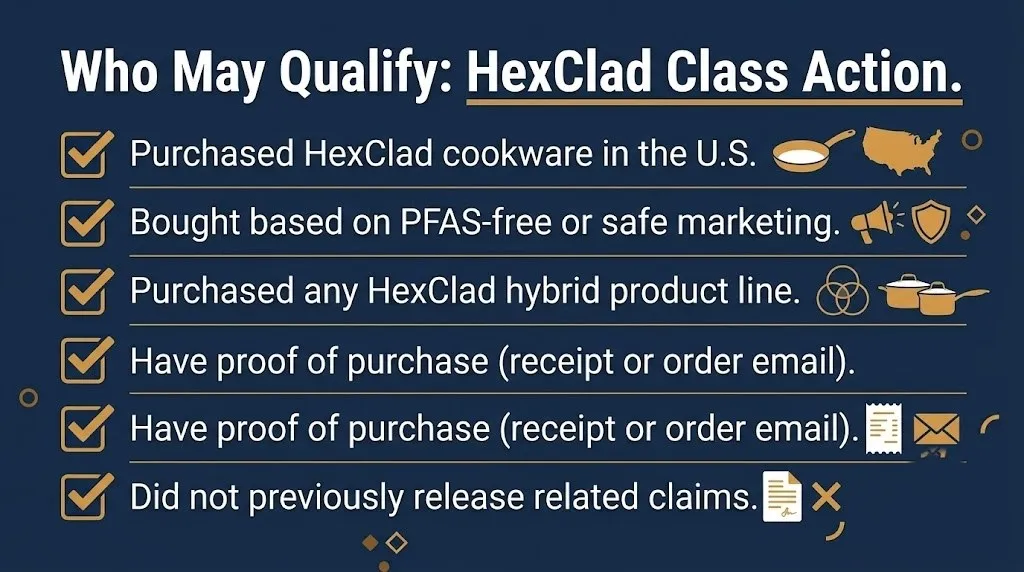
People who purchased HexClad cookware in the United States may qualify for the class action if a settlement is ultimately reached. The proposed class is expected to cover buyers who relied on HexClad’s marketing claims about chemical safety when making their purchase decision. The exact class definition will be set by the court when it certifies the class.
Eligibility in consumer product cases like this typically depends on three things. First, you must have bought the product during the covered period. Second, the product must be one of the models named in the complaint. Third, you must have been in a jurisdiction the lawsuit covers, which is generally all U.S. states.
Keeping your proof of purchase now is the single most useful thing you can do. Think of it like holding onto a receipt for a product you suspect may be recalled. The receipt does not guarantee a refund, but without it, you have nothing to file. If you bought your HexClad pans online, your order confirmation email is your receipt.
Who may qualify if a settlement is reached:
- U.S. residents who purchased HexClad hybrid cookware
- Buyers who purchased based on PFAS-free or safe-coating marketing claims
- Customers across all HexClad product lines, not just one specific pan
- Both individual buyers and households, regardless of purchase price paid
Key Takeaway: No HexClad settlement exists yet, and no claim form is open. Save your proof of purchase now because it will be the key document when the claim portal eventually launches.
How Much Could You Get From a HexClad Settlement?
The payout per person from a HexClad settlement is not yet determined because no settlement fund has been approved by a court. Speculating on a number would be irresponsible given where the case stands.
What comparable consumer cookware PFAS cases tell us is useful context, not a guarantee. Similar cases involving cookware marketed as PFAS-free have settled in ranges tied to the purchase price of the product and the size of the class. In some consumer false advertising cases, individual payouts have ranged from $20 to $150 depending on the number of claimants and the total fund size.
HexClad’s price point is relevant here. A single HexClad pan can cost over $100, and many buyers purchased full sets worth several hundred dollars. A strong argument exists that the “benefit of the bargain” damages, what you overpaid because of the false claims, are higher than for a $20 bargain-brand pan. But courts decide these formulas, not plaintiffs or reporters.
What we know about payout potential:
| Factor | Current Status |
|---|---|
| Settlement fund approved | Not yet confirmed |
| Payment tiers confirmed | Not yet confirmed |
| Per-person estimate | Not yet determined |
| Comparable case range | $20 to $150 in similar consumer cookware PFAS cases |
| Higher payout factors | Proof of purchase, full set vs. single pan, documented harm |
Reality Check: No one will email or text you a HexClad settlement check. When a real claim portal opens, it will be announced through the court system and covered by legal news outlets. Any website right now asking you to “file your HexClad claim” and pay a fee is not part of any official process. Filing is always free in class actions.
What Are PFAS and Why Do They Matter in This Lawsuit?
PFAS are a group of more than 12,000 synthetic chemicals that have been used in manufacturing since the 1940s. The name stands for per- and polyfluoroalkyl substances. They are sometimes called “forever chemicals” because they do not break down naturally in the environment or in the human body.
In cookware, PFAS are most commonly associated with PTFE-based coatings like traditional Teflon. Some brands have moved toward ceramic or hybrid coatings specifically to market away from PFAS concerns. HexClad’s hybrid design, which combines stainless steel with a nonstick coating, was part of its pitch as a safer alternative.
The science on PFAS exposure through cookware is still developing. Regulatory agencies including the EPA and FDA have been tightening standards around PFAS in food-contact materials. The fact that regulators are paying closer attention to these chemicals is one reason class action lawyers are also focusing on cookware brands whose marketing claims outpace their actual chemistry.
- PFAS full name: Per- and polyfluoroalkyl substances
- Health concerns: Cancer, thyroid disruption, immune interference, developmental issues
- In cookware: Used in many nonstick coatings, including some marketed as “safe”
- Regulatory status: EPA and FDA tightening limits on PFAS in food-contact products
- Why it matters here: HexClad’s marketing specifically targeted health-aware buyers
HexClad Lawsuit 2026: What the Company Says
HexClad has not made a detailed public statement specifically addressing the class action lawsuit claims as of the date of this report. The company’s public marketing continues to describe its cookware as non-toxic and designed with consumer safety in mind. That position has not changed despite the pending litigation.
This is not unusual. Companies under active litigation are advised by their lawyers to avoid public statements that could be used against them in court. What you will not find is HexClad issuing a press release saying “our pans contain PFAS.” What you will also not find is a verified independent statement from the company saying independent testing has fully cleared their products of any PFAS presence.
The gap between HexClad’s marketing claims and any independent chemical verification of those claims is exactly what the lawsuit is examining. Until the court processes the evidence from discovery, both the company’s position and the plaintiffs’ claims remain contested.
- Company’s public stance: Non-toxic, safe product marketing continues
- Legal posture: No public admission, standard for active litigation
- What is missing: Independent verified lab results clearing the product of all PFAS
- What the lawsuit demands: Damages for buyers who paid a premium based on allegedly false claims
Gordon Ramsay, HexClad Marketing, and Why It Matters Legally
Gordon Ramsay’s endorsement of HexClad is relevant to this lawsuit because it amplified the premium safety messaging that buyers relied on. Ramsay is not a defendant in the lawsuit based on sources reviewed for this report. However, his prominent role in HexClad advertising reinforced the brand’s positioning as a professional-grade, health-conscious choice.
When a celebrity chef with a reputation for demanding quality personally endorses a product as the one he uses in his kitchen, it carries weight with buyers. The lawsuit argues that buyers made purchasing decisions based on a package of claims, including the celebrity endorsement, the premium pricing, and the PFAS-free safety claims. That combination is the “premium product” promise plaintiffs say was not delivered.
This does not mean Ramsay did anything wrong. Endorsers are generally not liable for product claims unless they personally made false statements they knew to be untrue. His role here is contextual: it helps explain why buyers paid high prices and had elevated expectations about product safety.
- Ramsay’s role: Celebrity endorser and business partner of HexClad
- Legal status: Not named as a defendant in sources reviewed
- Relevance to lawsuit: Endorsement amplified premium safety marketing that buyers relied on
- Buyer expectation: Consumers paid more because of the implied professional and health-safe standard
Key Takeaway: Gordon Ramsay’s endorsement is legally relevant as context for why buyers paid premium prices and expected verified safety claims, even though he is not named as a defendant.
How to Prepare to File a HexClad Claim When the Portal Opens
Preparing to file a HexClad claim now, before any portal exists, is the smart move. Courts move slowly. When a settlement is finally announced, the claim window may be only 60 to 90 days long. Buyers who have their documentation ready will not scramble.
This is similar to how you might keep your car’s service records even before you know whether you’ll need a warranty claim. The records exist before the problem is confirmed. Having them ready costs nothing and protects your ability to act quickly when the time comes.
Steps to take now:
- Search your email inbox for any HexClad order confirmations.
- Check your Amazon, Williams-Sonoma, or other retailer order history for HexClad purchases.
- Locate any physical receipts from in-store purchases.
- Note which specific HexClad products you purchased and when.
- Keep the pans themselves if you still have them. Some claims require photos of the product.
- Write down approximately how much you paid in total for all HexClad products.
- Sign up for updates at legal news outlets or court monitoring services for the case docket.
- Do not pay any third party to “pre-register” you for the HexClad settlement. No such process exists yet.
HexClad vs. Other PFAS Cookware Lawsuits: How Does This Case Compare?
The HexClad lawsuit is part of a broader wave of PFAS-related cookware litigation that has grown significantly since 2022. Understanding where HexClad sits in this pattern helps you judge how the case might develop.
Several competing brands have faced similar lawsuits. Some have settled. Others are still in litigation. The legal theories are nearly identical across cases: company markets product as PFAS-free, independent testing finds PFAS, consumers sue for the price premium they paid.
| Brand | Lawsuit Status | Settlement Status |
|---|---|---|
| HexClad | Active litigation, 2026 | No settlement yet |
| Teflon / Chemours | Historical litigation | Various state settlements |
| Other hybrid cookware brands | Multiple cases in various courts | Mixed, some settled |
| Ceramic coating brands | Active in some jurisdictions | Not yet confirmed across cases |
What makes the HexClad case stand out is the company’s aggressive premium pricing and celebrity-backed marketing. Courts in consumer fraud cases sometimes consider the gap between what a product cost and what an equivalent product without the false claims would have cost. HexClad’s price point gives plaintiffs a larger “benefit of the bargain” argument than a lower-priced competitor would face.
What Does the Science Say About HexClad’s Nonstick Coating?
The science around HexClad’s specific coating formulation is a central factual dispute in the litigation. The company describes its hybrid design as combining stainless steel with a nonstick layer. Independent consumer advocacy organizations and laboratory testing services have evaluated various “PFAS-free” cookware brands with mixed findings.
Some independent tests have detected PFAS compounds on cookware described by manufacturers as PFAS-free. The detection methods used, the specific chemicals tested for, and the threshold levels involved are all points of legitimate scientific debate. Not all PFAS are equally harmful, and not all testing methodologies are equally rigorous.
What is clear is that the plaintiffs in the HexClad lawsuit will need independent laboratory evidence to support their claim that PFAS are present in the product. HexClad will likely present its own testing or manufacturing process documentation to counter that evidence. The court will then decide what the evidence proves.
- Testing status: Independent lab testing of HexClad products not publicly confirmed in sources reviewed
- Science debate: Detection methods, threshold levels, and specific PFAS types are all contested
- What matters legally: Whether the marketing claim was false relative to what the product actually contains
- Regulatory backdrop: EPA and FDA are tightening PFAS standards, which increases legal pressure on all cookware brands
Key Takeaway: The science around HexClad’s PFAS claims is a live factual dispute in court. Independent laboratory evidence will be central to how this case resolves, and buyers should not assume either side’s position is proven until a court decides.
What Happens Next
- Summer 2026 (Expected): Discovery continues as both sides exchange product testing data, internal company communications, and marketing material records.
- Late 2026 (Expected): Class certification motion is expected. If the judge certifies the class, the case moves significantly faster toward resolution.
- 2026 to 2027 (Expected): Mediation between the parties may occur. Many consumer product class actions settle during or after the class certification phase.
- TBD: If a settlement is reached, a preliminary approval hearing will be scheduled, and an official settlement website and claim deadline will be announced.
- TBD: Payment distribution to valid claimants would follow final court approval, typically six to twelve months after a settlement is announced.
Frequently Asked Questions
Is there a HexClad class action settlement I can file for right now?
No. As of June 2026, no HexClad settlement has been approved and no claim form is open.
The lawsuit is in active pretrial litigation, and no settlement fund has been confirmed.
Watch the court docket or legal news outlets for a settlement announcement.
What did HexClad do wrong, according to the lawsuit?
The lawsuit alleges HexClad falsely marketed its cookware as PFAS-free and non-toxic.
Plaintiffs claim the nonstick coating contains or is manufactured using PFAS chemicals.
Buyers allegedly paid premium prices based on safety claims that were not accurate.
Do I need to still own my HexClad pans to qualify for the settlement?
You do not need to currently own the pans, but proof of purchase is typically required.
An order confirmation email or credit card statement showing the purchase date and amount is usually sufficient.
Keep any documentation you have from when you bought your HexClad products.
How long will the HexClad lawsuit take to resolve?
Consumer PFAS class actions typically take two to four years from filing to payment.
The class certification phase alone can take one to two years in federal court.
There is no confirmed trial or settlement date for the HexClad case as of June 2026.
Is HexClad still safe to use while the lawsuit is pending?
That is a personal health decision, not a legal one, and LawCompensate.com does not give health advice.
No government agency has issued a recall or safety warning specifically for HexClad cookware.
If you have concerns, consult the EPA’s PFAS guidance or a healthcare provider.
Will Gordon Ramsay owe me money from the HexClad lawsuit?
No. Gordon Ramsay is not named as a defendant in the HexClad class action based on sources reviewed.
His endorsement is relevant context for the marketing claims but does not create personal legal liability here.
Any damages would come from HexClad Cookware LLC as the defendant company.
How do I know when the HexClad settlement claim form is live?
A real settlement announcement will appear in the court docket and be covered by legal news outlets.
The official claim website will be listed in the court’s preliminary approval order, which is a public document.
Do not trust any website claiming to take HexClad claims before that official announcement is made.
Can I opt out of the HexClad class action to sue on my own?
Yes. Once a class is certified, members have a window to opt out and pursue individual claims.
For most buyers, staying in the class is more practical than filing an individual lawsuit.
The opt-out deadline will be specified in the class notice when it is issued by the court.
Save your HexClad purchase records today. That is the single most useful action you can take right now. An order confirmation email, a credit card statement, or a printed receipt is all you need to position yourself to file if and when a settlement is announced.
The claim window, when it opens, will likely run 60 to 90 days. Buyers who scramble to find old receipts during that window often miss the deadline. The next major milestone to watch for is the court’s class certification decision, expected in late 2026 or early 2027.