Essure Lawsuit 2026: Settlement Status, Who Still Qualifies, and What Comes Next
Quick Answer
- The Essure lawsuit is real: Bayer paid $1.6 billion in August 2020 to resolve roughly 90% of about 39,000 claims.
- Per-person payouts were never made public. There is no new mass settlement fund open in 2026.
- The only live deadline now is your state’s statute of limitations, typically 2 to 4 years from when you discovered your injury.
Essure was a permanent birth control coil that Bayer pulled from the U.S. market at the end of 2018. Thousands of women blamed it for organ damage, chronic pain, and unplanned pregnancies, and most of those claims were resolved in a single massive settlement six years ago.
If you’re searching for this in 2026, you likely fall into one of two groups: someone who filed years ago and wants to know if money is still moving, or someone who never filed and is wondering if it’s too late. Both questions have real, checkable answers, and neither one is answered honestly by most of the pages currently ranking for this term.
This article breaks down exactly where the litigation stands, what “settled” actually means for your wallet, and the one legal clock that still matters if you never filed a claim. One detail most competitor pages bury: Essure was never resolved through a certified class action. Every payout came from thousands of individual settlements negotiated by private law firms, which is exactly why there was never a single claims administrator or public payout schedule to check.
The Facts
| Case | Essure Products Cases (JCCP No. 4887, Alameda County Superior Court, California) and consolidated individual suits, U.S. District Court, Eastern District of Pennsylvania |
| Status | Settled. Bayer paid $1.6 billion in August 2020 for about 90% of roughly 39,000 claims. Remaining cases resolved individually through 2025. |
| Fund Size | $1.6 billion (2020 global resolution) |
| Est. Per Person | Not officially disclosed by Bayer. Not yet determined for any individual case. |
| Claim Deadline | 2020 settlement deadlines have passed. New claims are governed by your state’s statute of limitations. |
| Administrator | Not publicly named. Individual law firms managed disbursement to their own clients. |
| Proof Needed | Medical records confirming Essure implantation, a diagnosed complication, and removal surgery records if applicable. |
Is the Essure Lawsuit Legit or a Scam?
The Essure lawsuit is a real, well-documented legal fight, not a scam.
Bayer AG agreed to pay $1.6 billion to resolve most of the U.S. litigation over its now-withdrawn Essure contraceptive device, after women said it failed to prevent pregnancies and caused excessive bleeding and pelvic pain. The company confirmed on August 20, 2020 that it would pay around $1.6 billion to settle the majority of U.S. claims involving the device.
That’s a documented corporate settlement covering tens of thousands of women, reported by Reuters, the Wall Street Journal, and Kaiser Health News. It is not a viral rumor or a text-message scam.
What is worth your skepticism: any site, call, or text claiming you can join a “new Essure class action” for a fee. There isn’t one. If someone asks for money upfront to check your eligibility, that’s your red flag, not the lawsuit itself.
Is There a Current Essure Class Action Lawsuit in 2026?
No. There is no active, open Essure class action accepting new members in 2026.
The 2020 resolution was not a certified class action at all. It was a coordinated settlement of individually filed lawsuits, negotiated between Bayer and plaintiffs’ law firms. There has never been an actual class action lawsuit over Essure, though many affected women pursued their own independent lawsuits, and there is no current pending class action to join.
That structure matters for you. It means there’s no single courthouse docket to watch and no class notice mailer coming. If you weren’t already represented by one of the firms involved in 2020, your only path now is filing an individual product liability suit, subject to your state’s deadline.
How Much Is the Essure Lawsuit Settlement Worth Per Person?
Bayer has never disclosed individual payout amounts, and no verified per-person figure exists publicly.
Nearly 39,000 women filed claims or hired lawyers over their use of Essure, and Bayer agreed to pay approximately $1.6 billion to resolve these claims, including an allowance for outstanding cases. Dividing $1.6 billion by roughly 39,000 claims produces a rough average near $41,000. That is simple math, not an official figure, and it tells you almost nothing about what any individual woman actually received.
Why the math is misleading:
| Factor | Effect on Payout |
|---|---|
| Injury severity | More severe complications (hysterectomy, organ perforation) generally command higher individual settlements |
| Documentation strength | Clear medical records tying symptoms to the device typically support stronger claims |
| Confidential terms | Individual settlement amounts were not published by Bayer or plaintiffs’ firms |
| Attorney fees and costs | Contingency fees and case costs reduce the amount a claimant actually keeps |
Not yet determined is the honest answer for anyone asking what a specific case is worth today, whether that’s a 2020 settlement or a new individual filing.
What Is the Essure Lawsuit Filing Deadline in 2026?
The filing deadline for a new Essure claim depends entirely on your state’s statute of limitations, not on any national settlement date.
Most states allow two to three years from when you discovered, or reasonably should have discovered, that Essure caused your injury. Some states also apply a statute of repose that can bar claims after a fixed number of years regardless of discovery.
The clock usually runs under what lawyers call the discovery rule.
Key Takeaway: There is no single national Essure deadline left in 2026. Your filing window is set by your state and by when you first connected your symptoms to the device.
Matters for slow-developing injuries, the discovery rule starts the filing-deadline clock when you discovered, or reasonably should have discovered, that you were hurt and what hurt you, not from when the device was implanted. If your device was implanted more than a decade ago, a statute of repose in your state could bar a claim even if you just discovered the connection.
Can I Still File an Essure Lawsuit in 2026?
Yes, in limited circumstances, filing is still possible if your state’s statute of limitations has not expired.
If you have not yet taken legal action and were not part of the 2020 settlement, it may not be too late to act, but you will need to determine if your case is still within the statute of limitations. Some women continued filing Essure lawsuits in California and Pennsylvania even after the 2020 settlement, including a 2023 case filed in the Eastern District of Pennsylvania.
Who is unlikely to qualify:
- You already received money as part of the 2020 settlement.
- You had Essure implanted without any significant complication.
- Your state’s filing deadline has already passed with no recognized exception.
Who may still have an option:
- You never filed a claim and your symptoms surfaced recently.
- You had a delayed diagnosis connecting a chronic condition to the device.
- Your state’s discovery rule extends your window past the original implant date.
This is a narrow lane, similar to finding out a warranty technically still covers you years after you assumed it had expired. It’s worth checking, but don’t assume you’re covered.
How Do I File an Essure Claim?
Filing an individual Essure claim follows the same basic process as any product liability lawsuit.
- Gather medical records showing your Essure implant date and any complications.
- Confirm your state’s statute of limitations and discovery rule.
- Consult a product liability or mass tort attorney for a case evaluation.
- Request your full FDA MedWatch report history if one was filed on your behalf.
- Document removal surgery records, if you had the device taken out.
- File your complaint in the appropriate state or federal court before your deadline.
- Preserve all correspondence with Bayer, Conceptus, or any prior legal representation.
Skipping the records step is the single most common reason legitimate claims get rejected early.
What Proof Do I Need for an Essure Lawsuit?
You need medical documentation connecting your injury directly to the Essure device, not just a diagnosis on its own.
The core proof categories that matter most:
- Records confirming Essure implantation and the date.
- Diagnostic records for the specific complication you’re claiming (perforation, migration, autoimmune-type symptoms, unintended pregnancy).
- Surgical records if the device was removed.
- A timeline showing when you first connected your symptoms to the device, which supports your discovery rule argument.
Reality Check: No legitimate law firm or claims process will ask you to pay an upfront fee to “activate” your Essure claim or check eligibility. Filing is free. Product liability attorneys work on contingency, meaning they only get paid if you recover money. Anyone demanding cash before doing any work is not part of the real litigation.
What Is the Latest Essure Lawsuit Update in 2026?
As of June 2026, there are no new major updates in this litigation. The bulk of the case has been closed for years.
The 2020 settlement resolved the bulk of active Essure litigation, and a small number of holdout cases involving women who rejected the initial settlement offers continued, with Bayer resolving remaining cases through 2025. That means the litigation is essentially in its final, quiet phase: no new mass filings, no new administrator announcement, just isolated individual suits still moving through the courts.
Key Takeaway: If you’re seeing “breaking news” headlines about a brand-new 2026 Essure settlement, treat that claim with real skepticism. Nothing in court records or official channels supports a new national settlement this year.
Has Bayer Paid Out the Essure Settlement Money Yet?
Yes, the large majority of the 2020 settlement funds have already been distributed to claimants.
For most women, Bayer’s 2020 global settlement resolved roughly 39,000 claims, and that settlement fund is closed. Payments to the roughly 90% of claimants covered by the original 2020 agreement went out to individual plaintiffs through their own law firms over the following years, not through one public payment portal.
If you were represented by a firm involved in the 2020 resolution and haven’t received your payment, that’s a conversation for your original attorney, not a sign of a new claims process.
Are Essure Settlement Checks Still Being Mailed?
Not as part of any active, ongoing distribution tied to the 2020 agreement.
The original $1.6 billion fund was allocated and paid out through individual settlements years ago. Any check activity happening now would relate to one of the small number of holdout cases that settled individually more recently, not a broad new mailing wave.
If you get a text or call claiming an “Essure settlement check” is waiting on you and asking for personal or banking information first, that is not how real settlement administrators operate.
What Is Essure and Why Was It Recalled?
Essure was a permanent, non-surgical birth control device made of two small metal coils inserted into the fallopian tubes.
Approximately 39,000 women filed claims saying they were injured by the device, which is a metal coil inserted into a fallopian tube. In thousands of cases, the coils migrated from the fallopian tubes and damaged other parts of the body, with symptoms including weight gain, irregular periods, fatigue, uterine perforation, dizziness, fainting, and memory lapses.
Bayer had said in 2018 that it would phase out the product in the United States, attributing the decision to declining sales rather than safety concerns. Bayer stopped selling Essure in the U.S. in 2018 and the device was formally recalled in September 2019.
Key Takeaway: Essure was pulled for commercial reasons on paper, but the timing followed years of mounting safety complaints and a 2016 FDA black box warning, the agency’s strongest consumer alert short of a full ban.
What Injuries Qualify for an Essure Lawsuit?
Qualifying injuries generally include organ perforation, device migration, chronic pelvic pain, and unintended pregnancy tied directly to device failure.
Symptoms tied to Essure migration in reported claims included weight gain, irregular periods, fatigue, uterine perforation, dizziness, fainting, and memory lapses. Some women required hysterectomies to remove the coils after they became embedded or migrated.
Common documented complications in filed lawsuits:
- Fallopian tube or uterine perforation
- Coil migration to other organs
- Chronic pelvic pain and inflammation
- Autoimmune-type reactions
- Unintended pregnancy despite the device
- Hysterectomy required for removal
A general side effect like mild cramping after insertion is very different, legally, from a documented perforation or migration. The stronger your medical paper trail, the stronger your case.
Who Is Bayer and Conceptus in the Essure Case?
Conceptus Inc. originally developed and sold Essure before Bayer acquired the company in 2013.
In April 2013, Bayer AG agreed to buy Conceptus Inc. for $1.1 billion to add the Essure device to its women’s health division, which also includes the Mirena IUD. Bayer inherited both the product and, eventually, the legal exposure tied to it.
Both companies are named as defendants in Essure litigation, since claims cover conduct both before and after the 2013 acquisition, including how safety data was reported to regulators.
What Did the FDA Say About Essure?
The FDA issued its strongest consumer warning, a black box label, for Essure in November 2016 after years of adverse event reports.
The FDA imposed its most serious warning label on Essure in November 2016. The FDA received more than 9,900 adverse medical device reports concerning the Essure device before regulators tightened restrictions further.
What Bayer knew from its own post-market surveillance, and when, was a central question that the litigation’s discovery process put before plaintiffs’ attorneys and experts, with Bayer’s internal complaint data, regulatory correspondence, and engineering records produced in discovery during the California and federal proceedings. No trial verdict ever resolved what those internal documents ultimately showed, because the case settled first.
The device also drew wider public attention after a 2018 Netflix documentary examined problems across the medical device industry, which many women say is what first led them to connect their symptoms to Essure.
What Happens Next
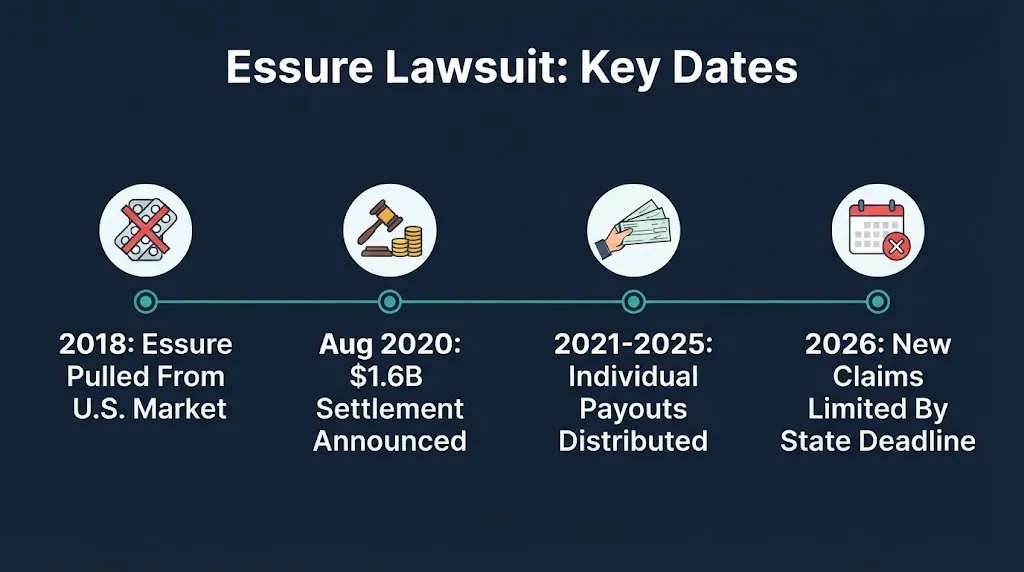
August 2020: Bayer announces the $1.6 billion global resolution covering about 90% of roughly 39,000 claims.
2021 to 2025: Individual settlement payments distributed through plaintiffs’ law firms; a small number of holdout cases continue.
2023: New individual suits, such as a case filed in the Eastern District of Pennsylvania, show the litigation isn’t fully closed for every claimant.
2026 (current): No new mass settlement fund open. Remaining activity limited to individual claims within state statutes of limitations.
Expected going forward: Continued case-by-case resolution of any remaining holdout suits, with no indication of a new national settlement on the horizon.
Frequently Asked Questions
Is the Essure lawsuit still active in 2026?
The large national settlement is closed, but a small number of individual cases are still moving through the courts.
New filings remain possible only if your state’s statute of limitations hasn’t expired.
How much money did Bayer pay in the Essure settlement?
Bayer paid approximately $1.6 billion in August 2020 to resolve about 90% of roughly 39,000 filed and unfiled claims.
Individual payout amounts were never made public.
Can I join the Essure lawsuit now?
There is no class action to join, since Essure litigation was never certified as one.
You can only pursue an individual lawsuit if you’re still within your state’s filing deadline.
What was the average Essure settlement payout?
No official average payout figure was ever released by Bayer.
Dividing the $1.6 billion fund by roughly 39,000 claims produces a rough calculated average near $41,000, but actual individual amounts varied and were confidential.
Is Essure still on the market?
No. Bayer stopped selling Essure in the United States after December 31, 2018, and the device was recalled in September 2019.
What if I had Essure removed years ago?
You may still have an option if your state’s discovery rule allows the filing clock to start from when you connected your symptoms to the device, not from the implant date.
A statute of repose in some states can still bar claims regardless of discovery.
Do I need a lawyer to file an Essure claim?
You are not legally required to have one, but product liability cases involving discovery-rule timing are complex.
Most firms handling these cases work on contingency, meaning no upfront cost to you.
Is there a new Essure class action lawsuit forming in 2026?
No verified reporting supports a new class action or national settlement forming in 2026.
Be cautious of any site or message claiming otherwise, especially if it asks for payment upfront.
If you think you may still qualify, the most useful next step is pulling your medical records and confirming your state’s statute of limitations before you do anything else. The one number that actually matters for you right now isn’t a settlement total, it’s your personal filing deadline.