Ed Sheeran Lawsuit 2026: The Copyright Cases, Verdicts, and What Comes Next
Quick Answer
- Ed Sheeran has faced multiple copyright lawsuits over alleged song similarities, not a class action.
- He won the high-profile “Thinking Out Loud” and “Shape of You” cases on jury verdicts and court rulings.
- No settlement fund or claims process exists for fans or the public in any Ed Sheeran case.
Ed Sheeran has been sued more than most artists of his generation. But these are not class actions, and they do not involve consumer payouts.
The lawsuits claim his songs copied earlier works. The plaintiffs are songwriters or estates seeking damages and royalties, not members of the public.
As of March 2026, Ed Sheeran has won every major copyright trial brought against him in the United States and the United Kingdom. No new lawsuit has been publicly filed against him in 2026.
This article covers the cases you have heard about, the verdicts, the legal standard at play, and what these lawsuits actually mean for music copyright.
The Facts
| Item | Details |
|---|---|
| Defendant | Ed Sheeran |
| Case Type | Copyright infringement |
| Major U.S. Case | Structured Asset Sales v. Sheeran |
| Verdict | Sheeran won (jury, 2023) |
| Major U.K. Case | Sami Chokri v. Sheeran |
| Verdict | Sheeran won (2022) |
| 2026 Active Lawsuit | Not yet confirmed |
| Consumer Settlement Fund | None exists |
Is the Ed Sheeran Lawsuit a Class Action?
No. Ed Sheeran has never faced a class action lawsuit over his music.
The cases against him are individual copyright infringement claims brought by specific songwriters or rights holders. They seek damages for themselves, not a class of plaintiffs.
A class action would involve many people with similar claims. Copyright cases almost never work that way because each claim depends on specific musical elements and specific songs.
So if you saw a notice about an Ed Sheeran class action settlement, it is fake. No such case exists.
What Was the Ed Sheeran “Thinking Out Loud” Lawsuit?
The most famous Ed Sheeran lawsuit claimed “Thinking Out Loud” copied Marvin Gaye’s “Let’s Get It On.”
The heirs of Ed Townsend, who co-wrote “Let’s Get It On” with Gaye, filed the case in the Southern District of New York.
The case was called Structured Asset Sales LLC v. Edward Christopher Sheeran. It went to trial in April 2023.
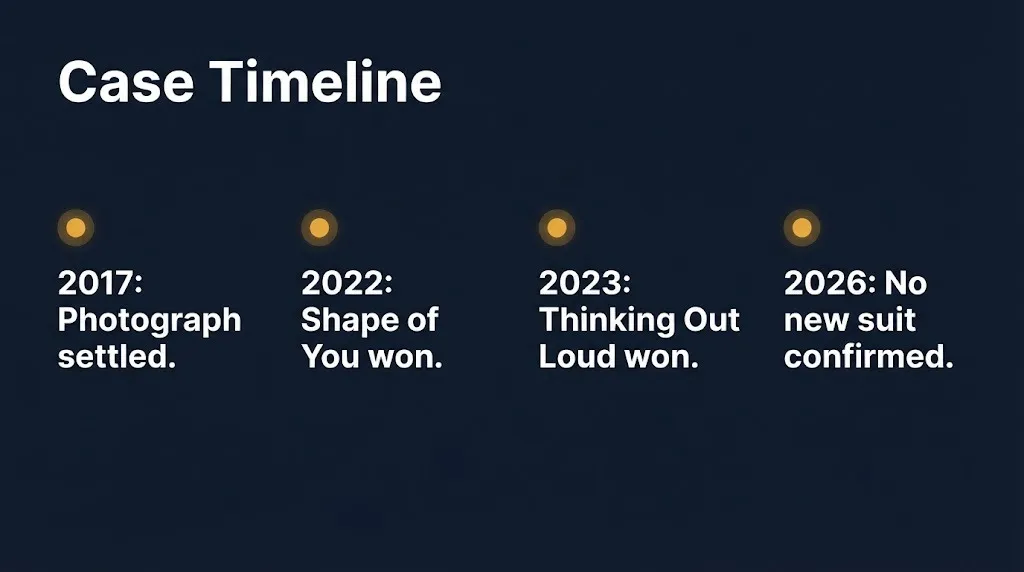
A federal jury returned a verdict in Sheeran’s favor on May 4, 2023. The jury found he did not infringe the copyright.
The plaintiffs appealed. The Second Circuit heard arguments, and the appeal remained pending into 2025. No final appellate ruling had been confirmed as of March 2026.
What Was the Ed Sheeran “Shape of You” Lawsuit?
In the United Kingdom, Sheeran faced a claim that “Shape of You” copied a phrase from a song called “Oh Why” by Sami Chokri.
The case went to trial in the High Court of England and Wales. Chokri claimed the “Oh I, oh I, oh I, oh I” hook was copied from his work.
The judge ruled in Sheeran’s favor in April 2022. The court found Sheeran had not copied Chokri’s song.
Chokri was ordered to pay legal costs, and the ruling stood on appeal.
Did Ed Sheeran Win the Copyright Lawsuit?
Yes. Ed Sheeran won the “Thinking Out Loud” case by jury verdict in 2023.
He won the “Shape of You” case by court ruling in 2022.
He has also won or settled other claims, including a case over “Photograph” that settled in 2017 before trial.
Here is the record as of March 2026:
| Song | Plaintiff | Outcome |
|---|---|---|
| Thinking Out Loud | Townsend heirs | Sheeran won, jury 2023 |
| Shape of You | Sami Chokri | Sheeran won, court 2022 |
| Photograph | Matt Cardle writers | Settled 2017 |
| Amazing | Jasmine Rae | Settled before trial |
Key Takeaway: Sheeran’s record in copyright trials is clean wins. The claims either failed at trial or settled early.
How Much Was Ed Sheeran Sued For?
The “Thinking Out Loud” plaintiffs sought over $100 million in damages.
The “Shape of You” case sought a share of royalties and an injunction, with total claims reported in the millions of pounds.
The “Photograph” case settled for an undisclosed amount, reportedly in the millions.
But those are claims, not payouts. Sheeran won the cases that went to trial, so he owed nothing in those matters.
What Legal Standard Did the Court Apply?
The courts applied the standard copyright infringement test: access plus substantial similarity.
The plaintiff must show the defendant had access to the earlier work. Then they must show the two works are substantially similar in protected expression.
Here is how that played out in the “Thinking Out Loud” case:
| Element | What Plaintiff Claimed | What Jury Found |
|---|---|---|
| Access | “Let’s Get It On” was famous | Not enough alone |
| Chord progression | Same I-vi-IV-V sequence | Not protectable |
| Melody | Similar feel | Not substantially similar |
| Overall impression | Songs sound alike | Independent creation |
The chord progression at issue is a common musical building block. Courts do not protect common building blocks, only original expression.
Key Takeaway: The law protects original expression, not basic musical elements like chord progressions that have been used for generations.
Are There Any Other Ed Sheeran Lawsuits in 2026?
No new Ed Sheeran copyright lawsuit has been publicly confirmed for 2026.
The “Thinking Out Loud” appeal remained the most watched pending matter as of late 2025. No ruling on that appeal had been confirmed by March 1, 2026.
Celebrity lawsuit rumors spread fast on social media. A viral post claiming a new suit does not make it real. Check federal court dockets before believing any claim.
Why Does Ed Sheeran Get Sued So Often?
Ed Sheeran gets sued often because he is a prolific songwriter with a high public profile and deep pockets.
Copyright plaintiffs target successful artists because the potential damages are large. A hit song earns royalties for decades.
But the legal standard protects legitimate independent creation. Common chord progressions, standard rhythms, and basic melodic patterns are not owned by anyone.
That is why Sheeran keeps winning. The plaintiffs keep claiming ownership of musical elements that the law does not protect.
Reality Check: No Ed Sheeran case involves a consumer settlement fund. If you see a post claiming fans can claim money from an Ed Sheeran lawsuit, it is a scam.
How Does the Ed Sheeran Case Affect Music Copyright Law?
The Ed Sheeran verdicts reinforce a line that courts have drawn for decades: basic musical building blocks stay free for everyone to use.
A ruling against Sheeran on the “Thinking Out Loud” chord progression would have chilled songwriting across the industry. Songwriters would have faced legal risk for using the most common progression in pop music.
The jury verdict in Sheeran’s favor keeps that risk low. It confirms that access plus a similar feel is not enough. The plaintiff must show copying of protected expression.
Here is what the case did not decide:
| Question | Status After Verdict |
|---|---|
| Are chord progressions copyrightable? | No, per longstanding doctrine |
| Is a similar groove infringement? | No, per jury verdict |
| Can a song’s “feel” be owned? | No, per court rulings |
| Is every similar song infringing? | No, independent creation is a defense |
What Should I Do If I See an Ed Sheeran Settlement Notice?
You should ignore it and report it as spam. No Ed Sheeran settlement notice exists for consumers.
Here is why:
- Ed Sheeran has not settled a case requiring a consumer claims process.
- No class action against him exists.
- Copyright cases do not create consumer payout funds.
- Real settlement notices name a court and case number.
- Fake notices ask for personal information or payment.
Treat any Ed Sheeran settlement text, email, or social media ad as a scam until a federal court docket proves otherwise.
What Happens Next
Expected 2026: The Second Circuit may rule on the “Thinking Out Loud” appeal. No date has been confirmed.
Ongoing: Sheeran continues touring and releasing music while the appeal remains pending.
If a new lawsuit is filed: It would appear in federal court dockets before any media report or social media post.
Your move: Nothing to file, nothing to claim. Watch the court record, not the rumor mill.
Ed Sheeran has been sued, and he has won. That is the short version.
The longer version matters for anyone who writes, performs, or listens to music. The law protects original expression, not the shared vocabulary of pop music.
No consumer settlement exists here. No claims process. No deadline. Just a legal record that says, for now, the songwriter keeps winning.