NCAA Settlement 2026: House v. NCAA Payout Status, Back Pay Delays, and Who Qualifies
Quick Answer
- The NCAA settlement is real and court-approved, covering Division I athletes from 2016 through June 6, 2025.
- Revenue-sharing payments to current athletes are flowing, but back-pay damages of up to $2.8 billion remain paused during Title IX appeals.
- The most important date isn’t a payout date, it’s unknown: the Ninth Circuit has given no timeline, and appeals like this can take one to two years.
If you’re searching “ncaa settlement” in 2026, you’re likely a current or former Division I athlete who got a notice, or a fan trying to understand why your favorite team is suddenly paying players. The short version: yes, it’s real, and yes, it’s already changing college sports, but the biggest checks are on hold.
This covers current and former athletes who competed in Division I sports between June 15, 2016, and June 6, 2025. The number that matters most: $2.8 billion in total back-pay damages, frozen since multiple groups of female athletes appealed the settlement on Title IX grounds within days of its approval. One detail that surprises people: this stay affects zero revenue-sharing payments going forward, only the historical back-pay portion.
This article breaks down what’s confirmed, what’s still stuck in court, who qualifies, how much money is realistically on the table, and what happens next. A surprising verified detail: schools were paying athletes directly under this deal starting July 1, 2025, months before the Ninth Circuit even finished receiving briefs on the appeal that’s freezing everyone else’s back pay.
The Facts
| Case | House v. NCAA (consolidated with Carter v. NCAA and Hubbard v. NCAA), No. 4:20-cv-03919, N.D. California |
| Status | Approved June 6, 2025; revenue sharing active; back-pay damages under Title IX appeal stay |
| Fund Size | $2.8 billion total back pay over 10 years, plus injunctive relief revenue sharing (potentially exceeding $20 billion over the decade) |
| Est. Per Person | Not yet determined for most classes; football and men’s basketball players allocated roughly 90% of the $2.6 billion damages pool |
| Claim Deadline | Passed for most classes; only Football, Men’s Basketball, and Women’s Basketball full-scholarship athletes at Power Five schools between 2016 and 2024 can still update contact/payment info |
| Administrator | House class counsel and a court-appointed settlement administrator (via collegeathletecompensation.com) |
| Proof Needed | Not applicable for most class members; eligibility is based on sport, scholarship status, school, and years of competition |
Is the NCAA Settlement Legit?
Yes, the House v. NCAA settlement is a real, federally approved class action, not a rumor or a marketing gimmick from the NCAA.
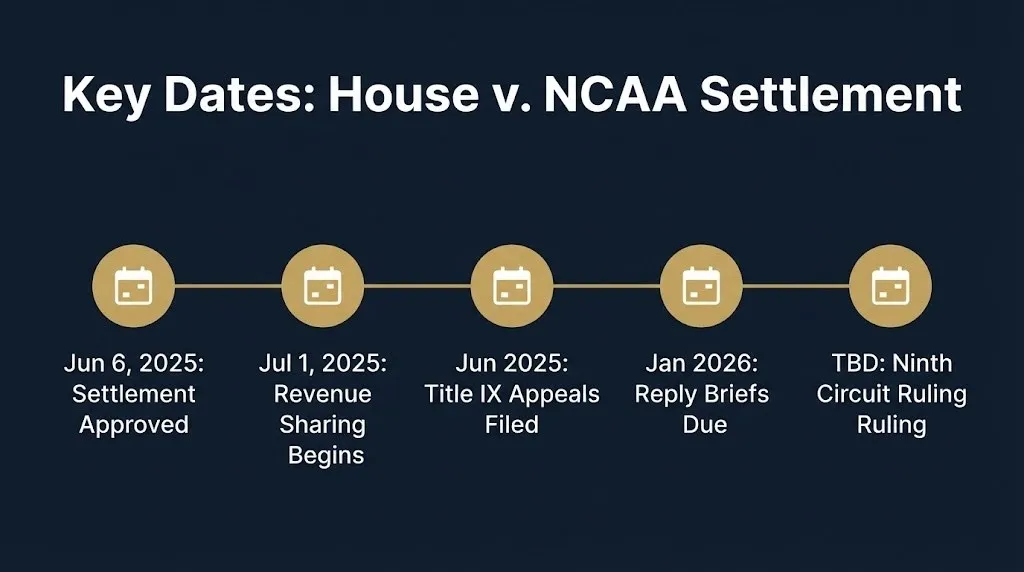
U.S. District Judge Claudia Wilken of the Northern District of California granted final approval on June 6, 2025, after more than a year of negotiations following the case’s initial settlement announcement in May 2024. The deal resolves three consolidated antitrust lawsuits: House, Carter, and Hubbard v. NCAA.
The NCAA and its Power Five conferences, the ACC, Big Ten, Big 12, SEC, and Pac-12, are all named defendants and parties to the settlement. This isn’t a class action mill site or a text scam; it’s one of the largest sports antitrust settlements in U.S. history.
Key facts confirming legitimacy:
- Approved by a sitting federal judge with a 76-page written order.
- Covers Division I athletes going back to June 15, 2016.
- Direct payments to current athletes began July 1, 2025, and are ongoing in 2026.
How Much Money Can You Get From the House v. NCAA Settlement?
Payout amounts depend entirely on your sport, scholarship status, and years of competition, and the largest share of the fund is currently frozen and not yet determined for individual athletes.
The settlement splits money into two very different buckets: back-pay damages for past athletes, and forward-looking revenue sharing for current athletes.
Back-pay damages allocation (paused, subject to appeal):
| Class | Share of ~$2.6 Billion Damages Pool |
|---|---|
| Football and Men’s Basketball (Power Five, 2016-2024) | Roughly 90 percent |
| Women’s Basketball | Roughly 5 percent |
| All other sports combined | Roughly 5 percent |
Revenue sharing (active, no appeal freeze):
- Each participating school can share up to a cap set at $20.5 million for the 2025-26 academic year.
- The cap is calculated as up to 22 percent of average Power Five athletic revenue and is expected to rise each year through the 10-year term.
- Individual athlete revenue-share amounts are set school by school and are not standardized or publicly tracked in one place.
Key Takeaway: Revenue-sharing payments to current athletes are real and flowing right now, but the $2.6 billion in back-pay damages for past athletes stays frozen until the Ninth Circuit rules on the Title IX appeals.
NCAA Lawsuit Claim Form: Do You Still Need to File Anything?
Most eligible athletes do not need to file a new claim, since class membership was determined automatically based on sport, school, and competition dates.
The exception involves the three headline classes: Football, Men’s Basketball, and Women’s Basketball athletes who held a full scholarship at a Power Five school between 2016 and 2024. Those athletes can and should keep their contact and payment information updated.
If you believe you’re a class member:
- Go to the official College Athlete Compensation site set up for the settlement.
- Check whether you fall under a Power Five full-scholarship class needing to update payment info.
- If you’re in another sport or conference, confirm your inclusion in the broader Division I class.
- Update your mailing address and payment method even though back pay is frozen.
- Watch for direct notices from class counsel, especially the newly ordered 2026-27 dissemination plan.
- Do not pay any third party claiming to “expedite” your NCAA settlement payment.
Athletes who did not opt out by the original deadline are automatically bound by the settlement’s terms, including the release of related antitrust claims.
NCAA Settlement Payout: When Will Back Pay Actually Arrive?
Back-pay distribution is on hold, and there’s currently no confirmed payment date, because an automatic stay froze all damages the moment appeals were filed.
Just five days after Judge Wilken’s approval, a group of eight female student-athletes filed a notice of appeal in the Ninth Circuit. Other objector groups quickly followed, and the court has since consolidated three separate appeals raising Title IX challenges.
That stay applies only to back damages. Revenue-sharing payments under the injunctive relief portion of the settlement began July 1, 2025, and were unaffected. As of the most recent case tracker update, the last docketed event in the case was July 10, 2026, but no ruling on the merits of the Title IX appeal has come down.
Attorneys close to the case have publicly noted the Ninth Circuit can take around two years to decide an appeal of this complexity, and a loss for either side could still be appealed further to the U.S. Supreme Court.
Reality Check
No settlement administrator or law firm will text you asking for a fee to “release” your NCAA back-pay damages faster, because that money isn’t being released to anyone right now, current athlete or former. Filing for revenue sharing or damages under this settlement was never something individual athletes pay to access. Any message pressuring you to act urgently or pay upfront on this case should be treated as a scam.
Why Is the NCAA Settlement Under a Title IX Appeal?
The Title IX appeal exists because objecting female athletes argue the back-pay damages formula illegally favors male football and basketball players over women.
According to the appellants, roughly 90 percent of the $2.6 billion in back damages goes to football and men’s basketball athletes, while women’s basketball and all other women’s sports combined receive a small fraction. The appellants argue this proportion violates Title IX’s requirement for equitable treatment of male and female athletes in federally funded programs.
Class counsel and the NCAA counter that Title IX doesn’t apply here because House was an antitrust case, not a discrimination case, and that damages are meant to reflect what athletes would have earned in NIL markets, which skewed heavily toward football and basketball.
Where the appeal stands, based on the most recent verified filings:
- Opening briefs from appellants were filed in late October 2025.
- Reply briefs were due in January 2026.
- Oral argument has been expected to follow, though no confirmed date has been publicly reported as of this writing.
- The court must decide whether Judge Wilken abused her discretion in approving the settlement as structured.
Key Takeaway: This isn’t a minor procedural objection. It’s a live legal fight over whether nearly $2.4 billion allocated to men should be redistributed to comply with federal gender-equity law.
Who Qualifies for NCAA Settlement Money?
You may qualify if you competed in a Division I sport at an NCAA member school at any point between June 15, 2016, and June 6, 2025, though your specific payout eligibility depends on your sport and scholarship status.
General eligibility categories:
- Football and men’s or women’s basketball players on full athletic scholarship at Power Five schools between 2016 and 2024 are part of the largest, most defined class.
- Athletes in other Division I sports may qualify for a smaller share of the damages pool, pending Title IX resolution.
- Current athletes at schools that have opted into revenue sharing may receive direct payments regardless of the back-pay appeal.
- Athletes who formally opted out of the settlement are not bound by it and pursued separate litigation, including the ongoing Hill v. NCAA case.
Schools outside the Power Four conferences can choose annually whether to opt into the settlement’s revenue-sharing terms; that decision is not automatic.
NCAA Settlement Update: What Else Changed in 2026
Beyond the Title IX appeal, several other developments have shaped how this settlement plays out in practice.
On April 3, 2026, the White House issued an executive order directing federal agencies to evaluate college athletics compliance, including revenue sharing and spending disclosures by sex, when awarding federal grants and contracts. This doesn’t directly rule on Title IX, but it signals more federal scrutiny is coming regardless of how the Ninth Circuit rules.
Separately, class counsel has been in ongoing disputes with the College Sports Commission, the entity created to enforce NIL clearinghouse rules under the settlement, over what counsel calls regulatory “overreach” beyond the settlement’s actual terms. That dispute remains active in the district court as of April 2026.
Houston Christian University also attempted to intervene and block the settlement outright; that motion was denied, and the university has separately appealed to the Ninth Circuit.
Student Athlete Compensation: How Revenue Sharing Works Right Now
Revenue sharing means participating schools can pay athletes directly out of athletic department revenue, up to a set cap that rises each year.
For the 2025-26 academic year, that cap sits at $20.5 million per school, a figure that does not include the value of grant-in-aid scholarships. The formula ties the cap to roughly 22 percent of average shared revenue among Power Five member institutions.
How the funding burden is split, according to verified reporting:
- The NCAA is using its reserve fund to cover roughly 40 percent of the overall settlement cost.
- Division I conferences cover the remaining 60 percent.
- Within that share, the Power Five conferences take on about 40 percent, with the rest spread across non-power conference schools.
This is a genuinely new system. Think of it like a company suddenly being allowed to pay commissions directly to its top salespeople instead of funneling everything through a fixed scholarship budget; the money moves differently now, and everyone is still figuring out the mechanics.
What Happens Next
July 2026 (current): Last docketed case activity was July 10, 2026, with no ruling yet on the Title IX appeal.
Expected next milestone: Ninth Circuit oral argument on the consolidated Title IX appeals, no confirmed date yet.
If the Ninth Circuit affirms the settlement: Back-pay damages distribution could begin, timing not yet confirmed.
If the Ninth Circuit requires changes: The damages formula could be restructured, delaying payments further, possibly by another year or more.
Ongoing regardless of appeal outcome: Revenue-sharing payments continue under the current $20.5 million cap through the 2026-27 academic year, with the cap expected to rise.
Frequently Asked Questions
Is the NCAA settlement real or a scam?
It’s a real, federally approved class action settlement, not a scam.
Judge Claudia Wilken granted final approval on June 6, 2025, in the Northern District of California.
The only legitimate source for status updates is official case filings and the settlement’s designated athlete compensation site.
How much money will I get from the NCAA settlement?
The amount depends heavily on your sport, scholarship status, and years of eligibility, and most figures are not yet determined.
Football and men’s basketball players are allocated roughly 90 percent of the $2.6 billion damages pool.
Back-pay distribution is currently frozen during Title IX appeals, so no individual payout amounts have been finalized.
When will House v. NCAA settlement checks be mailed?
No payment date exists yet for back-pay damages, because of an active Title IX appeal stay.
Revenue-sharing payments to current athletes are already happening and are unaffected by the stay.
Watch for updates from class counsel and the Ninth Circuit docket for the damages timeline.
Do I need to file a claim for the NCAA settlement?
Most athletes do not need to file a new claim, since eligibility was determined automatically.
Only certain Power Five full-scholarship athletes in football, men’s basketball, or women’s basketball need to actively update payment information.
If you’re unsure of your class status, check the official athlete compensation settlement site.
Why is NCAA back pay frozen right now?
Back pay is frozen because female athletes appealed the settlement’s damages formula on Title IX grounds.
The appeal argues the formula illegally shortchanges women by allocating roughly 90 percent of damages to men.
The Ninth Circuit Court of Appeals has not yet ruled, and the stay remains active as of July 2026.
Can I still opt out of the NCAA settlement?
The general opt-out window for the settlement has passed for most class members.
Athletes who opted out on time preserved separate legal claims, including in the ongoing Hill v. NCAA case.
If you didn’t opt out by the original deadline, you’re bound by the settlement’s terms.
Does the NCAA settlement affect current athletes differently than former athletes?
Yes, current athletes benefit primarily from active revenue-sharing payments, which are not affected by the appeal.
Former athletes are eligible mainly for back-pay damages, which remain frozen pending the Title IX ruling.
Some athletes who competed both before and after July 2025 may have claims in both categories.
How long could the Title IX appeal take to resolve?
There’s no confirmed timeline, and appeals of this size can take one to two years at the Ninth Circuit alone.
A loss for either side could be further appealed to the U.S. Supreme Court, extending the timeline more.
The settlement website and court dockets remain the only reliable places to track progress.
This case will keep evolving as the Ninth Circuit works through the Title IX appeals, so don’t expect a quick resolution on back pay. If you’re a class member, the most useful thing you can do right now is keep your contact and payment information current and check official sources rather than secondhand headlines.
The one fact worth calendaring: as of July 19, 2026, no ruling has come down from the Ninth Circuit, and back-pay damages remain frozen with no confirmed release date.