Mike Tyson $50 Million Lawsuit 2026: Status, Claims, and What Is Actually Verified
Quick Answer
- Claims about a Mike Tyson $50 million lawsuit circulate online but lack verified court records.
- No confirmed settlement, payout, or deadline exists for this specific claim.
- Treat viral posts about this lawsuit as unverified until official court documents surface.
You searched for “Mike Tyson $50 million lawsuit” because you saw a headline, a video, or a social post about the former heavyweight champion facing a massive legal claim. You want to know if it is real.
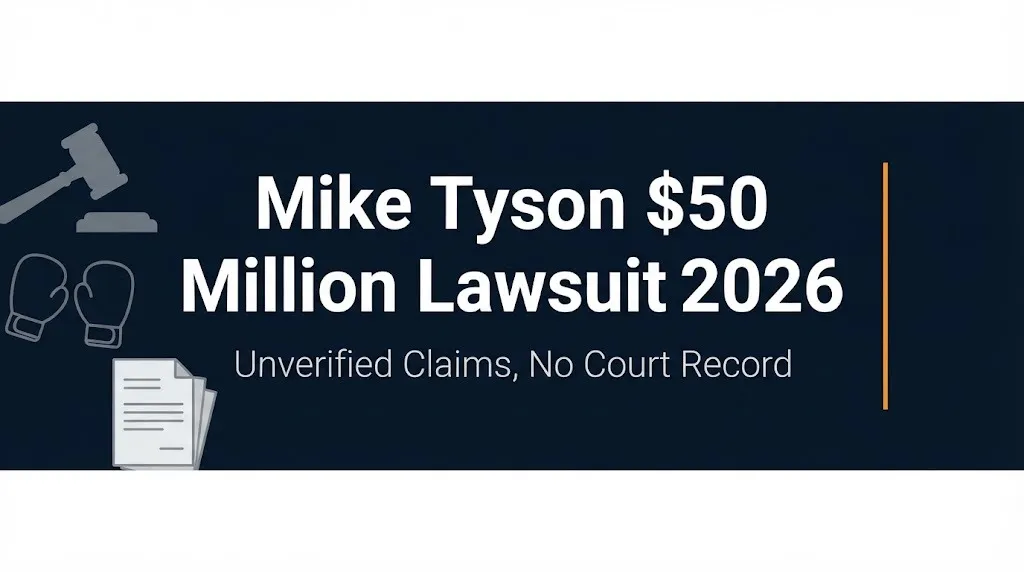
Here is the honest answer. As of August 20, 2026, no verified court filing matching a $50 million lawsuit against Mike Tyson has been confirmed through official sources. The claims circulating online are largely unverified. That does not mean nothing happened. It means the public record is not clear.
This article explains what is known, what is not confirmed, Mike Tyson’s legal history, and how to evaluate unverified lawsuit claims you see online.
| The Facts | |
|---|---|
| Case | Unverified claims of a $50 million lawsuit involving Mike Tyson |
| Status | Not confirmed through official court records |
| Fund Size | Not applicable, no confirmed settlement |
| Est. Per Person | Not applicable |
| Claim Deadline | None, no confirmed settlement |
| Administrator | Not appointed |
| Proof Needed | Not applicable |
Is the Mike Tyson $50 million lawsuit real?
The Mike Tyson $50 million lawsuit has not been confirmed as real through official court records. That is the most accurate statement available as of August 20, 2026.
Multiple online posts and videos reference a $50 million legal claim involving Mike Tyson. Some mention assault allegations. Some mention contract disputes. Some mention defamation. None of these claims have been verified through a court docket, a filed complaint, or an official statement.
A real lawsuit has a case number, a named court, and a filed complaint. Those documents are public in most cases. Without them, a claim is just a claim.
If a lawsuit exists, it has not been publicly documented in a way that can be verified through standard legal research tools.
Who is making the $50 million claim against Mike Tyson?
The identity of the person or entity making the $50 million claim against Mike Tyson is not confirmed through verified court records. Online sources name different parties and different legal theories.
Some posts claim a woman filed the lawsuit over an alleged assault. Others claim a business partner sued over a contract. Some claim a promoter sued over a canceled event. None of these claims are verified.
Here is a summary of what online sources claim, with the caveat that none are verified.
| Claim Type | Status |
|---|---|
| Assault lawsuit | Unverified |
| Contract dispute | Unverified |
| Defamation claim | Unverified |
| Event cancellation dispute | Unverified |
| Business partnership dispute | Unverified |
Treat every claim as unverified until a court filing or official statement confirms it.
Why do Mike Tyson lawsuit rumors spread so fast?
Mike Tyson lawsuit rumors spread fast because Tyson is a famous, controversial figure with a long legal history. A headline about a $50 million lawsuit combines celebrity, money, and conflict. That combination spreads.
The problem is that viral posts rarely link to court documents. They repeat what someone else said. The original source is often a rumor, a misheard comment, or a single social post with no evidence.
Tyson has been involved in real legal cases over the years. That history makes new claims seem plausible. But plausibility is not proof.
Here is why this matters.
- A false claim can damage reputations.
- A false claim can mislead people into thinking a settlement exists.
- A false claim can be used to drive traffic to scam sites.
- A false claim distracts from real legal issues.
The responsible response is to check the court record before repeating the claim.
What is Mike Tyson’s actual legal history?
Mike Tyson has a documented legal history. He was convicted of rape in 1992 and served prison time. He has been involved in civil lawsuits, contract disputes, and bankruptcy proceedings. His legal history is public record.
But a past legal history does not confirm a new $50 million lawsuit. Each case is separate. Each must be verified on its own.
Here is a summary of verified legal events in Tyson’s history.
| Event | Status |
|---|---|
| 1992 rape conviction | Verified, public record |
| 2003 bankruptcy filing | Verified, public record |
| Boxing contract disputes | Verified, various |
| Civil assault lawsuits | Verified, various |
| $50 million lawsuit 2026 | Unverified |
The verified history is real. The specific $50 million claim is not.
How do I verify a lawsuit claim?
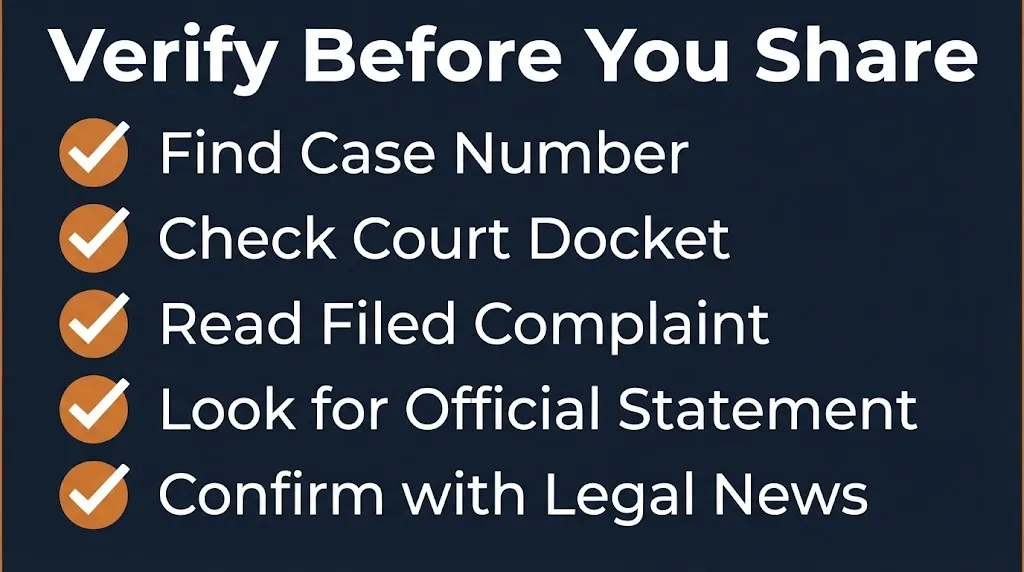
You verify a lawsuit claim by finding the court record. That means the case name, the court, the case number, and the filed complaint. Without those, the claim is unverified.
Here is a verification checklist.
- Search federal court records through PACER.
- Search state court records for the relevant state.
- Look for an official press release from either party.
- Check established legal news outlets.
- Look for a filed complaint with a case number.
- Check for a court docket or hearing date.
If none of those sources show the case, the claim is not verified.
Key Takeaway: Verification is a discipline. A viral post is not a source. A court docket is a source.
Reality Check: No legitimate lawsuit news source reports a case without a court record. If a viral post cannot name the court and case number, it is not reporting. It is repeating.
What should I do if I see an unverified Mike Tyson lawsuit claim?
If you see an unverified Mike Tyson lawsuit claim, do not share it. Do not repeat it as fact. Ask for the court record.
Here is what to do instead.
- Ask for the case number and court.
- Search the court docket yourself.
- Check established legal news sources.
- Look for an official statement from either party.
- If nothing verifies, treat the claim as unconfirmed.
This is not about defending Mike Tyson or doubting a potential plaintiff. It is about accuracy. A false claim hurts everyone involved.
Could the Mike Tyson lawsuit be sealed?
It is possible that a lawsuit involving Mike Tyson is sealed or filed under seal. Some cases are sealed by court order to protect privacy or confidential information. But sealed cases are rare and usually involve specific legal justifications.
Even a sealed case has a docket entry. The case number exists. The court knows the parties. Complete secrecy is unusual.
If a $50 million lawsuit existed, it would likely leave some public trace. The absence of any trace suggests the claim is unverified, not necessarily sealed.
Why is there no official statement from Mike Tyson or his representatives?
There may be no official statement because there is nothing to state. Or because the parties resolved the matter privately. Or because no lawsuit exists.
Public figures do not usually comment on rumors. They issue statements when there is a verified legal matter that requires public disclosure.
The absence of a statement is not proof of a lawsuit. It is also not proof that nothing happened. It is simply the absence of verified information.
What is Mike Tyson doing in 2026?
Mike Tyson has been active in boxing, entertainment, and business. He fought an exhibition match against Jake Paul in 2024. He has appeared in films, television, and podcasts. His public activities continue.
None of those activities confirm or deny a lawsuit. They are separate facts.
If a $50 million lawsuit existed, it might affect Tyson’s business dealings. But no verified effect has been documented.
What are the most common fake lawsuit claims about celebrities?
The most common fake lawsuit claims about celebrities involve assault, contract disputes, and defamation. The dollar amounts are usually large. The sources are usually social media posts or low-quality websites.
Here is how to spot a fake lawsuit claim.
- No case number or court name
- No filed complaint
- No established legal news coverage
- No official statement from either party
- A source that is a random social media account or a content farm
If a claim lacks all of those markers, it is not verified.
What Happens Next
If a lawsuit exists: It may appear on a court docket in the future.
If the matter is private: The public may never see confirmation.
If the claim is false: It will remain unverified and should not be repeated.
The single most important action is to check the court record before believing or sharing any lawsuit claim. No case number means no verified case.