UFC Antitrust Lawsuit 2026: $375 Million Paid, Johnson Case Still Open
Quick Answer
- Real and active: Le v. Zuffa settled for $375 million; Johnson v. Zuffa is still pending in Nevada.
- Payout: Le fighters averaged about $250,000, per class counsel. Johnson payouts are not yet determined.
- No claim deadline is confirmed for Johnson. A sanctions hearing ran June 30 to July 2, 2026.
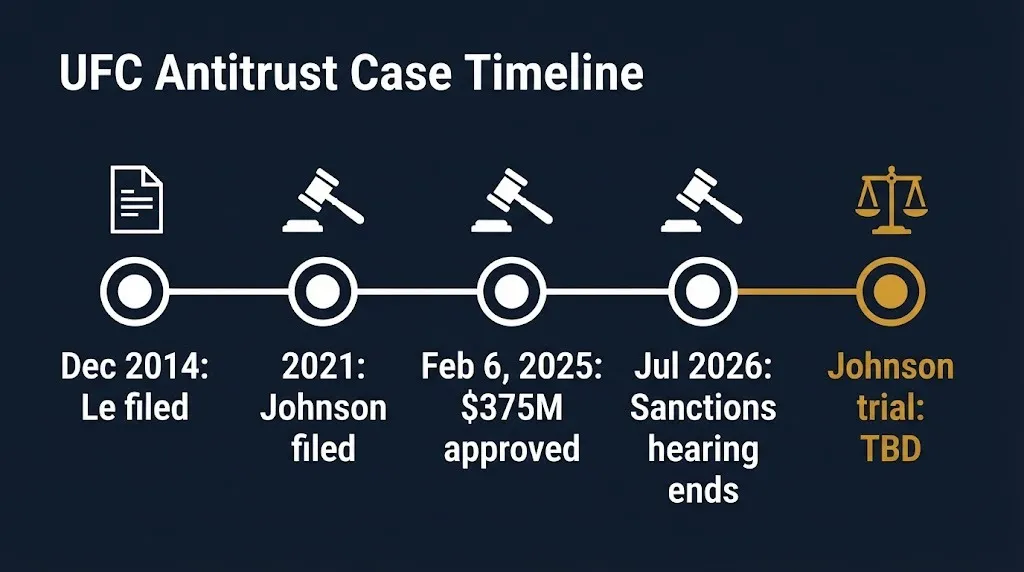
The UFC antitrust lawsuit is really several cases, and only one has paid out. Le v. Zuffa ended in a $375 million settlement that won final approval on February 6, 2025.
If you fought in the UFC after July 1, 2017, the Johnson case is the one that may matter to you. It has no settlement, no claim form, and no confirmed trial date.
This guide sorts the cases, the money, and the 2026 evidence fight. One surprising detail: a popular guide still cites $335 million as the final number, which the judge rejected.
| The Facts | |
|---|---|
| Case | Le v. Zuffa (settled) and Johnson v. Zuffa, No. 2:21-cv-01189 (pending) |
| Status | Le: final approval Feb. 6, 2025. Johnson: pending; sanctions hearing ended July 2, 2026 |
| Fund Size | $375 million (Le only). Johnson: Not yet confirmed |
| Est. Per Person | About $250,000 average in Le, per class counsel. Johnson: Not yet determined |
| Claim Deadline | None confirmed for Johnson, watch the official site |
| Administrator | Not confirmed in the sources checked |
| Proof Needed | Check any official notice. Keep contracts and fight records |
Is the UFC antitrust lawsuit still active in 2026?
Yes, Johnson v. Zuffa is still active in 2026, though the Le case settled.
Johnson was filed in 2021 in the U.S. District Court for the District of Nevada. Judge Richard F. Boulware II oversees it. Fighters’ lawyers seek damages and court-ordered changes to UFC contracts for fighters who competed from July 1, 2017 onward.
Court docket entries show an evidentiary hearing on evidence destruction from June 30 through July 2, 2026. One popular guide calls the matter closed and in its “final distribution phase.” The docket says otherwise.
Here’s what is active and what isn’t:
- Settled: Le v. Zuffa, covering December 2010 to June 2017
- Pending: Johnson v. Zuffa, covering July 2017 to the present
- Pending: Cirkunovs v. Zuffa and Davis v. Zuffa, both filed May 2025
Did the UFC antitrust lawsuit settle for $335 million or $375 million?
The approved settlement was $375 million, not $335 million.
In March 2024, the UFC agreed to a $335 million deal that covered both Le and Johnson. Judge Boulware rejected it in July 2024. The two sides then reached a new, Le-only agreement for $375 million.
The judge granted preliminary approval on October 21, 2024, and final approval on February 6, 2025.
| Deal | Cases covered | Amount | Outcome |
|---|---|---|---|
| March 2024 joint deal | Le and Johnson | $335 million | Rejected July 2024 |
| September 2024 revised deal | Le only | $375 million | Final approval Feb. 6, 2025 |
The $335 million figure is a rejected number. Pages that present it as the final payout are wrong. Check the date and the case name before you trust any figure.
How much did UFC fighters get from the antitrust settlement?
Fighters in Le v. Zuffa averaged about $250,000 each from the $375 million fund.
That average comes from the Saveri Law Firm, which served as co-lead counsel. Berger Montague, the other co-lead firm, reports that 1,088 of 1,121 eligible class members are receiving compensation. That’s a 97 percent participation rate.
An average is like a restaurant bill split evenly: nobody paid exactly that amount. Individual shares depended on the court-approved allocation, so check with class counsel for yours.
| Item | Figure |
|---|---|
| Total fund | $375 million |
| Average per fighter (class counsel) | About $250,000 |
| Eligible class members paid | 1,088 of 1,121 |
| Estimated net after fees (Forbes figure, reported October 2024) | $240 to $260 million |
| Johnson per-person amount | Not yet determined: no settlement or verdict exists |
Key Takeaway: The UFC antitrust lawsuit has paid out once, $375 million in Le v. Zuffa, and the Johnson case has no confirmed money.
Can you still get money from the UFC antitrust lawsuit?
You may qualify for Johnson money if you fought in the UFC after July 1, 2017.
Nothing is confirmed, because Johnson has no settlement or verdict. The class is proposed, not certified, in the sources checked. Amounts depend on a win or a deal.
The Le class is closed. It covered fighters who competed between December 16, 2010 and June 30, 2017.
Who might fit each pending case:
- Johnson: fighters in UFC bouts from July 1, 2017 to the present (proposed class)
- Cirkunovs: fighters since July 1, 2017, with a challenge to arbitration clauses and class waivers
- Davis: non-UFC fighters who competed in the U.S. since May 29, 2021
The Cirkunovs case matters because contract clauses kept hundreds of fighters out of earlier classes. If plaintiffs win that fight, the Johnson class could grow.
Reality Check: No one will text you UFC settlement money first. Court-run class cases don’t charge fighters a fee to be included. Treat any paid “claim service” promising a Johnson payout as a red flag.
How do you check if you’re in the UFC antitrust class?
You can’t file a Johnson claim today, but seven steps show where you may stand.
- Pull your UFC contract and list every fight date.
- Find your first bout after June 30, 2017.
- Check whether your contract has an arbitration clause or class waiver.
- Contact class counsel listed in the case, Berger Montague or the Saveri Law Firm.
- Review docket entries for Johnson v. Zuffa in the District of Nevada.
- Keep contracts, purse records, and pay statements.
- Read any release closely before you sign it.
Wait for an official court notice before submitting anything. A real notice names the court, the case number, and counsel.
Is there a claim deadline in the UFC antitrust case?
No claim deadline exists in Johnson v. Zuffa, because no settlement or claims process is open.
For Le, the claim window isn’t confirmed in the sources checked. Class counsel reports payments are going to eligible members.
| Date type | Johnson status |
|---|---|
| Claim deadline | None |
| Opt-out deadline | None |
| Final approval hearing | None scheduled |
| Trial date | Not confirmed |
Individual antitrust claims carry time limits, and they vary with your facts. Ask an attorney how a limit applies to you.
Key Takeaway: There is no Johnson claim deadline today, but your own legal time limits may still be running.
What does the spoliation fight in Johnson v. Zuffa mean?
Spoliation means destroying or losing evidence, and fighters’ lawyers say the UFC side did.
Judge Boulware ordered a hearing for February 4 and 5, 2026, with Dana White as the first witness. On February 25, 2026, plaintiffs moved for severe sanctions, including a default judgment. They named TKO Operating Co. (which does business as the UFC), Endeavor Group Holdings, and Zuffa LLC.
The judge also ordered a full accounting of missing phones and data. The hearing resumed June 30 and ran through July 2, 2026.
It’s like a store return where the store lost the receipt: the question is whether the loss was an accident or on purpose. Under Federal Rule 37(e), harsh penalties need an “intent to deprive.”
A docket listing references an order on the sanctions motion in July 2026. Its terms are not yet confirmed in the sources checked. The sources include no UFC response to the motion.
What is the latest in the Cirkunovs and Davis lawsuits?
Both were filed in May 2025 and remain pending, with no confirmed class certification.
Cirkunovs v. Zuffa was filed May 23, 2025, by retired fighter Misha Cirkunov. It names Zuffa LLC, Zuffa Parent LLC, and Endeavor Group Holdings. The complaint tracks Johnson but targets a different class and attacks the arbitration and class-waiver terms.
Davis v. Zuffa came from former fighter Phil Davis. It claims UFC practices hurt wages for fighters outside the UFC too. Its proposed class covers non-UFC fighters who competed in the U.S. since May 29, 2021.
Judge Boulware is handling these matters alongside Johnson. A ruling in one can shape the others.
When will the UFC antitrust trial happen?
No Johnson trial date is confirmed in the sources checked.
Several steps come first. The court must resolve the sanctions fight and decide class certification. The Le case reached the edge of trial before it settled, so a deal remains possible in any case.
Trial risk cuts both ways. A jury verdict must be unanimous, and the loser can appeal, so money could take years.
What has to happen before any trial:
- A ruling on the sanctions motion
- A decision on class certification
- Completion of discovery
- A trial date set by the court
Key Takeaway: Johnson has no confirmed trial date, and the evidence fight could change how the case proceeds.
What is the UFC antitrust lawsuit about?
It accuses Zuffa LLC, which does business as the UFC, of illegally suppressing fighter pay.
Plaintiffs say the UFC built and kept monopoly power over MMA promotion, then held down what fighters earned. They sued under Section 2 of the Sherman Act and sought treble damages. The Le plaintiffs sought between $800 million and $1.6 billion in damages.
Le was filed in December 2014 by Cung Le, Nate Quarry, and Jon Fitch, and others joined later. The UFC has defended itself by pointing to its investment in the sport and to rival promotions.
Those are allegations and defenses. No court has issued a final liability finding.
Why did the judge reject the first UFC antitrust settlement?
Judge Boulware rejected the $335 million deal in July 2024 over low pay and weak reforms.
Reporting cites three concerns:
- Compensation was too low, especially for the Johnson class
- The deal didn’t challenge contract clauses that excluded hundreds of fighters
- It lacked meaningful relief aimed at the alleged monopsony power
It’s like a lender refusing a loan application that skips a major debt. The paperwork has to cover the whole picture.
TKO said it disagreed and argued the ruling disregarded counsel and an expert mediator. The sides returned with a $375 million Le-only deal, and Johnson stayed alive.
What does monopsony mean in the UFC antitrust case?
A monopsony is a market with one dominant buyer, which plaintiffs say is the UFC.
A monopoly has one seller. A monopsony has one main buyer, so sellers have few places to take their work. Here the sellers are fighters, and the product is their services.
| Term | Meaning | UFC case claim |
|---|---|---|
| Monopoly | One seller controls a market | Not the core theory |
| Monopsony | One buyer controls a market | UFC dominates buying elite fighter services |
| Suppressed wages | Pay held below competitive levels | The central damages claim |
One filing compares the UFC to the NFL. The NFL has teams that compete for players in free agency, and plaintiffs say the UFC has no such bidding.
How do the four UFC antitrust cases compare?
Le is settled, and Johnson, Cirkunovs, and Davis are pending.
| Case | Who it covers | Status |
|---|---|---|
| Le v. Zuffa | Fought Dec. 16, 2010 to June 30, 2017 | $375 million; final approval Feb. 6, 2025 |
| Johnson v. Zuffa | July 1, 2017 to present (proposed) | Pending; sanctions hearing ended July 2, 2026 |
| Cirkunovs v. Zuffa | Fighters since July 1, 2017; contract clause challenge | Pending |
| Davis v. Zuffa | Non-UFC fighters in the U.S. since May 29, 2021 | Pending |
Key Takeaway: Only Le has paid, and fighters in the other three cases have no confirmed recovery.
What happens next in the UFC antitrust lawsuit?
Expect court-driven steps, and most carry no confirmed date.
Date not confirmed: The court’s July 2026 sanctions order in Johnson is reflected on the docket, but its terms need verification.
Expected, not confirmed: The judge decides class certification in Johnson and Cirkunovs.
Expected, not confirmed: The court rules on whether arbitration clauses and class waivers hold up.
Date not set: A Johnson trial, if no settlement comes first.
Frequently Asked Questions
Is the UFC antitrust lawsuit real?
Yes, several federal antitrust cases against Zuffa LLC are on the court record.
Le v. Zuffa settled for $375 million.
Johnson v. Zuffa is still pending in Nevada.
Did the UFC settle the antitrust lawsuit?
It settled Le v. Zuffa only, for $375 million.
Final approval came February 6, 2025.
Johnson has no settlement.
Can I still join the UFC antitrust lawsuit?
You may qualify for Johnson if you fought in the UFC after July 1, 2017.
No claim form is open.
Watch for an official court notice.
Who is the judge in the UFC antitrust lawsuit?
Judge Richard F. Boulware II of the District of Nevada oversees the cases.
He handled the Le settlement.
He is also hearing Johnson and Cirkunovs.
Is the UFC antitrust case over?
No, the Johnson case is still active in 2026.
Sanctions proceedings ran through July 2, 2026.
Cirkunovs and Davis are pending too.
What does the UFC say about the lawsuit?
The UFC has defended itself by citing its investment in the sport and rival promotions.
It disagreed publicly with the July 2024 ruling on the first deal.
Sources checked include no UFC response on the sanctions motion.
How much will Johnson fighters get?
The amount is not yet determined.
No settlement or verdict exists.
Le’s $375 million does not set a number for Johnson.
Keep your contracts, purse records, and fight dates in one folder. Ignore any page that quotes a Johnson payout, since none exists.
The date that matters most right now is February 6, 2025, when the $375 million Le settlement won final approval. Johnson has no deadline yet.