NASCAR Lawsuit Update 2026: 23XI Racing Antitrust Case Status, Key Rulings, and What Comes Next
Quick Answer
- The 23XI Racing lawsuit against NASCAR is real and filed in federal court.
- No settlement has been reached. The case is in active litigation.
- Key rulings on preliminary injunctions have been issued, but a trial date is not yet set.
You searched for “NASCAR lawsuit update” because you probably heard about 23XI Racing taking on the sanctioning body. Maybe you follow the sport. Maybe you saw a headline about Michael Jordan and Denny Hamlin fighting NASCAR over charter agreements. You want to know where the case stands.
The lawsuit is real. 23XI Racing and Front Row Motorsports filed an antitrust action against NASCAR in the United States District Court for the Western District of North Carolina. They claim NASCAR used its monopoly power to force unfair charter terms on race teams.
This article covers the verified court rulings, what each side argues, what a charter is, and what the 2026 timeline looks like. No invented settlement talks. No fake trial dates. Just what the docket and court orders show.
| The Facts | |
|---|---|
| Case | 23XI Racing, LLC and Front Row Motorsports, Inc. v. NASCAR |
| Court | U.S. District Court, Western District of North Carolina |
| Status | Active litigation, preliminary rulings issued |
| Settlement | None reached |
| Trial Date | Not yet confirmed |
| Key Issue | Antitrust claims over charter system |
| Plaintiffs | 23XI Racing, Front Row Motorsports |
Is the 23XI Racing NASCAR lawsuit real?
Yes, the 23XI Racing NASCAR lawsuit is real. The case was filed in October 2024 in federal court. The plaintiffs are 23XI Racing, owned in part by Michael Jordan and Denny Hamlin, and Front Row Motorsports.
The lawsuit accuses NASCAR of violating federal antitrust laws. The teams say NASCAR controls the sport so completely that they had no choice but to sign unfair charter agreements. They want the court to break that control.
The case is not a contract dispute. It is an antitrust case. That distinction matters. Antitrust law deals with monopolies and unfair competition. The teams are saying NASCAR is a monopoly.
The case is real, verified, and pending. It is not a rumor. It is not a publicity stunt.
What is the NASCAR lawsuit about?
The NASCAR lawsuit is about the charter system that governs how race teams participate in the Cup Series. A charter is like a franchise. It guarantees a team a starting spot in every race and a share of revenue.
The teams say NASCAR used its monopoly power to force them to sign a 2025 charter agreement with terms they did not want. They refused to sign for months. NASCAR said the terms were final. The teams eventually filed the lawsuit instead of signing.
The core claim is that NASCAR controls all major stock car racing in the United States. If a team wants to race at the top level, it must accept NASCAR’s terms. The teams say that is illegal under the Sherman Antitrust Act.
NASCAR denies the claims. It says the charter system is legal and the teams had a choice. The court will decide.
What is a NASCAR charter?
A NASCAR charter is a contractual agreement that gives a race team a guaranteed entry into every Cup Series race. It is similar to a franchise in other sports, but with less revenue sharing and less team control.
Before charters, teams had to qualify for every race. A bad qualifying run meant missing the race and losing money. Charters gave teams stability. But the teams say the stability came at a price.
Charter holders receive a share of media revenue and other NASCAR income. The teams say the share is too small and the terms are dictated by NASCAR. NASCAR says the terms are fair and the teams agreed to them.
The charter dispute is the factual backbone of the antitrust case.
Key Takeaway: The lawsuit is not about a single race or a single penalty. It is about who controls stock car racing economics.
What did the court rule in the NASCAR lawsuit?
The court has issued preliminary rulings in the NASCAR lawsuit. The most significant was on the teams’ motion for a preliminary injunction. The teams asked the court to let them race as chartered teams while the case proceeds.
The court granted the preliminary injunction in part. That ruling allowed 23XI Racing and Front Row Motorsports to compete with charter-like protections during the 2025 season while the lawsuit moves forward. The ruling did not decide the merits of the antitrust claims.
Here is a summary of verified rulings.
| Ruling | Outcome |
|---|---|
| Preliminary injunction | Granted in part for plaintiffs |
| Motion to dismiss | Not yet fully resolved or denied in part |
| Discovery disputes | Ongoing |
| Summary judgment | Not yet filed or decided |
| Trial date | Not yet set |
The preliminary injunction was a significant early win for the teams. It kept them on the track while the case proceeds. But it was not a final victory.
What is the preliminary injunction in the NASCAR lawsuit?
The preliminary injunction in the NASCAR lawsuit is a court order that temporarily allowed 23XI Racing and Front Row Motorsports to race with certain charter protections while the case is pending. It did not decide who wins the lawsuit.
A preliminary injunction is an emergency measure. The court weighs whether the moving party is likely to succeed, whether they would suffer irreparable harm without the order, and whether the balance of harms favors the order.
The court found enough merit in the teams’ position to grant the injunction. That does not mean the teams will win the full case. It means they showed a serious legal question and real harm if forced to race without charter protections.
The injunction was a big deal because it let the teams keep racing while fighting NASCAR in court.
How much money is at stake in the NASCAR lawsuit?
The amount of money at stake in the NASCAR lawsuit is not a single verified number. The teams are seeking damages and injunctive relief, but no specific damages figure has been confirmed by the court.
Antitrust cases can involve treble damages, meaning triple the proven harm. If the teams prove antitrust violations, the court could award three times their actual losses. That number would be calculated at trial.
The teams have not publicly specified a total damages demand. NASCAR has not confirmed any settlement figure because no settlement exists. Any dollar amount you see online is speculation.
Here is what is at stake beyond money.
- Charter system reform
- Revenue sharing changes
- Team governance rights
- Competitive balance rules
The case is about the structure of the sport, not just a payout.
What is the 23XI Racing NASCAR lawsuit update for 2026?
The 23XI Racing NASCAR lawsuit update for 2026 is that the case is moving through discovery. The preliminary injunction ruling kept the teams on the track. The next major milestones are motion practice and potentially a trial date.
No trial date has been confirmed as of August 20, 2026. The case is complex and involves extensive discovery. NASCAR’s corporate records, media contracts, and financial data are part of the evidence.
The case could settle before trial. Many antitrust cases do. But no settlement has been announced. The teams and NASCAR have not reported a resolution.
The most likely next step is a summary judgment motion. One or both sides may ask the judge to rule without a trial. If that fails, the case moves toward trial.
Key Takeaway: The teams won the preliminary round, but the fight is far from over. Discovery and summary judgment will shape the next year.
Reality Check: This lawsuit is not a consumer class action. You cannot file a claim. There is no settlement administrator. No one is mailing checks to fans. If you see an ad promising a NASCAR lawsuit payout, it is fake.
Who are the parties in the NASCAR lawsuit?
The plaintiffs are 23XI Racing and Front Row Motorsports. 23XI Racing is owned by Michael Jordan, Denny Hamlin, and others. Front Row Motorsports is a separate team owned by Bob Jenkins.
The defendant is NASCAR itself. The case also names NASCAR’s CEO, Jim France, in some filings. NASCAR is the sanctioning body for stock car racing in the United States.
The case is in the Western District of North Carolina. That is significant because NASCAR is based in Charlotte and many teams are located nearby. The venue is home turf for NASCAR.
What is the Sherman Antitrust Act claim?
The Sherman Antitrust Act claim is the legal foundation of the NASCAR lawsuit. The Sherman Act prohibits monopolies and conspiracies that restrain trade. The teams say NASCAR violated the Sherman Act by using its monopoly power over stock car racing to force unfair terms.
Section 2 of the Sherman Act addresses monopolization. The teams say NASCAR has monopoly power in the market for premier stock car racing. They say it used that power to maintain control and exclude competition.
NASCAR argues that it is a private sports league with the right to set its own rules. The court will decide whether NASCAR’s conduct crosses the line from legitimate league governance to illegal monopoly behavior.
What is the charter negotiation dispute?
The charter negotiation dispute is the specific conflict that led to the lawsuit. The previous charter agreement expired after the 2024 season. NASCAR proposed new terms for 2025 and beyond.
Most teams signed the new agreement. 23XI Racing and Front Row Motorsports refused. They said the terms were unfair and the negotiation was not real. They said NASCAR gave them a take-it-or-leave-it offer.
The teams filed the lawsuit in October 2024. The preliminary injunction allowed them to race in 2025 without signing. The dispute over the charter terms remains unresolved.
What do the teams want from the lawsuit?
The teams want structural changes to how NASCAR operates. They want a fairer revenue split, more team control, and an end to what they call monopoly behavior.
Here is what the lawsuit seeks.
- A declaration that NASCAR violated antitrust laws.
- An injunction stopping NASCAR from enforcing the disputed charter terms.
- Damages for the harm caused by the allegedly illegal terms.
- Treble damages under antitrust law.
- Attorney fees and costs.
The lawsuit is about changing the sport’s economics. A cash settlement alone would not satisfy the stated goals.
What does NASCAR say in response?
NASCAR says the lawsuit is without merit. It argues that the charter system is legal, that the teams had a choice, and that the antitrust claims mischaracterize how sports leagues work.
NASCAR’s position is that it is a private organization with the right to set its own rules. It says the teams voluntarily participated in the sport and benefited from the charter system.
NASCAR also points out that most teams signed the 2025 charter agreement. It argues that the plaintiffs are unhappy with terms they simply did not like, not with illegal conduct.
The court will evaluate both positions against antitrust law and the evidence.
What is the discovery process in the NASCAR lawsuit?
The discovery process in the NASCAR lawsuit is the exchange of documents and testimony between the parties. It is the fact-finding phase of the litigation.
The teams are seeking NASCAR’s financial records, media contracts, governance documents, and communications about the charter negotiations. NASCAR is seeking the teams’ financial records and communications.
Discovery is often where antitrust cases turn. If the documents show NASCAR deliberately excluded competition or coerced teams, the case strengthens. If they show a legitimate sports league making ordinary business decisions, the case weakens.
Discovery is ongoing and largely private. The public docket shows filings, but the substance of documents is often sealed.
Key Takeaway: The lawsuit is in its evidence phase. The outcome will turn on what the documents show about NASCAR’s control and the teams’ choices.
Could the NASCAR lawsuit settle?
Yes, the NASCAR lawsuit could settle. Most antitrust cases settle before trial. Settlement is common because trials are expensive, slow, and uncertain for both sides.
No settlement has been announced. The teams and NASCAR have not reported meaningful settlement talks. The litigation is still in an adversarial posture.
If the case settles, the terms would likely include structural changes to the charter system and possibly a payment. But that is speculation. The verified status is no settlement.
What happens if the teams win?
If the teams win the NASCAR lawsuit, the court could order changes to the charter system and award damages. The exact outcome depends on what the court finds.
A win for the teams might mean a new revenue sharing formula, more team governance, and limits on NASCAR’s unilateral decision-making. It might also mean treble damages if the court finds willful antitrust violations.
A win would not mean the end of NASCAR. It would mean a change in how NASCAR operates.
What happens if NASCAR wins?
If NASCAR wins, the charter system stays in place under NASCAR’s terms. The teams would have to sign the disputed agreement or race without charter protections.
A NASCAR win would confirm that the sanctioning body’s governance model is legal under antitrust law. It would strengthen NASCAR’s position in future negotiations.
But a NASCAR win would not resolve the underlying tension between teams and the sanctioning body. That tension has existed for decades.
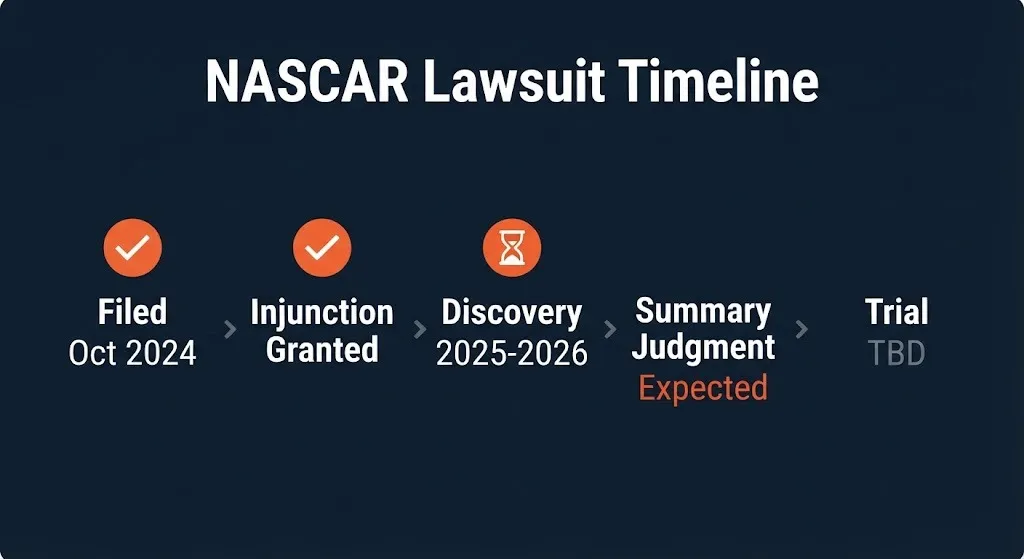
What is the timeline for the NASCAR lawsuit?
The timeline for the NASCAR lawsuit is not fully confirmed. Here is what is known or expected.
| Stage | Timing |
|---|---|
| Lawsuit filed | October 2024 |
| Preliminary injunction ruling | Late 2024 |
| Discovery | 2025 to 2026 |
| Summary judgment motions | Expected 2026 to 2027 |
| Trial | Not yet set, possible 2027 |
| Appeal | Possible after trial |
These dates are estimates based on typical federal litigation timelines. The court has not set a trial date.
What Happens Next
Late 2026: Discovery likely continues.
2026 to 2027: Summary judgment motions may be filed.
If no summary judgment: A trial date could be set for 2027.
After trial: The losing side may appeal.
The single most important date is the next court order. Check the Western District of North Carolina docket for the case number and updates.