Body Parts Payout Workers’ Comp Settlement Chart 2026: What States Actually Pay
Quick Answer
- Workers’ comp body part payouts are set by state law, not a national chart, so amounts vary widely.
- A wrist injury may settle for a few thousand dollars or over $100,000 depending on wage loss and permanency.
- No settlement deadline applies universally, but reporting injuries and filing claims quickly protects your rights.
If you searched for a workers’ comp body part settlement chart, you probably want a number. What is a wrist worth? A knee? A back? The honest answer is that no single chart exists. Each state sets its own rules for how much a body part injury pays.
Workers’ compensation is not like a menu with fixed prices. It is a system that pays for medical care, lost wages, and permanent impairment. The amount depends on your state, your wages, the severity of the injury, and how much work you miss.
This article explains how body part payouts actually work, what a wrist injury might settle for, and how to find your state’s specific schedule.
The Facts
| Detail | Verified Information |
|---|---|
| Governing System | State workers’ compensation laws |
| Federal Oversight | U.S. Department of Labor for federal employees |
| Body Part Schedules | Vary by state |
| Settlement Factors | Medical costs, wage loss, impairment rating |
| Claim Deadline | Varies by state, often 1 to 3 years |
| Administrator | State workers’ comp board |
| Proof Needed | Medical records, wage statements, incident report |
Is There a National Body Parts Workers’ Comp Settlement Chart?
No national workers’ comp body part settlement chart exists. Each state sets its own benefit schedule and settlement rules.
The U.S. Department of Labor does not publish a national body part price list. Workers’ compensation is a state system. California, Texas, Florida, New York, and every other state have their own laws.

Some states use a schedule of injuries. That schedule assigns a number of weeks of benefits for the loss of a specific body part. For example, losing an arm might be worth 312 weeks of benefits in one state and 250 weeks in another.
The dollar amount depends on your average weekly wage. The same body part can produce very different payouts in different states.
Key Takeaway: No national chart exists. Your state’s workers’ comp board sets the body part payout schedule.
How Much Is a Wrist Injury Workers’ Comp Settlement Worth?
A wrist injury workers’ comp settlement often falls between $10,000 and $75,000, but the range is wide. Some settle for less. Some exceed $100,000.
The amount depends on several factors.
- Severity: a sprain settles for less than a fracture or carpal tunnel syndrome requiring surgery.
- Medical evidence: strong documentation of the injury and treatment increases value.
- Wage loss: more time off work means a larger lost wage component.
- Permanent impairment: if the wrist loses range of motion or strength, the settlement increases.
- State law: some states cap benefits or use a strict schedule.
A wrist injury that requires surgery and leaves permanent impairment will settle for far more than a strain that heals in weeks.
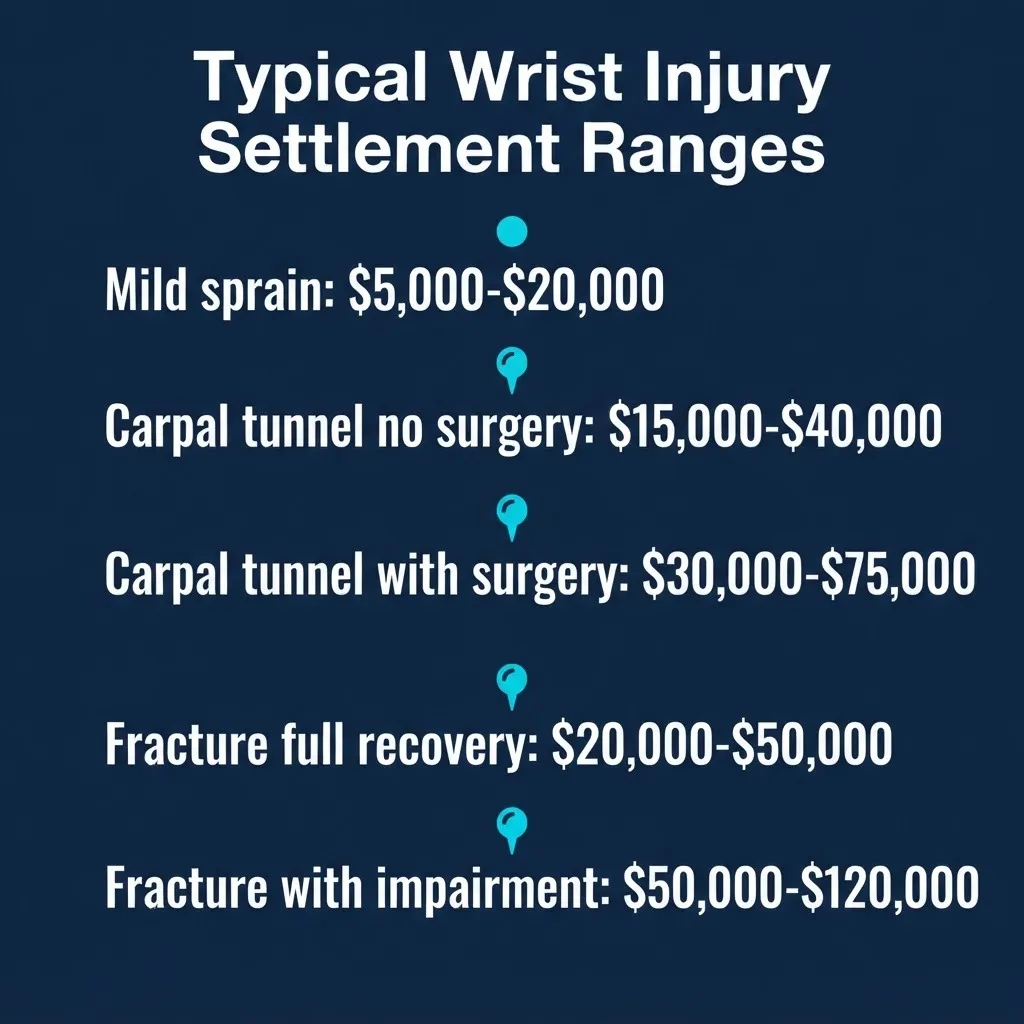
Estimated Wrist Injury Settlement Ranges
| Injury Type | Typical Range |
|---|---|
| Mild sprain or strain | $5,000 to $20,000 |
| Carpal tunnel without surgery | $15,000 to $40,000 |
| Carpal tunnel with surgery | $30,000 to $75,000 |
| Wrist fracture with full recovery | $20,000 to $50,000 |
| Wrist fracture with permanent impairment | $50,000 to $120,000 |
These ranges are estimates based on reported settlements, not guaranteed amounts. Your case may differ.
Key Takeaway: Wrist injury settlements vary widely, with surgery and permanent impairment driving higher payouts.
How Do Workers’ Comp Body Part Payouts Work?
Workers’ comp body part payouts work through a schedule of benefits or an impairment rating system. The exact method depends on your state.
In schedule states, a body part has a set number of weeks assigned. Your payout is your average weekly wage multiplied by a percentage of those weeks. A hand might be worth 200 weeks. A finger might be worth 50 weeks.
In impairment states, a doctor assigns a permanent impairment rating. The rating is a percentage of your whole body. A 10 percent impairment produces a different payout than a 50 percent impairment.
Some states use both. Texas uses an impairment rating combined with a body part schedule. California uses a permanent disability rating based on medical evidence.
The system is not simple. That is why lawyers and claims adjusters exist.
Key Takeaway: States use either a body part schedule or an impairment rating, not a simple price list.
What Are the Highest Paying Body Parts in Workers’ Comp?
The highest paying body parts in workers’ comp settlements are typically the back, neck, brain, and spinal cord. These injuries often produce the largest wage loss and permanent impairment.
Amputations of arms or legs also produce high settlements. The loss of a limb affects earning capacity for life.
Here is a general ranking of body parts by typical settlement value, from highest to lowest.
- Brain and spinal cord
- Neck and back
- Arm and leg amputations
- Knee and shoulder with surgery
- Hand and wrist with surgery
- Foot and ankle
- Fingers and toes
The actual value depends on your state and your wages. A high-wage earner with a back injury will receive more than a low-wage earner with the same injury.
Key Takeaway: Brain, spinal cord, and back injuries typically produce the largest workers’ comp settlements.
Reality Check: No One Can Guarantee a Specific Body Part Payout
No one can guarantee a specific workers’ comp settlement amount. The value depends on your state’s schedule, your average weekly wage, your medical records, and your impairment rating. Any website or service claiming to know your exact payout without reviewing your file is guessing. Workers’ comp claims are free to file through your state board. Third-party services that charge upfront fees to “help” you settle are unnecessary.
How Do I Calculate My Workers’ Comp Settlement?
You calculate your workers’ comp settlement by understanding your state’s formula, not by using a generic online calculator.
Here are the steps to estimate your claim.
- Find your state’s workers’ compensation body part schedule or impairment rating rules.
- Determine your average weekly wage from your pay stubs or wage statement.
- Get a medical evaluation that assigns an impairment rating or permanent disability percentage.
- Multiply the assigned weeks by your average weekly wage and the state’s compensation rate.
- Add medical costs, including future care estimates.
- Add lost wages for time already missed.
- Consult a workers’ comp attorney for a realistic settlement range.
This is not a do-it-yourself calculation. Mistakes cost money.
Key Takeaway: Calculating a settlement requires your state’s schedule, your wage records, and a medical impairment rating.
What Is a Workers’ Comp Settlement Chart Used For?
A workers’ comp settlement chart is used to estimate the value of a claim. Lawyers, claims adjusters, and injured workers all use them.
The chart shows the number of weeks assigned to each body part under a state’s schedule. It does not show dollar amounts because those depend on wages.
Some charts include impairment rating percentages. A 10 percent impairment rating might produce a certain number of weeks of benefits. A 50 percent rating produces more.
These charts are tools, not guarantees. They help you understand the ballpark. They do not predict the final settlement.
How Does Impairment Rating Affect Body Part Payouts?
Impairment rating directly affects body part payouts in states that use the rating system. A higher rating means more money.
An impairment rating is a medical determination. A doctor evaluates your injury and assigns a percentage. That percentage represents how much function you lost.
For example, a wrist that lost 20 percent of its range of motion might receive a 5 percent whole person impairment rating. A back injury with nerve damage might receive a 20 percent rating.
The state converts the rating to weeks of benefits. More weeks means a larger settlement.
The rating is often the single most contested issue in a workers’ comp case. Insurance companies push for lower ratings. You need medical evidence to support yours.
Key Takeaway: A higher impairment rating means a larger settlement, making the medical evaluation critical.
What If My Body Part Is Not on the State Schedule?
If your body part is not on the state schedule, your settlement is calculated differently. Some states list every body part. Others use a general impairment system.
For injuries not listed, the state usually applies a “whole person” impairment rating. The doctor assigns a percentage of disability. The state converts that percentage to weeks of benefits.
Mental health conditions are an example. They are not body parts, but they can be compensable. The settlement is based on the impairment to your earning capacity, not a scheduled body part.
This area of law is complex. An attorney can explain how your specific injury is valued in your state.
How Do Lost Wages Affect a Workers’ Comp Settlement?
Lost wages are a major component of any workers’ comp settlement. The system exists to replace income you lost because of the injury.
If you missed work, you are entitled to a portion of those lost wages. The state sets a compensation rate, often two-thirds of your average weekly wage. Some states cap the weekly benefit.
If your injury prevents you from returning to your old job, the settlement may include future wage loss. That is often the largest single component of a serious injury claim.
A wrist injury that keeps you out of work for six months produces a larger settlement than one where you returned to work the next day.
Key Takeaway: Lost wages, both past and future, are often the largest component of a workers’ comp settlement.
How Long Does a Workers’ Comp Settlement Take?
A workers’ comp settlement typically takes 12 to 24 months from the date of injury to resolution. Some cases settle faster. Others take years.
The timeline depends on several factors.
- How quickly you report the injury
- Whether the insurance company disputes the claim
- How long your medical treatment lasts
- Whether you reach maximum medical improvement
- Whether the parties agree on the impairment rating
Cases with surgery and permanent impairment take longer because the medical picture is not clear until treatment ends.
Think of it like a warranty claim on a major appliance. The diagnosis happens quickly. The fix takes time.
Key Takeaway: Workers’ comp settlements often take one to two years, longer if the injury is severe or disputed.
What Happens Next After a Workers’ Comp Injury
After a workers’ comp injury, the process follows a predictable path.
Day 1 to 30: Report the injury to your employer and file a claim with your state board.
Month 1 to 6: Receive medical treatment and document everything.
Month 6 to 12: Reach maximum medical improvement and receive an impairment rating.
Month 12 to 24: Negotiate a settlement or proceed to a hearing.
After settlement: Payment is typically made within 30 to 60 days.
These are general timelines. Your state and your specific injury will determine the exact schedule.
Frequently Asked Questions
Is there a body part settlement chart for my state?
Yes, most states publish a schedule of body parts or an impairment rating table. Check your state workers’ comp board.
How much is a lost finger worth in workers’ comp?
It depends on your state and which finger. A thumb is worth more than a pinky. Amounts range from a few thousand to over $50,000.
Can I get workers’ comp for carpal tunnel?
Yes, if you can show the condition was caused by your job. Repetitive motion injuries are compensable.
What is the average workers’ comp settlement?
No reliable national average exists. Settlements range from a few thousand dollars to millions for catastrophic injuries.
Do I need a lawyer for a workers’ comp settlement?
You are not required to have one, but a lawyer often increases the settlement enough to justify the fee.
How long do I have to file a workers’ comp claim?
The deadline varies by state, usually one to three years from the date of injury. Report the injury immediately.
Can I get a settlement without surgery?
Yes. Many claims settle without surgery, but surgical cases typically settle for more.
Is a workers’ comp settlement taxable?
Generally no. Workers’ comp settlements are not taxable as income under federal law.
The most important fact about body part settlement charts is that they are state-specific, not national. Your wrist injury is worth what your state’s schedule and your wage records say it is worth. Do not trust a generic online chart. Check your state board. Gather your medical records. And if the insurance company offers a number, compare it to the state schedule before you sign.