Elon Musk Lawsuit 2026: OpenAI Case Status, Legal Claims, and What It Means
Quick Answer
- Musk’s OpenAI lawsuit is real and filed in federal court, not a consumer class action.
- No settlement fund or per-person payout exists; this is a corporate governance dispute.
- No claim form or deadline applies to the public.
If you searched for the Elon Musk lawsuit, you are likely seeing headlines about his fight with OpenAI and wondering what is actually happening, who is suing whom, and whether any of it affects you. The answer starts with one verified fact: the core case is Musk v. Altman, filed in the U.S. District Court for the Northern District of California.
This is not a consumer lawsuit. It is a corporate dispute over the direction of OpenAI, the artificial intelligence company Musk co-founded. The stakes are large, but they are not settlement checks for the public.
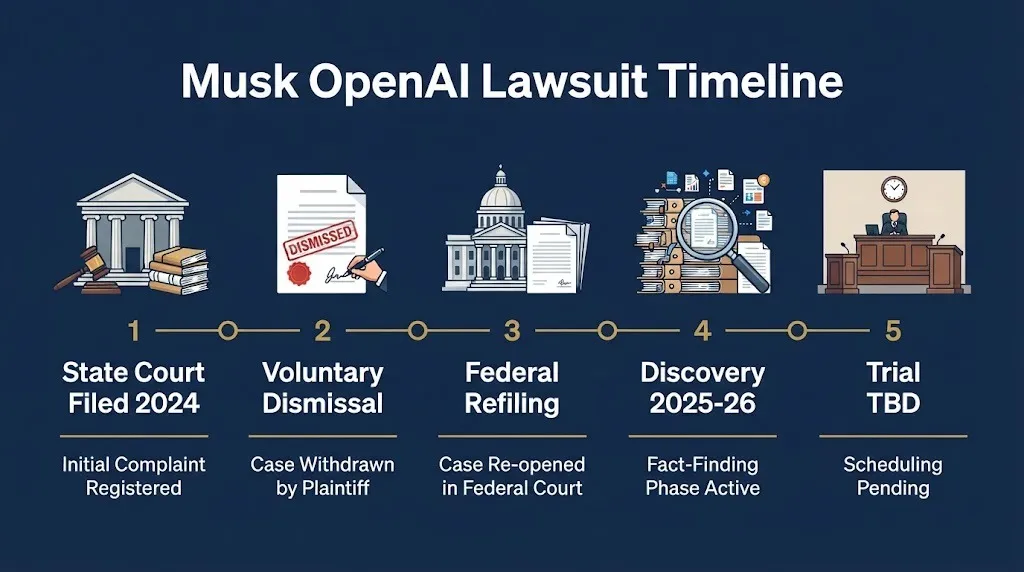
This article breaks down the named cases, the legal claims, the current status, and the possible outcomes. One surprising detail: Musk originally filed suit in state court, then voluntarily dismissed it, then refiled in federal court. That kind of procedural whiplash is unusual even in high-stakes tech litigation.
The Facts
| Case | Musk v. Altman et al. |
|---|---|
| Court | U.S. District Court, Northern District of California |
| Status | Active; motions and discovery ongoing |
| Fund Size | Not applicable |
| Est. Per Person | Not applicable |
| Claim Deadline | Not applicable |
| Administrator | Not applicable |
| Proof Needed | Not applicable |
Is the Elon Musk OpenAI Lawsuit Real?
The Elon Musk OpenAI lawsuit is real and verifiable in federal court records. The lead case is styled Musk v. Altman, and it names OpenAI CEO Sam Altman, OpenAI co-founder Greg Brockman, and the OpenAI entities as defendants.
The case was filed after Musk publicly criticized OpenAI’s transformation from a nonprofit research lab into a for-profit company with a major commercial partnership with Microsoft. Musk argues that transformation betrayed the company’s founding mission.
You can verify the case through PACER or by checking the court’s public docket. The filings are real, and the case has generated hundreds of pages of motions, briefs, and declarations.
Key Takeaway: This is a genuine corporate lawsuit with a public docket, not a rumor or a consumer settlement.
What Is the OpenAI Lawsuit About?
The OpenAI lawsuit is about the company’s shift from a nonprofit to a capped-profit structure. Musk claims that shift violated the founding agreements and diverted the company from its original mission to develop artificial intelligence for public benefit.
Musk’s complaint alleges breach of contract, breach of fiduciary duty, and unfair competition. He asks the court to force OpenAI to return to its nonprofit roots or to compensate him for the value he says was taken from him.
OpenAI has responded that Musk’s claims are revisionist history. The company argues Musk supported the for-profit pivot until he failed to gain control of the company, and that his lawsuit is a competitive move tied to his own AI company, xAI.
| Legal Claim | Musk’s Argument | OpenAI’s Response |
|---|---|---|
| Breach of contract | Founding agreements were violated | No enforceable contract exists |
| Breach of fiduciary duty | Altman and Brockman betrayed the mission | Musk supported the pivot |
| Unfair competition | OpenAI used Musk’s early support unfairly | Musk competes through xAI |
| Fraud | Musk was induced to fund the nonprofit | No false statements made |
Why Is Elon Musk Suing OpenAI?
Musk says he is suing OpenAI because the company abandoned its promise to develop artificial intelligence for the benefit of humanity, not for profit. He argues he donated tens of millions of dollars to the nonprofit based on that promise.
The deeper context is competitive. Musk now runs xAI, a rival artificial intelligence company. OpenAI has become one of the most valuable private companies in the world, with a commercial partnership with Microsoft worth billions.
OpenAI argues the lawsuit is a competitive tactic. The company has pointed to emails and messages that it says show Musk supported the for-profit shift when he thought he would lead it.
Key Takeaway: The legal fight is partly about mission and partly about money, and the line between the two is exactly what the court will have to sort out.
Did Elon Musk Drop His OpenAI Lawsuit?
Musk has dropped and refiled his OpenAI lawsuit once. He first filed in California state court in early 2024. He then voluntarily dismissed that case without explanation and refiled in federal court months later.
The federal complaint expanded the claims and added new defendants, including some OpenAI affiliates. The refiling also sharpened the breach of fiduciary duty arguments.
That procedural move is common in high-stakes litigation when a plaintiff wants to add federal claims or change strategy. But it also delayed the case by months.
What Is the Current Status of the Musk OpenAI Lawsuit in 2026?
The case remains active in federal court as of September 2026. Discovery is ongoing, and the court has ruled on several motions to dismiss, allowing some claims to proceed while dismissing others.
No trial date has been firmly set. The case is procedurally complex, with multiple defendants, voluminous documents, and high-profile attorneys on both sides.
The case has not settled. Both sides have made aggressive public statements that suggest a negotiated resolution is not close.
How Much Money Is at Stake in the Musk OpenAI Lawsuit?
The amount at stake is not publicly quantified in the court record as a fixed dollar figure. Musk has not asked for a specific damages number in the public filings.
Instead, the lawsuit seeks equitable relief, meaning court orders that would restructure OpenAI or unwind certain transactions. Those remedies could be worth billions in practical terms.
Musk has also suggested that the value of his early contributions to OpenAI, which he estimates in the tens of millions, was improperly appropriated. But that is an argument, not a verified damages award.
Reality Check: This is not a class action. You are not a class member. No one is getting a settlement check from Musk’s lawsuit against OpenAI. Any site offering “OpenAI lawsuit settlement money” is a scam.
Could the Musk OpenAI Lawsuit Settle?
It could settle, but the public posture of both sides makes a near-term deal unlikely. Musk has continued to criticize OpenAI publicly, and OpenAI has continued to defend its structure.
Settlement would likely require structural changes at OpenAI, not just a money payment. Musk has said he wants the company to return to its nonprofit mission, which OpenAI shows no sign of doing.
Most corporate governance fights of this scale end in some kind of negotiated resolution, but timing is unpredictable.
What Other Lawsuits Is Elon Musk Involved In?
Musk is involved in multiple lawsuits in 2026. They include cases over Tesla board compensation, a shareholder suit over his pay package, and various regulatory disputes.
The Tesla pay package case is separate from the OpenAI case. In that case, a Delaware court previously voided Musk’s compensation plan, and the company has attempted to ratify it through a shareholder vote.
Musk also faces litigation over his acquisition of Twitter, now called X, and various employment-related claims from former workers.
| Lawsuit | Subject | Status |
|---|---|---|
| Musk v. Altman | OpenAI structure and mission | Active |
| Tesla shareholder suit | Musk pay package | Active |
| Twitter acquisition suits | Fired workers, unpaid bills | Active |
| SEC and regulatory actions | Securities and market conduct | Varies |
Is There a Class Action Against Elon Musk?
There are class actions involving Musk’s companies, but the OpenAI lawsuit is not one of them. The OpenAI case is a direct suit brought by Musk himself, not on behalf of a class.
Class actions involving Musk’s companies include shareholder suits against Tesla and consumer actions related to Twitter or X. Those cases follow the usual class action process with certification, notice, and potential settlement funds.
If you are looking for a Musk-related settlement you can join, the OpenAI case is not it.
What Is Musk’s Relationship to OpenAI?
Musk co-founded OpenAI in 2015 as a nonprofit artificial intelligence research lab. He provided early funding and helped recruit key talent.
He left the board in 2018, and OpenAI later created a for-profit subsidiary to raise money. That subsidiary is now the primary operating entity and is majority-controlled by Microsoft through a complex investment structure.
Musk now runs xAI, a direct competitor to OpenAI. The two companies compete for talent, funding, and market position in the artificial intelligence industry.
Key Takeaway: Musk went from co-founder to critic to competitor, and the lawsuit is the legal expression of that transformation.
What Is OpenAI’s Defense in the Musk Lawsuit?
OpenAI’s defense is that Musk’s claims are legally and factually wrong. The company argues there was no binding contract that required it to remain a pure nonprofit forever.
OpenAI also argues that Musk knew about and supported the for-profit pivot when it happened. The company has released emails that it says show Musk proposing to run the for-profit entity himself.
Finally, OpenAI argues that the lawsuit is a competitive tactic tied to xAI. The company points to Musk’s own AI company as evidence that his motivations are not purely charitable.
What Legal Standard Will the Court Apply?
The court will apply California contract and fiduciary duty law to the OpenAI claims. The central question is whether Musk can prove an enforceable agreement that OpenAI violated.
That is harder than it sounds. Musk’s claims rest partly on emails and informal statements, not a signed contract with clear terms. OpenAI argues those informal communications do not create legal obligations.
The fiduciary duty claims face a similar hurdle. Musk must show that Altman and Brockman owed him a duty and breached it, which is complicated by the fact that Musk left the board years ago.
What Is the Timeline for the Musk OpenAI Lawsuit?
The case has moved through initial motions and is now in discovery. That phase involves exchanging documents, taking depositions, and building the factual record.
After discovery closes, the court will likely set a trial date. A trial could occur in 2027 if the case does not settle first.
Any verdict would likely be appealed, adding another year or more. Final resolution is not expected before 2028 in the absence of a settlement.
Expected late 2026: Discovery continues; motions for summary judgment possible.
Expected 2027: Trial date set or settlement negotiations intensify.
Expected 2028: Trial or resolution; appeals likely.
What Does the Musk OpenAI Lawsuit Mean for Consumers?
The lawsuit has no direct financial impact on consumers. No settlement fund exists, and no claim form will be mailed.
The indirect impact is on the artificial intelligence industry. The case could shape how AI companies are structured and governed, which affects the products consumers use.
If Musk wins, OpenAI might face structural changes that alter its product roadmap. If OpenAI wins, the for-profit model continues unchanged.
What Should I Do If I See a Musk Lawsuit Settlement Offer?
Treat it as a scam. No Musk OpenAI settlement exists, and no third party can file a claim for you.
Do not click links, do not provide personal information, and do not pay any fee. Real settlements involving Musk’s companies, if they occur, will have official administrators and public notices.
Report suspicious offers to the Federal Trade Commission and your state attorney general.
Key Takeaway: The only people making money from fake Musk settlement offers are the scammers running them.
What Happens Next in the Musk OpenAI Lawsuit?
The immediate next step is continued discovery. Both sides are fighting over documents, emails, and internal communications that go to the heart of the case.
After discovery, expect motions for summary judgment. Each side will ask the court to rule in its favor without a trial.
If the case survives summary judgment, a trial date will be set. That trial would be one of the most closely watched corporate trials in tech history.
Expected late 2026: Discovery disputes and document production.
Expected early 2027: Summary judgment motions filed.
Expected mid 2027: Court rules on summary judgment.
Expected late 2027 or 2028: Trial if the case survives.
Frequently Asked Questions
Is the Elon Musk OpenAI lawsuit real?
Yes, the case is filed in federal court and verifiable through public docket records.
Can I get money from the Musk lawsuit?
No, this is a corporate dispute with no settlement fund or class member payouts.
What is Musk suing OpenAI for?
He alleges breach of contract, breach of fiduciary duty, and unfair competition over OpenAI’s for-profit shift.
Has the Musk OpenAI lawsuit settled?
No settlement has been reached as of September 4, 2026.
Will the Musk lawsuit affect OpenAI’s products?
Not directly, but structural changes ordered by a court could affect the company’s operations.
Is there a class action against Musk I can join?
There are separate class actions involving Musk’s companies, but the OpenAI case is not one.
How long will the Musk lawsuit take?
Final resolution may not come until 2027 or 2028, absent a settlement.
Where can I verify Musk lawsuit updates?
Check PACER for federal court dockets or verified legal news coverage.
The Musk OpenAI lawsuit is a real corporate fight with billions of dollars in implied stakes, but it is not your fight. No claim form is coming, no settlement check will arrive, and no one needs your personal information to process a payout.
The single most important fact: this case is about who controls the future of artificial intelligence, not who gets paid. Watch it for what it is, not what scammers pretend it to be.