Is the Zantac cancer lawsuit real
Quick Answer
- Is it legit: Yes. Thousands of Zantac (ranitidine) cancer lawsuits are real, though most run through individual state court filings, not a single class action.
- How much you could get: Not yet determined for any new claim. GSK’s roughly $2.2 billion settlement was private, and individual amounts have not been publicly confirmed.
- Most important status: Bladder, stomach, liver, esophageal, and pancreatic cancers are most commonly cited in filings; the federal case remains dismissed pending an appeal with no confirmed ruling yet.
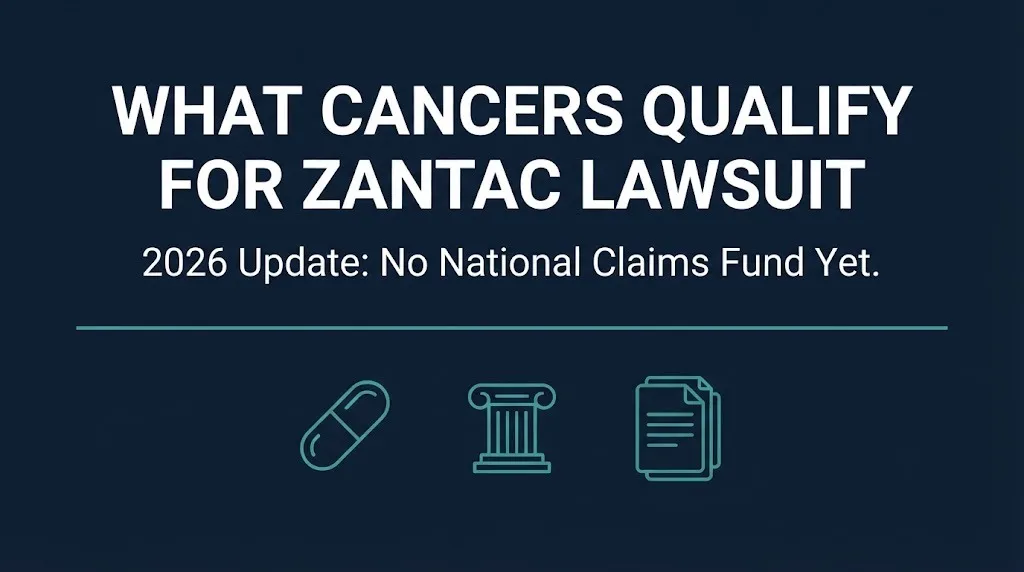
If you’re asking what cancers qualify for a Zantac lawsuit, the honest answer starts with which cancers plaintiffs’ attorneys have actually litigated, not a fixed legal list.
Bladder, stomach, liver, esophageal, and pancreatic cancers appear most consistently across filed cases, based on the underlying claim that NDMA, a contaminant found in ranitidine, is a probable human carcinogen. The federal court overseeing thousands of these cases dismissed them in December 2022 after excluding plaintiffs’ expert testimony, and that dismissal remains on appeal with no confirmed ruling as of this update.
This article separates confirmed court and settlement facts from the estimated payout ranges circulating on law firm marketing sites, since those numbers are not verified by any court record. One detail that surprises people: even the exact number of pending Zantac cases varies by thousands depending on which tracker you check, because settlement negotiations are largely confidential.
The Facts
| Category | Verified Detail |
|---|---|
| Case | In re: Zantac (Ranitidine) Products Liability Litigation, MDL No. 2924, plus parallel state court cases in Delaware, California, Illinois, Connecticut, and Pennsylvania |
| Status | Federal MDL claims dismissed since December 2022; appeal pending before the Eleventh Circuit with no confirmed ruling. GSK reached a private settlement in October 2024 |
| Fund Size | GSK settlement reported at up to $2.2 billion, covering roughly 80,000 state court cases. This is a private settlement, not a public claims fund |
| Est. Per Person | Not yet confirmed by any court record or official source. Marketing estimates of $100,000 to $500,000 are unverified |
| Claim Deadline | Not applicable nationally. Individual state statutes of limitations vary and depend on your diagnosis date |
| Administrator | Not applicable. These are private settlements negotiated directly between defendants and plaintiffs’ law firms |
| Proof Needed | Not applicable for a public claim. Pursuing an individual case requires an attorney, documented ranitidine or Zantac use, and a qualifying cancer diagnosis |
Is the Zantac cancer lawsuit real
Yes. Thousands of lawsuits allege that Zantac and generic ranitidine caused cancer due to NDMA contamination.
The FDA found NDMA, classified as a probable human carcinogen, in ranitidine products and requested a full market withdrawal in April 2020. That finding is the scientific basis for essentially all Zantac litigation, whether filed in federal or state court.
Most of these cases are structured as individual mass tort claims rather than a single traditional class action, meaning compensation, if any, is decided case by case rather than distributed evenly across everyone who took the drug.
Key Takeaway: The underlying claim is confirmed and FDA-documented, but that doesn’t mean every case involving every cancer type has held up equally well in court.
Is there a scam risk with Zantac lawsuit ads
Yes, in the sense that many ads and websites overstate certainty about payouts that no court record actually confirms.
You’ll see claims like “settlement payout deadline approaching” or specific dollar ranges presented as guaranteed. These figures typically come from law firm marketing content, not from an official settlement administrator or court filing, since GSK’s and Pfizer’s settlement terms are confidential.
Reality Check: No text, email, or ad can tell you exactly what your Zantac claim is worth, because no public settlement fund with fixed payout tiers currently exists. Free case reviews from attorneys are normal, but treat any site promising a specific guaranteed payout amount with real skepticism.
What cancers qualify for a Zantac lawsuit
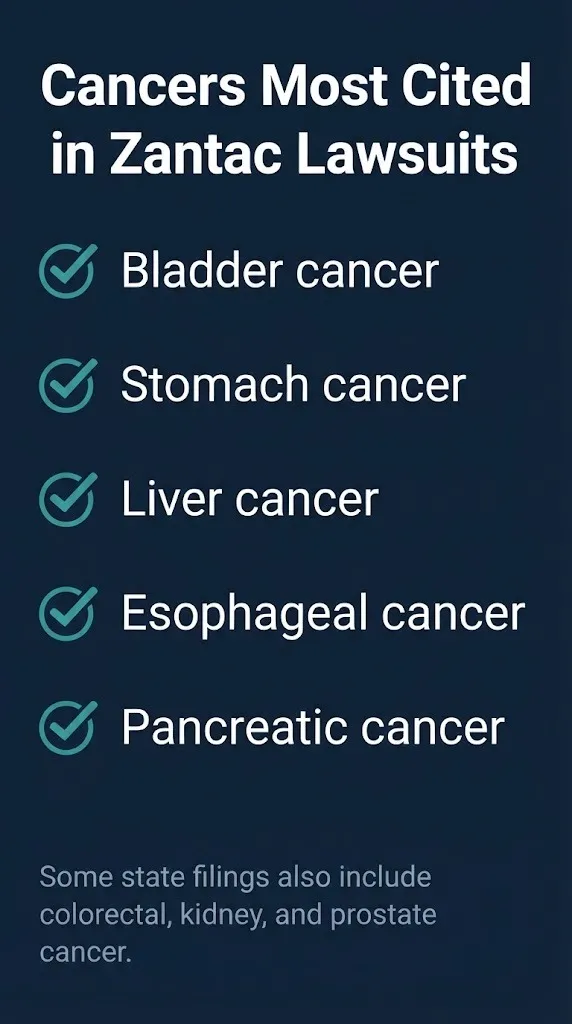
Bladder, stomach, liver, esophageal, and pancreatic cancers are the cancer types most consistently cited across filed Zantac lawsuits.
These specific cancers appear most often because they align with how NDMA is understood to affect the body based on the underlying toxicology and epidemiology cited in court filings. That said, “most commonly cited” is not the same as “guaranteed to qualify,” since courts have not uniformly accepted the causation evidence for any cancer type.
| Cancer Type | Litigation Status |
|---|---|
| Bladder cancer | Most frequently cited in filings |
| Stomach (gastric) cancer | Frequently cited; some Connecticut bellwether trials scheduled |
| Liver cancer | Frequently cited |
| Esophageal cancer | Frequently cited |
| Pancreatic cancer | Frequently cited |
| Colorectal cancer | Cited in some state filings; bellwether trials reportedly scheduled |
| Kidney cancer | Cited in some state filings, less common |
| Prostate cancer | Cited in some filings, but has faced multiple defense verdicts (see below) |
Not yet confirmed: any official, court-published list of “qualifying” cancers exists nationwide. Eligibility for an individual case depends on your specific diagnosis, documented usage history, and an attorney’s case-by-case evaluation.
Does prostate cancer qualify for a Zantac lawsuit
Prostate cancer claims face a weaker litigation track record than the other cancer types listed above, based on multiple reported defense verdicts.
Several sources tracking Illinois and other state court bellwether trials note a string of defense verdicts or mistrials in cases involving prostate cancer specifically. This doesn’t mean a prostate cancer claim is automatically disqualified, but it does mean the evidentiary path has been harder for plaintiffs in the cases that have gone to trial so far.
If you have a prostate cancer diagnosis and ranitidine use history, an attorney would need to assess your specific case in light of this trial record before taking it on.
How much is a Zantac lawsuit worth
Not yet determined for any new individual claim, because no court-confirmed payout schedule exists publicly.
GSK’s settlement, reported at up to $2.2 billion covering roughly 80,000 cases, was negotiated privately with plaintiffs’ law firms. Confirmed public reporting states only the aggregate settlement figure and case count, not individual per-person amounts.
| What’s Confirmed | What’s Not Confirmed |
|---|---|
| GSK settlement covers ~80,000 cases | Individual payout amounts |
| Total reported at up to $2.2 billion | Specific tier structure by cancer type |
| Pfizer settled cases involving 17 Connecticut plaintiffs | Pfizer’s settlement dollar figures |
| Terms are confidential per court filings | Any fixed national per-person range |
Marketing sites publishing specific figures like “$100,000 to $500,000” are presenting estimates based on general mass tort patterns, not confirmed settlement terms. Treat those ranges as informed guesses, not facts.
Is there a national Zantac settlement fund you can file a claim with
No. There is no public, court-administered national Zantac settlement fund that consumers can currently submit a claim form to.
The GSK and Pfizer settlements were private agreements negotiated directly with specific plaintiffs’ law firms representing clients who already had cases filed. There is no independent claims portal, administrator website, or public claim form for people who haven’t already retained an attorney and filed suit.
Key Takeaway: If a website suggests you can “file a claim” against an existing Zantac settlement fund without an attorney representing you in an actual lawsuit, that structure doesn’t match how these settlements actually work.
How to find out if you qualify for a Zantac lawsuit
You would need to consult an attorney experienced in Zantac litigation, since eligibility depends on case-specific facts no article can evaluate for you.
- Confirm your specific cancer diagnosis and diagnosis date
- Gather documentation of your Zantac or ranitidine use, including pharmacy records if possible
- Note how long and how frequently you used the product
- Check your state’s statute of limitations for product liability claims promptly
- Contact an attorney who currently accepts Zantac cases, since some firms have stopped taking new clients
- Ask directly whether your specific cancer type has a track record in that firm’s cases
What proof do you need for a Zantac cancer claim
You generally need documented proof of both your Zantac or ranitidine use and a qualifying cancer diagnosis to pursue an individual claim.
Attorneys handling these cases typically look for pharmacy receipts, prescription records, or other documentation showing consistent use over a meaningful period, paired with medical records confirming your diagnosis. The strength of that documentation affects how a firm evaluates your case.
- Pharmacy or purchase records showing Zantac or ranitidine use
- Medical records confirming your specific cancer diagnosis
- Timeline connecting your usage period to your diagnosis
- Any prior medical history relevant to alternative causation arguments
- Physician records, if available, supporting your case
Key Takeaway: Documentation quality, not just having taken the drug, is often what separates a viable case from one an attorney won’t accept.
What is the status of the Zantac federal lawsuit in 2026
The federal Zantac MDL remains dismissed as of this update, with an appeal pending before the Eleventh Circuit and no confirmed final ruling.
Judge Robin L. Rosenberg of the U.S. District Court for the Southern District of Florida issued a 341-page ruling in December 2022 excluding all ten of plaintiffs’ general causation experts under the Daubert standard. That exclusion led to summary judgment for defendants across the federal cases.
Plaintiffs appealed to the Eleventh Circuit, with oral arguments held October 10, 2025. Multiple sources tracking the litigation as recently as mid-2026 report that no confirmed decision had been issued as of their publication dates, though the case remains one of the most closely watched developments in the litigation.
Did the Eleventh Circuit rule on the Zantac appeal
Not yet confirmed. Reporting on this specific question conflicts across sources as of this update, and no single authoritative ruling date can be verified here.
Some trackers describe a decision as “expected imminently” without confirming it happened, while at least one source suggests an affirmance may have occurred without providing a specific date or docket citation. Given this inconsistency, treat any claim about the Eleventh Circuit’s final ruling as unconfirmed until you can verify it against the actual court docket or a primary legal news source reporting the specific opinion date.
What happened to the GSK Zantac settlement
GSK reached a private settlement reported at up to $2.2 billion, announced around October 2024, covering approximately 80,000 state court cases.
That figure represents roughly 93% of GSK’s pending state court claims, concentrated mainly in Delaware Superior Court. The settlement was negotiated with plaintiffs’ law firms directly rather than structured as a public class fund, meaning affected individuals would have needed an attorney already handling their filed case to be part of it.
Key Takeaway: The GSK settlement resolved a large share of pending cases against that specific defendant, but it did not create any new, publicly accessible claims process for people who haven’t already filed suit.
Are Pfizer and Sanofi settling Zantac cases too
Pfizer has reached confirmed confidential settlements in Connecticut state court cases involving 17 plaintiffs, according to court filings reviewed by legal news outlets.
Reports describing broader Sanofi settlement activity, including estimated case counts in the thousands, come from secondary litigation trackers rather than confirmed primary court records, so treat specific Sanofi settlement figures as not yet confirmed until verified against an actual court filing or official statement.
Settlement terms for both companies remain confidential, consistent with how GSK’s settlement was also structured.
Is Boehringer Ingelheim still facing Zantac lawsuits
Yes. Boehringer Ingelheim remains an active defendant continuing to litigate rather than settle broadly, based on multiple tracked bellwether trial schedules.
Reported bellwether trial dates against Boehringer Ingelheim in Connecticut state court include a colorectal cancer trial and later stomach and prostate cancer trials scheduled into 2028 and 2029, according to litigation trackers monitoring the docket. Multiple defense verdicts have also been reported in Illinois state court cases during 2025.
Key Takeaway: Not every Zantac manufacturer has settled at the same pace; Boehringer Ingelheim’s cases are proceeding through active trials rather than a broad settlement like GSK’s.
Why are people suing over Zantac
Plaintiffs allege that ranitidine, the active ingredient in Zantac, can degrade into NDMA, a substance the FDA classifies as a probable human carcinogen.
Zantac was one of the world’s best-selling drugs after its 1983 FDA approval, used widely for heartburn and acid reflux for decades before the NDMA contamination concern surfaced. A pharmacy testing lab first alerted the FDA to elevated NDMA levels in 2019, which led to manufacturer recalls that same year and a full market withdrawal request in 2020.
That timeline, decades of widespread use followed by a sudden contamination finding, is part of why the resulting litigation is so large in scale.
What is NDMA and why does it matter
NDMA, or N-Nitrosodimethylamine, is a chemical compound the FDA classifies as a probable human carcinogen.
It’s found in some foods and drinking water at trace levels, but the concern with ranitidine involved contamination levels reported by some testing well above what’s typically considered an acceptable daily intake. That gap between expected background exposure and what was allegedly found in some ranitidine products became central to the scientific dispute at the heart of the Daubert rulings.
The legal fight over Zantac largely comes down to whether plaintiffs’ expert witnesses can reliably connect NDMA exposure from ranitidine specifically to individual cancer diagnoses, a bar that federal courts and some state courts have found the current expert testimony hasn’t cleared.
Is it too late to file a Zantac lawsuit
That depends entirely on your state’s statute of limitations, which varies and is tied to your diagnosis or discovery date, not a single nationwide deadline.
Some law firms have stopped accepting new Zantac cases given the federal MDL’s dismissal and the mixed state court track record, while others continue accepting cases for specific cancer types with stronger documentation. This article cannot tell you whether your individual timeline still allows a claim.
Consult a licensed attorney promptly if you believe you may have a claim, since missing your state’s applicable deadline can foreclose your case entirely regardless of its underlying merits.
What happens next
October 10, 2025: Oral arguments were held before the Eleventh Circuit on the federal MDL appeal. This has already happened.
Not yet confirmed: A final Eleventh Circuit ruling on whether to reverse the December 2022 Daubert dismissal.
Ongoing: State court cases against Boehringer Ingelheim continue toward scheduled bellwether trials.
Expected, per litigation trackers: Connecticut bellwether trials against Boehringer Ingelheim reportedly scheduled beginning March 2028 for colorectal cancer, followed by stomach cancer later that year and prostate cancer in early 2029.
Ongoing: Continued processing of GSK’s settled cases, with many individual payouts reportedly not expected until after 2026.
Frequently Asked Questions
What cancers qualify for a Zantac lawsuit?
Bladder, stomach, liver, esophageal, and pancreatic cancers are the types most commonly cited in filed lawsuits.
Some state court cases also involve colorectal, kidney, and prostate cancer claims.
No official nationwide list of “qualifying” cancers exists; eligibility depends on individual case evaluation by an attorney.
Is the Zantac lawsuit still active in 2026?
Yes, though the federal MDL remains dismissed pending an unresolved appeal.
State court litigation, particularly against Boehringer Ingelheim, continues with scheduled trials.
GSK and Pfizer have reached private settlements covering large portions of their pending state court cases.
How much money can I get from a Zantac lawsuit?
This is not yet determined for any new claim, since no public settlement fund with confirmed payout amounts exists.
GSK’s settlement terms are confidential, and marketing estimates you may see online are not verified by any court record.
An attorney evaluating your specific case is the only way to get a realistic sense of potential value.
Is there a Zantac settlement I can file a claim under right now?
No, not as an independent claims process open to the general public.
GSK’s and Pfizer’s settlements were private agreements with plaintiffs’ law firms representing already-filed cases.
You would need to retain an attorney and have an active case to participate in any current or future settlement.
Did the courts rule that Zantac causes cancer?
No single court ruling has established that Zantac causes cancer as settled fact.
The federal court excluded plaintiffs’ expert testimony on causation in December 2022, which is under appeal.
Some state courts have applied different evidentiary standards with mixed results across trials.
Can I still file a Zantac lawsuit today?
Possibly, depending on your state’s statute of limitations and your specific diagnosis and documentation.
Some attorneys have stopped accepting new cases while others continue, particularly for the more commonly cited cancer types.
Consult a licensed attorney promptly, since missed deadlines can end a claim regardless of its merits.
Why did the federal Zantac cases get dismissed?
A federal judge excluded all of plaintiffs’ expert witnesses on general causation in December 2022, citing unreliable methodology under the Daubert standard.
Without that expert testimony, the cases could not survive summary judgment.
That dismissal remains on appeal, with no confirmed final ruling as of this update.
If you believe you have a Zantac-related claim, the clearest next step is a documented case review with a licensed attorney rather than relying on unverified payout estimates online. No nationwide claim deadline applies, but individual state statutes of limitations do, so don’t delay confirming yours.