Nationwide Robocall Lawsuit Settlement: 2026 Claim Deadlines, Payout Amounts, and Filing Steps
Quick Answer
- The “Nationwide Robocall Lawsuit Settlement” is not a confirmed single case; it may refer to several unrelated robocall suits.
- No verified payout amount or claim deadline is attached to this exact phrase as of February 2026.
- Check the official settlement website or federal court docket for case-specific notices before filing anything.
The term “Nationwide Robocall Lawsuit Settlement” does not match any verified, single class action settlement in federal or state court records as of February 2026. Searches return a mix of unrelated robocall cases involving insurance companies, telemarketers, and lead generators.
This affects anyone who received a text, email, or voicemail about a “Nationwide Robocall Settlement” and is trying to determine if it is real. It also affects consumers who received unwanted robocalls from companies that may have settled under different case names.
This article covers what is actually verified about robocall litigation in 2026, how to spot a fake settlement notice, and what to do if you believe you have a legitimate claim.
The Facts
| Field | Verified Detail |
|---|---|
| Case | No single “Nationwide Robocall Lawsuit Settlement” found |
| Status | Unverified as a distinct case |
| Fund Size | Not applicable; no single fund identified |
| Est. Per Person | Not applicable |
| Claim Deadline | Not applicable |
| Administrator | Not applicable |
| Proof Required | Depends on the specific robocall case |
Robocall litigation remains active in 2026. The Telephone Consumer Protection Act, or TCPA, allows consumers to sue companies that place unauthorized robocalls or robotexts. Penalties range from $500 to $1,500 per violation.
Class actions under the TCPA have produced numerous settlements. Payouts to individual class members typically range from $20 to $300, though larger cases can pay more.
No verified case uses the phrase “Nationwide Robocall Lawsuit Settlement” as its official caption.
Is the Nationwide Robocall Lawsuit Settlement Real or a Scam?
The “Nationwide Robocall Lawsuit Settlement” is unverified as a real, single class action settlement. If you received a message about it, treat the claim with caution until you verify it independently.
Legitimate settlement notices come from court-appointed administrators. They include a case name, court name, case number, and official website. They never ask for upfront payment.
Scammers often use phrases like “nationwide settlement” and “robocall settlement” to create believable fake notices. They may ask for your phone number, Social Security number, or bank account details.
The Federal Trade Commission has warned about fake settlement and refund scams. Real settlements never require payment to file a claim.
If you received a “Nationwide Robocall Settlement” notice, do not click any links. Search the federal court docket for the exact case name. If no case appears, the notice is likely fake.
How Much Do Robocall Settlements Pay Per Person?
Robocall settlements pay anywhere from $20 to $300 per person in most cases. Some larger settlements have paid $500 or more per class member.
The Telephone Consumer Protection Act sets statutory damages at $500 per violation. Willful violations can reach $1,500 per call. But class action settlements almost never pay the full statutory amount.
The settlement fund is divided among all eligible claimants. After attorney fees and administrative costs, individual payouts shrink.
A payout table based on recent robocall settlements:
| Case Type | Typical Per-Person Payout |
|---|---|
| Small telemarketer settlement | $20 to $75 |
| Medium insurance robocall case | $50 to $150 |
| Large TCPA class action | $100 to $300 |
| Individual TCPA lawsuit | $500 to $1,500 per call |
Individual TCPA lawsuits pay far more than class action claims. But they require your own attorney and carry litigation risk.
Reality Check: No legitimate robocall settlement requires you to pay a filing fee. The claims process is free. Third-party companies that charge fees to file your claim are unnecessary and often take a cut of your recovery.
What Is the Telephone Consumer Protection Act?
The Telephone Consumer Protection Act is a federal law that restricts robocalls, robotexts, and unsolicited faxes. It was passed in 1991 and remains the primary legal tool for robocall litigation.
The TCPA prohibits companies from using automatic dialing systems or prerecorded messages to call cell phones without prior express consent. It also creates the National Do Not Call Registry.
Violations carry statutory damages. Consumers can recover $500 per illegal call or text. Courts can triple that to $1,500 for willful violations.
Class actions under the TCPA have become common. Companies face millions in potential liability for mass robocall campaigns.
What Types of Companies Face Robocall Lawsuits?
Many types of companies face robocall lawsuits under the TCPA.
Common defendants include:
- Insurance companies and agents
- Debt collectors
- Telemarketers
- Lead generation companies
- Political campaigns
- Retailers and service providers
Insurance companies are frequent defendants. Many robocall cases allege that agents used automated dialers to contact consumers without consent.
Debt collection robocalls are another major source of litigation. The TCPA and the Fair Debt Collection Practices Act both regulate these calls.
How Do I File a Robocall Settlement Claim?
Filing a robocall settlement claim requires submitting a proof of claim form to the settlement administrator before the court-set deadline.
The process works like this:
- Receive a notice by mail or email with the case name and administrator.
- Visit the official settlement website named in the notice.
- Enter your personal information and phone number.
- Confirm the phone number that received the robocalls.
- Provide the dates and times of the calls if available.
- Submit the form before the deadline, which varies by case.
The claim form is usually simple. You may not need documentation beyond confirming your phone number was on the receiving end of the calls.
If you have call logs showing the robocalls, attach them. Records strengthen your claim and reduce verification delays.
What Is the Deadline to File a Robocall Settlement Claim?
The deadline to file a robocall settlement claim varies by case. Each settlement sets its own claim deadline, typically 60 to 120 days after the notice is mailed.
For active 2026 robocall settlements, deadlines are spread throughout the year. Some cases have deadlines in March 2026. Others extend into summer or fall 2026.
The notice you receive will state the deadline clearly. If you miss it, you forfeit your right to recover from that settlement. There is no grace period.
Set a calendar reminder immediately when you receive a notice. These deadlines are strict. Courts rarely extend them except in extraordinary circumstances.
Are There Any Real Robocall Settlements Paying in 2026?
Real robocall settlements are paying in 2026, but they are filed under specific case names, not “Nationwide Robocall Lawsuit Settlement.”
Some known robocall settlement categories include:
- Insurance telemarketing TCPA class actions
- Debt collection robocall settlements
- Retailer text message spam settlements
- Political campaign robocall cases
Each of these has its own case name, court, administrator, and claim deadline. None uses the phrase “Nationwide Robocall Lawsuit Settlement.”
If you received unwanted robocalls, the first step is identifying the specific company and case. Search by the company name, not by a vague settlement phrase.
Key Takeaway: The phrase “Nationwide Robocall Lawsuit Settlement” is not verified as a real case. Legitimate robocall settlements use specific company names and court dockets.
How Do I Know If a Robocall Settlement Notice Is Legitimate?
You can check if a robocall settlement notice is legitimate by following these steps.
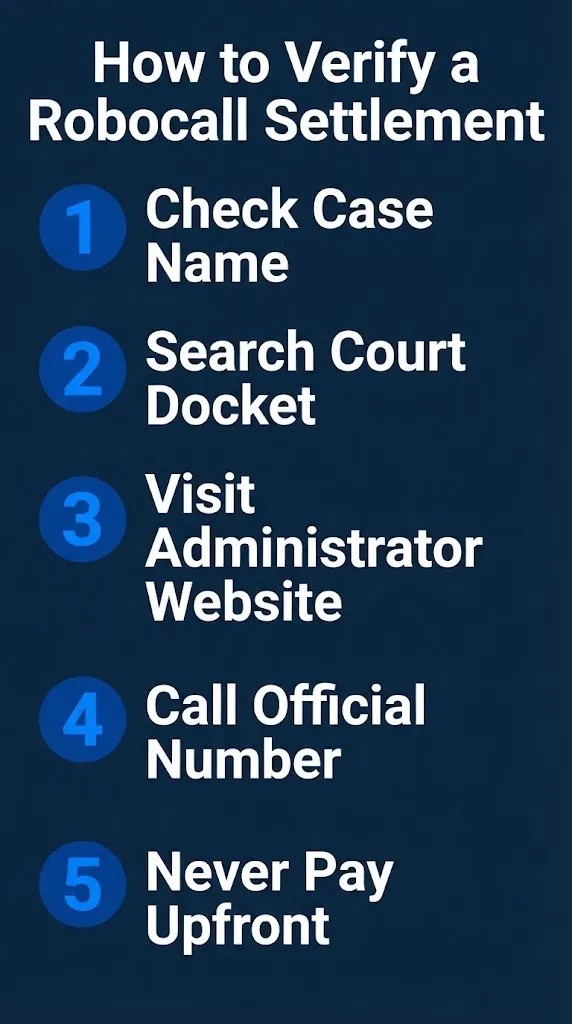
- Look for the full case name and court on the notice.
- Search the federal court docket for that exact case name.
- Check the settlement administrator’s website directly, not through links in the notice.
- Verify the administrator is a known company like Epiq, Kroll, or JND.
- Call the administrator using the phone number on their official website, not the notice.
- Confirm the claim deadline and filing requirements match the court record.
- Never pay any fee or provide bank details just to receive a notice.
Legitimate notices almost always arrive by mail. Email notices happen, but they come from the administrator’s official domain, not a generic Gmail or Yahoo address.
If the notice says “Nationwide Robocall Lawsuit Settlement” but gives no case number, no court, and no administrator website, it is almost certainly fake.
What Should I Do If I Received a Nationwide Robocall Settlement Text?
If you received a text or email about a “Nationwide Robocall Settlement,” do not respond. Do not click any links. Do not provide personal information.
The first step is to verify whether the message is legitimate. Search the federal court docket for the exact case name. If no case exists, the message is fake.
The second step is to report the message. The FTC accepts fraud reports online. You can also report phishing attempts to the FBI’s Internet Crime Complaint Center.
The third step is to block the sender. Do not engage further. Scammers often follow up with more convincing messages if you respond at all.
How Much Can I Sue for Unwanted Robocalls?
You can sue for $500 to $1,500 per unwanted robocall under the TCPA. The exact amount depends on whether the violation was willful.
Willful violations, where the company knew or should have known the calls were illegal, can reach $1,500 per call. Non-willful violations pay $500 per call.
An individual TCPA lawsuit is different from a class action settlement. You hire your own attorney and file your own case. The potential recovery is higher, but so is the risk.
Most consumers find that joining a class action settlement is simpler. The payout is smaller, but the process requires no legal work on your part.
What Evidence Do I Need for a Robocall Claim?
You need basic evidence for a robocall claim, and more detailed evidence for an individual lawsuit.
For a class action settlement claim, you typically need:
- The phone number that received the calls
- Approximate dates and times of the calls
- The caller’s identity or phone number if known
For an individual TCPA lawsuit, you need stronger evidence:
- Call logs from your phone carrier
- Voicemail recordings of the robocalls
- Screenshots of text messages
- A log of each call with date, time, and caller
Cell phone carriers provide detailed call records. You can often download them from your online account. These records are strong evidence in TCPA cases.
What Happens Next With Robocall Litigation?
Robocall litigation continues to grow in 2026. The Federal Communications Commission and FTC both pursue enforcement actions alongside private class actions.
Early 2026: Courts rule on pending motions in major TCPA class actions.
Spring 2026: Several robocall settlements receive final approval and open claim filing windows.
Summer 2026: Claim deadlines for early-2026 settlements begin to close.
Fall 2026: Distribution plans filed for approved settlements, with payments expected in late 2026 or 2027.
Ongoing: FCC enforcement activity remains high, generating follow-on private litigation.
If you received unwanted robocalls from a specific company, watch for official notices by mail. Verify every notice against the court docket before filing.
Frequently Asked Questions
Is the Nationwide Robocall Lawsuit Settlement real?
No verified case under that exact name exists in federal court records as of February 2026.
The phrase may refer to a scam or a misunderstanding of a different robocall case.
How much will the Nationwide Robocall Settlement pay?
No verified payout amount exists because no single verified case uses that name.
Legitimate robocall settlements have their own case-specific payout amounts.
How do I file a Nationwide Robocall Settlement claim?
You cannot file a claim for a case that does not exist under that name.
Verify the actual case name and use the official settlement website if a real settlement exists.
How much can I get for unwanted robocalls?
You may recover $500 to $1,500 per call under the TCPA in an individual lawsuit.
Class action settlements typically pay $20 to $300 per person.
What should I do if I got a Nationwide Robocall Settlement text?
Do not click any links or provide information.
Verify the case independently, report the message to the FTC, and block the sender.
Are robocall settlement claims free to file?
Yes. Legitimate robocall settlement claims are always free to file.
No legitimate administrator charges a filing fee.
How do I know if I qualify for a robocall settlement?
Read the official notice carefully. It defines the class and eligibility criteria.
You qualify only if you meet the specific requirements in the notice.
Where can I check real robocall settlement notices?
Check the federal court PACER database, state court dockets, and known administrator websites.
Use specific search terms, not vague phrases like “Nationwide Robocall Lawsuit Settlement.”
The phrase “Nationwide Robocall Lawsuit Settlement” does not trace to any verified case in federal or state court records as of February 2026. If you received a notice with that name, treat it as unverified and do not share personal information.
The safest action is to search the court docket, check known settlement administrator websites, and report any suspicious message to the FTC. Real robocall settlements are specific, formal, and free to join.