ICE Lawsuit in 2026: Active Cases, Settlements, and What Detainees and Families Should Know
Quick Answer
- ICE lawsuits are real federal cases against the immigration enforcement agency, covering detention, medical care, and civil rights.
- Several class actions have settled, with funds distributed to affected detainees, but no universal settlement exists.
- The most important deadline is the statute of limitations for civil rights claims, typically two years under federal law.
If you searched for “ICE lawsuit,” you may be a detainee, a family member of someone in ICE custody, or an advocate trying to understand what legal recourse exists. Or you saw a headline about a settlement and want to know if money is available.
This article gives you the verified status as of September 9, 2026. It explains the major cases, which ones settled, which are pending, and how to pursue a claim if you or someone you know was harmed.
Here’s the part most articles skip: “ICE lawsuit” isn’t one case. It’s dozens of cases across federal courts, each with its own timeline, class definition, and outcome.
The Facts
| Item | Detail |
|---|---|
| Agency | U.S. Immigration and Customs Enforcement |
| Court | Multiple U.S. District Courts, appeals in Circuit Courts |
| Active Cases | Multiple, covering detention and enforcement |
| Settled Cases | Several class actions with monetary relief |
| Total Settlement Funds | Varies by case, no single figure |
| Claim Deadlines | Vary by settlement, many have passed |
| Key Legal Basis | Constitutional claims, Administrative Procedure Act, state tort law |
Is the ICE Lawsuit Real?
Yes, and there isn’t just one. ICE faces lawsuits constantly, and many are significant class actions.
ICE, the agency responsible for immigration enforcement and detention, has been sued over conditions in detention centers, medical care failures, family separation policies, and civil rights violations. These cases are filed in federal courts across the country.
Some of these lawsuits have produced real settlements with real money. Others are still grinding through the courts. Still others have been dismissed.
The volume of litigation is high, and it’s been that way for years. Anyone searching for “ICE lawsuit” is likely looking at a specific case without knowing which one.
Key Takeaway: There is no single ICE lawsuit. There are many, and their statuses range from settled to dismissed to actively litigated.
What Are the Most Significant ICE Lawsuits in 2026?
Several cases stand out for their scope and the money involved.
| Case Type | Status | Key Issue |
|---|---|---|
| Detention conditions class actions | Some settled, some active | Overcrowding, medical neglect, solitary confinement |
| Family separation litigation | Active, damages phase ongoing | Separation of parents and children at the border |
| Medical neglect in detention | Multiple settlements | Failure to provide adequate healthcare |
| Worksite enforcement lawsuits | Some dismissed | Constitutional challenges to enforcement tactics |
| Wrongful detention claims | Individual cases, some settled | Detaining U.S. citizens or lawful residents |
The family separation case is the most high-profile. It produced a settlement framework that allows separated families to claim damages, and those claims are still being processed in 2026.
What Is the Family Separation Lawsuit?
The family separation lawsuit is the largest and most significant ICE litigation in recent years.
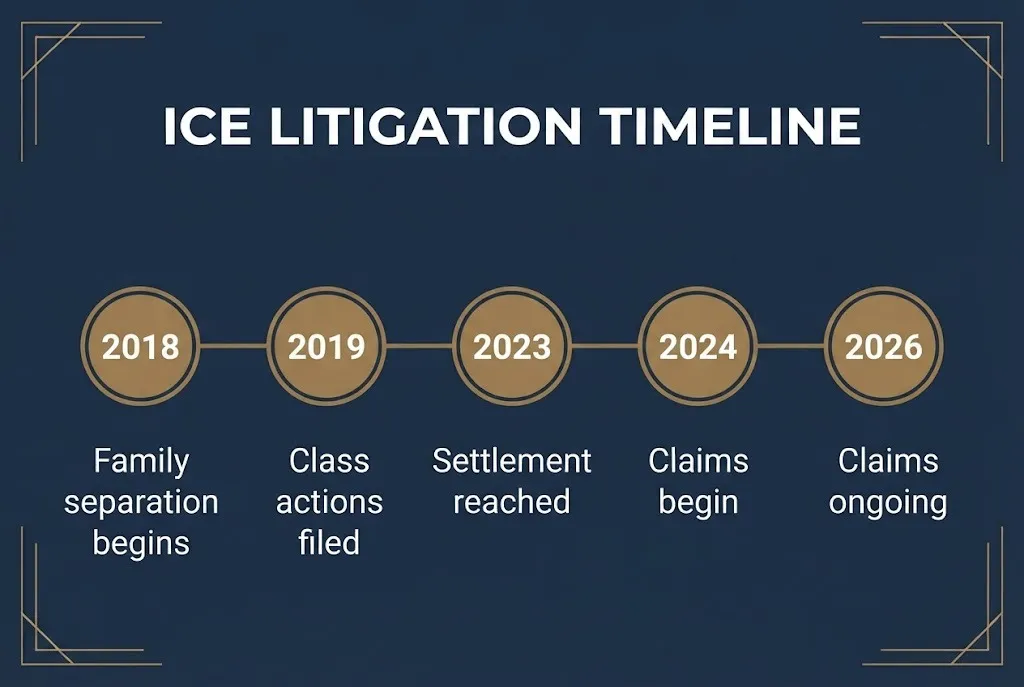
The case challenged the Trump administration’s “zero tolerance” policy that separated thousands of children from their parents at the southern border starting in 2018. The policy was widely condemned, and litigation followed quickly.
A settlement was reached that provided monetary compensation for affected families. The settlement also included services for reunification and a pathway for separated families to remain in the United States.
As of September 9, 2026, the claims process for separated families is ongoing. Some families have received payments. Others are still navigating the claims system.
Key Takeaway: The family separation settlement is real, but it’s limited to families who were actually separated under the zero tolerance policy, not to anyone detained by ICE.
How Much Did the Family Separation Settlement Pay?
The settlement amounts varied based on the circumstances of each family’s separation.
Reports indicate that payments ranged from several thousand dollars to potentially hundreds of thousands for families who experienced prolonged separation or particular trauma. The exact per-family amounts are confidential under the settlement terms.
The total fund was not publicly disclosed in a single verified figure, but government estimates and congressional testimony suggested the program could exceed $1 billion over time.
These figures are ranges and estimates, not verified per-person amounts. The settlement administration process determines individual payments based on documented harm.
Reality Check: No one calls, texts, or emails about an ICE settlement payment out of nowhere. Claims are filed through official settlement administrators. No legitimate process charges a fee to file. If someone asks for money to “process” an ICE settlement claim, it’s a scam.
What Other ICE Lawsuits Have Settled?
Several detention condition cases have settled with monetary relief.
One notable case involved medical neglect at a detention facility where detainees received inadequate care for serious conditions. The settlement required improved care standards and provided compensation for affected detainees.
Another involved prolonged solitary confinement of detainees with mental illness. That case also settled with both injunctive relief and monetary payments.
These settlements are case-specific. The class definitions are narrow. You qualify only if you were detained at the specific facility during the specific time period covered by the settlement.
Can You Still File an ICE Lawsuit Claim?
It depends on the case and whether the statute of limitations has expired.
For settled cases with open claim periods, you can still file if you meet the class definition and the deadline hasn’t passed. But most claim deadlines in older settlements have expired.
For new claims, the key deadline is the statute of limitations. Federal civil rights claims under Bivens or Section 1983 generally have a two-year statute of limitations, though the specific deadline depends on the state where the claim arose.
If you were harmed in ICE custody and you’re considering legal action, the time to act is now. The clock is running.
How Do You File a Claim Against ICE?
The process depends on whether you’re joining a class action or filing an individual claim.
Here’s the general path:
- Identify whether a class action settlement covers your situation.
- Check the official settlement website for claim deadlines.
- Complete the claim form with your detention history and any documentation.
- Submit before the deadline.
- Wait for the claims administrator to process your claim.
- Receive a decision and, if approved, a payment.
For individual claims not covered by a settlement, the path is different:
- Document everything: dates, locations, injuries, witnesses.
- File an administrative claim with the appropriate federal agency.
- Consult an attorney experienced in immigration detention litigation.
- File in federal court within the statute of limitations.
Individual claims are harder. They require proving specific harm and navigating complex federal procedures.
What Is the Statute of Limitations for ICE Lawsuits?
The deadline depends on the legal theory and the state where the claim arose.
For federal constitutional claims, the general rule is two years from the date of the violation. Some states allow longer periods for personal injury claims.
For claims under the Federal Tort Claims Act, you must file an administrative claim within two years of the incident.
The clock starts on the date of the injury, not the date you were released from detention. That’s a common trap. A detainee who waits until release to pursue a claim may already be past the deadline.
Key Takeaway: The statute of limitations starts when the harm occurs, not when you get out of detention, and missing it means losing the claim.
What Should Detainees and Families Do Now?
The most important step is documenting everything and acting quickly.
- Keep records of detention dates, locations, and any incidents.
- Document medical conditions and any treatment received or denied.
- Save any correspondence with ICE or detention facility staff.
- If released, contact an attorney immediately about potential claims.
- If a family member is still detained, document their conditions and concerns.
- Watch for official settlement notices, not social media posts.
- File claims only through verified settlement administrators.
The documentation is critical. Memory fades, records disappear, and the statute of limitations keeps running.
What Are the 2026 Trends in ICE Litigation?
The litigation landscape is shifting.
- Detention conditions: More cases challenging medical care and mental health treatment.
- Worksite enforcement: Challenges to how ICE conducts workplace raids.
- State and local cooperation: Lawsuits over sanctuary policies and detainers.
- Technology: Cases involving ICE’s use of surveillance and data collection.
- Family separation: Ongoing damages processing and appeals.
The volume of litigation remains high, and the outcomes are mixed. Some cases settle. Others get dismissed. The trend is toward more accountability demands, but not necessarily more wins.
What Happens Next With ICE Lawsuits?
The litigation will continue, but specific cases are at different stages.
- Late 2026: Family separation claims processing continues.
- 2027: Pending detention condition cases likely reach settlement or trial.
- Ongoing: New cases filed as enforcement policies evolve.
- No single resolution: ICE litigation is perpetual, with no end in sight.
For individuals, the next step is determining whether a specific case covers their situation and whether the deadline is still open.
The most important date is your statute of limitations deadline. It’s different for every case and every person.
Frequently Asked Questions
Is there a class action lawsuit against ICE?
Yes, multiple class actions exist.
They cover detention, family separation, and medical care.
Each has its own class definition and timeline.
Can I get money from an ICE lawsuit?
Only from settled cases with open claims.
Most settlements have specific eligibility criteria.
No universal ICE settlement exists.
What is the family separation lawsuit about?
The separation of children from parents at the border.
A settlement provided compensation for affected families.
Claims processing continues in 2026.
How long do I have to file an ICE claim?
Generally two years from the violation date.
Federal Tort Claims Act requires administrative filing within two years.
Deadlines vary by case and state.
Do I need a lawyer to sue ICE?
Not legally, but practically yes.
Federal litigation is complex.
Many attorneys take meritorious cases on contingency.
Can I file a claim while still detained?
Yes, and you should.
The statute of limitations doesn’t pause during detention.
Document everything and seek legal help.
What proof do I need for an ICE claim?
Detention records and dates.
Medical records showing treatment or denial.
Witness names and statements.
Any documentation of the harm.
Are ICE settlements taxable?
It depends on the nature of the payment.
Physical injury settlements are generally tax-free.
Emotional distress damages may be taxable without physical injury.
If you or someone you know was harmed in ICE custody, the time to act is now. Check whether a class action covers your situation, document everything, and consult an attorney before the statute of limitations expires.
The most important fact: deadlines are running, and waiting means losing the claim forever.