TRESemmé Lawsuit 2026: No Settlement Exists, Unilever Wins Key Rulings, and What Shampoo Users Need to Know Now
Quick Answer
- No settlement exists. Unilever has won summary judgment in two 2026 hair-loss cases due to failed expert testimony. No fund or claim deadline is active.
- A $3.6 million benzene settlement was proposed but a federal judge rejected it in February 2026. Negotiations may resume.
- No verified payout amounts. Any website listing TRESemmé claim deadlines or dollar figures in 2026 is not reporting confirmed court information.
Is the TRESemmé lawsuit real or a scam?
The TRESemmé lawsuit is real. It is not a scam. But the “settlement” you may have seen mentioned online is not real. Unilever, the parent company of TRESemmé, faces active product liability litigation in federal courts. Consumers allege that DMDM hydantoin, a preservative in some TRESemmé shampoos, caused hair loss and scalp irritation.
No court has approved a settlement for these claims. No claims administrator is accepting forms. If you see a website or social post promising money from a “TRESemmé settlement,” treat it as a red flag. Real settlements have official court-approved websites and deadlines published in court records.
The confusion is understandable. A separate TRESemmé Naturals false advertising class action settled for $3.25 million back in 2016 . That case involved misleading “natural” labeling, not hair loss. That settlement closed years ago.
The current hair-loss litigation is different. It is active, contested, and Unilever is winning key rulings. No money is available to claim right now.
How much money can you get from the TRESemmé lawsuit?
There is no confirmed payout amount. Not yet determined. No settlement fund has been approved for the hair-loss claims. Any dollar figures you see online are estimates or speculation, not court-approved numbers.
For context, a separate TRESemmé benzene contamination case had a proposed settlement of $3.6 million on the table . That deal would have paid $3 per bottle for claims without receipts, capped at four bottles per household. But a federal judge in Connecticut rejected the proposal in February 2026 .
Reality Check: The judge’s rejection was significant. He said the proposed class period going back to 2014 was unjustified because evidence of benzene contamination only appeared in court documents starting in 2018 . He also said the deal covered too many products that tested clean. The settlement is not dead, but it is not approved either.
For the hair-loss cases, no settlement fund exists. If one is eventually approved, payout amounts would depend on documentation and how many people file valid claims. That is standard for class actions. The more proof you have, the more you may receive. But right now, that is hypothetical.
Why did Unilever win the hair-loss lawsuits in 2026?
Unilever won because the plaintiffs could not prove their experts’ testimony was reliable. In federal court, expert testimony must meet standards for scientific reliability. If the expert’s opinion is excluded, the case often collapses.
Two rulings in 2026 show this pattern clearly:
Maddox v. Conopco (D.N.J. May 12, 2026): The plaintiff’s dermatologist never reviewed medical records, never performed a physical exam, and never ran lab tests . He relied almost entirely on the plaintiff’s own description of symptoms. The court excluded his testimony as unreliable. Without an expert to prove causation, summary judgment went to Unilever .
Hossain v. Unilever (E.D.N.Y. August 2026): The plaintiff’s claims were time-barred. The court ruled her claims accrued when she first discovered hair loss, not when she later linked it to shampoo . That distinction matters. If you notice shedding in year one but file suit in year three, your window may have closed.
These rulings do not mean every TRESemmé case will fail. But they show the central hurdle: proving a specific shampoo caused a specific person’s hair loss. Hair loss has many causes, including genetics, hormones, stress, and medications. Courts are demanding rigorous medical proof.
Key Takeaway: Unilever is not settling these cases easily. It is fighting them on scientific grounds and winning. That means no quick payout is coming for most claimants.
What is DMDM hydantoin and why is it in the lawsuit?
DMDM hydantoin is a preservative used in many personal care products, including some TRESemmé shampoos. It releases small amounts of formaldehyde over time to prevent bacterial growth .
The chemical has been used for decades. Regulators in the U.S. and Europe permit it at concentrations up to 0.6% . In TRESemmé products, it was reportedly used at around 0.2% .
The lawsuits claim this preservative can cause allergic reactions that lead to hair loss. The plaintiffs argue Unilever knew about this risk since at least 2012. That year, Unilever settled a separate case involving Suave Professionals Keratin products for $10.2 million after complaints of hair loss and scalp burns .
But there is a scientific gap. A 2023 risk assessment in the International Journal of Toxicology concluded that DMDM at permitted levels is “not expected to increase the risk of skin sensitization induction in healthy individuals” . The Cosmetic Ingredient Review Expert Panel has repeatedly found it safe within limits .
That does not mean allergic reactions are impossible. They can happen. But proving that DMDM, and not something else, caused a particular person’s hair loss is difficult. That is why these cases keep failing at the expert testimony stage.
Who may qualify for a future TRESemmé settlement?
If a settlement is eventually approved, eligibility would depend on the specific terms. No eligibility rules are confirmed for any active TRESemmé case. But based on typical class action structure and the proposed benzene deal, potential categories could include:
- Purchasers of specific TRESemmé products during a defined time period
- Consumers who used the products and experienced documented adverse effects
- Those with proof of purchase (receipts, loyalty records, online order history)
- Those without receipts who can attest to purchase under penalty of perjury
The benzene settlement proposal, before it was rejected, would have covered purchases from January 1, 2014 to December 31, 2022 . But the judge found the 2014 start date unjustified. Any revised deal would likely have a narrower class period.
For the hair-loss claims, there is no proposed class definition at all. The litigation is still in the individual case stage. That means no one can tell you right now whether you would qualify.
How do you file a TRESemmé claim if a settlement is approved?
You cannot file a TRESemmé claim right now. There is no active settlement. But if one is approved in the future, here is the standard process:
- Wait for official notice. Courts require notice to class members. That notice includes the claim deadline and website.
- Check the official settlement website. Only use the site named in court documents. Not a third-party “claim helper” site.
- Gather your documentation. Receipts, order confirmations, loyalty statements, photos of the product.
- Complete the claim form accurately. Do not guess purchase dates or quantities.
- Submit by the deadline. Late claims are usually denied.
- Keep your confirmation number. You will need it to check status.
- Wait for processing. Claims review can take many months.
Filing is typically free. You do not need a lawyer for a standard class action claim. Be skeptical of any service charging a fee to “process” your claim.
What is the TRESemmé benzene lawsuit about?
The benzene lawsuit is separate from the hair-loss cases. It involves dry shampoo products, not liquid shampoos. Independent lab testing found benzene, a known carcinogen, in several Unilever dry shampoo brands including TRESemmé .
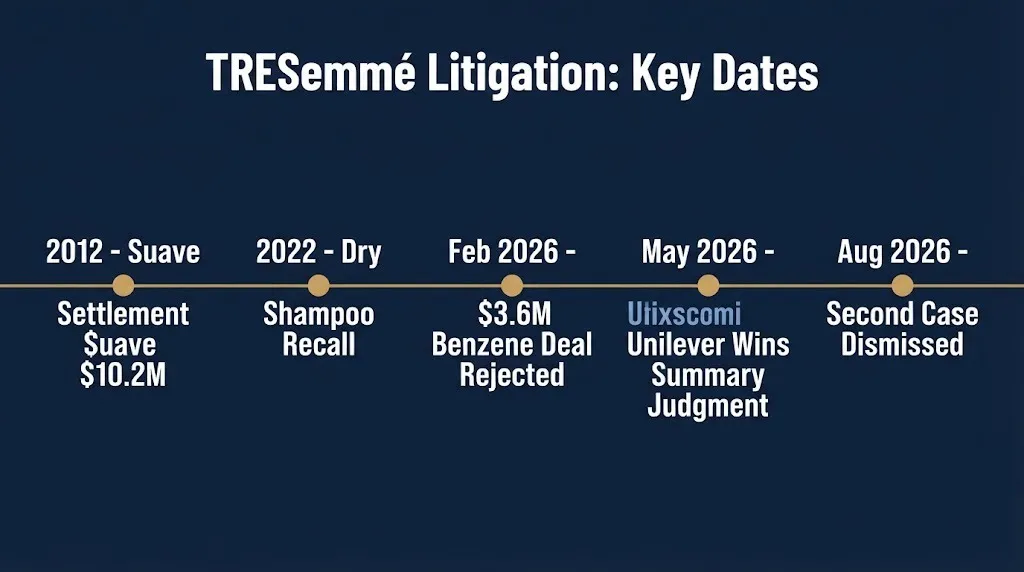
Unilever recalled some products in October 2022 . The proposed $3.6 million settlement would have compensated consumers who bought the affected products. But the judge rejected the deal in February 2026 .
The rejection was “without prejudice.” That means the parties can try again with a revised proposal. As of September 2026, no new deal has been announced. No claim process is open.
What happens next in the TRESemmé litigation?
Expected Q4 2026: Plaintiffs may file a revised benzene settlement proposal addressing the judge’s concerns about class period and product scope.
Ongoing: Individual hair-loss cases continue in federal courts. Unilever is likely to keep challenging expert testimony and filing summary judgment motions.
No confirmed trial date: No TRESemmé hair-loss case has a confirmed trial date. Most are resolving at the summary judgment stage.
No payout timeline: Even if a settlement is reached, payment would come months after final approval. There is no expected payment window for any TRESemmé case right now.
Key Takeaway: The TRESemmé litigation is active but unsettled. Unilever is winning the causation battle. No money is available to claim in 2026, and no deadline exists to miss.
Frequently Asked Questions
Is there a TRESemmé settlement in 2026?
No. There is no approved TRESemmé settlement in 2026. A proposed benzene settlement was rejected in February 2026, and hair-loss cases are still in litigation.
How much is the TRESemmé lawsuit worth?
No total settlement value is confirmed. A proposed benzene deal was $3.6 million but was rejected. Hair-loss cases have no proposed settlement fund.
Did Unilever lose the TRESemmé lawsuit?
No. Unilever won summary judgment in at least two 2026 hair-loss cases because plaintiffs’ expert testimony was excluded. The company has not lost a major TRESemmé case in 2026.
Can I still file a TRESemmé claim?
No. There is no open claim process for any TRESemmé settlement. Any website accepting claims is not authorized by a court.
What products are covered in the TRESemmé lawsuit?
Hair-loss cases involve various TRESemmé shampoos and conditioners containing DMDM hydantoin. The benzene case involved dry shampoo sprays. Specific product lists are not finalized for any settlement.
Is DMDM hydantoin banned?
No. DMDM hydantoin is permitted in cosmetics in the U.S. and Europe at concentrations up to 0.6%. Regulators consider it safe within those limits.
How long do I have to sue Unilever over TRESemmé?
Statutes of limitations vary by state, typically 2 to 4 years for personal injury or product liability claims. If you noticed symptoms years ago, your window may be closing. Consult a lawyer about your specific situation.
Will there be a TRESemmé settlement in 2027?
Not yet confirmed. The benzene settlement may be revised. Hair-loss cases could settle individually or as a group. No timeline is guaranteed.
What should you do now?
If you used TRESemmé products and believe you suffered hair loss, start keeping records. Save any remaining product, take photos of your scalp and hair, and gather receipts or order histories. If you have seen a dermatologist, request copies of those records.
Do not pay anyone who promises to file a TRESemmé claim for you. There is no claim to file. Do not rely on social media posts for settlement news. Check federal court records or established legal news sources.
The single most important fact: no TRESemmé settlement exists in 2026. Any deadline you see is not real. Any payout figure is not confirmed. The litigation continues, and Unilever is fighting hard.