Non-Qualified Deferred Compensation Plan 2026: Rules, Taxes, and What Executives Need to Know
Quick Answer
- Is it legit? Yes. NQDC plans are common executive benefits governed by IRC Section 409A.
- How much can you defer? No IRS contribution limit, but plans set their own caps and eligibility.
- Most important deadline? Deferral elections generally must be made before the year the income is earned.
What Is a Non-Qualified Deferred Compensation Plan?
A non-qualified deferred compensation plan (NQDC) is a contractual arrangement between an employer and a select group of employees that allows income to be earned in one year but paid in a later year. The plan is “non-qualified” because it does not meet the IRS requirements for tax-favored retirement plans like 401(k)s.
The arrangement is a promise to pay in the future, not a funded trust account. That distinction matters. Your money in an NQDC plan is an unsecured liability of your employer. If the company goes bankrupt, you stand in line with other general creditors.

NQDC plans are typically offered to executives, highly compensated employees, and management-level staff. The employer selects who participates. Unlike a 401(k), there is no requirement to open the plan to all employees, and no IRS limit on how much you can defer.
The Facts
| Topic | Non-Qualified Deferred Compensation Plan |
| Governing Law | Internal Revenue Code Section 409A |
| Status | Active. 2026 rules in effect. |
| Contribution Limit | No IRS limit. Plan-specific caps apply. |
| Eligibility | Select group of management or highly compensated employees |
| Est. Per Person | Varies. No IRS cap on deferrals. |
| Claim Deadline | Deferral elections generally due before the tax year of earning |
| Administrator | Employer (plan sponsor) |
| Proof Needed | Written plan document, deferral election form |
How Does a Non-Qualified Deferred Compensation Plan Work?
A non-qualified deferred compensation plan works by letting you elect to defer a portion of your salary, bonus, or both into the plan before you earn it. The employer credits your account with the deferred amount, and the balance grows based on investment options you select.
The deferral election is irrevocable for that year. You cannot change your mind mid-year and pull the money back. That restriction is what keeps the IRS from taxing the income immediately under the constructive receipt doctrine.
Your account balance is typically measured by “notional” investments. These are bookkeeping entries that track the performance of mutual funds or other investments. The employer does not actually buy those investments for you. The notional earnings are credited to your account, and you pay ordinary income tax when you receive distributions.
Employers often use rabbi trusts to set aside assets informally. A rabbi trust is a funding vehicle that protects the deferred compensation from the employer’s day-to-day spending, but the assets remain subject to the claims of the employer’s creditors in bankruptcy. It is not a true trust in the ERISA sense.
Who Is Eligible for a Non-Qualified Deferred Compensation Plan?
Eligibility for a non-qualified deferred compensation plan is limited to a select group of management or highly compensated employees. The employer decides who participates. There is no statutory income threshold, but many plans set minimum salary requirements. One company plan allows employees earning more than $140,000 annually to contribute.
The “top-hat” exemption under ERISA allows these plans to skip most ERISA requirements, including participation, vesting, and fiduciary rules. That is why NQDC plans are not subject to the same nondiscrimination testing that limits 401(k) contributions for high earners.
You are not automatically eligible just because you earn a high salary. The employer must designate you as a participant in the plan document. Many companies limit participation to executives at the VP level and above.
How Much Can You Defer into a Non-Qualified Plan?
There is no IRS limit on how much you can defer into a non-qualified deferred compensation plan. The 401(k) contribution limit does not apply because NQDC plans are not tax-qualified.
Your plan document will set the actual cap. Common limits range from 50% of base salary to 100% of bonus, or a flat dollar amount like $100,000 per year.
The lack of a statutory limit is one of the main attractions. Executives who max out their 401(k) can use an NQDC plan to defer additional income and reduce their current tax bill. The trade-off is that the money is at risk if the employer becomes insolvent.
Key Takeaway: NQDC plans have no IRS contribution limit, but your employer sets the cap and you cannot access the money early without penalty.
What Are the Section 409A Deferred Compensation Rules?
Section 409A of the Internal Revenue Code governs non-qualified deferred compensation. The rules are strict, and violations trigger severe tax penalties.
The core requirements are straightforward. Deferral elections must be made in the tax year before the income is earned. The plan must specify the time and form of payment up front. Distributions can only occur upon one of six permitted events.
The six permitted distribution triggers are:
- Separation from service
- Disability
- Death
- A specified time or fixed schedule set at deferral
- Qualified change in control
- Unforeseeable emergency
The plan must designate the payment date or schedule with objective specificity. You cannot leave the timing to later discretion.
For performance-based compensation, there is a narrow exception. You may make the deferral election up to six months before the end of the performance period. That gives you more flexibility than the standard prior-year rule.
The short-term deferral rule is another key exception. If compensation is paid by March 15 of the year following vesting, it generally avoids Section 409A coverage entirely. That is why many annual bonuses are structured to pay by that date.
What Happens If You Violate Section 409A?
A Section 409A violation triggers immediate income inclusion plus a 20% additional tax and interest penalties. The IRS does not negotiate on this. The penalties apply to the participant, not just the employer.
If the plan fails to comply, all compensation deferred under the plan for that year and all preceding years is included in your gross income. You pay ordinary income tax on the entire amount, plus a 20% penalty, plus interest from the date the income should have been recognized.
The employer faces withholding and reporting exposure. But the tax hit lands on you. That is why plan administrators spend so much time on compliance.
Common violations include paying out too early, changing the payment schedule without following the re-deferral rules, and failing to specify the time and form of payment in the plan document. The rules are technical, and small drafting errors can be expensive.
Reality Check: Your NQDC Balance Is Not Guaranteed
The biggest myth about non-qualified deferred compensation is that it is as safe as a 401(k). It is not. Your NQDC balance is an unsecured promise from your employer. If the company goes bankrupt, you become a general creditor. Money in a rabbi trust does not protect you from that risk. It only keeps the employer from spending the assets on daily operations before insolvency. Before deferring a large portion of your income, assess your employer’s financial health.
How Do You Make a Deferral Election in an NQDC Plan?
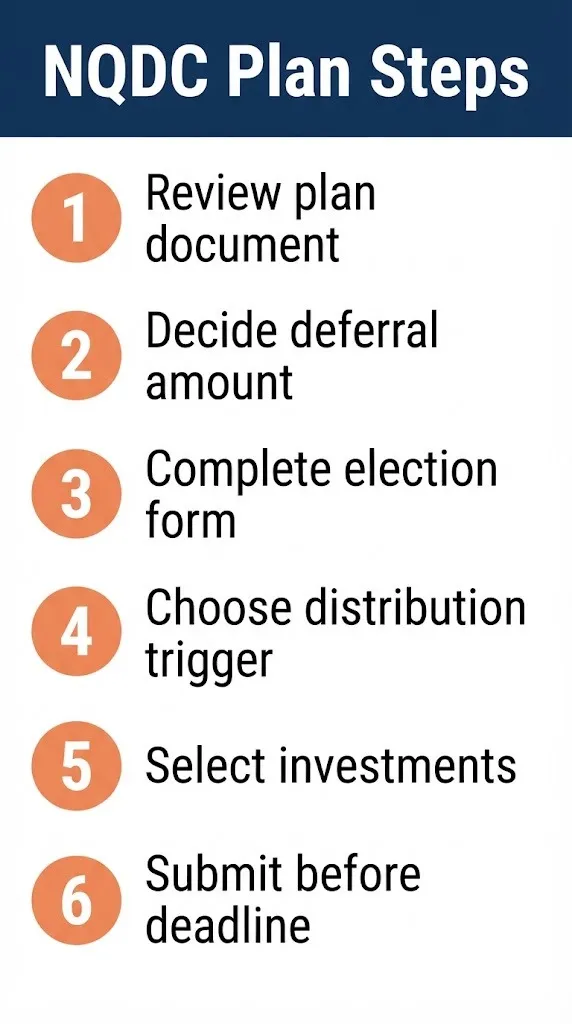
Making a deferral election requires careful timing and a clear understanding of your cash flow. Here are the steps.
- Review your plan document. Understand the deferral limits, investment options, and distribution triggers.
- Decide how much to defer. Consider your cash needs and tax bracket for the deferral year.
- Complete the election form before the deadline. For salary, this is typically before the start of the year.
- Choose your distribution election. Select lump sum or installments, and the trigger event.
- Select notional investments. These determine how your account balance grows.
- Sign and submit the form. The election is irrevocable for that year.
- Confirm your employer received it. Keep a copy for your records.
The election timing is like filing your taxes early. Miss the deadline and you lose the opportunity for that year. There is no extension.
What Are the Tax Rules for NQDC Plan Distributions?
NQDC distributions are taxed as ordinary income when you receive them. There is no capital gains treatment and no special retirement tax break.
Your employer reports distributions on Form W-2 as wages. The amount is subject to federal income tax, state income tax, and Social Security and Medicare taxes if not already withheld at deferral.
The tax deferral benefit comes from the timing. If you defer income during a high-tax year and receive it in a lower-tax year, you pay less overall. Some executives also move to a state with no income tax before receiving distributions, which can reduce state tax liability.
There is no early withdrawal exception for NQDC plans. You cannot take a loan or hardship distribution unless the plan specifically allows an unforeseeable emergency distribution, which is narrowly defined. The money is locked until the scheduled distribution event.
What Happens to Your NQDC Plan When You Leave the Company?
When you separate from service, your NQDC plan distributions follow the election you made when you deferred the income. If you chose a lump sum, you get it all at once. If you chose installments, you get payments over the schedule you selected.
The six-month delay rule applies to “specified employees” at public companies. If you are a key employee, distributions triggered by separation from service cannot begin until six months after you leave. That rule exists to prevent executives from using NQDC plans as short-term tax shelters.
If you die before receiving all distributions, the remaining balance goes to your designated beneficiary. The beneficiary pays income tax on the distributions as they receive them.
If you become disabled, you can receive distributions under the disability trigger. The definition of disability under Section 409A is strict. It generally requires a condition expected to last at least 12 months or result in death.
What Happens Next for NQDC Plans in 2026?
March 15, 2027: Short-term deferral deadline for 2026 bonuses. Payments after this date may need Section 409A compliance.
Ongoing 2026: Employers must ensure plan documents reflect current election procedures and distribution triggers.
Expected late 2026: Companies will open deferral election windows for 2027 salary and bonus deferrals.
TBD: No major legislative changes to Section 409A are pending as of September 2026.
Frequently Asked Questions
What is a non-qualified deferred compensation plan?
It is a contractual arrangement that lets select employees defer income taxes on salary or bonus until a future distribution date. The plan is unfunded and not subject to ERISA’s strict rules.
How is NQDC different from a 401(k)?
NQDC plans are not tax-qualified, have no IRS contribution limit, and are only offered to select employees. 401(k) plans are open to most employees, have contribution limits, and are protected by ERISA.
What happens if I quit my job with an NQDC balance?
You receive distributions according to the election you made when you deferred the income. If you are a specified employee at a public company, distributions may be delayed six months.
Can I lose my NQDC money if my employer goes bankrupt?
Yes. Your NQDC balance is an unsecured liability. If the company becomes insolvent, you are a general creditor and may not recover the full amount.
What is the 409A 20% penalty?
If a plan violates Section 409A, the deferred compensation is included in your income immediately, plus a 20% additional tax and interest. The penalty applies to the participant.
When must I make my deferral election?
Generally before the start of the year in which you earn the income. For performance-based compensation, the deadline can be up to six months before the end of the performance period.
Are NQDC plan distributions taxed as ordinary income?
Yes. Distributions are reported as W-2 wages and taxed at ordinary income rates. There is no capital gains treatment.
Can I take a loan from my NQDC plan?
No. NQDC plans do not allow loans. The only early access is an unforeseeable emergency distribution, which is narrowly defined and rarely approved.
What You Should Do Right Now
If you are eligible for an NQDC plan, review the plan document before the next election window. Understand the distribution triggers and your employer’s financial health. Defer only what you can afford to leave at risk.
The single most important date to remember: March 15, 2027 is the short-term deferral deadline for 2026 bonuses. Missing it can trigger Section 409A compliance requirements.