Ohio Unemployment Lawsuit 2026: What the Supreme Court Ruled and What It Means for You
Quick Answer
- The Ohio unemployment lawsuit is Bowling v. DeWine, over $300 weekly federal checks Ohio cut off in 2021.
- Payout: not yet determined. A plaintiffs’ attorney estimates about $3,000 each for 300,000 Ohioans, but nothing is ordered.
- No claim deadline exists. The Ohio Supreme Court ruled the case moot in August 2026.
The Ohio unemployment lawsuit is State ex rel. Bowling v. DeWine, and the Ohio Supreme Court just rejected it again. In August 2026, the justices ruled the roughly $900 million case moot for the second time.
It affects about 300,000 Ohioans who say Gov. Mike DeWine ended $300 weekly federal checks too early in 2021. There’s no claim form and no filing deadline to meet.
Below, you’ll see what the court decided, how the case differs from the PUA overpayment fight, and what to do with a repayment notice. One detail stands out: the plaintiffs say the federal money is still available.
The Facts
| Case | State ex rel. Bowling v. DeWine, a class action over Ohio leaving the FPUC program early |
| Status | Ohio Supreme Court ruled it moot in August 2026. Plaintiffs’ attorney says it isn’t over |
| Fund Size | About $900 million claimed. Nothing awarded |
| Est. Per Person | Not yet determined. Attorney estimate of about $3,000 is unverified by the court |
| Claim Deadline | None. No claim form exists |
| Administrator | Not yet appointed |
| Proof Needed | Not applicable. Keep your ODJFS payment records |
Is there really an Ohio unemployment lawsuit in 2026?
Yes, the Ohio unemployment lawsuit is real, and it’s called Bowling v. DeWine. Workers sued in Franklin County Common Pleas Court in July 2021, after the governor pulled Ohio out of a federal $300 weekly benefit program.
The case has climbed the courts for five years. The Ohio Supreme Court heard oral arguments on May 20, 2026, and ruled in August. That’s a real docket, not a marketing claim.
Beware of pages that lump it together with other Ohio benefit disputes. Some news coverage calls the $300 checks pandemic unemployment assistance, which blurs two programs.
Here’s what’s verified:
- Court: Ohio Supreme Court, after the Franklin County trial court and Tenth District
- Defendants: Gov. Mike DeWine and the ODJFS director
- Claim: Ohio’s early exit from FPUC was not legally allowed
Is the Ohio PUA lawsuit the same as the $900 million case?
No, the Ohio PUA lawsuit and the $900 million case are two different programs. The $900 million case concerns Federal Pandemic Unemployment Compensation, or FPUC, the extra $300 a week. PUA is Pandemic Unemployment Assistance, which covered people who didn’t qualify for regular benefits.
We found no verified court docket for a single Ohio PUA class action. Competing pages describe one, but the searches surfaced no case name we could confirm. Treat that as not yet confirmed.
The PUA fight is mostly about repayment demands. ODJFS sent overpayment letters to some PUA recipients in 2021, according to a 2021 agency press release cited by the Franklin County Law Library.
| Program | What it paid | Legal fight |
|---|---|---|
| FPUC | Extra $300 per week | Bowling v. DeWine class action |
| PUA | Benefits for gig and self-employed workers | Overpayment notices and appeals |
Is the Ohio unemployment lawsuit over after the Supreme Court ruling?
The Ohio Supreme Court dismissed the case as moot for the second time, but the plaintiffs’ attorney says it isn’t over. The court agreed with the state that the federal program ended in 2021. The same court issued the same ruling in November 2022.
Attorney Marc Dann said the court may be misunderstanding one point: the federal money is still available. He said Ohio simply needs to ask for it. He also said the plaintiffs are close to the end.
The next legal step is not yet confirmed. We couldn’t verify a filed motion or a new appeal.
Think of a moot ruling like a return window that closed. The court isn’t saying the store was right. It’s saying the window has shut.
Key Takeaway: The Ohio unemployment lawsuit is real, it isn’t the same as the PUA fight, and the Supreme Court has ruled it moot twice.
How much money is at stake in the Ohio unemployment lawsuit?
About $900 million is at stake, according to the plaintiffs, and no money has been awarded. That figure is what FPUC would have paid Ohioans if the state had stayed in the program.
Lower courts sided with the workers first. The trial court ruled in 2025 that claimants were entitled to the money, and the Tenth District Court of Appeals agreed. The Ohio Supreme Court then reversed course by ruling the case moot.
| Number | Detail |
|---|---|
| About $900 million | Withheld FPUC funds, per the plaintiffs |
| About 300,000 | Ohioans in the claimed class |
| $300 | Extra weekly federal benefit |
| Dec. 27, 2020 to Sept. 6, 2021 | Period the program offered checks |
These are the plaintiffs’ numbers. The state disputes that any money is owed.
Could you get $3,000 from the Ohio unemployment lawsuit?
Your payout is not yet determined, and no court has ordered any payment. Dann estimated about $3,000 each for 300,000 Ohioans. That’s a lawyer’s estimate, not a court finding, and the case is now dismissed as moot.
Amounts would depend on how many weeks you were unemployed after Ohio stopped the checks. Dann said people unemployed in the summer and fall of 2021 would qualify for $300 per week. You may qualify only if a court ever orders payment.
Do the math on your own record. Count the weeks you received regular benefits after June 2021.
Reality Check: No one is texting settlement money from this case. There’s no claim form to fill out, and nobody can charge you a fee to “register” you. Any site offering to file your Ohio unemployment lawsuit claim for a price is a red flag.
How much do Ohio PUA overpayments total?
The figures are large, and the sources disagree on totals. In May 2021, the ODJFS interim director said Ohioans received over $1.2 billion in accidental PUA payments between May 2020 and February 2021. Nearly 1 in 5 PUA recipients got a repayment letter that April, according to Eye on Ohio.
A Franklin County Law Library guide links to reporting that Ohio’s pandemic overpayments hit $3.86 billion, with few people requesting waivers. That figure covers overpayments across programs, not just PUA.
One competing page claims 900,000 overpayment notices and $1.3 billion in debt. We couldn’t confirm those numbers from an official source, so we’re not repeating them.
Amounts owed depend on your own determination notice. Read yours line by line.
Key Takeaway: The $900 million is unpaid FPUC money the plaintiffs claim, while the PUA problem is repayment demands that differ for every claimant.
How do you check whether you were part of the FPUC class?
You check by reviewing your own payment records, because no claim form exists. You may qualify only if you received unemployment benefits after Ohio ended the $300 checks. Follow these steps:
- Pull your ODJFS payment history for 2021.
- Note when your $300 weekly payments stopped.
- Count your unemployed weeks after that date.
- Save your benefit statements and tax forms.
- Watch for updates from the court or the plaintiffs’ lawyers.
- Ignore texts or calls asking for fees.
Keep everything in one folder. If a court ever orders payment, records will matter.
Dann’s law firm, DannLaw, and Zimmerman Law Offices represent the plaintiffs, according to the court’s opinion. Contact them directly for status, not an unknown site.
How do you fight an Ohio PUA overpayment notice?
You fight an Ohio PUA overpayment by filing an appeal using the instructions in your determination notice. ODJFS says the old waiver program is no longer available. Its guidance now points to appeals, and every overpayment notice carries appeal instructions.
An attorney blog advises that a waiver isn’t a substitute for an appeal. It says missing the appeal can cost you a deadline. Follow these steps:
- Read your determination notice from start to finish.
- Find the appeal instructions near the end.
- File the appeal by the date printed on the notice.
- Prepare for a telephone hearing with the Unemployment Compensation Review Commission.
- Gather income records and messages from ODJFS.
- Keep copies of everything you send.
An appeal filed late may still be reviewed. The same attorney says the agency decides whether to accept it. That’s not guaranteed.
What deadlines apply to Ohio unemployment lawsuit claims?
There’s no claim deadline for the Bowling case, because there’s no claim process. The only deadlines that matter are on your own ODJFS notices. The date printed on your overpayment notice controls your appeal.
The last known appeal window in Bowling was 45 days for DeWine to appeal the July 2025 Tenth District ruling, according to the Franklin County Law Library guide. That window has passed. The case then reached the Ohio Supreme Court.
Any new step by the plaintiffs has no confirmed date. That’s not yet confirmed.
It’s like a warranty claim. The manufacturer’s dates matter, not the store’s advertising.
Key Takeaway: No deadline exists for the $900 million case, but your PUA appeal date is printed on your notice and it’s the one that counts.
What is the Ohio unemployment lawsuit update today?
The update today is that the Ohio Supreme Court has ruled the case moot and the plaintiffs say they’re not done. The ruling came in August 2026, in an opinion posted as 2026-Ohio-3208. The Statehouse News Bureau reported it on August 24.
Ohio’s lawyers argued the case was pointless because the program ended in 2021. Chief Justice Sharon Kennedy asked at the May 20 argument why the case was back at all, since the court had already dismissed it once.
Plaintiffs’ lawyers argue the money remains available at the U.S. Department of Labor. Andrew Engel, representing the claimants, said Congress appropriated it without a fiscal-year limit.
Here’s where each side stands:
- State: The federal program is over, so the case has no point.
- Plaintiffs: The funds remain available and Ohio can request them.
- Court: Dismissed as moot.
What did the Ohio Supreme Court decide, and why “moot”?
The Ohio Supreme Court decided the case was moot, which means there’s nothing left for a court to fix because the federal program ended. It’s the second time the court used that reasoning. The first was in November 2022.
The plaintiffs went back to court after 2022. They argued the earlier dismissal covered only a preliminary injunction, not DeWine’s power to leave the program. The trial court and Tenth District agreed with them.
The opinion text posted by the court discusses whether the federal benefits may still be available. Read the full opinion for the holding, because news summaries compress it.
A moot ruling isn’t a finding that Ohio was right. It doesn’t decide whether the governor had the legal authority. That question stays unanswered.
What happens if the plaintiffs win or lose from here?
The next step is not yet confirmed, and we found no filed follow-up motion. Dann said the plaintiffs will raise the availability of federal money with the court. That’s a stated plan, not a docket entry.
If the plaintiffs somehow prevail later, the state would need to ask the Labor Department for the funds. That’s the plaintiffs’ theory. No federal agency has confirmed that the money would be released.
If they lose, the FPUC fight ends with no payments. Your regular unemployment benefits aren’t affected either way. Those run through a separate system.
Keep expectations low and records ready. Both can be true.
Key Takeaway: The court dismissed the case as moot without deciding whether DeWine had the authority to end the checks.
When will Ohioans get the FPUC money, if ever?
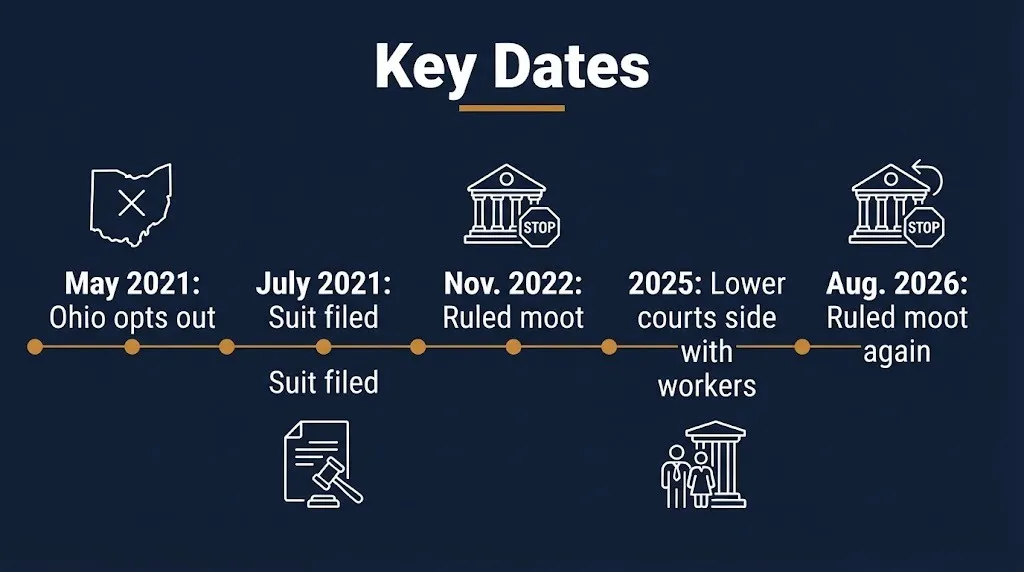
No payment date exists, and payment is not yet confirmed. The case is dismissed, and nothing is ordered. Here’s the timeline of how it got here:
| Date | Event |
|---|---|
| March 2020 | Congress creates FPUC in the CARES Act |
| May 2021 | DeWine announces Ohio will opt out |
| Late June 2021 | Ohio’s $300 checks stop |
| July 2021 | Workers file suit in Franklin County |
| Sept. 6, 2021 | Federal program ends |
| November 2022 | Ohio Supreme Court dismisses as moot |
| 2025 | Trial court and Tenth District side with workers |
| May 20, 2026 | Ohio Supreme Court hears arguments |
| August 2026 | Court rules moot again |
It’s like a delayed tax refund with no filing on record. There’s nothing to track yet.
Why did DeWine end the $300 checks early?
DeWine ended the checks because he and business groups said the extra $300 was discouraging people from returning to work. He announced the exit in May 2021. The governor’s office said businesses were struggling to hire.
The state says the extra money tightened labor markets. An attorney for the state made that argument before the Ohio Supreme Court. Plaintiffs answer that the General Assembly, not the governor, had the power to end the program.
Ohio wasn’t alone. The Buckeye Institute says 24 other states also opted out of the program. Lawmakers later amended Ohio’s Cooperation Statute to clarify the governor isn’t required to accept federal funds just because they’re offered.
Here’s the core dispute:
- State: The governor had authority to withdraw.
- Plaintiffs: State law reserved that power to lawmakers.
- Timing question: Whether the later statute change applies to a 2021 decision.
What is Federal Pandemic Unemployment Compensation?
Federal Pandemic Unemployment Compensation, or FPUC, is a federal program that paid an extra $300 per week on top of regular unemployment. Congress created it in March 2020 through the CARES Act. The extra weekly benefit ran from December 27, 2020 to September 6, 2021.
Ohio ended its participation about 10 weeks before the federal end date. That gap drives the whole lawsuit. Plaintiffs say every unemployed Ohioan lost those weeks of extra checks.
FPUC differs from PUA. FPUC topped up regular benefits. PUA covered workers who had no regular claim, like gig workers and the self-employed.
Ohio also ran other pandemic programs. Don’t assume a repayment notice ties back to the $900 million case. Check which program your letter names.
Who are the lawyers and parties in Bowling v. DeWine?
The parties are a group of Ohio workers, led by named plaintiff Candy Bowling, against Gov. Mike DeWine and the ODJFS director. The court’s opinion names DannLaw, attorneys Marc Dann, Brian Flick, and Andrew Engel, and Zimmerman Law Offices for the workers. Ohio Attorney General Dave Yost’s office argued for the state.
The Ohio Attorney General’s office is listed as D. Andrew Wilson in the opinion. Check the official opinion for exact names.
The Buckeye Institute filed friend-of-the-court briefs supporting the governor. It filed its fourth on December 18. The Legal Aid Society of Columbus filed a brief supporting the workers, per the opinion.
Key Takeaway: The case is a class action against the governor, with workers’ lawyers at DannLaw and the state’s position defended by the Attorney General’s office.
What Happens Next
Now: Keep your ODJFS records and check any repayment notice for its appeal date.
Expected, date not confirmed: The plaintiffs’ lawyers may raise the availability of federal funds with the court.
Expected, date not confirmed: A court or lawyer announcement would tell you whether any new step is filed.
Your own date, printed on your notice: File any PUA overpayment appeal.
No date: No payment schedule exists for the $900 million claim.
Frequently Asked Questions
What is the Ohio unemployment lawsuit?
It’s State ex rel. Bowling v. DeWine, a class action over Ohio ending $300 weekly federal checks in 2021.
Workers say the governor lacked the authority to do that.
The Ohio Supreme Court ruled it moot in August 2026.
Is the Ohio PUA lawsuit the same case?
No, it isn’t the same case.
The $900 million case involves FPUC, the extra $300.
PUA disputes mostly involve repayment notices and appeals.
Will I get money from the Ohio unemployment lawsuit?
That’s not yet determined, and no payment has been ordered.
A plaintiffs’ lawyer estimates about $3,000 each, but the court hasn’t ruled on any amount.
You may qualify only if a court ever orders payment.
Is there a claim deadline?
No, there isn’t a claim deadline.
There’s no claim form for the $900 million case.
Be careful with any site that says otherwise.
What is the unemployment lawsuit update today?
The Ohio Supreme Court ruled the case moot in August 2026.
The plaintiffs’ attorney says it isn’t over.
The next step is not yet confirmed.
Can I still get a waiver for a PUA overpayment?
ODJFS says its waiver program is no longer available.
The agency points to appeals for overpayments you dispute.
Your notice lists the appeal instructions.
How many states ended the $300 checks early?
Ohio and 24 other states opted out, according to the Buckeye Institute.
Ohio’s exit came about 10 weeks before the federal end date.
Each state’s legal situation differs.
Does the ruling affect my regular unemployment benefits?
The reporting doesn’t show that it does.
Regular benefits run through a separate system.
Check your ODJFS account for your own status.
Closing
Pull your ODJFS payment history today and save it in one folder. If you got a PUA overpayment notice, find the appeal date on it and calendar it now.
For the $900 million FPUC case, there’s no form to file. The Ohio Supreme Court ruled it moot in August 2026.