Roundup Lawsuit Cancer 2026: Which Cancers Qualify and Settlement Status
Quick Answer
- Which cancers? The Roundup lawsuits primarily cover non-Hodgkin lymphoma, not leukemia in the strict sense .
- How much? Payouts range from $10,000 to $165,000, depending on age, exposure, and severity .
- Key deadline? The opt-out deadline passed June 4, 2026. If you did not exclude yourself, you are bound by the settlement .
The Roundup lawsuit cancer question has a specific answer that most headlines get wrong. The litigation centers on non-Hodgkin lymphoma (NHL), a group of blood cancers affecting the lymphatic system. It is not a general “cancer” settlement, and it is not primarily about leukemia.
This article covers the verified medical criteria, the specific cancer subtypes included, and the current status of the $7.25 billion settlement. One detail worth knowing up front: some NHL subtypes, like chronic lymphocytic leukemia/small lymphocytic lymphoma (CLL/SLL), blur the line between lymphoma and leukemia, which is why “Roundup leukemia” has entered the public vocabulary .
The Facts
| Case | In re Roundup Products Liability Litigation and related state cases |
|---|---|
| Primary Cancer | Non-Hodgkin lymphoma (NHL) |
| Settlement Fund | Up to $7.25 billion |
| Court | 22nd Judicial Circuit Court, St. Louis, Missouri |
| Status | Final approval hearing held July 9, 2026. Ruling pending. |
| Estimated Payout | $10,000 to $165,000 per claimant |
| Opt-Out Deadline | June 4, 2026 (passed) |
| Proof Needed | Medical diagnosis of NHL and documented Roundup exposure |
What Cancers Are Included in the Roundup Lawsuit?
The Roundup lawsuit primarily covers non-Hodgkin lymphoma (NHL). This is a group of blood cancers that originate in lymphocytes, a type of white blood cell. The lawsuits allege that glyphosate exposure caused or contributed to the development of NHL .
NHL is not a single disease. It includes multiple subtypes, and the lawsuits cover the broader category. The most commonly cited subtypes in litigation include:
- Diffuse large B-cell lymphoma (DLBCL). The most common aggressive NHL subtype .
- Follicular lymphoma. A slower-growing form of NHL .
- Chronic lymphocytic leukemia/small lymphocytic lymphoma (CLL/SLL). This subtype straddles the lymphoma-leukemia boundary .
- Hairy cell leukemia. A rare B-cell malignancy occasionally cited in cases .
- Marginal zone lymphoma. Another NHL subtype included in the litigation .
The confusion between lymphoma and leukemia is understandable. CLL/SLL is classified as both a lymphoma and a leukemia because it involves the same type of lymphocyte. But the core legal claim is about NHL, not classical leukemia like AML or ALL .
Does Roundup Cause Leukemia Specifically?
The strongest evidence links glyphosate to non-Hodgkin lymphoma, not classical leukemia. However, some NHL subtypes overlap with leukemia classifications, which creates public confusion.
The scientific debate is real. In 2015, the World Health Organization’s International Agency for Research on Cancer (IARC) classified glyphosate as a Group 2A carcinogen, meaning “probably carcinogenic to humans” . This classification was based on limited human evidence and sufficient animal studies.
The U.S. Environmental Protection Agency (EPA), however, has maintained that glyphosate is “not likely to be carcinogenic to humans” at typical exposure levels . This regulatory split is central to the legal battles.
A widely cited 2019 meta-analysis found a 41% increased risk of NHL among individuals with the highest cumulative glyphosate exposure . That study is a key piece of evidence plaintiffs cite.
How Much Can You Get from the Roundup Settlement?
The proposed settlement offers payouts ranging from $10,000 to $165,000, depending on several factors . The average for some claimants could be higher.
Here is how the payout tiers work.
| Factor | Impact on Payout |
|---|---|
| Age at diagnosis | Younger claimants receive more |
| Exposure type | Occupational exposure pays more than residential |
| Cancer severity | Aggressive NHL subtypes pay more |
| Diagnosis timing | Diagnosed before age 60 pays more |
A patient with occupational exposure diagnosed with aggressive NHL before age 60 could receive an average of $165,000 . Patients older than 78 with a qualifying diagnosis would receive $10,000 .
Not yet determined: The exact final payout depends on how many valid claims are approved and how much of the $7.25 billion fund is distributed.
Reality Check
Reality Check: No one texts you Roundup settlement money before you register a claim. The claims process requires a medical diagnosis of NHL and proof of Roundup exposure. If someone contacts you promising payment in exchange for a fee, it is a scam. Registration for the settlement is free and handled through the official court-authorized process.
How Do You File a Roundup Lawsuit Claim?
You cannot file a new claim if you are not already part of the settlement class. The cutoff for new claimants was February 13, 2026, for initial claimants with pending lawsuits or tolling agreements .
If you are already a class member, here is what the process involves:
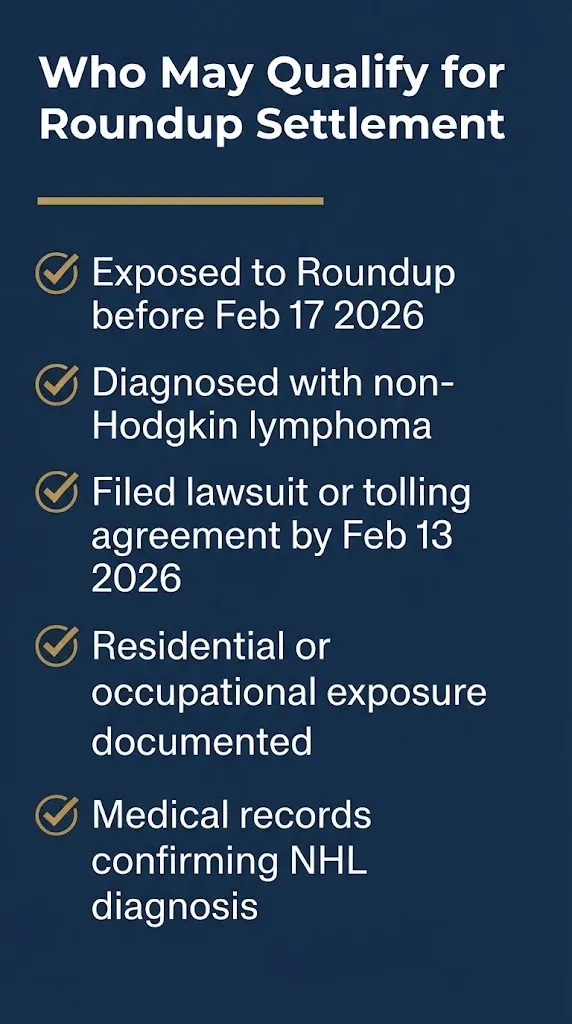
- Confirm your eligibility. You must have been exposed to Roundup before February 17, 2026, and have an NHL diagnosis .
- Register for the settlement. Class members must register within 180 days of final approval .
- Apply for a Program Award or Quick-Pay Award. Quick-Pay is available for certain tiers .
- Submit medical documentation. Proof of NHL diagnosis is required.
- Document your exposure. Work history or residential use records establish the exposure timeline.
- Pause any pending lawsuit. If you filed suit, you must agree to stay and eventually dismiss it .
Who May Qualify for the Roundup Settlement?
You may qualify if you were exposed to Roundup before February 17, 2026, and have been diagnosed with non-Hodgkin lymphoma . The settlement also covers future claims for people who develop NHL within 16 years after the effective date.
The settlement class includes:
- Current claimants. People with pending lawsuits or tolling agreements filed before February 13, 2026 .
- Future claimants. People who were exposed to Roundup before the settlement date and develop NHL within 16 years .
- Residential users. Homeowners who used Roundup on their lawns and gardens.
- Occupational users. Farmers, groundskeepers, and landscapers with regular exposure.
MDL plaintiffs are excluded from the class unless they request inclusion and dismiss their pending federal claims .
What Is the Status of the Roundup Settlement in 2026?
The settlement is pending final approval. A fairness hearing was held on July 9, 2026, before Judge Timothy Boyer in St. Louis . The judge did not issue an immediate ruling.
Bayer filed the proposed settlement in February 2026. It covers approximately 65,000 claims pending in state and federal courts . The company will make declining capped annual payments over up to 21 years .
The settlement is separate from the Supreme Court case Monsanto Co. v. Durnell, which the Court granted certiorari on January 16, 2026 . The Supreme Court ruled in June 2026 that federal law preempts state failure-to-warn claims, undercutting one of the central legal theories in the Roundup cases .
What Happens Next
Pending: Judge Boyer’s written ruling on final approval of the $7.25 billion settlement.
Expected late 2026: Registration period opens for class members to file claims.
Expected 2027: First payments distributed to approved claimants.
TBD: Appeal timeline if the settlement is approved. Appeals could delay payments for years.
Frequently Asked Questions
What cancer is the Roundup lawsuit about?
The Roundup lawsuit primarily covers non-Hodgkin lymphoma (NHL), a group of blood cancers affecting the lymphatic system .
Does Roundup cause leukemia?
The strongest evidence links glyphosate to non-Hodgkin lymphoma, not classical leukemia. However, some NHL subtypes like CLL/SLL blur the lymphoma-leukemia boundary .
How much can you get from the Roundup settlement?
Payouts range from $10,000 to $165,000, depending on age at diagnosis, exposure type, and cancer severity .
Can I still file a Roundup lawsuit?
The cutoff for initial claimants was February 13, 2026. If you did not file a lawsuit or tolling agreement before that date, you may not be eligible for this settlement .
What is non-Hodgkin lymphoma?
NHL is a group of blood cancers that originate in lymphocytes, a type of white blood cell. It affects the lymphatic system and immune system .
Did the Supreme Court rule on Roundup?
Yes. In June 2026, the Supreme Court ruled that federal law preempts state failure-to-warn claims against Monsanto, undercutting a central legal theory in the Roundup cases .
What is the deadline to opt out of the Roundup settlement?
The opt-out deadline was June 4, 2026. If you did not exclude yourself, you are bound by the settlement terms .
What You Should Do Now
If you are a class member, watch for registration instructions after final approval. The official settlement website is WeedKillerClass.com.
The most important fact: the settlement covers non-Hodgkin lymphoma, not all cancers. If you have a qualifying diagnosis and documented Roundup exposure, your claim is already part of the process. If you missed the February 2026 cutoff, you may not be eligible for this settlement.