Election Lawsuit 2026: Dominion Settles with Lindell as Midterm Voting Fights Escalate
Quick Answer
- Dominion settled its $1.3 billion defamation lawsuit against Mike Lindell in June 2026, with each side paying its own legal fees.
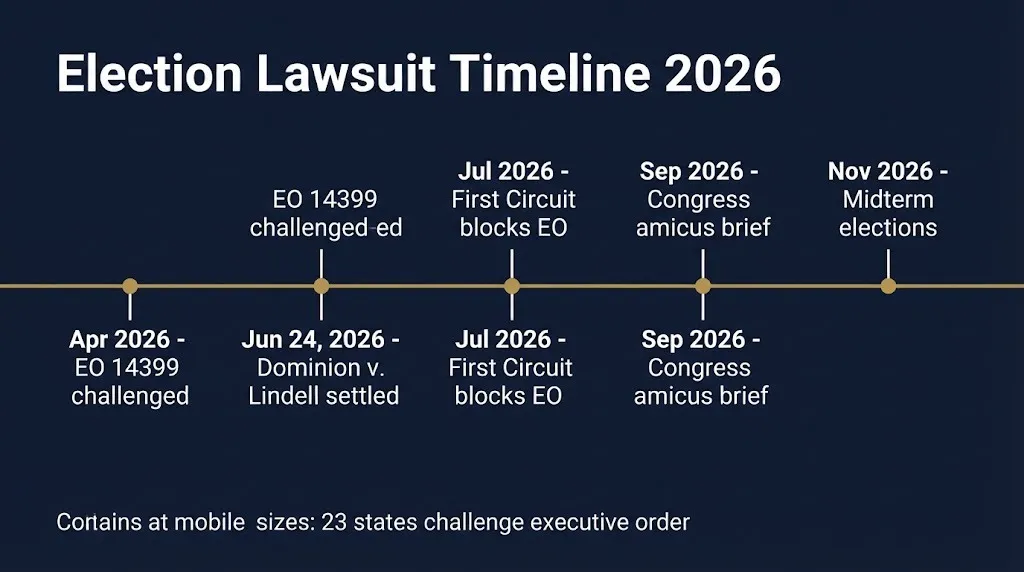
- A coalition of 23 attorneys general won a First Circuit ruling in July 2026 keeping mail-ballot restrictions blocked for the midterms.
- The Supreme Court is weighing emergency appeals on mail voting rules and redistricting maps less than two months before Election Day.
If you’re searching for information on election lawsuits, the landscape has shifted dramatically in 2026. The once-blockbuster Dominion defamation case is over. New fights over mail-in voting and congressional maps are now racing through federal courts.
The Dominion settlement closed a chapter on 2020 election litigation. Lindell, the MyPillow CEO, agreed to a confidential settlement in June, ending a five-year legal battle that he said cost him roughly $20 million .
Meanwhile, the 2026 midterms have spawned a fresh wave of litigation. Twenty-three state attorneys general are defending a court order that blocks key parts of President Trump’s elections executive order. And the Supreme Court is juggling emergency appeals on redistricting from Missouri and mail-voting rules from Pennsylvania.
Here’s what’s actually happening, what the courts have decided, and what it means for voters.
The Facts
| Dominion v. Lindell | Settled June 24, 2026, in U.S. District Court for the District of Columbia |
| Settlement Terms | Confidential; each party bears own attorneys’ fees |
| Dominion Status | Purchased October 2025, now operating as Liberty Vote |
| Executive Order Challenge | EO 14399 blocked in plaintiff states by district court; First Circuit denied stay |
| Coalition | 23 state attorneys general plus Pennsylvania Governor |
| Supreme Court Cases | Missouri redistricting (denied), Pennsylvania mail voting (pending) |
Is the Dominion lawsuit against Mike Lindell really over?
Yes. Dominion Voting Systems, now called Liberty Vote, settled its $1.3 billion defamation lawsuit against Mike Lindell on June 24, 2026, and the case was dismissed with prejudice .
The settlement came nine months after the company was purchased by Scott Leiendecker, a former Republican election official, and renamed Liberty Vote . A spokesperson said the parties agreed to a confidential settlement. Court filings show each side agreed to cover its own attorneys’ fees and expenses .
The lawsuit, filed in 2021, accused Lindell of spreading false claims that Dominion rigged the 2020 presidential election. Lindell said the legal fight cost him roughly $20 million .
The resolution didn’t stop other litigation against Lindell. A federal jury in Colorado awarded $2.3 million to a former Dominion employee after finding Lindell defamed him. A federal judge also found Lindell defamed the voting company Smartmatic, though damages in that case haven’t been determined .
Reality Check: No one texts you election settlement money. These are defamation cases between voting companies and media figures. There is no claim form, no payout, and no class of affected voters. Anyone offering to “process” an election lawsuit claim for a fee is running a scam.
What is the election lawsuit over Trump’s executive order?
The election lawsuit over Trump’s executive order is a challenge to EO 14399, which directed the U.S. Postal Service to restrict mail-in ballots and directed Homeland Security to create voter eligibility lists .
A coalition of 23 state attorneys general, co-led by California’s Rob Bonta, Massachusetts’ Andrea Campbell, Nevada’s Aaron Ford, and Washington’s Nick Brown, filed suit in April 2026. Pennsylvania Governor Josh Shapiro joined the coalition .
The district court blocked key provisions of the order for the upcoming fall midterms. The First Circuit Court of Appeals denied the Justice Department’s request to pause that order while the appeal proceeds. All three judges who considered the appeal unanimously agreed the provision should remain blocked .
The blocked provisions include the USPS rule prohibiting ballot mailing to voters not on new “enrolled” lists, and the DHS voter eligibility list requirement, which the government conceded would be incomplete .
Key Takeaway: The executive order’s core mail-voting restrictions remain blocked in the plaintiff states for the 2026 midterms.
What did the Supreme Court decide about the mail voting case?
The Supreme Court has not yet decided the mail voting case, but more than 250 current and former members of Congress have urged the justices to block the executive order .
The lawmakers filed an amicus brief in September 2026 in the case United States Postal Service v. State of California. The bipartisan, bicameral coalition includes 261 lawmakers from both parties .
The brief argues the executive order violates the separation of powers and usurps Congress’s authority under Article I of the Constitution. “The Constitution does not contemplate the Executive Branch acting unilaterally to assert power over federal elections,” the lawmakers wrote .
One-third of Americans are expected to vote by mail in the midterms. President Trump himself voted by mail in Florida’s Republican primary in August 2026 .
The Supreme Court is also weighing a request from the Trump administration to reinstate a citizenship records system for reviewing state voter rolls .
What happened in the Missouri redistricting lawsuit?
The Missouri redistricting lawsuit ended in a temporary win for Republicans after the Supreme Court denied an emergency appeal and a federal judge ordered the state to proceed with a GOP-friendly map .
The Supreme Court’s denial came from Justice Brett Kavanaugh, who handles emergency cases from the Midwest. He did not refer the case to the full court and offered no explanation .
Minutes later, U.S. District Judge Stephen Clark ordered Missouri to use the map enacted in 2025 for the November midterms, warning that switching maps between the primary and general election would “wreak havoc” and cause “widespread voter confusion” .
The map targets Democratic Rep. Emanuel Cleaver’s Kansas City district. Missouri’s highest court had ruled that officials wrongly dismissed a petition with more than 300,000 signatures seeking a referendum on the map .
Key Takeaway: The Supreme Court’s Missouri ruling was a procedural denial, not a merits decision, and the underlying redistricting fight continues.
How does this affect your vote in the 2026 midterms?
The election lawsuits affect your vote in two main ways: whether you can vote by mail and which congressional district you vote in.
If you live in one of the 23 plaintiff states, the mail-voting restrictions in EO 14399 remain blocked for the midterms. The First Circuit’s denial means the USPS cannot enforce the new “enrolled voter” list requirement in those states .
If you live in Missouri, you will likely vote under the GOP-friendly congressional map for the November election, unless a higher court intervenes. The federal judge’s order requires the state to proceed under that map .
Other states are watching these cases closely. The outcomes could determine control of the House of Representatives, where Republicans currently hold a narrow majority .
For voters, the practical advice is simple: check your state’s mail-ballot rules and confirm your polling location. The legal fights are about procedures, not about whether you can vote.
What other election lawsuits are active in 2026?
Other active election lawsuits in 2026 include voting rights challenges and election tribunal disputes in Pakistan, which operates a separate legal system.
In Pakistan, the Election Commission has a 60-day window after results are published to void a poll for grave illegalities. Any aggrieved person has 30 days to appeal to the Supreme Court .
A recent case in NA-251 saw the Supreme Court of Pakistan declare Khushal Khan Kakar the returned candidate after discrepancies between Form 45 and Form 48 were documented. The court directed the ECP to issue his notification of success .
The Islamabad High Court also suspended an ECP recount order in PB-21 Balochistan after a candidate challenged the decision as a violation of the Elections Act 2017 .
In the U.S., the New York Voting Rights Act was upheld after a challenge to Newburgh’s at-large voting system. The settlement requires the town to switch to proportional ranked-choice voting .
Frequently Asked Questions
Did Dominion settle with Mike Lindell?
Yes. Dominion Voting Systems, now Liberty Vote, settled its $1.3 billion defamation lawsuit against Mike Lindell in June 2026. The settlement terms are confidential.
How much did Mike Lindell pay in the Dominion settlement?
The settlement amount was not disclosed. Court filings show each party agreed to bear its own attorneys’ fees and expenses.
Is Trump’s executive order on mail voting still blocked?
Yes, in the 23 plaintiff states. The First Circuit denied the Justice Department’s request to pause the district court order blocking key provisions for the midterms.
What did the Supreme Court decide about Missouri redistricting?
The Supreme Court denied Missouri’s emergency appeal to use a GOP-friendly map. A federal judge then ordered the state to proceed with that map for the November election.
Can you vote by mail in the 2026 midterms?
Mail voting rules depend on your state. The executive order’s restrictions are blocked in plaintiff states, but other states may have different rules. Check your state’s election website.
What is the Dominion lawsuit about?
Dominion sued Lindell in 2021 for defamation over his false claims that the company rigged the 2020 presidential election. The lawsuit sought $1.3 billion in damages.
Will the election lawsuits delay the 2026 midterms?
No. The courts are resolving emergency appeals on expedited timelines. The midterms are scheduled for November 2026, and election officials are preparing to proceed.
Check your state’s mail-ballot deadlines and confirm your congressional district before November. The Supreme Court’s next rulings on mail voting could change the rules in your state. The most important date is the one your local election office publishes for ballot requests and returns.