Data Breach Class Action 2026: How to Spot a Real Settlement, Verify Your Claim, and Avoid the Scam Wave
Quick Answer
- Real data breach settlements pay $1 to $10,000+ depending on documentation and breach severity .
- Never pay to file a claim. Real settlement administrators never charge processing fees .
- Verify any settlement through the FTC, official settlement websites, or court records before entering personal data .
If you got a postcard or email about a data breach settlement, you’re probably wondering whether it’s real. The honest answer: it might be, or it might be a phishing trap that stole someone’s logo and five minutes of AI-generated code.
Data breach class actions hit record numbers in 2026. The 23andMe genetic data settlement paid out $46.75 million to consumers who filed claims by February 2026 . Yahoo’s $117.5 million settlement covered 194 million class members, though per-person recovery was only about $0.60 . Equifax’s $505 million+ settlement remains the largest in history .
This article explains how data breach settlements work, how much you can actually expect, how to verify a claim site, and how to spot the scams that are multiplying alongside the payouts.
The Facts
| Item | Detail |
|---|---|
| Settlement Types | Cash payments, credit monitoring, identity restoration services |
| Typical Payout Range | $0.60 to $165 for statutory claims; up to $10,000 for documented extraordinary losses |
| 23andMe Settlement | $46.75 million, final approval January 30, 2026, payments expected September 2026 |
| Yahoo Settlement | $117.5 million for 194 million class members, approximately $0.60 per person |
| Equifax Settlement | $505 million+, largest data breach settlement in history |
| Verification Sources | FTC, official settlement websites, court dockets |
How Do Data Breach Class Actions Actually Work?
A data breach class action is a lawsuit filed on behalf of everyone whose personal information was compromised in a single security incident . Instead of each victim suing individually, one or a few named plaintiffs represent the entire group.
The legal theory is usually simple: the company failed to protect your data, and that failure caused you harm. Harms include identity theft risk, time spent monitoring accounts, and in some cases actual financial losses .
Most cases settle rather than go to trial. The company agrees to pay a fixed amount, and class members who file valid claims split the fund. The settlement administrator handles the claims process under court supervision .
Key Takeaway: Data breach class actions are about compensating you for the risk and inconvenience of having your data exposed, not usually for direct financial losses. That’s why per-person payouts are often small.
How Much Can You Actually Get from a Data Breach Settlement?
Data breach settlement payouts vary wildly, from less than a dollar to five figures. The amount depends on the size of the fund, the number of claims filed, and what you can document.
Typical Payout Tiers:
| Claim Type | Typical Amount | Documentation Required |
|---|---|---|
| Statutory Cash Claim | $50 to $165 | None, just attestation |
| Documented Losses | Up to $5,000 to $10,000 | Receipts, bank statements, identity theft records |
| Credit Monitoring | Value varies, often $100+ | None |
| Alternative Cash (no receipts) | $45 to $85 | None |
The 23andMe settlement offered up to $10,000 for extraordinary claims, up to $165 for health information claims, and an estimated $100 for statutory claims . The Yahoo settlement resulted in only $0.60 per class member because 194 million people were covered by a $117.5 million fund .
Reality Check: If someone promises you thousands of dollars from a data breach settlement without documentation, that’s a red flag. The biggest payouts require proof of actual losses.
How Do You Verify a Data Breach Settlement Is Real?
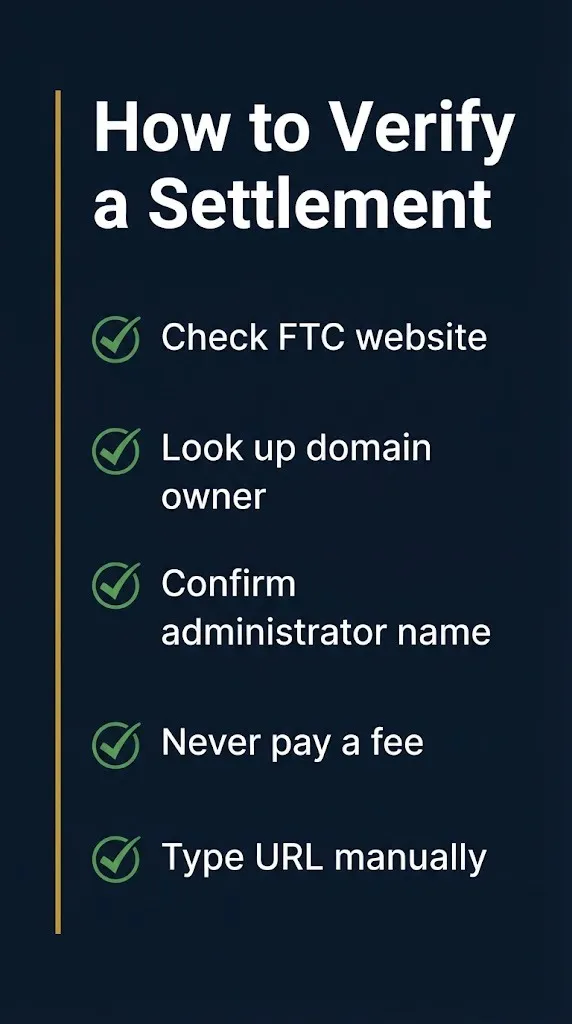
You verify a data breach settlement by checking the FTC website, searching for the official settlement domain, and confirming the administrator’s identity before entering any personal information .
Here’s the step-by-step verification process:
- Don’t click links in the email or text. Open your browser and search for the settlement name plus “official settlement website.”
- Check the FTC. The Federal Trade Commission maintains lists of major settlements and hosts vetted claim forms .
- Look up the domain owner. Use a WHOIS lookup tool to see who registered the settlement website. Legitimate sites are owned by settlement administration companies like Epiq, Kroll, or A.B. Data .
- Confirm the administrator. Real settlement notices name the administrator. If you can’t verify that company handles the settlement, don’t enter your information .
- Search for news coverage. Established legal news outlets report on major settlements. If only one obscure site mentions it, be skeptical.
- Never pay a fee. Legitimate settlements never charge you to file a claim .
What Are the Biggest Data Breach Class Actions in 2026?
The biggest active and recent data breach class actions in 2026 include 23andMe, Yahoo, Equifax, and several healthcare and consumer data settlements.
23andMe Genetic Data Breach: The $46.75 million class settlement received final approval on January 30, 2026. Payments were expected to begin in September 2026 for claimants who filed by February 17, 2026 . The breach exposed genetic data of 6.9 million customers worldwide .
Yahoo Data Breach: The $117.5 million settlement covered 194 million class members across multiple breaches. Per-capita recovery was approximately $0.60 .
Equifax Data Breach: The $505 million+ settlement resolved claims from 147 million consumers. It remains the largest data breach class action settlement in U.S. history .
23andMe State AG Settlement: Separately, 42 state attorneys general reached an $18 million bankruptcy settlement with 23andMe over the same breach .
How Do You File a Claim for a Data Breach Settlement?
You file a data breach settlement claim by submitting a claim form through the official settlement website before the deadline, providing your notice ID and any required documentation .
Filing Steps:
- Locate your notice. It contains a unique class member ID and PIN.
- Go to the official settlement website. Type the address manually; don’t click email links .
- Choose your claim type. Statutory cash, documented losses, or credit monitoring.
- Gather documentation for documented loss claims: receipts, bank statements, identity theft reports.
- Submit the form online or print and mail it.
- Keep a copy of everything you submit.
- Watch for deficiency notices. If your claim is incomplete, the administrator will give you time to fix it .
Filing is always free. No legitimate settlement charges a processing fee .
What Happens If You Miss a Data Breach Settlement Deadline?
If you miss the claim deadline, you typically get nothing from that settlement, even though you’re still bound by its release of claims against the company .
The 23andMe claim deadline was February 17, 2026. If you missed it, you can’t receive a cash payment, though you may still be eligible for the five years of privacy monitoring offered as a non-cash benefit .
Some settlements offer a cure period for incomplete claims, but not for late claims. The deadline is firm .
Key Takeaway: Missing a data breach settlement deadline means losing your payout. Calendar every deadline the moment you receive a notice.
How Do You Spot a Fake Data Breach Settlement Scam?
You spot a fake data breach settlement scam by checking for payment requests, unverifiable domains, and pressure tactics that real settlements never use .
Red Flags of a Fake Settlement:
- Asks for payment. Real settlements never charge fees .
- Threatens you. Legitimate notices don’t threaten legal action if you don’t respond.
- Uses a suspicious domain. Real settlement sites use domains registered to known administrators .
- Asks for unrelated information. If a form asks for your social security number before you’ve confirmed the site is real, stop .
- Creates urgency. Real settlements give you months, not hours, to respond.
- Has poor design. Ironically, real settlement sites often look plain. Scammers make them look polished and professional.
PCMag demonstrated how easy it is to create a fake settlement site using AI, building convincing phishing pages in under five minutes .
Reality Check: If a settlement notice asks you to pay a fee to “release” your payment, it’s a scam. If it asks for your bank account to “deposit” funds before you’ve filed a claim, it’s a scam. If it threatens you, it’s a scam.
What Happens Next for Data Breach Class Actions in 2026?
Data breach litigation continues to accelerate. New breaches mean new class actions, and settlements are reaching final approval on a rolling basis.
Expected Timeline:
- September 2026: 23andMe settlement payments begin distribution to approved claimants .
- Ongoing 2026: New data breach settlements reach final approval and open claim periods.
- Ongoing: Scammers continue targeting breach victims with AI-generated phishing sites .
The cycle is predictable: breach, lawsuit, settlement, claims period, payment. Your job is to verify each notice before acting and file before the deadline.
Frequently Asked Questions
How much can I get from a data breach class action settlement?
Payouts range from less than $1 to over $10,000. Statutory claims typically pay $50 to $165. Documented losses can pay up to $5,000 to $10,000 with receipts .
How do I know if a data breach settlement email is real?
Verify through the FTC, check the domain owner with a WHOIS lookup, and confirm the settlement administrator’s name. Never click links in the email; type the website address manually .
Can I still claim the 23andMe settlement?
No. The claim deadline was February 17, 2026. Payments are expected to begin in September 2026 for those who filed on time .
Do I need a lawyer to file a data breach claim?
No. You can file a claim yourself through the official settlement website. Hiring a lawyer is optional and usually unnecessary for standard claims .
What happens if I miss a data breach settlement deadline?
You lose your right to payment from that settlement. The deadline is firm, and late claims are not accepted .
Is it worth filing a data breach claim for $0.60?
That depends on you. For small payouts, the time cost may exceed the benefit. But filing is free, and collective participation strengthens future settlements .
How long do data breach settlement payments take?
Payments typically go out 30 to 90 days after final approval, though bankruptcy proceedings and appeals can delay distribution by months .
What Should You Do If You Receive a Data Breach Settlement Notice?
Verify the settlement through the FTC or the official settlement website before entering any information. Never pay a fee. Never click email links; type the address manually.
If it’s real and you qualify, file your claim before the deadline. If it’s fake, report it to the FTC.
The most important fact to remember: legitimate data breach settlements never charge you to file a claim. If someone asks for payment, it’s a scam .