Ticketmaster Settlement in 2026: $280 Million Fund, DOJ Deal Status, and What It Means for You
Quick Answer
- Ticketmaster’s parent company Live Nation agreed to a DOJ antitrust settlement in March 2026 that includes a $280 million fund for settling states and injunctive relief .
- The money goes to state governments, not directly to individual ticket buyers. A separate $9.9 million DC settlement will refund DC residents .
- The critical deadline for public comments was September 4, 2026. Individual refunds for DC residents have no confirmed claim deadline yet .
Introduction to the Ticketmaster Settlement
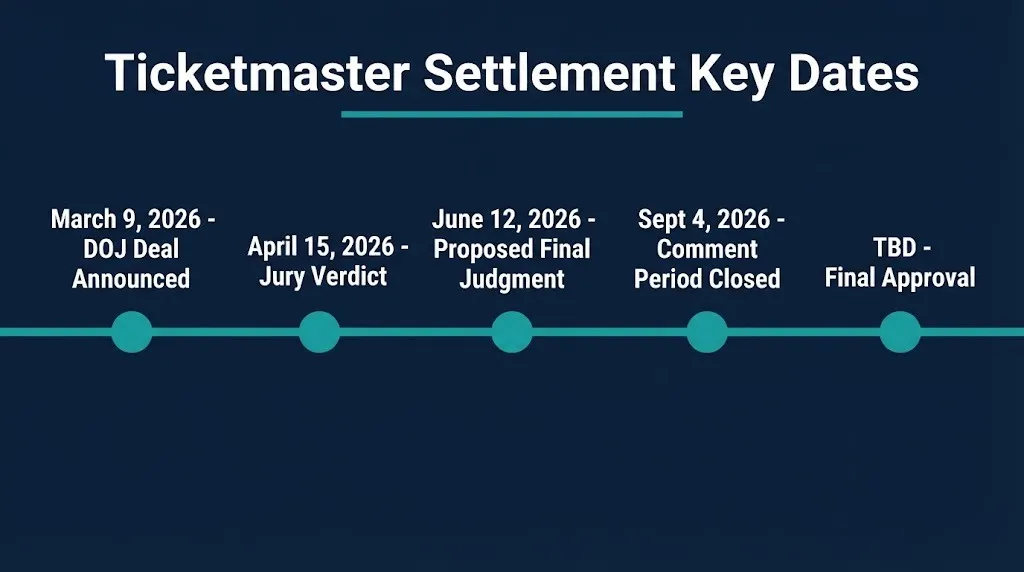
The Ticketmaster settlement in 2026 refers to the antitrust resolution between Live Nation Entertainment and the U.S. Department of Justice, announced in March 2026 during the government’s monopoly trial against the ticketing giant. The deal avoids a forced breakup of Ticketmaster but imposes conduct remedies and creates a settlement fund .
If you’ve bought tickets through Ticketmaster, you might be wondering if you’re getting a check. The short answer: probably not from this federal settlement. The $280 million is earmarked for states that joined the DOJ’s case, not for individual consumers .
This article explains what the settlement requires, how the separate DC refund program works, what the jury verdict means for future damages, and what deadlines matter if you’re hoping for money back. One critical detail: 34 states rejected the DOJ deal and proceeded to trial, where a jury found Live Nation guilty of illegal monopolization in April 2026 .
The Facts
| Item | Detail |
|---|---|
| Case Name | U.S. v. Live Nation Entertainment, Inc. (DOJ antitrust) |
| Court | U.S. District Court for the Southern District of New York |
| Case Number | 1:24-cv-03973-AS |
| Status | Proposed settlement under Tunney Act review. Jury verdict for litigating states entered April 2026. |
| Settlement Fund | $280 million initial fund for settling states |
| Est. Per Person | Not applicable for federal fund. DC residents may receive refunds from $8.9M settlement . |
| Claim Deadline | No individual claim process. DC refund details not yet confirmed . |
| Administrator | Not yet appointed for individual refunds |
| Proof Needed | DC residents need ticket purchase records for 2015-2025 |
Is the Ticketmaster DOJ Settlement Legitimate?
Yes, the DOJ settlement with Live Nation is legitimate and is undergoing formal review under the Tunney Act. The proposed final judgment was filed on June 12, 2026, and published in the Federal Register in July 2026 .
The Tunney Act requires a federal judge to determine that the settlement is in the public interest before it takes effect. Judge Arun Subramanian opened a 60-day public comment period that closed on September 4, 2026 .
The settlement resolves the DOJ’s May 2024 antitrust complaint against Live Nation and Ticketmaster. The government alleged the company used its control over concert promotion, venue operation, and ticketing to stifle competition and drive up prices .
Live Nation has consistently denied wrongdoing. The company’s SEC filing states it “believes the jury verdict and damages award are legally infirm” and intends to appeal . That means this settlement is not the final word on the antitrust claims.
Key Takeaway: The DOJ settlement is real and moving through the required legal process, but it only binds the federal government and six settling states. The other 34 states are still litigating.
How Much Money Is in the Ticketmaster Settlement Fund?
The settlement fund started at $280 million to address damages and civil penalties for states that joined the DOJ deal. Six additional states later settled, adding approximately $18.6 million to their shares of the fund .
Here’s the breakdown of state-specific payments from the proposed final judgment :
| State | Settlement Amount |
|---|---|
| Arkansas | $3,548,637.22 |
| Iowa | $3,000,000.00 |
| Mississippi | $2,780,037.76 |
| Nebraska | $3,588,759.96 |
| Oklahoma | $4,967,661.87 |
| South Dakota | $677,920.00 |
Those amounts are for the six states that settled after the initial DOJ agreement. The remaining fund is allocated among the states that joined the original deal in March 2026.
None of this money is designated for individual ticket buyers. The settlement states it addresses “damages and civil penalty claims by plaintiff states” . If you bought tickets and paid fees, the federal settlement does not create a claim form for you.
What Does the Ticketmaster Settlement Require Live Nation to Change?
The settlement requires significant changes to how Ticketmaster operates, designed to open competition in ticketing. These are structural and behavioral remedies, not just money.
Key requirements include :
- Open distribution system: Ticketmaster must develop a system allowing any major concert venue to sell primary tickets through any eligible ticketing provider, operational within 275 days of final judgment.
- No retaliation: Ticketmaster cannot use contractual, pricing, or technological means to restrict venues’ choice of ticketing providers.
- Automatic renewal waivers: Existing contracts with automatic renewal or extension terms are waived and unenforceable.
- 50% ticket allocation: At Live Nation-owned venues, artists and promoters can sell up to 50% of fee-bearing tickets through any ticketing marketplace.
- 15% fee cap: Ticketmaster cannot charge service fees exceeding 15% of ticket face value on tickets it sells at those venues.
- Venue divestitures: Live Nation must divest ownership of multiple listed concert venues .
The DOJ described these terms as a victory for consumers that would end the illegal monopoly. Several state attorneys general disagreed, calling it “a terrible deal” and proceeding to trial .
What Happened with the Jury Verdict Against Ticketmaster?
On April 15, 2026, a federal jury in Manhattan found Live Nation guilty of illegal monopolization in violation of U.S. antitrust laws. The verdict came after 34 states refused to join the DOJ settlement and proceeded to trial .
The jury found that Ticketmaster overcharged customers by $1.56 to $1.72 per ticket during the period from May 2020 to 2024. The total damages will be calculated by the judge, who can triple the amount under antitrust law .
The damages calculation could run into hundreds of millions of dollars, according to legal analysts. Live Nation has filed post-trial motions arguing the verdict is legally infirm and has indicated it will appeal to the Second Circuit .
For consumers, this verdict is more significant than the DOJ settlement because it establishes a damages figure tied directly to overcharges. But no money has been distributed yet, and the appeals process could take years.
Is There a Separate Ticketmaster Refund for DC Residents?
Yes, Washington DC residents have a separate refund program under a $9.9 million settlement with the DC Attorney General’s office. This is not part of the DOJ settlement .
DC residents who purchased tickets between 2015 and May 2025 may be eligible for a portion of the $8.9 million designated for refunds. The settlement resolved claims that Live Nation misled customers about ticket prices and added hidden mandatory fees at checkout .
DC Attorney General Brian Schwalb said, “With this settlement, we’re putting millions of dollars back into the pockets of DC fans and ensuring that the price fans see when they first start shopping for tickets is the price they actually pay” .
Details on how to claim the DC refund have not yet been published. The attorney general’s office said information would be shared on its website and social media “in the coming months” . If you’re a DC resident who bought tickets during the covered period, check the DC AG’s website for updates.
What Are the Deadlines for the Ticketmaster Settlement?
The most important deadline has already passed: the Tunney Act public comment period closed on September 4, 2026 . That was the window for fans, artists, and venues to tell the court why they thought the settlement was inadequate.
Here are the key dates to track:
| Deadline | What It Means |
|---|---|
| July 6, 2026 | Opt-out deadline for separate Popp v. Live Nation fee class action (passed) |
| September 4, 2026 | Tunney Act comment period closed (passed) |
| TBD | Final judgment approval by Judge Subramanian |
| TBD | DC refund claim process announced |
| July 6, 2027 | Trial date for separate fee class action |
The separate Popp v. Live Nation class action challenges Ticketmaster fees and is pending trial in the Central District of California. The opt-out deadline was July 6, 2026, and trial is set for July 6, 2027 . That case has no settlement and no claim form.
What Happens Next with the Ticketmaster Settlement?
The settlement’s future depends on Judge Subramanian’s Tunney Act review and the ongoing litigation with the 34 non-settling states.
Expected late 2026: Judge Subramanian rules on whether the DOJ settlement is in the public interest, considering the public comments submitted by the September 4 deadline .
Ongoing: Post-trial motions in the states’ case. Judge Subramanian will determine damages and remedies for the monopolization verdict .
Expected 2027: Second Circuit appeal of the jury verdict if Live Nation’s post-trial motions fail .
TBD: DC Attorney General’s office announces refund claim process for DC residents .
July 6, 2027: Trial date for Popp v. Live Nation fee class action .
Frequently Asked Questions
Is the Ticketmaster settlement money going to consumers?
No. The $280 million DOJ settlement fund is for states, not individuals. A separate $9.9 million DC settlement will refund DC residents, but the claim process has not been announced.
How much will I get from the Ticketmaster settlement?
If you’re a DC resident who bought tickets from 2015 to 2025, you may receive a portion of the $8.9 million refund pool. The exact amount depends on what you paid in fees. Non-DC residents have no individual payout from the DOJ settlement.
When will Ticketmaster settlement payments be sent?
No payment date has been confirmed. The DC Attorney General’s office said details would be shared “in the coming months” . The DOJ settlement money goes to states, not individuals.
What is the Tunney Act and why does it matter?
The Tunney Act requires a federal judge to review antitrust settlements and determine if they serve the public interest. The public comment period for the Ticketmaster settlement closed September 4, 2026 .
Did Ticketmaster lose the monopoly trial?
Yes. On April 15, 2026, a jury found Live Nation guilty of illegal monopolization. The jury calculated damages at $1.56 to $1.72 per ticket, which the judge can triple .
Can I still file a claim for Ticketmaster fees?
No. The Popp v. Live Nation class action has no settlement and no claim form. The opt-out deadline was July 6, 2026. If you stayed in the class, you’ll be notified if there’s a settlement or verdict later .
What changes will Ticketmaster have to make?
Ticketmaster must create an open distribution system, allow venues to choose other ticketing providers, cap fees at 15% at Live Nation-owned venues, and divest multiple venues within 275 days of final judgment .
Who qualifies for the DC Ticketmaster refund?
Washington DC residents who purchased tickets between 2015 and May 2025 may qualify for a portion of the $8.9 million refund. You’ll need proof of purchase when the claim process opens .