Nike Lawsuit 2026: Sex Discrimination Verdict, $15M Payout & Settlement Claims Explained
Quick Answer
- A Portland jury found Nike liable for sex discrimination against Heather Hender on July 22, 2026.
- The $15 million verdict is punitive damages for one plaintiff, not a settlement fund for a class.
- No claim deadline exists because no class settlement has been approved or certified.
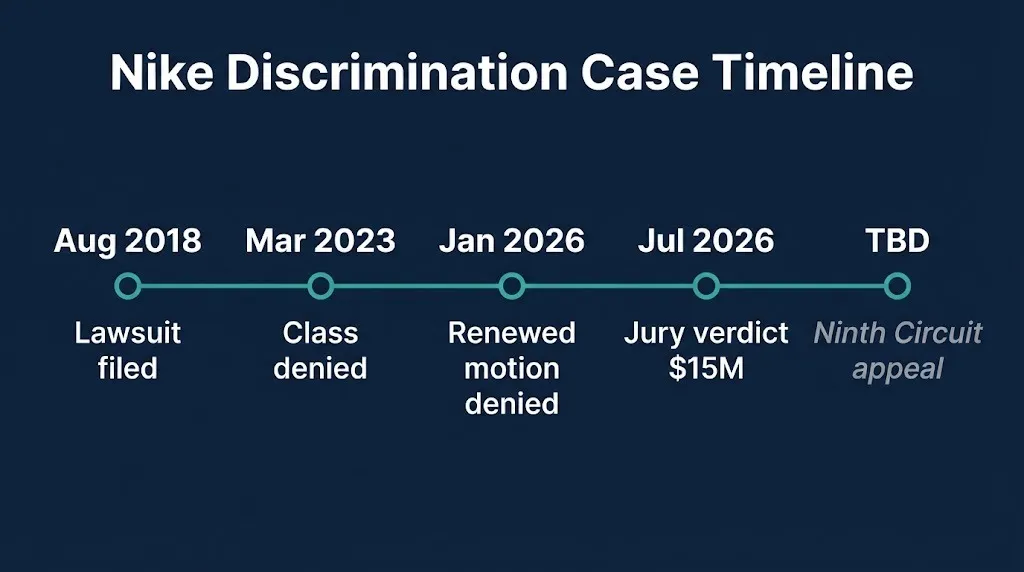
The Nike discrimination lawsuit everyone is searching for in 2026 is not a settlement. It is a jury verdict in a single woman’s case that has been grinding through federal court in Oregon since 2018. Heather Hender, a former Nike engineer, won $15 million in punitive damages plus roughly $19,740 in backpay after a six-day trial in July 2026.
Here’s what makes this case unusual. The $15 million goes to Hender alone. About 5,000 other women who worked at Nike’s Beaverton headquarters in salaried corporate roles have been trying to form a class, and a judge has repeatedly said no.
If you are one of those women, there is no claim form to fill out today. No settlement administrator has been appointed. No deadline has been set. The case is on appeal to the Ninth Circuit, and the class certification fight is the whole ballgame.
This article breaks down what is confirmed, what is still pending, and what the verdict actually means for anyone who worked at Nike headquarters.
The Facts
| Case | Hender v. Nike, Inc. (originally Cahill v. Nike, Inc.) |
| Court | U.S. District Court for the District of Oregon |
| Case Number | 3:18-cv-01477 |
| Status | Jury verdict for individual plaintiff; class certification denied; appeal to Ninth Circuit pending |
| Verdict Amount | $15 million punitive + $19,739.52 backpay |
| Class Fund | Not yet established, no certified class |
| Est. Per Person | Not applicable, no class settlement |
| Claim Deadline | No claims process open |
| Administrator | Not yet appointed |
| Proof Needed | Not applicable at this stage |
Is the Nike discrimination lawsuit real or a scam?
The Nike discrimination lawsuit is real, filed in federal court in 2018, and resulted in a $15 million jury verdict in July 2026. It is not a scam, and it is not a settlement that pays class members.
You may have seen headlines about “Nike paying $15 million” and wondered if you qualify. The reality is narrower. That money is a punitive damages award for one woman, Heather Hender. Punitive damages are meant to punish the company, not compensate a group.
The confusion is understandable. Lawsuit news often blurs individual verdicts with class settlements. This case is a single-plaintiff trial that grew out of a proposed class action, but the class was never certified.
If someone contacts you claiming you are owed money from a Nike discrimination settlement, be skeptical. No court has approved any class settlement in this case. There is no claims administrator. There is no fund to distribute.
How much could women at Nike headquarters actually get?
There is no confirmed payout amount for anyone other than Heather Hender, and no class-wide money has been approved. The $15 million verdict belongs to one plaintiff.
Hender’s award breaks down like this:
- $19,739.52 in backpay, the maximum the verdict form allowed
- $7.5 million in punitive damages under Title VII (federal law)
- $7.5 million in punitive damages under Oregon law
The total is $15,019,739.52. That is a massive number for one person. But it does not create a pool for other women to draw from.
The roughly 5,000 women in the proposed class have not received anything. They have not been certified as a class. They have no claim form, no deadline, and no guarantee of any payout. The appeal to the Ninth Circuit is about whether the class can exist at all.
If the Ninth Circuit reverses the class certification denial, the case could return to district court and a class could eventually be certified. That would open the door to a settlement or further trials. Until then, the money question for anyone other than Hender has no answer.
Key Takeaway: The $15 million Nike verdict is a single plaintiff’s punitive damages award, not a settlement fund, and no other woman has a confirmed payout or claim process.
Who qualifies for the Nike sex discrimination class?
No one qualifies for a class payout right now because no class has been certified. The proposed class definition covers women who worked at Nike headquarters in certain roles.
The class definition has been consistent throughout the litigation. It includes women who worked in salaried, corporate positions below the level of Vice President at Nike’s World Headquarters in Beaverton, Oregon.
The claims date back to August 2018, when the original lawsuit was filed after a New York Times exposé described a “boys’ club” culture at Nike. The women allege Nike violated:
- The federal Equal Pay Act
- Title VII of the Civil Rights Act
- The Oregon Equal Pay Act
- Oregon anti-discrimination law ORS 659A.030
The specific practices challenged include setting starting pay based on prior salary history, a forced ranking system that drove raises and promotions, budgets that shortchanged women, and channeling women into roles the company valued less.
If you worked at Nike headquarters in a salaried role below VP during the relevant period, you may be part of the proposed class. But being part of a proposed class does not mean you have a claim or a payout right today. You cannot file anything yet.
Why did the judge deny class certification?
The judge denied class certification because she found the plaintiffs did not meet the procedural requirements for a class action, not because their claims lacked merit. The denial is now on appeal.
In November 2022, a magistrate judge recommended denying certification. The district court adopted that recommendation in March 2023, ruling that the women’s claims had to proceed individually. The Ninth Circuit declined to review that decision at the time.
In October 2025, the plaintiffs tried again. They filed a renewed motion for class certification backed by more than 800 pages of new evidence, including details about Nike’s use of prior salaries and internal “Starfish” surveys. In January 2026, the district court denied leave to file that renewed motion on procedural grounds, without even looking at the new evidence.
The court’s reasoning was about diligence and timing. The judge noted a “year-long lag” with no request to revisit certification, including while the case was being prepared for trial.
The plaintiffs are now appealing that denial to the Ninth Circuit. If they win, the class could be revived. If they lose, the 5,000 women may have to pursue individual claims or nothing at all.
What proof would you need if a settlement opens?
No proof requirements exist yet because there is no settlement. In a future class settlement, you would likely need employment records showing your role and dates.
Typical class action settlements require basic documentation. You would likely need to show you worked at Nike headquarters during a defined period, in a qualifying salaried position below VP level. Pay stubs, offer letters, performance reviews, or HR records could all serve as proof.
But this is hypothetical. No settlement has been reached. No administrator has set rules. No claim form exists. Anything you see online telling you what to submit right now is premature.
If a settlement is eventually reached and approved, the court would appoint a claims administrator and publish an official notice. That notice would define exactly what proof you need and how to submit it. Until that happens, there is nothing to file.
Reality Check: No one texts you settlement money first. If you get a message saying you are owed Nike discrimination money and need to pay a fee or provide bank details, it is a scam. Court-approved settlements never require upfront payment. Filing is always free.
How do you file a Nike discrimination claim?
You cannot file a Nike discrimination claim today because there is no open claims process. No class has been certified and no settlement has been reached.
Here is what the process would look like if a settlement eventually happens:
- A court approves a class settlement and appoints a claims administrator.
- Official notice goes out to class members by mail or email.
- A claim form becomes available on the official settlement website.
- You submit the form with proof of your Nike employment.
- The administrator reviews claims and calculates payments.
- The court holds a final approval hearing.
- Payments go out by check or direct deposit.
None of these steps have happened yet. The case is at the appeal stage. There is no official settlement website to check. There is no administrator to contact. There is no form to download.
If you believe you are part of the proposed class, your best move right now is to preserve your employment records. Keep any documents showing your job title, salary, dates of employment, and performance history. If a settlement ever opens, those records will matter.
When will checks mail or payments go out?
No payment timeline exists because no class settlement has been approved. Any check date you see online is speculation.
The only payment that has been ordered is Hender’s $15 million verdict. Even that is not final yet. Nike can appeal the verdict, and the case has been litigated for eight years, so more appeals are likely.
For the proposed class, the timeline depends entirely on the Ninth Circuit appeal. If the Ninth Circuit reverses the certification denial, the case returns to district court. Then the class certification process would restart, followed by discovery, trial or settlement, approval, and finally payment. That could take years.
If the Ninth Circuit affirms the denial, the class claims are effectively dead. The women would have to file individual lawsuits or give up. Individual lawsuits are expensive and slow, and many women may not pursue them.
Key Takeaway: No payment timeline exists for the proposed class, and the only confirmed money is Hender’s verdict, which is still subject to appeal.
What is the EEOC investigation into Nike?
A separate EEOC investigation into Nike is ongoing, focused on race discrimination claims, and involves a subpoena fight in federal court in Missouri.
In February 2026, the U.S. Equal Employment Opportunity Commission filed an action to enforce an administrative subpoena against Nike. The EEOC is seeking documents related to a discrimination probe involving intentional race discrimination against White employees and job applicants.
Nike signed a settlement agreement with the EEOC during the final weeks of the Biden administration, but that agreement was withdrawn when the Trump administration took office. The EEOC then pursued the subpoena enforcement.
Nike has filed motions to dismiss or transfer the case, and the parties are litigating in the Eastern District of Missouri. This is a separate matter from the Hender sex discrimination case. It does not create a settlement fund or claims process for anyone.
The EEOC investigation is about race discrimination. The Hender case is about sex discrimination. Both involve Nike, but they are distinct legal proceedings with different plaintiffs and different courts.
What happens next in the Nike lawsuit?
The next major step is the Ninth Circuit appeal on class certification. The timeline for that appeal is not yet confirmed.
Here are the expected stages:
Expected late 2026 or 2027: Ninth Circuit briefing and argument on class certification appeal. Both sides will file legal briefs and the court will hear oral arguments.
Expected 2027: Ninth Circuit ruling. The court could affirm the denial, reverse it, or remand for further proceedings.
If reversed: Return to district court, renewed class certification proceedings, possibly a new trial or settlement negotiations.
If affirmed: The class claims end, and individual women must decide whether to file their own lawsuits.
Separate track: Nike may appeal Hender’s $15 million verdict, which would add more delay.
Nothing moves fast in this case. It was filed in 2018. The trial happened in 2026. Eight years for one plaintiff. A class-wide resolution, if it ever happens, could take several more years.
Frequently Asked Questions
Is the Nike lawsuit a settlement?
No. The Nike discrimination lawsuit resulted in a jury verdict for one plaintiff, Heather Hender. No class settlement has been reached or approved.
How much will each person get from the Nike lawsuit?
Not yet determined. No class has been certified and no settlement fund exists. The $15 million verdict belongs to one woman, not a class.
Can I file a claim for the Nike discrimination lawsuit?
No. There is no open claims process, no administrator, and no deadline. The case is on appeal regarding class certification.
Did Nike lose the discrimination case?
Yes, a federal jury found Nike liable for sex discrimination against Heather Hender on July 22, 2026, and awarded $15 million in punitive damages.
Who is Heather Hender?
She is a former Nike engineer who worked at Nike headquarters from 2015 to 2020. She sued Nike in 2018 and won her individual trial in 2026.
What is the deadline to join the Nike lawsuit?
There is no deadline because there is no certified class and no settlement. If a class is certified later, a deadline would be set at that time.
Is Nike still facing other discrimination claims?
Yes. The EEOC has an ongoing investigation into race discrimination claims against Nike, separate from the Hender sex discrimination case.
What should I do if I worked at Nike headquarters?
Preserve your employment records, including pay stubs, offer letters, and performance reviews. Watch for official court notices if the class is revived on appeal.
What Happens Next
Expected late 2026 or 2027: Ninth Circuit briefing and oral argument on the class certification appeal.
Expected 2027: Ninth Circuit ruling on whether the class can be revived.
If reversed: District court proceedings resume, possibly leading to class certification and a future settlement or trial.
If affirmed: Class claims end; individual lawsuits become the only option for other women.
Separate track: Potential Nike appeal of the $15 million Hender verdict.
The single most important fact remains this: no class settlement exists, and no claim process is open. The verdict is real. The payout for anyone other than Heather Hender is not.