Taylor Swift Copyright Lawsuit 2026: The Poet Case Was Dismissed, But a Trademark Fight Is Still Live
Quick Answer
- What happened? A federal judge dismissed Kimberly Marasco’s copyright lawsuit against Taylor Swift on July 6, 2026.
- Is it over? Yes for the Marasco case. It was dismissed with prejudice and cannot be refiled.
- Any money? No. Marasco sought over $30 million, but the court ruled her claims had no legal basis.
Taylor Swift won. That’s the short version of the copyright lawsuit that a Florida poet filed against her. On July 6, 2026, a federal judge in Florida dismissed the case with prejudice, meaning it can never be brought back to court .
The lawsuit, filed by self-published poet Kimberly Marasco, claimed Swift copied phrases and themes from her poetry in more than a dozen songs. Marasco sought over $30 million in damages and wanted profits from 18 tracks . The court found her claims lacked any legal foundation.
If you’re searching for this case, you’re likely trying to understand what happened, whether any money changed hands, or if Taylor Swift is still facing other legal battles. The answers: the case was dismissed, no money was paid, and yes, there’s a separate trademark lawsuit still pending.
This article breaks down the dismissal, the legal reasoning, and the one Taylor Swift legal fight that’s still unresolved.
The Facts
| Case | Kimberly Marasco v. Taylor Swift, et al. |
|---|---|
| Court | U.S. District Court, Southern District of Florida |
| Judge | Aileen M. Cannon |
| Status | Dismissed with prejudice, July 6, 2026 |
| Fund Size | None. No settlement or judgment paid |
| Est. Per Person | Not applicable |
| Claim Deadline | None. Case permanently closed |
Is the Taylor Swift Copyright Lawsuit Real or a Scam?
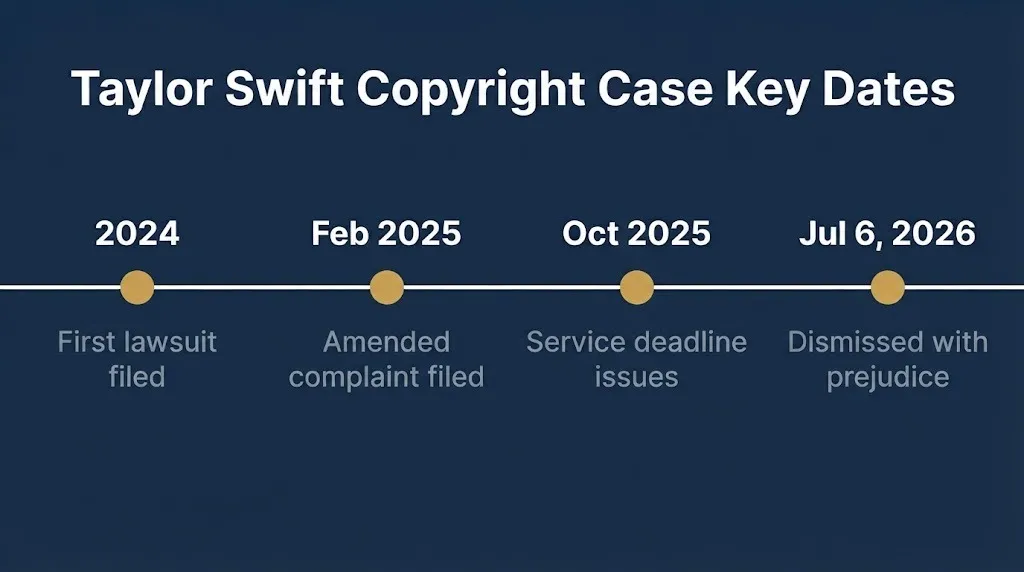
The Taylor Swift copyright lawsuit was real, filed in federal court, and litigated for over a year. It was not a scam, a rumor, or a publicity stunt. Kimberly Marasco filed her first complaint in 2024 and an amended complaint in February 2025 .
The scam risk here isn’t the lawsuit itself. It’s the websites and social media posts that claim Taylor Swift “settled” the case for millions or that fans can somehow claim a portion of a settlement fund. None of that is true. The case was dismissed. No money changed hands.
Marasco represented herself in the litigation, which is unusual for a case of this scale. Swift’s legal team included attorneys from Venable LLP, a major national firm . The mismatch in legal resources was evident in the outcome.
Reality Check: No Taylor Swift settlement fund exists. No one is paying fans or poetry readers anything. The case was dismissed with prejudice, meaning Swift paid nothing and Marasco received nothing.
How Much Money Did Taylor Swift Pay in the Copyright Lawsuit?
Taylor Swift paid nothing. The case was dismissed with prejudice on July 6, 2026, meaning the court ruled in Swift’s favor without any financial award or settlement .
Marasco had sought over $30 million in damages, plus all profits from the songs she claimed infringed her work . She also asked the court to block the release of “The Eras Tour” content on Disney+, a request that was denied .
Here’s what the court rejected:
| What Marasco Sought | What the Court Ruled |
|---|---|
| $30+ million in damages | Dismissed with prejudice |
| Profits from 18 songs | No infringement found |
| Injunction against Eras Tour release | Denied |
| Attorney fees | Not awarded |
Swift’s legal team had called the lawsuit “frivolous and harassing” and “absurd and legally baseless” in court filings . The judge’s dismissal validated that position.
Why Was the Taylor Swift Copyright Lawsuit Dismissed?
The Taylor Swift copyright lawsuit was dismissed because Marasco’s poems did not contain protectable expression, and she failed to plausibly plead copying. Judge Aileen Cannon’s ruling was detailed and unambiguous .
The core legal problem was simple. Copyright protects original expression, not ideas, themes, metaphors, or common phrases. Marasco’s claims relied on exactly the kind of material copyright law excludes.
Judge Cannon wrote that the similarities between Swift’s songs and Marasco’s poems involved “basic ideas and themes,” “ubiquitous metaphors,” and “isolated common words and short phrases” . She listed examples:
- “The Man” vs. Marasco’s “Ordinary Citizen”: Both describe a woman in a male-dominated workplace. The court said that’s an idea, not protected expression.
- “The Great War” vs. “The Fire”: Both use the metaphor of desire as fuel and fire. The court called that a ubiquitous metaphor.
- Common words: “Tears,” “running,” “fire,” “rain,” “sky,” “love,” “invisible.” The court said isolated common words are not copyrightable .
The judge also found that Marasco failed to prove Swift had access to her poems. One of Marasco’s poetry books sold only about 3,000 copies worldwide and was not actively promoted . That made it difficult to argue Swift ever saw the work.
What Did Kimberly Marasco Claim Taylor Swift Copied?
Kimberly Marasco claimed Taylor Swift copied phrases, themes, and metaphors from her poetry in more than a dozen songs across five albums. She pointed to specific lyric comparisons that she believed proved copying .
Her claims spanned:
- Lover (2019): “The Man,” “I Think He Knows”
- Folklore (2020): “My Tears Ricochet,” “Invisible String”
- Evermore (2020): “The Great War”
- Midnights (2022): “Midnight Rain,” “Down Bad”
- The Tortured Poets Department (2024): “I Can Do It With a Broken Heart,” “The Manuscript”
She filed a 47-page amended complaint detailing alleged overlaps. For example, she claimed “Guilty as Sin?” borrowed from her poem “Devious Minds,” and “My Tears Ricochet” pulled from four of her poems including “Scorpion” and “Gaslight” .
The court reviewed these claims and found them legally insufficient. Even if Swift had been inspired by Marasco’s ideas, the ideas themselves were not protected by copyright.
Can You File a Claim in the Taylor Swift Copyright Lawsuit?
No. You cannot file a claim in the Taylor Swift copyright lawsuit. There is no settlement fund, no claims administrator, and no deadline because the case was dismissed without any financial resolution .
This was a private copyright dispute between two individuals, not a class action. The only person who could have received money was Marasco, and she received nothing.
If you see a website or social media post claiming Taylor Swift fans can claim money from a “copyright settlement,” it’s a scam. There is no such thing.
What Is the Maren Flagg Trademark Lawsuit?
The Maren Flagg trademark lawsuit is a separate active case against Taylor Swift that is still pending in California federal court. It is not a copyright case. It is a trademark dispute over the phrase “showgirl” .
Maren Flagg is a Las Vegas performer who owns a registered trademark for “Confessions of a Showgirl.” She filed suit claiming Swift’s album “The Life of a Showgirl” infringes on her trademark. Flagg is seeking injunctive relief, damages, profits, and attorney’s fees .
The case is in its early stages. Swift’s legal team filed an opposition to Flagg’s motion for a preliminary injunction on May 6, 2026 . Swift’s lawyers have argued the trademark fight “should never have been filed” .
Unlike the Marasco case, this one involves registered trademark rights rather than copyright. The legal standards are different, and the outcome is not yet determined. No trial date has been set.
What Happens Next With Taylor Swift Copyright Lawsuits?
The Marasco copyright case is over. The dismissal with prejudice means Marasco cannot refile the same claims, though she has said she plans to appeal . Appeals of dismissals with prejudice are difficult but not impossible.
Expected timeline:
- Ongoing 2026: Maren Flagg trademark lawsuit continues in California federal court.
- Expected TBD: Ruling on Flagg’s preliminary injunction motion.
- Expected 2027: Possible trial date for the Flagg case if it proceeds.
- Marasco appeal: No date set; appeals of dismissals with prejudice rarely succeed.
For Swift, the copyright chapter is closed. The trademark fight remains open.
Frequently Asked Questions
Did Taylor Swift win the copyright lawsuit?
Yes. Judge Aileen Cannon dismissed the case with prejudice on July 6, 2026, ruling that Marasco’s poems did not contain protectable expression and she failed to plead copying .
How much did Taylor Swift pay Kimberly Marasco?
Nothing. The case was dismissed with prejudice. No settlement, no judgment, no payment .
Can Kimberly Marasco appeal the dismissal?
She has said she plans to appeal. Appeals of dismissals with prejudice are difficult because the judge found defects in the underlying works, not just the pleadings .
Is there a Taylor Swift settlement fund for this lawsuit?
No. There is no settlement fund, no claims process, and no money for anyone. The case was dismissed without any financial resolution.
What is the Maren Flagg lawsuit about?
Maren Flagg, a Las Vegas performer, claims Swift’s album “The Life of a Showgirl” infringes her registered trademark for “Confessions of a Showgirl.” The case is active in California federal court .
Did Taylor Swift copy poems from Kimberly Marasco?
The court ruled that even if Swift drew inspiration from Marasco’s ideas, those ideas were not protected by copyright. Common themes, metaphors, and short phrases are not copyrightable .
What songs did Marasco claim were copied?
She claimed 18 songs across five albums, including “The Man,” “My Tears Ricochet,” “The Great War,” and “I Can Do It With a Broken Heart” .
Is the Taylor Swift copyright lawsuit a class action?
No. It was a private lawsuit filed by one individual, Kimberly Marasco, against Swift and her associates. No class action status was ever sought.
What You Should Do Now
The Taylor Swift copyright lawsuit is closed. No money exists for anyone. The single most important date was July 6, 2026, when Judge Cannon dismissed the case with prejudice.
If you’re following Swift’s legal battles, the Maren Flagg trademark case is the one still active. That case is pending in California federal court, and a ruling on Flagg’s injunction motion is expected at some point. No trial date is set.
For anyone who sees claims about a “Taylor Swift settlement payout,” ignore them. No fund exists. No claims process exists. The copyright case is over.