What to Ask for in a Discrimination Settlement in 2026: Beyond the Dollar Amount
Quick Answer
- A discrimination settlement can include monetary damages, policy changes, neutral references, and training requirements.
- Monetary recoveries vary widely, with median conciliated settlements around $4,600 and class cases averaging $66,000 per plaintiff.
- The EEOC resolved 34.5% of conciliation cases in FY 2025, recovering $52.2 million, a 26% increase over FY 2024.
If you are negotiating a discrimination settlement, you are likely focused on one number: the dollar amount. But the money is only one piece of what you can negotiate.
A discrimination settlement is a contract. It can include compensation, policy changes, a neutral reference, training requirements, and terms that protect your reputation and future employment prospects. The strongest settlements address all of these, not just the check.
Federal law allows you to recover lost wages, emotional distress damages, and attorney fees. State laws may add more. And the terms you negotiate beyond money can matter just as much as the dollars.
This article covers what to ask for, what the numbers actually look like, and how to avoid signing away rights you did not mean to give up.
The Facts
| Item | Details |
|---|---|
| EEOC FY 2025 Recoveries | Nearly $660 million for workers |
| Mediation Success Rate | 70% (7,929 of 11,346 mediations resolved) |
| Conciliation Recovery | $52.2 million, up 26% from FY 2024 |
| Systemic Recoveries | Over $55 million for 1,823 workers |
| Median Conciliated Settlement | Approximately $4,600 in one jurisdiction |
| Class Action Mean Per Plaintiff | $66,000 |
| Typical Timeline | Discrimination cases often take 12-24 months |
| ADEA Revocation Period | 7 days after signing |
What Should You Ask for in a Discrimination Settlement?
You should ask for compensatory damages for lost wages and emotional distress, and you should negotiate non-monetary terms that protect your future employment and address the workplace conduct that harmed you .
The monetary side covers what you lost. The non-monetary side covers what you need to move forward.
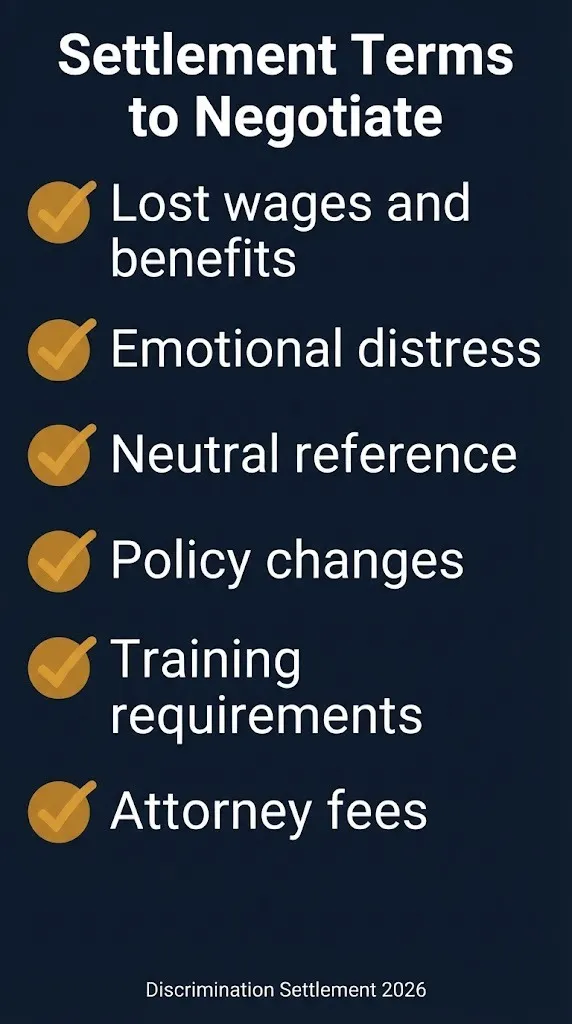
Here is what a complete settlement package can include:
Monetary Terms:
- Lost wages and back pay
- Lost benefits (health insurance, retirement contributions)
- Emotional distress compensation
- Out-of-pocket job search costs
- Attorney fees and costs
Non-Monetary Terms:
- Reinstatement or eligibility for rehire
- Neutral reference for future employers
- Policy changes to prevent future discrimination
- Training requirements for management
- Confidentiality or non-disparagement terms
- Timing of payment and tax treatment
The EEOC’s FY 2025 data shows that mediation and conciliation are the most common paths to resolution, with mediation resolving 70% of cases it handles . That means most settlements happen before litigation, and the terms you negotiate early matter.
How Much Money Can You Get in a Discrimination Settlement?
Settlement amounts in discrimination cases vary widely, from a few thousand dollars in early conciliation to hundreds of thousands in class cases or systemic litigation .
There is no standard formula. The amount depends on your lost wages, the severity of the conduct, the strength of the evidence, and the employer’s willingness to settle.
What the data shows:
| Source | Metric | Amount |
|---|---|---|
| Hong Kong EOC (2025) | Median conciliated settlement | ~$4,600 (HK$36,000) |
| Hong Kong EOC (2025) | Highest conciliated settlement | ~$205,000 (HK$1.6 million) |
| Academic study (US) | Mean per plaintiff (class cases) | $66,000 |
| Academic study (US) | Median per plaintiff | $50,000 |
| EEOC FY 2025 | Total recoveries | $660 million for 17,680 people |
A case study from Australia shows how expectations can be unrealistic. A complainant initially asked for $20,000, then agreed to $1,746 after reviewing actual settlement data . The lesson: anchor your demand in evidence, not emotion.
For individual cases, compensatory damages for “garden variety” emotional distress often range from $30,000 to $90,000 . Lost wages are typically the largest component in wrongful termination cases.
Can You Ask for Reinstatement in a Discrimination Settlement?
Yes, you can ask for reinstatement or eligibility for rehire as part of a discrimination settlement, and it is a common non-monetary term in wrongful termination cases .
Reinstatement restores your job, your income, and your professional identity. For many plaintiffs, it matters more than additional money.
But reinstatement is not always the right choice. The conditions that caused the discrimination may still exist. If you return to the same supervisor and the same environment, you may face retaliation or find yourself back in the same situation .
Questions to consider:
- Can you return to a different supervisor or department?
- Would eligibility for rehire (without immediate reinstatement) give you more flexibility?
- Is the employer willing to address the root cause of the discrimination?
If reinstatement is not realistic, eligibility for rehire preserves your ability to work for the company again in the future. It also avoids an employment gap that can be hard to explain in interviews.
Some settlements include a neutral reference, which confirms only your dates of employment and position. That prevents a former employer from bad-mouthing you to prospective employers .
What Non-Monetary Terms Should Be in a Discrimination Settlement?
The non-monetary terms in a discrimination settlement often matter more than the dollars because they address the workplace conduct that harmed you and protect your future .
These terms can include:
- Policy changes. The employer agrees to revise its anti-discrimination policies or complaint procedures.
- Training requirements. Management and HR staff complete discrimination prevention training.
- Neutral reference. Your former employer provides only dates and position to future employers.
- Confidentiality. Both parties agree not to disclose the settlement terms.
- Non-disparagement. Neither party makes negative statements about the other.
- Personnel file cleanup. Negative documents related to the discrimination are removed.
- Timing of payment. Some settlements include an incentive payment made a year later to encourage compliance with non-disparagement terms .
Key Takeaway: Money is important, but the terms that protect your career and prevent future discrimination are what make a settlement complete.
What Is a Standard Release of Claims and What Should You Watch For?
A release of claims is a contract where you agree to give up your right to sue in exchange for the settlement, and you must read it carefully before signing .
Standard releases waive all claims related to your employment, not just the discrimination claim. That can include claims you did not know you had.
What to watch for:
- Scope of the release. Does it cover only the discrimination claim or all employment claims?
- Carve-outs. You cannot waive workers’ compensation or vested retirement benefits, even if you sign .
- Age discrimination claims. Under the ADEA, you have 21 days to consider the agreement and 7 days to revoke after signing .
- Confidentiality. Does the agreement prevent you from discussing the settlement with a lawyer, therapist, or family member?
- Non-disparagement. How broadly is it worded? Can you respond if the employer disparages you?
A settlement agreement is a binding contract. If either party breaches it, the other can sue. Do not sign anything you do not understand.
How Long Does a Discrimination Settlement Take?
Discrimination cases typically take 12 to 24 months from filing to resolution, though settlement can happen at any stage .
The timeline depends on the forum and complexity:
| Stage | Typical Timeline |
|---|---|
| Early conciliation (ACAS/Early mediation) | 4 weeks |
| EEOC investigation | 6-12 months |
| Litigation (if filed) | 12-24 months |
| Complex discrimination cases | 24+ months |
The EEOC’s ADR program resolves charges faster than full investigation. In FY 2025, the agency held 11,346 mediations and successfully resolved 7,929 of them, a 70% success rate .
For cases that do not settle early, discrimination claims take longer to prepare than other employment cases because of the evidence involved . The hearing itself is often longer too.
What Happens If You Face Retaliation After Reporting Discrimination?
Retaliation after reporting discrimination is illegal, and you can file a separate claim even if your original discrimination claim is not successful .
Federal law protects you from punishment for filing a complaint, participating in an investigation, or opposing discrimination. The protection applies regardless of whether the underlying discrimination claim is valid .
Examples of illegal retaliation include:
- Firing or demoting you after you report
- Giving you worse assignments or shifts
- Forcing you to take leave
- Threatening to call immigration authorities
- Giving you a bad reference after you leave
You are protected even if you are a witness in someone else’s case, or if you complain about discrimination against someone else . Former employees are protected too. An employer cannot retaliate by giving you a bad reference .
If you face retaliation, document everything. Keep emails, notes, and a timeline. Report it to the EEOC or your state agency.
Reality Check: A settlement agreement cannot waive your right to workers’ compensation or vested retirement benefits. If a release asks you to give those up, it is overreaching. Get legal advice before signing.
What Happens Next in a Discrimination Settlement?
EEOC Mediation: If your charge is selected for mediation, both sides meet with a neutral mediator. About 70% of EEOC mediations resolve successfully .
Conciliation: If mediation fails or is not offered, the EEOC investigates and may attempt conciliation. In FY 2025, 34.5% of conciliation cases resolved .
Right to Sue: If the EEOC cannot resolve your charge, it issues a Notice of Right to Sue. You then have 90 days to file a lawsuit.
Litigation: If you file suit, discovery and motions typically take 12-24 months. About 97-98% of employment cases settle before trial .
Settlement Negotiation: Settlement can happen at any stage, from the initial charge to the courthouse steps.
Payment: Once you sign a settlement agreement, payment timing depends on the terms. Some agreements pay within 30 days; others stretch to 90 days or more.
Frequently Asked Questions
What can I ask for in a discrimination settlement?
You can ask for lost wages, emotional distress damages, attorney fees, reinstatement or rehire eligibility, neutral references, policy changes, and training requirements.
How much is a typical discrimination settlement?
Amounts vary widely. Median conciliated settlements can be around $4,600, while class cases average $66,000 per plaintiff. Individual cases with strong evidence and significant lost wages can settle for much more.
Can I get my job back in a discrimination settlement?
Yes. Reinstatement or eligibility for rehire is a common non-monetary term. But consider whether returning to the same environment is in your best interest.
What is a neutral reference?
A neutral reference confirms only your dates of employment and position. It prevents a former employer from giving you a bad reference.
How long do I have to sign a discrimination settlement?
Under the ADEA, you have 21 days to consider the agreement and 7 days to revoke after signing. Other agreements may have different timelines. Never sign under pressure.
Can I negotiate a discrimination settlement without a lawyer?
Yes, but it is risky. A lawyer can evaluate the offer, identify terms you might miss, and negotiate better terms.
What happens if I face retaliation after settling?
Retaliation after settlement is still illegal. If your employer punishes you for filing the original claim or for the settlement itself, you can file a new retaliation claim.
Do I have to keep the settlement confidential?
Only if you agree to a confidentiality clause. Many settlements include one, but you can negotiate carve-outs for lawyers, therapists, and family members.
Before you sign anything, read the release carefully and understand what claims you are giving up. Ask for the settlement terms in writing. And remember that the EEOC recovered nearly $660 million for workers in FY 2025, so the system does produce results. The most important date is the deadline on your Right to Sue letter. Do not miss it.