What Happens When You Reject an Insurance Settlement Offer? 2026 Guide
Quick Answer
- Rejecting an offer does not automatically trigger a lawsuit. It typically leads to further negotiations or a counteroffer.
- The current offer is usually gone once you formally reject it, and a new offer may be higher or lower.
- The biggest risk is the statute of limitations. If it expires while you negotiate, you may lose the right to sue entirely.
Rejecting an insurance settlement offer is a normal part of the claims process, not a dead end. Insurers frequently open with low numbers designed to close files quickly and cheaply. Saying no signals that you know the real value of your claim and are willing to push for it.
That said, rejecting an offer comes with real consequences. The most immediate is that the specific offer on the table is usually gone. You cannot change your mind two weeks later and demand the same amount unless the insurer agrees to re-offer it. The second is timing. Settlement negotiations take time, and the statute of limitations does not pause while you argue.
This article breaks down exactly what happens after you reject an offer, what your options are, and the deadlines you cannot afford to miss. One detail most people miss: the statute of limitations for a bad faith claim can start running the moment the insurer makes an unreasonable offer, not when you finally decide to sue.
The Facts
| Case | Insurance Settlement Rejection (claims process concept) |
|---|---|
| Status | Standard claims process, not a specific legal case |
| Fund Size | Not applicable |
| Est. Per Person | Varies by policy limits and damages |
| Claim Deadline | Statute of limitations applies, varies by state and claim type |
| Administrator | Not applicable |
| Proof Needed | Policy documents, medical records, evidence of damages |
Is Rejecting an Insurance Settlement Offer Legit or a Scam Risk?
Rejecting an insurance settlement offer is completely legitimate. You are not legally required to accept any settlement offer an insurance company makes. The right to reject is built into the claims process, and insurers expect it.
The scam risk runs the other direction. The real danger is an insurer pressuring you to accept an offer before you understand your full damages. Some adjusters use deadlines as pressure tactics. A short window to decide is often a sign the offer is lower than what your claim is worth.
Another risk is “claim helpers” who charge fees to negotiate on your behalf without being licensed attorneys. You do not need a paid middleman to reject an offer. Filing a counteroffer or a lawsuit does not require a fee to a third party.
The legitimate path is straightforward. You reject the offer, you document why it is insufficient, and you either negotiate yourself or hire an attorney. No upfront payment is required for a contingency-fee attorney in most personal injury cases.
Key Takeaway: Rejecting an offer is a normal, protected part of the claims process. The real risk is accepting too little too soon, not saying no.
How Much Can You Get After Rejecting an Offer?
There is no guaranteed amount you will receive after rejecting an offer. The outcome depends on your damages, the policy limits, the strength of your evidence, and whether the case settles or goes to trial.
What is confirmed: the first offer is usually not the final offer. Insurance companies often make multiple settlement offers if you reject the initial one. The number of offers and the amounts depend on the nature of your claim, your evidence, and how persistent you are.
Policy limits cap the maximum. If the at-fault party’s auto insurance policy has a $50,000 bodily injury limit, the insurer will not offer more than $50,000 for bodily injury, no matter how many times you reject. That is a hard ceiling unless you pursue the at-fault party’s personal assets separately.
Here is what can change the number:
| Factor | Effect on Settlement Value |
|---|---|
| Strong medical documentation | Pushes offer higher |
| Clear liability evidence | Pushes offer higher |
| Future medical needs documented | Pushes offer higher |
| Policy limits reached | Caps the offer |
| Weak or disputed liability | May lower or delay offers |
Not yet determined: The exact payout in any individual case cannot be predicted. Amounts depend on your specific damages, jurisdiction, and the evidence you can produce.
Key Takeaway: Rejecting an offer can lead to a higher settlement, but policy limits and evidence quality set the real ceiling.
How Do You Reject an Insurance Settlement Offer Step by Step?
You reject an insurance settlement offer by sending a formal written response that states the offer is insufficient and provides your counteroffer with supporting evidence. Do not reject verbally over the phone. Get it in writing.
Here are the steps:
- Do not cash any check. Cashing a settlement check can be treated as acceptance.
- Review the offer letter carefully. Note the deadline and any conditions.
- Calculate your full damages. Add medical bills, lost income, future care, and pain and suffering.
- Gather supporting documents. Medical records, bills, pay stubs, photos, and reports.
- Write a counteroffer letter. State the amount you will accept and why.
- Send it before the offer deadline. Keep proof of delivery.
- Do not sign a release. A release ends your claim permanently.
The counteroffer should be backed by evidence, not emotion. Insurers respond to documentation, not frustration.
What Happens to the Original Offer When You Reject It?
The original offer is typically gone once you formally reject it. You cannot later demand the same amount unless the insurance company voluntarily re-offers it. This is one of the biggest risks of rejecting an offer.
That means you are starting fresh. The next offer could be higher if your counteroffer and evidence are strong. It could also be lower if new evidence weakens your position. There is no guarantee the insurer will improve its number.
Some offers have expiration dates. If you do not respond by the deadline, the offer simply disappears. The insurer may assume you are not serious about moving the case forward.
Think of it like a store return without a receipt. The store might give you store credit, but it does not have to give you cash back. Once you walk away from the original deal, you are negotiating from scratch.
Key Takeaway: The original offer does not stay on the table. Rejecting it means starting a new negotiation with no guarantee of a better outcome.
What Are Your Options If Negotiations Stall?
If negotiations stall after you reject an offer, your options include mediation, arbitration, or filing a lawsuit. Which path makes sense depends on how far apart the parties are and how much time and risk you can tolerate.
| Option | Formality | Typical Timeline | Binding? |
|---|---|---|---|
| Continued negotiation | Low | Weeks to months | No |
| Mediation | Moderate | Often weeks | No |
| Arbitration | Moderate to high | Often faster than trial | Often yes |
| Lawsuit | High | Months to years | Yes |
Mediation involves a neutral third party who helps guide settlement discussions. The mediator does not decide the outcome. It is typically less expensive and less time-consuming than litigation.
Arbitration is more formal. An arbitrator hears evidence and issues a decision, which is often binding. This option is sometimes required by contract.
Filing a lawsuit is the final path. Litigation allows a judge or jury to decide liability and damages. It can result in a higher recovery when injuries are severe or the insurer acts unfairly. But it involves additional time, cost, and uncertainty.
Why Do Insurance Companies Lowball Settlement Offers?
Insurance companies lowball settlement offers because their business model depends on paying out less than they collect in premiums. Adjusters are trained to control claim costs. A low opening offer is a standard tactic, not a personal insult.
Quick settlements help insurers control costs and close files efficiently. Early offers may come before the full extent of your injuries or long-term impacts is clear. That benefits the insurer, not you.
Adjusters may conduct improper investigations, miss key facts, or ignore evidence that supports a higher value. They may also use your own statements against you. That is why you should avoid giving recorded statements to an adjuster without legal advice.
The pressure to settle fast is a red flag. If an insurer is pushing you to accept immediately, it may be worried about the strength of your case or the true value of your damages.
Key Takeaway: Low offers are a strategy, not a reflection of your claim’s value. Adjusters are trained to minimize payouts.
Reality Check: No one will text you settlement money first. Filing a counteroffer or a lawsuit does not require paying a third-party “claim helper.” If someone contacts you offering to recover your settlement for an upfront fee, that is a scam. Legitimate attorneys work on contingency, meaning they get paid only if you recover.
How Long Does It Take to Get a Second Offer After Rejecting?
A second offer after rejecting typically takes three to six weeks, but it can take longer. The average response time is several weeks to months, depending on case complexity.
Quick responses in days to weeks happen when liability is clear and evidence is straightforward. Minor injuries with thorough documentation also tend to move faster.
Average timeframes of several weeks to months are more common. Insurers often wait for maximum medical improvement before making significant offers. Multiple rounds of negotiation can stretch the process to several months.
Delays happen when the insurer needs more documentation, the claim is approaching policy limits, or medical experts need to be consulted. High-value claims require multiple levels of approval inside the insurance company.
Your own speed matters. If you respond slowly to requests or take weeks to send records, the process drags. Prompt, organized responses keep the negotiation moving.
What Happens If You Do Not Respond to a Settlement Offer?
If you do not respond to a settlement offer, the offer may simply expire. Most offers have a deadline. If you stay silent past it, the insurer may assume you are not serious about moving the case forward.
Ignoring an offer is generally a bad move. It does not strengthen your position. It signals disengagement. The insurer may close the file or move on to other claims.
If you need more time to evaluate the offer, ask for an extension in writing. Some insurers will grant it, especially if you show you are actively gathering documentation. Do not just let the deadline pass.
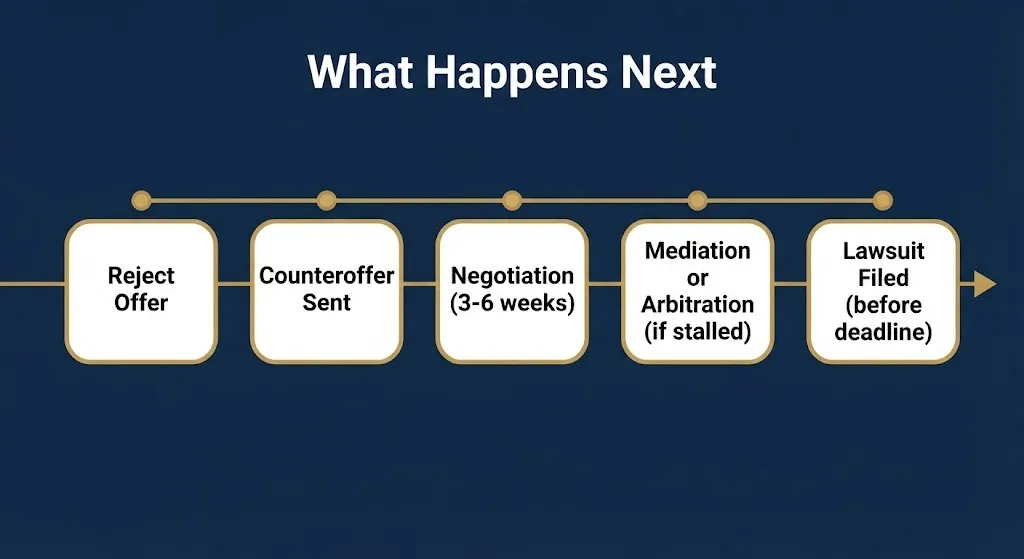
What Happens Next
Immediately: If you reject an offer, send a written counteroffer with supporting evidence. Do not let the original offer expire without a response.
Within 3 to 6 weeks: Expect a response to your counteroffer. If you hear nothing, follow up in writing.
If negotiations stall: Consider mediation or arbitration before filing a lawsuit. These options are often faster and less expensive than trial.
Before the statute of limitations expires: File a lawsuit if settlement is not reached. The deadline varies by state and claim type.
Frequently Asked Questions
What happens if you reject a settlement offer?
Rejecting a settlement offer typically starts further negotiations and a counteroffer. It does not automatically trigger a lawsuit. The original offer is usually gone, and you are negotiating from a new position.
Can you negotiate after rejecting a settlement offer?
Yes. Rejecting an offer is often the first step in negotiating a higher amount. You or your attorney can submit a counteroffer with evidence supporting your valuation.
How long do you have to accept a settlement offer?
There is no universal deadline. Many offers come with a window of seven to 30 days. Short deadlines can be a pressure tactic.
Can an insurance company rescind a settlement offer?
Yes. Insurance companies can rescind offers anytime, but they usually remain open for the stated period. If an offer is rescinded, it may mean new evidence was discovered.
What happens if negotiations fail?
If negotiations fail, your options include mediation, arbitration, or filing a lawsuit. Mediation is often the next step before litigation.
Does rejecting a settlement offer affect the statute of limitations?
The statute of limitations continues to run regardless of settlement negotiations. If it expires before you file a lawsuit, you may lose the right to sue permanently.
Should I hire a lawyer after rejecting a settlement offer?
An attorney can evaluate your claim, gather evidence, and negotiate on your behalf. Most personal injury attorneys work on contingency, meaning no upfront fees.
Can I reject a settlement offer and then accept it later?
Usually no. Once you formally reject an offer, it is typically off the table. You cannot change your mind unless the insurer agrees to re-offer the same amount.