Police Settlement Payouts by State 2026: The Real Numbers Behind Misconduct Costs
Quick Answer
- Police settlement payouts vary wildly by state, with New York’s average per-case payout more than three times higher than Illinois.
- A proposed $260.8 million settlement in Chicago would be the largest police misconduct payout in U.S. history.
- The National Police Funding Database shows California has the most misconduct cases, but New York pays the most per case.
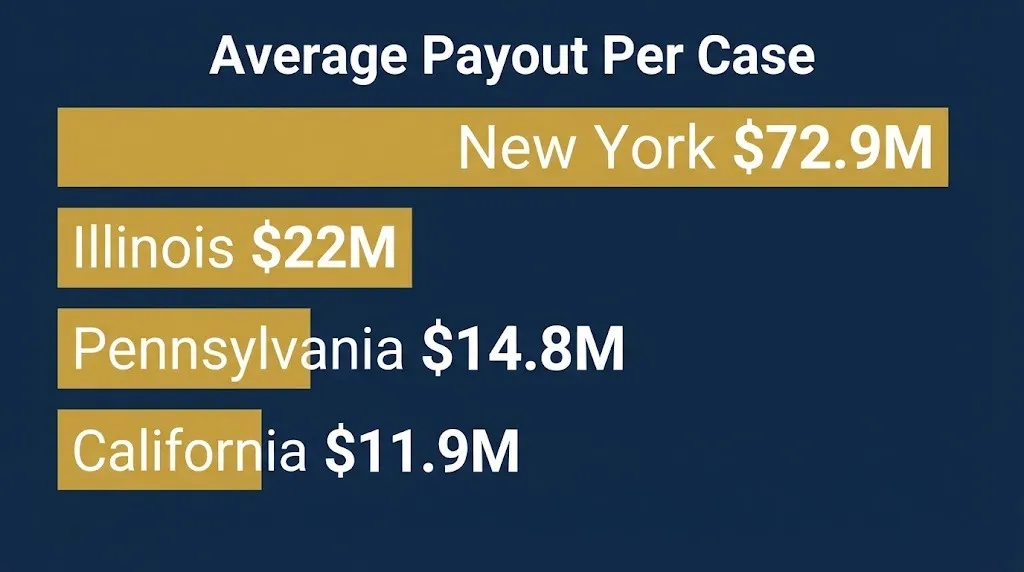
Police settlement payouts by state are not uniform, and the gaps are enormous. A 2025 study analyzing National Police Funding Database data found New York’s average payout per case reached $72,961,800, while Illinois averaged $22,007,000 and California averaged $11,873,393 . Those averages reflect a small number of high-dollar cases, not typical outcomes.
The numbers matter because taxpayers foot the bill. New York City alone paid nearly $1 billion to resolve NYPD misconduct claims between 2018 and mid-2026 . Chicago has spent more than $225 million just six months into 2026 .
This article breaks down the verified state-by-state data, the largest active settlements, and what the numbers actually mean for taxpayers. One detail that stands out: Florida’s average payout of $2.1 million per case is 64% below the national average, despite high-profile incidents .
The Facts
| Case | Police Misconduct Settlements by State (aggregate data) |
|---|---|
| Status | Ongoing payouts across multiple jurisdictions |
| Fund Size | Not applicable |
| Est. Per Person | New York: $72.9M avg; Illinois: $22M avg; California: $11.9M avg |
| Claim Deadline | Not applicable |
| Administrator | Not applicable |
| Proof Needed | Not applicable |
Is Police Settlement Payout Data Legit or Misleading?
Police settlement payout data is legitimate but requires careful reading. The National Police Funding Database compiles verified settlements and judgments from public records. The Bader Scott study analyzed this data to rank states by average payout per case .
The catch is that averages are skewed by a handful of massive settlements. New York’s $72.9 million average reflects cases like the $18 million Palm Beach settlement and multimillion-dollar verdicts in wrongful conviction cases . Most police misconduct cases settle for far less.
A separate analysis found the national average payout across 5.7 cases per state was $6,447,665 . That figure is more representative of typical outcomes, though still influenced by outliers.
The data also excludes confidential settlements. Many police misconduct cases settle with confidentiality agreements that keep amounts out of public view. The Palm Beach Post had to file a public records request to learn about an $18 million settlement .
Key Takeaway: Average payout data is real but skewed by high-dollar outliers. Most settlements are far smaller than the headline numbers suggest.
How Much Do Police Settlements Pay by State?
Police settlement payouts by state range from $72.9 million per case in New York to $2.1 million per case in Florida, according to the Bader Scott analysis of National Police Funding Database data . The national average across all states was $5,930,098 per case .
Here is the verified ranking of states by average payout per case:
| Rank | State | Average Payout Per Case |
|---|---|---|
| 1 | New York | $72,961,800 |
| 2 | Illinois | $22,007,000 |
| 3 | Pennsylvania | $14,798,000 |
| 4 | California | $11,873,393 |
| 5 | Maryland | $6,773,250 |
| 6 | Louisiana | $5,945,000 |
| 7 | Colorado | $4,693,636 |
| 8 | Ohio | $4,212,500 |
| 9 | Washington | $3,640,625 |
| 10 | Minnesota | $3,090,658 |
The top four states account for the largest payouts. New York’s average is more than three times higher than Illinois, the second-ranked state. Pennsylvania and California follow with averages in the $11 million to $15 million range.
States with lower averages include Florida at $2,132,500 per case (ranked 21st) and Texas at $2,035,378 per case . South Carolina, Mississippi, and Connecticut reported no payouts in the dataset, though each had one case .
Key Takeaway: New York, Illinois, Pennsylvania, and California have the highest average police misconduct payouts. Florida and Texas rank near the bottom despite large populations.
What Are the Largest Police Misconduct Settlements in 2026?
The largest police misconduct settlement in 2026 is a proposed $260.8 million deal in Chicago to resolve 16 lawsuits tied to former Detective Reynaldo Guevara . If approved, it would be the largest single police misconduct settlement in U.S. history.
The Guevara settlement covers 17 plaintiffs who collectively spent 384 years in custody, according to city data . That works out to approximately $680,000 for each year spent behind bars.
Other significant 2026 settlements include:
| Settlement | Amount | Jurisdiction | Status |
|---|---|---|---|
| Guevara mass settlement | $260.8 million | Chicago | Pending City Council approval |
| Watts global settlement (2025) | $90 million | Chicago | Paid in May 2026 |
| Palm Beach taser paralysis | $18 million | Florida | Settled 2025 |
| Carl Reed wrongful conviction | $9.5 million | Chicago | Approved 2026 |
The Watts settlement resolved 176 reversed-conviction lawsuits tied to former Sgt. Ronald Watts. The city completed payments in May 2026 to all 180 plaintiffs .
In New York, the city paid $53.5 million between January 1 and July 31, 2026, resolving 493 lawsuits . One settlement exceeded $10 million, and four others topped $2.5 million .
Not yet determined: The Guevara settlement requires final approval from the Chicago City Council. A committee vote was scheduled for early October 2026 .
Key Takeaway: Chicago dominates the largest settlements, with the proposed $260.8 million Guevara deal leading all U.S. police misconduct payouts.
How Do You File a Police Misconduct Lawsuit?
Filing a police misconduct lawsuit requires meeting specific legal standards and deadlines. You cannot simply sue because you are unhappy with police conduct. You must show a violation of constitutional rights, typically under 42 U.S.C. § 1983, or a state law tort like assault or false arrest.
Here are the general steps:
- Document everything immediately. Gather photos, videos, witness names, and medical records.
- File a notice of claim. Many jurisdictions require this within 60 to 180 days of the incident.
- Consult an attorney. Police misconduct cases are complex. Most attorneys offer free consultations.
- Meet the statute of limitations. Deadlines vary by state, typically one to three years.
- File the lawsuit in the correct court. Federal claims go to U.S. District Court; state claims go to state court.
- Survive qualified immunity. The officer must have violated clearly established law.
- Prepare for settlement or trial. Most cases settle before trial, but some go to verdict.
The qualified immunity doctrine is the biggest hurdle. It protects officers from liability unless their conduct violated a right that was clearly established at the time. That standard is high.
Key Takeaway: Police misconduct lawsuits require proof of constitutional violations, strict deadline compliance, and overcoming qualified immunity.
Reality Check: Not every interaction with police that feels unfair is a lawsuit. You must prove a specific legal violation. Most attorneys work on contingency, meaning you pay nothing upfront. If someone asks for an upfront fee to file a police misconduct claim, walk away.
Which Cities Pay the Most Police Misconduct Settlements?
New York City pays the most in total police misconduct settlements, with nearly $1 billion paid between 2018 and mid-2026 . Chicago is second, having spent $225 million in just the first six months of 2026 .
The per-capita costs are staggering. New York City’s payouts averaged $76 million to $206 million per year over the past seven years . Chicago’s 2026 budget set aside only $82.5 million for settlements but authorized borrowing an additional $283.3 million to cover the gap .
Here is how the two largest payers compare:
| City | Total Paid | Time Period | Number of Cases |
|---|---|---|---|
| New York City | $926,305,945 | 2018 to July 2026 | 8,838 |
| Chicago | $225,000,000+ | January to June 2026 | 200+ |
Other cities with significant payouts include Los Angeles, which has paid out millions in individual settlements. A 2025 study found California ranked fourth nationally with an average payout of $11.1 million per case .
The pattern is clear: large cities with high-profile police departments pay the most. The costs are borne by taxpayers, not by the officers involved. In most cases, officers are not disciplined and do not contribute to settlements .
What Happens Next
October 2026: Chicago City Council votes on the proposed $260.8 million Guevara settlement. Committee vote scheduled for early October, full Council vote as early as October 14 .
Late 2026: Additional Guevara-related lawsuits remain pending. City officials expect more settlements.
2027: Chicago’s budget will absorb the Guevara settlement costs, with payments spread across 2027 and 2028 .
Ongoing: New York City continues resolving NYPD misconduct claims, with payouts tracking at similar levels to prior years.
Frequently Asked Questions
Which state pays the most for police misconduct settlements?
New York pays the most per case, with an average payout of $72,961,800. Illinois ranks second at $22,007,000 per case.
What is the largest police misconduct settlement in U.S. history?
The proposed $260.8 million settlement in Chicago for victims of former Detective Reynaldo Guevara would be the largest if approved by the City Council.
How much has New York City paid for NYPD misconduct?
New York City has paid nearly $1 billion between 2018 and July 2026 to resolve NYPD misconduct claims.
Do police officers pay settlements themselves?
In most cases, no. Settlements are paid by the city or municipality. Officers rarely contribute personal funds.
What is qualified immunity?
Qualified immunity is a legal doctrine that protects police officers from liability unless they violated a clearly established constitutional right.
Can I sue the police for misconduct?
You can sue if you can prove a constitutional violation, such as excessive force or false arrest. Deadlines are strict and vary by state.
How long do police misconduct lawsuits take?
Cases can take one to five years or longer, depending on complexity, court backlog, and whether the case settles or goes to trial.
Why do some states pay more than others?
Higher payouts often reflect larger jurisdictions, more high-profile cases, and differing legal standards. A few massive settlements can skew a state’s average upward.