Flock Camera Lawsuit 2026: $105K in Settlements, Class Action Status, and What the Litigation Actually Claims
Quick Answer
- Flock Safety faces multiple lawsuits in 2026 over warrantless surveillance, data sharing with federal agencies, and mistaken identity arrests.
- Washington cities settled records cases for $25,000 and $80,000. No consumer payout fund exists for Flock camera users.
- A new federal class action seeks to represent anyone whose license plate was scanned by Flock cameras since January 1, 2024.
Flock Safety operates more than 120,000 automated license plate reader cameras across the United States. The company sells access to law enforcement agencies, homeowners associations, and private businesses. The data captured has become the center of a growing legal fight.
Lawsuits filed in 2026 allege that Flock’s system enables warrantless surveillance, shares data improperly with federal immigration agencies, and produces inaccurate results that lead to innocent people being accused of crimes. Cities in Washington have already paid settlements over Flock records disputes.
This guide breaks down every active Flock camera lawsuit, what the settlements mean, and why the class action matters for anyone whose vehicle has been photographed by these cameras.
The Facts
| Item | Detail |
|---|---|
| Company | Flock Safety (also known as Flock Group Inc.) |
| Active Litigation | Federal class action (Colorado), Waukesha County lawsuit, California class action, Washington records cases |
| Washington Settlements | $25,000 (Everett), $80,000 combined (Stanwood and Sedro-Woolley) |
| Class Action Scope | Anyone whose license plate was scanned by Flock since January 1, 2024 |
| Key Allegation | Warrantless surveillance, data sharing with ICE and CBP, inaccurate plate reads |
| Current Status | Active litigation, no consumer payout fund established |
Is the Flock Camera Lawsuit Legit or a Scam?
The Flock camera lawsuits are legitimate federal and state court cases. They involve real plaintiffs, named defendants, and documented allegations of constitutional violations.
Multiple civil rights organizations have filed suits. The Kansas Justice Institute sued Wichita in July 2026, arguing Flock cameras violate the Kansas Constitution’s protections against warrantless surveillance . A civic group called NoCams Muskego filed suit in Wisconsin in September 2026, seeking to require warrants before police can search Flock’s database .
The most significant case is a federal class action filed in Colorado in October 2026. Chrisanna Elser, a Colorado woman, is suing Flock Safety, two towns, and individual police officers after she was wrongly accused of stealing a $25 package based on Flock camera footage .
If you’re searching because you received a text or email about a Flock settlement payout, be careful. No consumer settlement fund has been established. Any message promising money from a Flock lawsuit is premature at best and fraudulent at worst.
How Much Are the Flock Camera Settlements Worth?
The Flock camera settlements total $105,000 across three Washington cities, but these are public records cases, not consumer payouts. The money went to a single individual who requested camera footage.
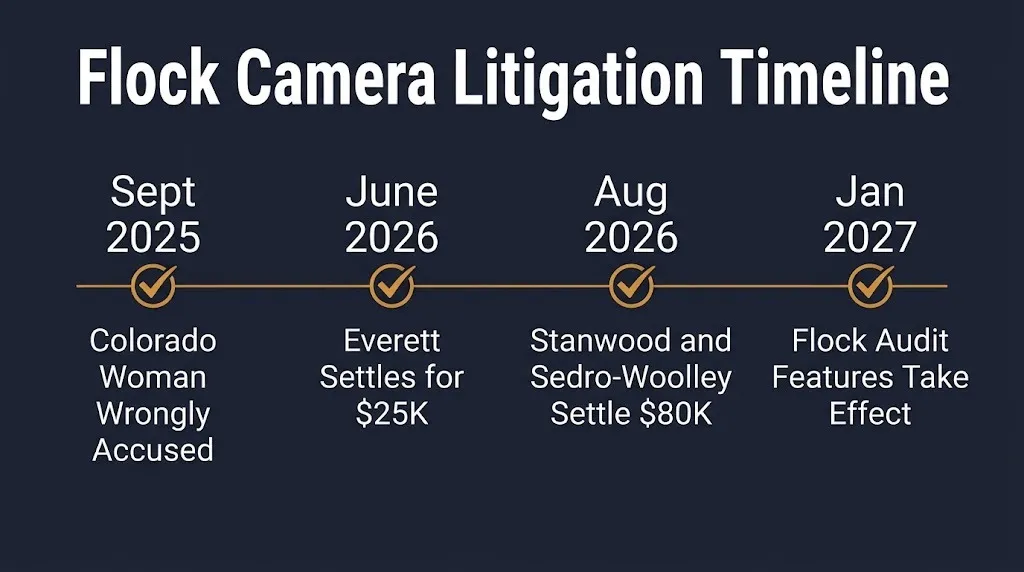
Everett settled for $25,000 in June 2026. Stanwood and Sedro-Woolley paid $40,000 each for a combined $80,000 in August 2026 .
The settlements resolved lawsuits filed by Oregon resident Jose Rodriguez. He requested Flock camera footage from multiple Washington cities under the state’s Public Records Act. The cities refused, arguing the footage was exempt from disclosure. Courts disagreed.
Here’s the breakdown:
| City | Settlement Amount | Date |
|---|---|---|
| Everett | $25,000 | June 2026 |
| Stanwood | $40,000 | August 2026 |
| Sedro-Woolley | $40,000 | August 2026 |
| Total | $105,000 |
These settlements do not establish a payout fund for Flock camera users. They compensate one person for attorneys’ fees and penalties related to public records violations. If you’re a regular driver whose plate was scanned, you’re not automatically entitled to any portion of these settlements.
Reality Check: No one is sending you a check because a Flock camera photographed your car. The Washington settlements went to a single records requester. The Colorado class action has not been certified, and no fund exists. If you receive a message offering Flock settlement money, it’s a scam.
Who Qualifies for the Flock Camera Class Action?
Anyone whose license plate was scanned by a Flock camera since January 1, 2024, may be included in the proposed class action. The lawsuit seeks to represent people nationwide.
The federal class action was filed in September 2026 by a Georgia woman. It claims Flock’s cameras are used for stalking, produce inaccurate results, and violate privacy rights .
The class definition covers “every person in the country whose license plate was scanned by a Flock camera since Jan. 1, 2024.” Given Flock’s 120,000+ cameras nationwide, that could include millions of drivers.
But the class has not been certified. Flock has not agreed to any settlement. And no payout amount has been determined. The lawsuit seeks damages for invasion of privacy and punitive damages against Flock Safety itself.
If you want to know whether you’re potentially included, ask yourself a simple question: have you driven on public roads in any city that uses Flock cameras? If yes, your plate was likely scanned. But that doesn’t mean you’ll get money.
Why Is Flock Safety Being Sued?
Flock Safety is being sued for three main reasons: warrantless surveillance, improper data sharing, and inaccurate plate reads that harm innocent people.
The warrantless surveillance claim is central. Plaintiffs argue that Flock’s system allows police to search a person’s past, present, and future movements without a warrant or probable cause. The Wisconsin lawsuit compares this to the Supreme Court’s Carpenter decision, which limited warrantless access to cell phone location data .
Data sharing with federal agencies is the second claim. California law prohibits sharing ALPR data with out-of-state or federal agencies. But investigations found that Flock’s centralized database allowed federal agencies like ICE and CBP to access data from California police departments. One report found federal agencies accessed San Francisco camera data more than 1.6 million times .
The third claim is accuracy. The class action cites an incident in California where over 70% of stolen car alerts were Flock cameras misreading license plates. Chrisanna Elser’s case in Colorado is the most detailed example. She was served with a criminal summons for package theft based solely on a Flock camera capturing her truck driving through the area. She was at a tailor getting fitted for a dress at the time of the theft .
What Happened in the Colorado Flock Camera Case?
A Colorado woman was wrongly accused of stealing a $25 package based on Flock camera footage. She is now suing Flock Safety, two towns, and police officers in federal court.
Chrisanna Elser learned she was under investigation on September 27, 2025, when a Columbine Valley police sergeant served her with a criminal summons at her home. The sergeant claimed Flock cameras captured her Rivian truck driving through Bow Mar around the time a package was stolen .
Elser told the officer she was at a tailor being fitted for a dress at the time. She offered to share footage from her truck’s cameras and data from her phone. The sergeant refused to look at her evidence .
The summons was voided on October 15, 2025, after Elser provided proof she was elsewhere. The police chief later admonished the sergeant for rude behavior and unwillingness to de-escalate. But the discipline was not based on the officer’s use of the Flock database .
Elser’s lawsuit argues that Flock, Bow Mar, and Columbine Valley allowed officers unrestricted access to the Flock database without a warrant, probable cause, or supervisory approval. She is asking the court to require a warrant, case number, and supervisor’s approval before Colorado agencies can search the system .
Flock’s public relations manager responded that the system “accurately identified the location of Ms. Elser’s vehicle,” and that law enforcement retained responsibility for interpreting the data .
Key Takeaway: The Colorado case shows the core of the Flock problem: the camera can be technically accurate about where a car was while still leading police to accuse the wrong person of a crime.
How Do You File a Flock Camera Lawsuit Claim?
You cannot file a claim for money from a Flock camera lawsuit right now. No settlement fund exists, and no claim process has been established.
The Colorado class action is seeking class certification. If the court certifies the class, a notice process would follow. That’s when you’d receive instructions on how to participate or opt out. Until then, there’s nothing to file.
If you believe you were harmed by a Flock camera error, you may have an individual claim. But that requires consulting a civil rights attorney. Cases like Chrisanna Elser’s are being litigated by firms that specialize in privacy and surveillance law.
Here’s what the process would look like if a settlement happens:
- Class certification: A judge decides whether the case can proceed as a class action.
- Notice: If certified, class members receive notice by mail or email.
- Claim period: A deadline is set for filing claims or opting out.
- Settlement approval: A judge reviews and approves any settlement.
- Payment: Funds are distributed after approval.
None of these steps have occurred for the Flock class action. Any website or service claiming you can file now is not legitimate.
What Does Flock Safety Say About the Lawsuits?
Flock Safety denies wrongdoing and says its technology is accurate. The company argues that local agencies control how data is used and that courts have largely upheld license plate readers.
Flock’s public relations manager told reporters that the system “accurately identified the location of Ms. Elser’s vehicle” in the Colorado case, adding that law enforcement is responsible for interpreting and weighing that information .
The company also points to court decisions. Flock states that more than 40 courts have found fixed license plate readers do not violate the Fourth Amendment and cannot track a person’s complete movements .
Flock has announced policy changes in response to criticism. Starting January 1, 2027, law enforcement customers must implement an audit tool that flags abnormal search behavior. Users who trigger it will be locked out pending review. The company also shortened its recommended default data retention window from 30 days to 7 days .
Critics call these changes “window dressing.” An attorney with the Institute for Justice said the changes are an effort to quiet opposition to Flock’s “mass surveillance business model” .
Frequently Asked Questions
Is there a Flock camera settlement?
No. The only Flock camera settlements are Washington public records cases totaling $105,000 paid to one individual. No consumer settlement fund exists.
How much will I get from the Flock class action?
Not yet determined. The class action has not been certified, and no settlement has been reached. Any payout amount is speculative at this point.
Who qualifies for the Flock camera lawsuit?
The proposed class covers anyone whose license plate was scanned by a Flock camera since January 1, 2024, nationwide. The class has not been certified .
Did Flock Safety admit wrongdoing?
No. Flock denies all allegations and says its technology is accurate. The company argues law enforcement agencies control how the data is used .
What is the Colorado Flock lawsuit about?
A woman was wrongly accused of package theft based on Flock camera footage. She is suing Flock and local police for warrantless surveillance and civil rights violations .
How do I know if my plate was scanned by Flock?
You likely won’t know unless police contact you. Flock does not notify people whose plates are scanned. You can ask your local police department if they use Flock cameras.
Are Flock cameras legal?
Courts have largely upheld fixed license plate readers as constitutional. But multiple lawsuits argue that Flock’s database search capabilities go beyond what courts have approved.
What happens if the Flock class action settles?
If a settlement occurs, class members would receive notice and instructions on filing claims. That process has not started yet.
What Happens Next: Flock Camera Litigation Timeline
January 1, 2027: Flock’s new audit and lockout features take effect for law enforcement customers.
Expected 2027: Colorado federal class action moves toward class certification or dismissal.
Ongoing: Waukesha County lawsuit and other state cases proceed through appeals.
Ongoing: Cities across the country continue debating whether to renew or cancel Flock contracts.
Future: Any settlement would trigger a notice and claims process for class members.
The Flock camera lawsuits are in early stages. No consumer payout is available. If you’re concerned about your privacy, contact your local officials and ask whether your city uses Flock cameras and what policies govern their use. The most important date to watch is January 1, 2027, when Flock’s new audit features take effect.