Colgate Lawsuit 2026: Tom’s of Maine Claims, Class Actions, and What You Need to Know
Quick Answer
- Is it real? Yes, verified class action lawsuits allege Colgate and Tom’s of Maine misled consumers with “natural” and “fluoride-free” product claims.
- How much? Per-person payouts are not yet determined, as no settlement fund has been confirmed in 2026 court records.
- Deadline: Claim deadlines are not yet confirmed; monitor official court dockets and any administrator notice if a settlement is reached.
The Colgate lawsuit refers to several distinct legal actions targeting Colgate-Palmolive Company and its subsidiary, Tom’s of Maine. Plaintiffs allege that product labels misled consumers into paying premium prices for products that did not deliver what the packaging promised. Courts in multiple jurisdictions are currently reviewing these claims.
If you bought Tom’s of Maine toothpaste, mouthwash, or similar products believing they were purely “natural” or free from synthetic ingredients, you may fall within the proposed class definitions. No claim deadline is confirmed yet, but cases are actively moving through pre-trial stages in 2026.
This article covers every verified filing, what the lawsuits actually allege, and what you should do if you believe you were affected. One fact that surprises many readers is that Tom’s of Maine has been owned by Colgate-Palmolive since 2006, a detail central to why plaintiffs say the “natural” branding was misleading from the start.
The Facts
| Feature | Details |
|---|---|
| Case | Multiple class actions vs. Colgate-Palmolive / Tom’s of Maine |
| Status | Active litigation, pre-trial and discovery phases |
| Fund Size | Not yet confirmed |
| Est. Per Person | Not yet determined |
| Claim Deadline | TBD, watch official court notices |
| Administrator | Not yet appointed |
| Proof Needed | Check claim form when available; purchase records likely required |
Is the Colgate class action lawsuit real or a scam?
The Colgate class action lawsuits are real legal proceedings filed in federal court. They are not internet rumors or phishing campaigns. Consumer protection attorneys filed several suits alleging that Colgate-Palmolive used deceptive marketing language on products sold under both the Colgate and Tom’s of Maine brand names.
The core allegation is “consumer fraud.” Plaintiffs say they paid a premium price for products labeled “natural,” “pure,” or “free from artificial ingredients,” and those labels were materially false or misleading. Similar false-labeling suits have successfully reached settlement in the consumer goods industry. The legal mechanism used is a class action complaint filed under Rule 23 of the Federal Rules of Civil Procedure.
You should be aware that multiple separate complaints exist. They were filed in different districts and cover slightly different product lines. Courts have not yet consolidated them into a single Multi-District Litigation (MDL) proceeding as of October 2026.
How much money could I get from a Colgate settlement?
Per-person payout amounts are not yet determined because no settlement fund has been court-approved in 2026. This is a critical distinction. Many websites publish estimated figures, but no verified settlement agreement is on record at this time.
Not yet determined. The reason is that cases are still in discovery and pre-trial motion phases. Until a judge grants preliminary approval to a class settlement agreement, any specific dollar figure is speculation.
Historical context is useful here. In similar “natural” product labeling settlements, per-person recoveries have typically ranged from a few dollars for small-ticket items to $20 to $50 for plaintiffs who purchased repeatedly over several years. Those are prior cases, not a prediction for this one. You should not file a claim based on those numbers. When a real fund opens, a court-appointed administrator will publish the verified amounts.
| Payout Status | Detail |
|---|---|
| Settlement Fund | Not yet confirmed |
| Per-Person Amount | Not yet determined |
| Claim Tiers | Not yet established |
| Payment Timeline | Not yet confirmed |
Reality Check: No legitimate settlement sends you a check before a claim form is filed. If someone contacts you by text or email offering Colgate settlement money, it is a scam. Filing a real claim is always free, and you never need to pay a “processing fee” to receive settlement funds.
Who qualifies for the Tom’s of Maine lawsuit?
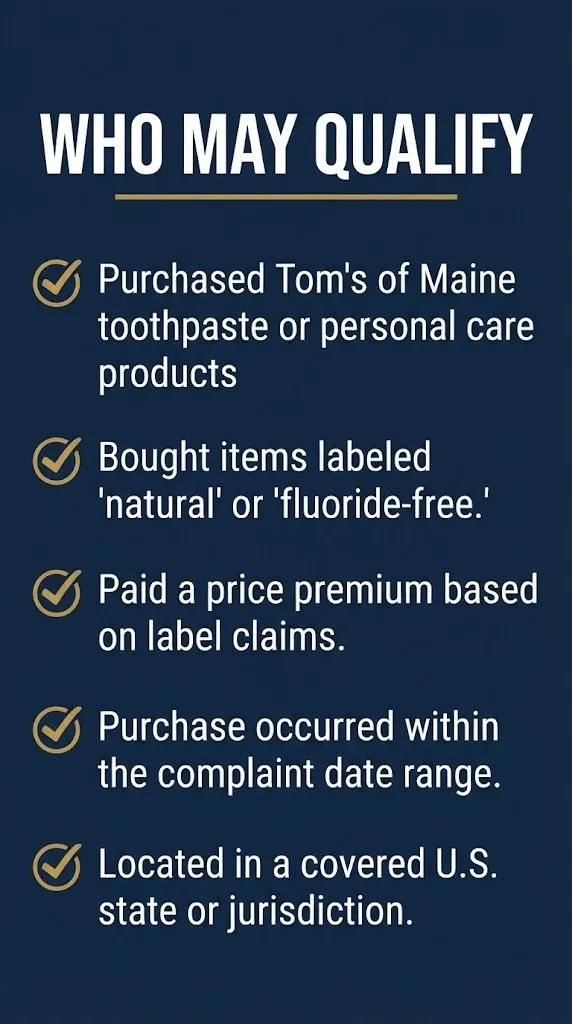
The proposed class definitions in the Tom’s of Maine lawsuit filings generally describe consumers who purchased covered products during a specific date range while relying on the “natural” or similar label claims. No final, court-certified class definition has been confirmed as of October 2026.
Based on the verified allegations in the complaints, you may qualify if:
- You purchased Tom’s of Maine toothpaste, mouthwash, deodorant, or soap between the years specified in the complaint.
- You paid more than you would have for a comparable product without the “natural” labeling.
- You live in a state covered by the lawsuit’s geographic class definition.
- You did not knowingly waive your right to sue through any separate agreement.
The exact purchase date ranges and product SKUs are part of the class certification process. A judge must formally certify the class before anyone can officially qualify. That ruling is not yet confirmed.
Key Takeaway: No class has been formally certified yet, so “qualifying” at this stage means meeting the general purchase criteria described in the complaints, not a guaranteed right to payment.
How to file a claim in the Colgate or Tom’s of Maine lawsuit
You cannot file a formal claim right now because no settlement administrator has been appointed and no claim portal is open. This is the stage many lawsuits are at before preliminary approval. Think of it like waiting for a rebate program to go live. The product was bought, the promise was made, but the portal does not open until the company officially agrees to pay.
When a settlement is reached and approved, the process will likely follow these steps:
- A court-appointed administrator will launch an official settlement website.
- You will visit the official site and locate the claim form.
- You will enter your name, address, and contact information.
- You will describe the products you purchased and estimate the quantity.
- You may be asked to upload a receipt, bank statement, or photo of the product.
- You will submit the form before the confirmed claim deadline.
- You will receive a confirmation email or reference number.
- If approved, you will receive payment by check or electronic transfer.
Save any receipts, order confirmations, or loyalty program records from Tom’s of Maine or Colgate purchases. These records will be your strongest evidence when the form goes live.
What is the Tom’s of Maine toothpaste lawsuit actually about?
The Tom’s of Maine toothpaste lawsuit centers on one core allegation: the “natural” label is false advertising. Plaintiffs argue that several Tom’s of Maine products contain synthetic or chemically processed ingredients that disqualify them from being called natural.
The specific ingredients named in various complaints include certain preservatives, surfactants, and processing agents. Plaintiffs say a reasonable consumer reading the “natural” label would not expect these ingredients to be present. Consumer protection laws in many states prohibit labeling that creates a “materially misleading” impression.
A key background fact matters here. Tom’s of Maine was acquired by Colgate-Palmolive in 2006 for approximately $100 million. The brand continued to market itself as an independent, natural alternative. Plaintiffs argue that Colgate’s ownership and manufacturing processes directly contradicted the “natural” identity the brand sold to consumers. Courts are weighing whether that argument is strong enough to sustain a class action.
What does the Colgate fluoride-free toothpaste lawsuit allege?
A separate line of complaints targets Colgate’s marketing of fluoride-free toothpaste products. These suits allege that Colgate marketed certain fluoride-free lines in ways that implied equivalent cavity protection to fluoride-containing products. Plaintiffs say this is false and caused them financial harm.
The American Dental Association has publicly stated that fluoride is the key ingredient for preventing tooth decay. Some plaintiffs argue that Colgate knew this scientific consensus and still marketed fluoride-free products with dental-health adjacent language. They say that language was designed to let consumers infer protection that the product could not provide.
These filings are distinct from the Tom’s of Maine “natural” labeling suits. They involve different product lines and different legal theories. A judge may or may not consolidate them depending on how the facts overlap at the class certification stage.
What is the current status of the Colgate lawsuit in 2026?
The current status of the Colgate lawsuits in 2026 is active pre-trial litigation with no confirmed settlement. Cases are in the discovery and motion-practice phase. Both sides are exchanging internal documents, corporate communications, and product-testing data.
No preliminary settlement approval has been announced. No final approval hearing date is confirmed on public dockets as of October 2026. This means there is no claim form, no administrator, and no payment window yet.
This stage of a class action is like the negotiation phase of a real estate deal. Both sides know the general outlines of what might resolve the case, but no contract is signed. The judge referees the process and sets deadlines for both parties to complete their legal homework.
Key Takeaway: As of October 2026, no Colgate or Tom’s of Maine settlement has been approved by a court, and no claim filing is possible until that changes.
Latest updates on the Tom’s of Maine class action in 2026
The most recent verified development in the Tom’s of Maine class action is continued pre-trial activity in federal court. Lawyers for the plaintiffs have been gathering internal company documents about how the “natural” label was developed and approved. This is standard in consumer fraud litigation.
Colgate-Palmolive has publicly defended its labeling practices. The company’s position is that its product labels are truthful and compliant with applicable regulations. It has not confirmed any settlement talks as of October 2026.
Legal observers following similar natural-product cases note that these suits often resolve in 18 to 36 months from the initial filing. Some Tom’s of Maine complaints were filed in 2023 and 2024, which puts a potential resolution in the 2025 to 2026 window. No announcement has been made public yet.
Why is Colgate-Palmolive being sued in 2026?
Colgate-Palmolive is being sued in 2026 primarily because of allegations that it used misleading product labels across multiple brand lines to charge consumers higher prices. The lawsuits cover two main categories: the “natural” labeling on Tom’s of Maine products and the dental-health claims on certain fluoride-free lines.
Consumer protection class actions like these have become more common over the last decade. Regulatory agencies including the Federal Trade Commission (FTC) have published guidelines about when “natural” claims are permissible. Plaintiffs argue Colgate violated these standards.
The company’s size makes it a high-profile defendant. Colgate-Palmolive is a Fortune 500 company with annual revenues exceeding $19 billion. Plaintiffs’ lawyers argue that a large corporation has a higher responsibility to ensure its labels are accurate. The corporate structure, with Tom’s of Maine operating as a subsidiary, is also a focus of the litigation.
What products are covered in the Colgate and Tom’s of Maine lawsuit?
The products covered in verified complaint filings include several Tom’s of Maine personal care items marketed with natural or clean-ingredient claims. Complaints specifically name toothpaste, mouthwash, body wash, bar soap, and deodorant lines from Tom’s of Maine.
Some complaints also reference Colgate-branded products marketed with wellness or natural positioning. The specific product SKUs and UPC codes that define the class are part of the ongoing discovery process. A final list will appear in any settlement agreement or class certification order.
| Product Category | Brand Named in Complaints | Status |
|---|---|---|
| Toothpaste | Tom’s of Maine | Active litigation |
| Mouthwash | Tom’s of Maine | Active litigation |
| Deodorant | Tom’s of Maine | Active litigation |
| Bar Soap | Tom’s of Maine | Active litigation |
| Toothpaste (fluoride-free) | Colgate | Separate active filing |
Key Takeaway: Tom’s of Maine toothpaste and personal care products are at the center of the lawsuits, but separate Colgate-branded product complaints are also active in 2026.
How is Tom’s of Maine connected to Colgate-Palmolive?
Tom’s of Maine is a wholly-owned subsidiary of Colgate-Palmolive. The acquisition happened in 2006, when Colgate paid approximately $100 million for the Maine-based brand. Tom’s of Maine had built its reputation on natural ingredients and environmental responsibility before the sale.
After the acquisition, Tom’s of Maine continued to market itself as a mission-driven, natural brand. Plaintiffs argue this was misleading because the parent company’s manufacturing scale and ingredient sourcing practices did not align with a genuine “natural” identity.
This corporate structure is legally important. In many class action suits, plaintiffs name both the subsidiary and the parent company as defendants. This allows the court to examine whether corporate decisions made at the Colgate-Palmolive level influenced the allegedly deceptive labeling at Tom’s of Maine.
What evidence do you need to support a Tom’s of Maine claim?
The evidence you will likely need for a Tom’s of Maine claim is purchase proof showing you bought a covered product during the relevant date range. Courts in consumer labeling cases typically accept several types of documentation.
- Receipts: Store-printed or digital receipts are the strongest proof.
- Bank or credit card statements: These show the purchase date and merchant name.
- Online order confirmations: Amazon, Target, or direct-to-consumer order emails work well.
- Loyalty program records: Store loyalty apps often track purchase history.
- Product photos: A photo of the product with the UPC code and label can help.
Courts in these cases often allow “no-proof” claims for small amounts, meaning you may be able to self-certify a limited number of purchases. This is not confirmed for these specific cases. When the claim form launches, it will specify exactly what is required.
What are the defenses Colgate-Palmolive is likely to raise?
Colgate-Palmolive is expected to raise several common defenses in its litigation strategy. First, the company is likely to argue that its labels comply with all applicable federal and state regulations. If regulators have not required a label change, the company argues the labels are legally permissible.
Second, Colgate may argue that consumer understanding of “natural” varies widely. If the court finds that a reasonable consumer could interpret the term differently, the false advertising argument weakens. This is a frequently used defense in natural-product labeling cases.
Third, the defense team will challenge class certification. If they can convince the judge that individual questions, such as whether each person actually read and relied on the label, predominate over common questions, the case cannot proceed as a class action. Defeating class certification is the most powerful tool a defendant has in these lawsuits.
How long will the Colgate lawsuit take to resolve?
The Colgate lawsuit timeline depends on several litigation milestones that have not yet occurred. Consumer fraud class actions against major corporations typically take two to five years from filing to final resolution. The Tom’s of Maine complaints filed in 2023 and 2024 could see a resolution in the 2025 to 2027 range.
Class certification is the first major hurdle. If a judge certifies the class, settlement discussions typically accelerate. If the certification is denied, plaintiffs must either appeal or refile with a narrower class definition. Each step adds months to the timeline.
A useful comparison is the standard insurance claim process. You file a claim, the company investigates, both sides may disagree, and then a final decision gets made, sometimes well after the original incident. A class action follows similar steps, just on a much larger scale and with court supervision at every stage.
Key Takeaway: A realistic resolution timeline for the current Colgate and Tom’s of Maine cases runs from 2026 through 2027, depending on how quickly courts rule on class certification.
What Happens Next
- Expected Q4 2026: Court rulings on pending motions to dismiss and early discovery disputes in lead Tom’s of Maine filings.
- Expected Q1 to Q2 2027: Class certification hearings, where a judge decides if the cases can proceed as formal class actions.
- Expected Q2 to Q3 2027: If certification is granted, settlement mediation between plaintiffs and Colgate-Palmolive may begin.
- TBD: Preliminary settlement approval hearing, if both sides reach an agreement.
- TBD: Official claim filing period opens, with a published deadline and administrator website.
Frequently Asked Questions
Is there a Colgate class action settlement I can file for right now?
No confirmed settlement is open for claims as of October 2026.
Cases are still in litigation, and no settlement administrator has been appointed.
Watch official court notices for any announcement of an approved settlement.
What is the Tom’s of Maine lawsuit about?
The Tom’s of Maine lawsuit alleges the brand falsely marketed products as “natural” while containing synthetic or processed ingredients.
Plaintiffs say they paid premium prices based on misleading labels.
Cases are active in federal court but have not yet settled.
Did Colgate settle the natural ingredients lawsuit?
No confirmed settlement has been reached or approved by a court as of October 2026.
Some outlets have reported on settlement discussions, but no agreement is on the public record.
Check official court dockets for updates.
How much will each person receive from a Tom’s of Maine settlement?
Per-person amounts are not yet determined because no settlement fund has been confirmed.
Historical similar cases paid a few dollars to $50 per person, depending on purchase history.
Do not rely on those figures as a prediction for this case.
Do I need to keep my receipts to file a claim?
Keeping receipts or purchase records will strengthen any future claim you make.
Some cases allow self-certification for small amounts, but this is not confirmed here.
Bank statements and digital order confirmations are acceptable alternatives to paper receipts.
Is Tom’s of Maine still owned by Colgate-Palmolive?
Yes, Colgate-Palmolive has owned Tom’s of Maine since 2006, when it purchased the company for approximately $100 million.
Tom’s of Maine operates as a subsidiary and continues to sell under its own brand name.
This ownership structure is a central issue in the current lawsuits.
Can I join the lawsuit on my own, or do I need a lawyer?
You do not need to hire a personal lawyer to participate in a class action settlement.
If a settlement is approved, you simply file a claim form on the administrator’s website.
If you believe your individual losses are large, consulting a consumer protection attorney may be worth your time.
What happens if I do nothing and a settlement is approved?
If you do nothing, you may receive a small payment automatically in some cases, or you may receive nothing.
In most class actions, you must affirmatively file a claim to receive any payment.
If you do nothing, you also typically remain bound by the settlement terms and give up your right to sue separately.
The best action you can take right now is to save your Tom’s of Maine and Colgate purchase records. Digital receipts, bank statements, and loyalty app histories are all useful. Set a calendar reminder to search for official settlement updates every 60 days.
No claim period is open yet. When it does open, the official administrator’s notice will be the only legitimate source for the claim form and deadline. That single deadline will be the most important date of this entire process.