Sexual Abuse Lawsuit 2026: Deadlines, Settlement Realities, and Why the Court Record Matters More Than the Headline
Quick Answer
- A sexual abuse lawsuit is a civil claim against an abuser or an institution, not a class action settlement you join online.
- Payouts vary wildly. A 2026 New York jury awarded $11.3 million to one survivor, while other cases settle for far less.
- The deadline depends on your state. Some have no limit for childhood claims; California’s adult revival window closes December 31, 2026.
You searched “sexual abuse lawsuit” because something happened, recently or decades ago, and you need to know whether the law still gives you a path. The answer is not a simple yes or no. It depends on the state, the age you were at the time, and whether a revival window is open.
Civil sexual abuse litigation is not a class action with a claim form. It is individual litigation. You file a case, you prove harm, and you either settle or go to trial. The timelines are unforgiving, and the rules changed dramatically in the last few years. Several states retroactively eliminated their deadlines, meaning claims that were once dead can now be filed.
This article explains the verified deadlines by state, the real settlement numbers from 2026, the evidence that matters, and the scam risks that target survivors. The surprising part: the federal government is moving to eliminate its own time limits, but that law has not passed yet.
The Facts
| Case | Sexual abuse litigation (individual civil claims, not one case) |
|---|---|
| Status | Active across multiple state and federal courts. No single settlement or fund |
| Fund Size | Not applicable. Payouts are case-specific |
| Est. Per Person | Varies. One 2026 New York verdict: $11.3 million; settlements vary widely |
| Claim Deadline | State-specific. Some states have no civil limit for childhood claims; others have strict windows |
| Administrator | Not applicable. These are court cases, not administered settlement funds |
| Proof Needed | Testimony, medical and mental health records, witness statements, institutional records |
Is a Sexual Abuse Lawsuit Real or a Scam?
A sexual abuse lawsuit is real and is one of the few legal tools that can hold both abusers and the institutions that protected them accountable. The scam risk sits in the pages and ads that promise settlement money without naming a case, a court, or a defendant.
Civil sexual abuse claims are filed in state or federal court against the perpetrator and, often, against an organization that knew or should have known about the abuse. The theory against institutions is usually negligent supervision, failure to report, or concealment. New York’s Child Victims Act, for example, opened a two-year window that allowed survivors to sue decades after the abuse, and one 2026 jury verdict under that law awarded $11.3 million to a man abused as a teenager in 1978 .
The legitimate path involves a lawyer, a court filing, and evidence. It does not involve a claim portal that asks for your Social Security number before you know who is being sued.
How Much Money Can You Get From a Sexual Abuse Lawsuit?
There is no standard payout. Verdicts and settlements range from five figures to eight figures, and the amount depends on the severity of the abuse, the proof of institutional failure, the jurisdiction, and whether the case goes to trial.
In 2026, a New York jury ordered Riverside Church to pay $11.3 million to a survivor abused in 1978, with $7.5 million for past pain and suffering and $3.8 million for future damages . In a separate 2026 California case, a jury ordered Bill Cosby to pay $19.3 million to a woman who said he drugged and assaulted her . Those are verdicts, not settlements, and they reflect juries willing to impose large numbers in specific circumstances.
Institutional settlements operate differently. The Diocese of Albany agreed to pay $148 million in its Chapter 11 bankruptcy to resolve sexual abuse claims . The Diocese of Buffalo’s bankruptcy plan involves a trust approaching $327 million, funded partly by a $177 million settlement with insurance carriers . Bank of America’s $72.5 million settlement for Epstein survivors received final approval in August 2026 .
| Case Type | 2026 Verified Figure |
|---|---|
| Individual jury verdict (New York church) | $11.3 million |
| Individual jury verdict (Cosby, California) | $19.3 million |
| Diocese of Albany bankruptcy settlement | $148 million |
| Diocese of Buffalo trust (proposed) | Approximately $327 million |
| Bank of America Epstein survivor settlement | $72.5 million |
Key Takeaway: Sexual abuse lawsuit payouts are not uniform, and the biggest numbers come from jury verdicts and institutional bankruptcies, not from a public claim fund. Your potential recovery depends on proof, jurisdiction, and the defendant’s assets.
What Is the Deadline to File a Sexual Abuse Lawsuit in 2026?
The deadline to file depends entirely on your state and the age you were when the abuse occurred. There is no national rule. Some states have no civil time limit at all for childhood claims, while others maintain windows that close quickly.
Sixteen states currently set no civil time limit for childhood sexual abuse lawsuits, according to a 2026 state-by-state analysis . Maryland, Nevada, Oregon, and Vermont retroactively abolished their deadlines, meaning claims that were already expired can now be filed. California has two adult revival paths open, with one closing December 31, 2026 . Rhode Island opened a two-year revival window running July 1, 2026 through June 30, 2028 for claims against non-perpetrator defendants .
Other states remain restrictive. Alabama gives childhood victims until age 25. Arizona sets the limit at age 30. Arkansas uses a discovery rule with a three-year filing window after discovery . These differences mean a claim that is viable in one state may be barred in another.
At the federal level, Senator Schumer introduced “Virginia’s Law” in February 2026, which would eliminate federal time limits for adult survivors and create a one-year lookback period for certain claims . The bill has not passed. A separate House bill would tie federal grants to state reforms eliminating child sexual abuse statutes of limitation .
Reality Check: No one texts you money from a sexual abuse lawsuit. There is no national settlement fund, no claim portal, and no automatic payout. If a page asks for payment to “process” your claim before naming a defendant, it is not part of the legal system. Filing a lawsuit is free; the court filing fee is the only mandatory cost, and lawyers in these cases typically work on contingency.
How Do You File a Sexual Abuse Lawsuit?
Filing starts with a lawyer who handles these cases, not with a form you fill out alone. The evidence requirements are heavy, and the deadlines are strict.
Here are the steps, drawn from litigation guidance and the evidence standards used in these cases :
- Write down everything you remember. Dates, locations, names, threats, and the impact on your life.
- Gather medical and mental health records. These document the harm and link it to the abuse.
- Identify witnesses and other survivors. Corroboration strengthens the case.
- Preserve institutional records if you have them. Letters, emails, or documents showing the organization knew.
- Consult a lawyer in your state. The deadline depends on where the abuse happened and when.
- File the complaint before the statute of limitations expires. Your lawyer will confirm the exact date.
- Prepare for discovery and possible trial. The defendant will demand records and may try to settle.
The evidence that matters most is your testimony, backed by records. Courts and juries weigh credibility heavily, and documentation of the harm, such as PTSD diagnoses and therapy records, supports damages.
What Is the Childhood Sexual Abuse Lawsuit Deadline in 2026?
Childhood sexual abuse claims often have different deadlines than adult claims, and several states have eliminated their limits entirely. If you were a minor when the abuse occurred, your window may be open even if decades have passed.
Maryland’s Child Victims Act of 2023 retroactively abolished the civil statute of limitations for childhood sexual abuse, allowing claims “at any time” and reaching back to claims already time-barred . Nevada did the same for claims against the perpetrator, with the 2021 law explicitly applying retroactively . Oregon and Vermont also permanently abolished the civil limit and made the abolition retroactive.
California’s childhood window under AB 218 closed on December 31, 2022, but the state has separate adult revival provisions still running . North Carolina’s original lookback window closed in 2021, but a permanent statute remains in force with no sunset date .
The practical result is that a survivor abused in one state may have no deadline at all, while a survivor abused across the border may have missed the window years ago. The only reliable answer comes from a lawyer in the state where the abuse happened.
Key Takeaway: Childhood sexual abuse deadlines have changed faster than almost any other area of law, and several states now allow claims that were once permanently barred. The state where the abuse occurred controls the rule.
What Evidence Do You Need for a Sexual Abuse Lawsuit?
The evidence that matters in a sexual abuse lawsuit is a combination of your testimony, corroborating records, and proof that an institution failed to act. Courts weigh credibility heavily, and documentation of the harm supports the damages claim.
Personal testimony is the foundation. Write down what happened, who was involved, where it occurred, and what threats or manipulation were used . Medical and mental health records document the harm, including PTSD, anxiety, and depression diagnoses. Sexual assault forensic exam records, if they exist, are powerful. Witness statements from other survivors or people who knew about the abuse add corroboration. Institutional records, which a lawyer can subpoena, may show the organization knew and concealed the abuse .
In institutional cases, the evidence often focuses on what the organization knew and when. The Riverside Church case turned partly on the church’s failure to supervise a coach who abused multiple players over years . The Peninsula School District settlement in Washington involved allegations that administrators failed to investigate concerns raised about a teacher before his criminal conviction .
What Happens Next in Sexual Abuse Litigation in 2026?
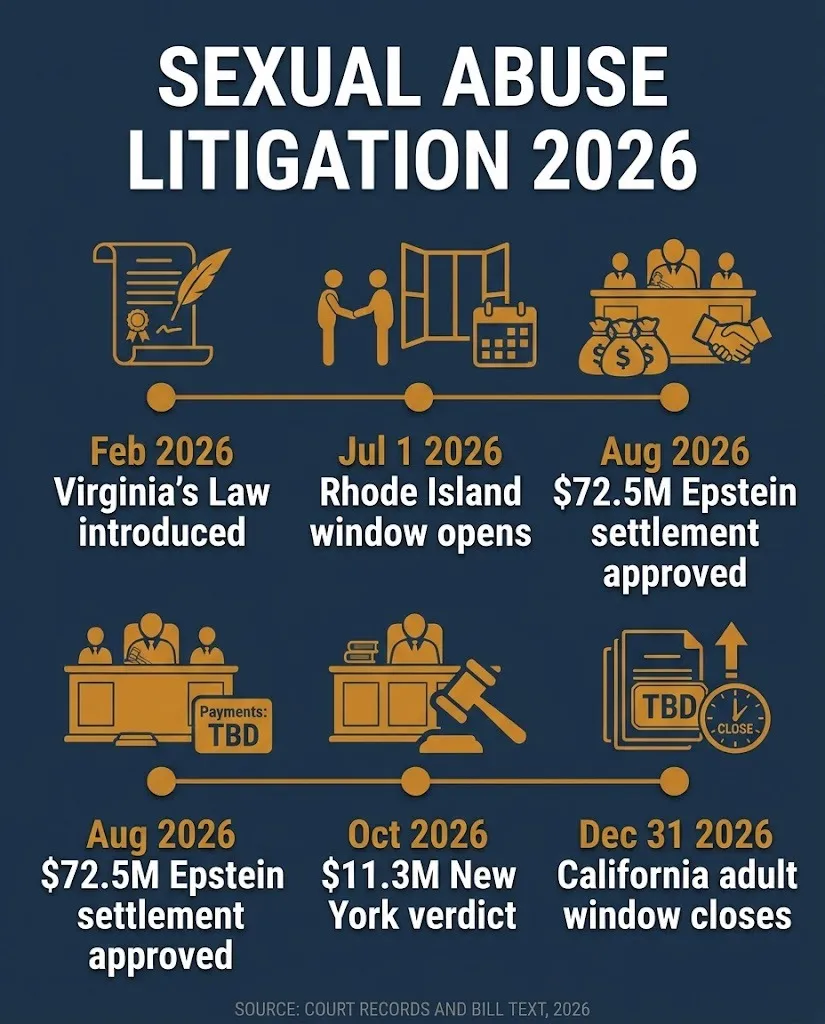
The timeline below covers the verified developments and the stages that matter for survivors considering a claim.
- February 2026: Senator Schumer introduces “Virginia’s Law” to eliminate federal time limits for adult survivors .
- March 2026: Jury orders Bill Cosby to pay $19.3 million in a California civil case .
- July 1, 2026: Rhode Island’s two-year revival window opens for childhood claims against institutions .
- August 2026: Bank of America’s $72.5 million Epstein survivor settlement receives final approval .
- October 2026: New York jury awards $11.3 million to a survivor abused in 1978 .
- December 31, 2026: One of California’s adult revival windows closes .
Frequently Asked Questions
Is there a national sexual abuse lawsuit settlement fund?
No. Sexual abuse lawsuits are individual civil claims filed in state or federal court. There is no universal fund or claim portal.
How long do you have to file a sexual abuse lawsuit?
The deadline depends on your state. Some states have no civil limit for childhood claims. California’s adult revival window closes December 31, 2026 .
Can you sue an institution for sexual abuse?
Yes, if you can show the institution knew or should have known about the abuse and failed to act. Negligent supervision and concealment are common theories.
How much does a sexual abuse lawsuit pay?
There is no standard amount. A 2026 New York jury awarded $11.3 million to one survivor, but settlements and verdicts vary widely .
Do you need a lawyer to file a sexual abuse lawsuit?
Not legally, but the evidence and procedural rules are complex. Most survivors use a lawyer, and many lawyers handle these cases on contingency.
What is a revival window?
A revival window is a limited period when claims that were previously time-barred can be filed. California and Rhode Island have open windows in 2026 .
Can you file a sexual abuse lawsuit years later?
Possibly. Several states, including Maryland, Nevada, Oregon, and Vermont, have retroactively abolished their deadlines for childhood claims .
Is there federal legislation changing sexual abuse lawsuit deadlines?
“Virginia’s Law” was introduced in February 2026 to eliminate federal time limits, but it has not passed .
Your Next Step
If you are considering a sexual abuse lawsuit, write down what you remember today. Dates, names, locations, and the impact on your life. Then find a lawyer in the state where the abuse happened and ask one question: is my claim still open? The answer depends on state law and the age you were, and in some states the window has closed while in others it never closes at all. The California adult revival window closes December 31, 2026, and that is the kind of deadline that ends claims for good.