Biggest Lawsuit Ever 2026: The $206 Billion Record, Rivals, and What Got Paid
Quick Answer
- The biggest lawsuit ever by dollars is the 1998 tobacco settlement, about $206 billion over 25 years.
- Payout: the 1998 deal paid states, not individuals. Roundup’s $7.25 billion class deal has no reported final approval.
- Deadline: none applies to the 1998 deal. Roundup’s opt-out period ran through June 4, 2026.
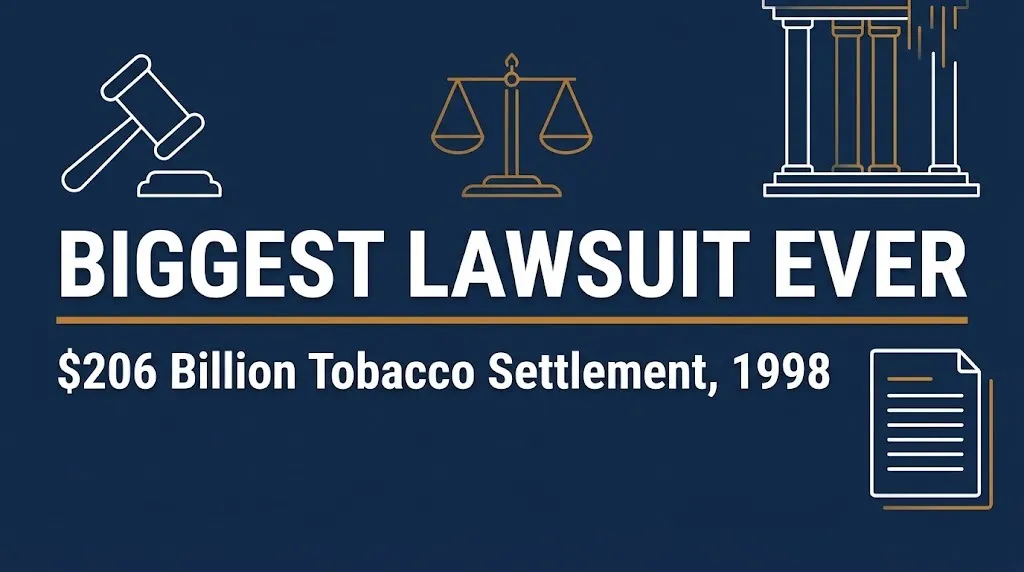
The biggest lawsuit ever, measured in dollars, is the 1998 Tobacco Master Settlement Agreement. It committed four tobacco companies to pay about $206 billion over 25 years.
No individual filed a claim for that money, because states collected it. Many other record headlines never reached injured people either.
This guide ranks the biggest settlements and verdicts, shows what was actually paid, and tracks 2026 updates. One surprise: the largest jury verdict we found, $150 billion, was never collectible.
The Facts
| Case | Tobacco Master Settlement Agreement (1998), the largest civil settlement by dollars |
| Status | Signed November 23, 1998; payments to states run annually, in perpetuity |
| Fund Size | About $206 billion estimated over the first 25 years |
| Est. Per Person | Not applicable. Paid to states, not individuals |
| Claim Deadline | None. No individual claim process exists for this deal |
| Administrator | National Association of Attorneys General coordinates for the states |
| Proof Needed | Not applicable |
What is the biggest lawsuit ever?
The biggest lawsuit ever by dollars is the 1998 tobacco settlement, about $206 billion.
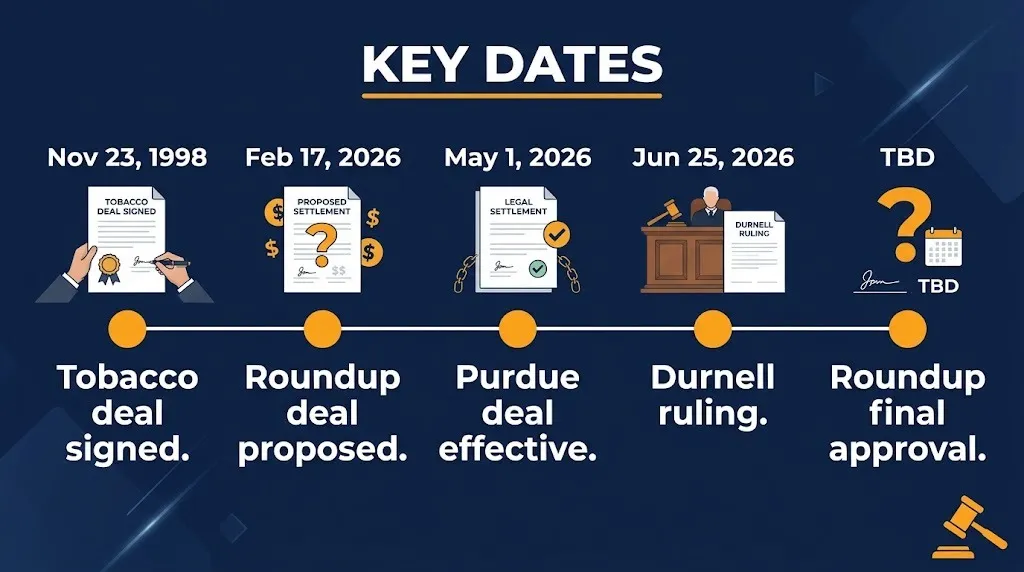
Attorneys general from 46 states signed the Tobacco Master Settlement Agreement on November 23, 1998. The District of Columbia, Puerto Rico, and the Virgin Islands signed too. Four cigarette makers agreed to pay: Philip Morris, R.J. Reynolds, Brown & Williamson, and Lorillard.
The money reimbursed states for past smoking-related costs, such as Medicaid spending. It wasn’t a payout to individual smokers.
Here’s the profile at a glance:
- Signed: November 23, 1998
- Headline amount: about $206 billion over the first 25 years
- Paid by: the four largest US cigarette makers
- Paid to: states and territories, with no claim process for individuals
- Catch: the $206 billion is an estimate, and a formula tied partly to cigarette sales moves the real total
Is the $206 billion tobacco deal really the largest lawsuit in history?
Yes, by settlement dollars, the tobacco deal is still the largest lawsuit in history.
The U.S. General Accounting Office (now the Government Accountability Office) called it the largest civil settlement in U.S. history in a 2001 report. A November 2025 news report still gives it that title. We found no larger settlement in any source we checked.
But “biggest” depends on the yardstick. Here’s how the records split:
| Yardstick | Record holder | Figure | Catch |
|---|---|---|---|
| Settlement dollars | Tobacco Master Settlement Agreement (1998) | About $206 billion | Paid to states over decades |
| Jury verdict | Middleton v. Collins (Texas, 2011) | $150 billion | Symbolic, never collectible |
| Verdict against companies | Engle v. Liggett Group (Florida, 2000) | $145 billion | Overturned in 2006 |
| Environmental settlement | BP Gulf oil spill (US government) | $20 billion | Penalties and cleanup funding |
| Securities class action | Enron (2008) | $7.2 billion | Paid to investors |
Pick the yardstick first. Then the answer is clear.
What is the biggest lawsuit verdict ever?
The biggest verdict we found is $150 billion, from a 2011 Texas wrongful death case.
A Fayette County jury awarded it to the family of Robbie Middleton. He was burned in a 1998 attack at age eight and died 12 years later. The defendant didn’t appear at the civil trial.
The family’s attorney acknowledged they would never collect. The verdict was meant as a moral statement.
The biggest verdict against companies was $145 billion in punitive damages in Engle v. Liggett Group. A Miami-Dade jury returned it in 2000 against major cigarette makers, including Philip Morris, R.J. Reynolds, and Lorillard.
The Florida Supreme Court overturned it in 2006 and decertified the class. It let individual smokers reuse the jury’s findings in their own suits.
Key Takeaway: The biggest lawsuit ever by dollars is the $206 billion tobacco deal, and the biggest verdicts on record were never paid.
How much did the biggest lawsuits actually pay out?
Record verdicts usually pay far less than the headline, because judges and appeals courts cut them.
Think of a car’s sticker price versus the out-the-door price. The jury announces the sticker. The appeals process sets the real one.
One law-firm compilation of court records found that nine of the 10 largest personal injury verdicts were reduced. Here are the biggest cuts:
| Case | Jury award | Reported outcome |
|---|---|---|
| Engle v. Liggett Group (2000) | $145 billion | Overturned by the Florida Supreme Court in 2006 |
| Bullock v. Philip Morris (2002) | $28 billion | Punitive damages cut to $28 million |
| Anderson v. General Motors (1999) | $4.9 billion | Cut to about $1.2 billion |
| Ingham v. Johnson & Johnson (2018) | $4.69 billion | Cut to $2.12 billion; Supreme Court declined review in 2021 |
| Pilliod v. Monsanto (2019) | $2.055 billion | Cut to $86.7 million |
| Ernst v. Merck (2005) | $253.4 million | Capped at $26.1 million, later overturned |
The pattern is plain. Punitive damages drive the headline numbers, and punitive damages draw the sharpest cuts.
Reality Check: You can’t claim a share of the $206 billion, because states collected it. Real claims are always free, so never pay a “claim helper.” Be wary of any text or site promising money from the “biggest lawsuit ever.”
What is the biggest personal injury lawsuit ever?
No official ranking exists, but mass torts hold the biggest personal injury numbers.
A mass tort is a wave of injury suits against one company. Courts often group them, and companies settle in bulk. These are the largest resolutions we could verify:
| Mass tort | Reported amount | Status |
|---|---|---|
| Purdue and Sackler opioid settlement | $7.4 billion | Took effect around April 30 to May 1, 2026; state-led |
| Roundup (Monsanto, Bayer) | Up to $7.25 billion over up to 21 years | Proposed February 17, 2026; no reported final approval |
| Vioxx (Merck) | $4.85 billion for about 27,000 suits | Resolved, per a law-firm compilation |
| Fen-phen diet drugs | $3.75 billion | Resolved |
| Breast implants (Dow Corning) | $3.2 billion, largest class settlement | Resolved |
Single plaintiffs see far smaller numbers. A 2026 tracker found the largest publicly reported individual personal injury settlement in the first quarter was $52 million. The top 10 totaled $177.2 million across six states.
What are the biggest lawsuit settlements in US history?
Lists we checked agree on the top three: tobacco, BP, and Volkswagen.
| Rank | Case | Headline amount | Who got paid |
|---|---|---|---|
| 1 | Tobacco Master Settlement Agreement (1998) | About $206 billion | States and territories |
| 2 | BP Gulf oil spill | $20 billion | US government penalties and cleanup |
| 3 | Volkswagen emissions | $14.7 billion | Buy-back program and cash payments |
| 4 | Purdue and Sackler opioids (2026) | $7.4 billion | States, communities, abatement programs |
| 5 | Roundup class deal (proposed) | Up to $7.25 billion | Claimants with non-Hodgkin lymphoma |
| 6 | Enron securities class action | $7.2 billion | Investors |
Two cautions apply. Roundup counts at its proposed cap, not a final number. Headline amounts also tend to pay out over many years.
A $7 billion deal paid over 15 years isn’t the same as $7 billion in cash today.
Key Takeaway: Headline numbers measure promises, not payments, so ask who gets paid, how fast, and whether a court has finalized it.
Can you join the biggest lawsuit ever and get paid?
No, you can’t claim money from the 1998 tobacco deal, because states received it. Roundup’s class deal is the live option, but final approval isn’t confirmed yet.
You may qualify if you allege Roundup exposure before February 17, 2026. A current non-Hodgkin lymphoma diagnosis counts. So does one made within 16 years after final approval.
Claims become payable only after the approval order turns final and non-appealable. Amounts depend on the court-approved claims program. Third-party estimates of $20,000 to $40,000 for home users are unofficial.
Follow these steps:
- Check that you allege Roundup exposure before February 17, 2026.
- Confirm a non-Hodgkin lymphoma diagnosis now, or one within 16 years after final approval.
- Note that the opt-out period ran through June 4, 2026.
- Wait for the court’s final approval ruling before expecting registration to open.
- Watch for notice from the court-appointed settlement administrator.
- Gather medical records and proof of product use.
- Ask a licensed attorney how the deal affects your own case.
- Never pay a fee to file.
How can you tell if a big lawsuit settlement is real?
A real settlement names a court, a case number, an administrator, and dates, and a fake one skips at least one.
Think of a store return. No receipt, no refund. In a settlement, the case number is the receipt.
Run through this checklist:
- Find the case name and case number in the notice.
- Confirm the case on the court’s own records.
- Look for a court order or a state attorney general release.
- Check that the administrator’s website matches the notice.
- Confirm deadlines appear in the court-approved notice.
- Type the administrator’s web address yourself instead of tapping a text message.
- Never share bank logins by text or email.
- Never pay a fee to file or “unlock” a claim.
Pressure phrases like “last chance” with no case number are red flags. Courts don’t rush you with pop-ups.
What is the latest on the largest lawsuits in 2026?
Four 2026 events matter most: Purdue’s deal, Roundup’s deal, Durnell, and a $1.1 billion verdict. Roundup’s final approval ruling isn’t confirmed in the coverage we found.
| Event | Date | Status |
|---|---|---|
| Purdue and Sackler $7.4 billion settlement | Around April 30 to May 1, 2026 | Took effect, per state attorneys general |
| Roundup $7.25 billion class deal | Proposed February 17, 2026; preliminary approval March 4, 2026 | Fairness hearing held September 14, 2026; no reported final ruling |
| Monsanto v. Durnell (Supreme Court) | June 25, 2026 | Decided 7-2 for Monsanto |
| Louisiana $1.1 billion verdict | June 12, 2026 | Post-trial status not confirmed |
The hearing was postponed twice before it happened. The administrator needed time to process people asking to reverse their opt-outs. Registration and claim filing stay closed until the court grants final approval.
Key Takeaway: In 2026, the biggest news is the Purdue money flowing and the Roundup deal waiting on a court ruling.
Did the Supreme Court change the Roundup lawsuits in 2026?
Yes, on June 25, 2026, the Supreme Court ruled 7-2 for Monsanto in Monsanto v. Durnell.
The Court held that federal pesticide law (FIFRA) blocks state failure-to-warn claims that demand a cancer warning the EPA hasn’t required. That reversed a $1.25 million verdict for Missouri farmer John Durnell. Justice Jackson dissented.
The ruling didn’t end the litigation. On July 13, 2026, Bayer asked the federal judge overseeing the Roundup MDL to dismiss nearly 4,000 pending suits. A Massachusetts federal judge said one Roundup case could still proceed.
Reports say many people who had opted out of the class deal asked to rejoin it afterward. That’s why the hearing slid to September 14. Outcomes now depend on how narrowly courts read the decision.
When will the Purdue and Sackler money be paid?
The Purdue and Sackler money is paid in installments, with the last scheduled Sackler payment in May 2029.
Think of a loan. The headline is the total, and the payment schedule is the monthly bill. State attorneys general listed these amounts:
| Payer | Amount | Timing |
|---|---|---|
| The Sacklers | More than $1.5 billion | When the plan took effect in 2026 |
| Purdue | About $900 million | When the plan took effect in 2026 |
| The Sacklers | About $500 million | May 2027 |
| The Sacklers | About $500 million | May 2028 |
| The Sacklers | About $400 million | May 2029 |
The full $7.4 billion is funded over 15 years. Pennsylvania said its share could start flowing as early as late 2026.
The Supreme Court rejected an earlier $6 billion version in June 2024. That’s how fragile giant deals can be.
What was the biggest lawsuit verdict of 2026?
The biggest 2026 verdict we found is $1.1 billion, returned June 12 in Bossier Parish, Louisiana.
Pamela Lockridge sued the estate of her late stepfather over childhood abuse that began in 1962. Louisiana’s lookback law reopened claims that had expired. The jury deliberated about two hours, according to local reporting.
Her attorney calls it the largest personal injury verdict for an individual plaintiff in Louisiana state court history. That’s the attorney’s description. Whether any of it can be collected isn’t confirmed.
Other 2026 verdicts reported by a personal injury newsletter:
- July 2026: a $104 million fatal trucking award
- August 2026: an $88 million Massachusetts defective hernia mesh verdict
Key Takeaway: A verdict is a first number, and 2026’s biggest ones still face post-trial rulings before anyone sees money.
Why do record lawsuit verdicts get cut or thrown out?
Record verdicts get cut because of constitutional limits, state caps, and judges’ power to reduce awards.
Three forces do most of the work:
- Due process limits: In State Farm v. Campbell (2003), the Supreme Court suggested punitive awards far above single-digit multiples of compensatory damages may be unconstitutional.
- State caps: Texas caps punitive damages at a formula of the greater of $200,000 or twice economic damages plus $750,000, per one compilation.
- Remittitur: Trial judges can shrink awards they find excessive, as happened in the General Motors case.
Jury awards keep climbing anyway. A Marathon Strategies report counted a record 135 verdicts above $10 million in 2024, with a median of $51 million. Verdicts above $100 million rose 81.5 percent from 2023 to 2024, per Risk & Insurance.
Who paid the tobacco settlement, and who got the money?
Four tobacco companies paid, and states, not individuals, received the money.
Philip Morris, R.J. Reynolds, Brown & Williamson, and Lorillard signed the 1998 deal. Forty-six states, the District of Columbia, Puerto Rico, and the Virgin Islands signed with them.
Four states had already settled on their own: Florida, Minnesota, Mississippi, and Texas. Congressional Research Service summaries put those separate deals at more than $40 billion over 25 years.
By April 2001, 45 of the 46 states had received nearly $13.5 billion, per the GAO. States could spend it on anything. Kentucky later reported more than $2.2 billion received, splitting funds across agriculture, early childhood, and public health programs.
The National Association of Attorneys General coordinates enforcement for the states.
Which mass tort lawsuits have the most plaintiffs?
Roundup has the largest active docket we found, with roughly 65,000 claims pending.
Reuters reported that figure when the class deal won preliminary approval in March 2026. A law-firm compilation says Bayer has faced more than 100,000 Roundup suits overall.
| Mass tort | Reported count | Note |
|---|---|---|
| Roundup | About 65,000 pending claims (March 2026) | More than 100,000 suits overall, per a compilation |
| Talc (Johnson & Johnson) | More than 38,000 suits | J&J ended North American talc baby powder sales in 2020 |
| Vioxx (Merck) | About 27,000 suits | Settled for $4.85 billion |
Counting plaintiffs is like counting a refund line. The line shortens as people get paid, so the number depends on the day you count.
Key Takeaway: Roundup is the biggest active mass tort we found, and its fate now rests on Missouri’s approval ruling.
What happens next with the biggest lawsuits?
Only a few dates are firm. Here’s the sequence we can verify, with “expected” where dates aren’t set:
Expected, date not confirmed: The Missouri court rules on final approval of the Roundup deal after the September 14, 2026 hearing.
As early as late 2026: Some states, including Pennsylvania, may begin receiving Purdue and Sackler funds.
May 2027: The Sacklers pay about $500 million.
May 2028: The Sacklers pay about $500 million more.
May 2029: The Sacklers make a final scheduled payment of about $400 million.
Frequently Asked Questions
What is the biggest lawsuit ever?
The biggest lawsuit ever by dollars is the 1998 Tobacco Master Settlement Agreement.
It committed four tobacco companies to pay about $206 billion over 25 years.
States received the money, not individuals.
What is the largest lawsuit settlement in history?
The largest settlement in history is the same tobacco deal, at about $206 billion.
BP’s $20 billion spill settlement and Volkswagen’s $14.7 billion emissions deal rank next in the lists we checked.
What is the largest jury verdict ever?
The largest verdict we found is $150 billion, from a 2011 Texas wrongful death case.
The family’s attorney acknowledged they would never collect.
The largest verdict against companies, $145 billion, was overturned in 2006.
What is the biggest personal injury lawsuit ever?
No official ranking exists, but mass torts hold the biggest numbers.
Purdue’s $7.4 billion opioid deal and Roundup’s proposed $7.25 billion deal lead the 2026 list.
Did anyone ever collect the $150 billion verdict?
No collection is reported.
The defendant didn’t appear at trial, and the family’s attorney said they’d never collect.
Can I get money from the tobacco settlement?
No, the 1998 deal paid states, not individuals.
No individual claim process or deadline exists.
Ignore any site charging a fee to “claim” it.
Is the $7.25 billion Roundup settlement final?
Not in the latest coverage we found.
The court held its fairness hearing September 14, 2026, and no final ruling was reported.
Check the settlement administrator’s official site for updates.
Before you act on any “biggest lawsuit” payout claim, find the case number and the official administrator site. Real claims are free, and real notices name a court.
For Roundup, watch the Missouri ruling. Whatever happens, one record stands: the tobacco deal, signed November 23, 1998, at about $206 billion.