Slip and Fall Settlement Calculator 2026: How the Math Works and What It Misses
Quick Answer
- Is it legit? Yes, as a rough starting point. The multiplier method (1.5x to 5x economic damages) is standard.
- How much? Minor injuries settle for $10,000 to $40,000; severe injuries can exceed $250,000.
- Key deadline: Most states give you two years to file, but government property claims can require notice in 90 days.
If you just fell on someone else’s property and you’re searching for a calculator, you’re trying to answer one question: what is this worth? The honest answer is that a calculator can give you a range, but it can’t tell you what your case will actually settle for. Insurance adjusters don’t plug numbers into a website and cut a check. They evaluate liability, medical documentation, and fault allocation, and those factors swing settlements by tens of thousands of dollars.
This guide breaks down how the multiplier method actually works, what verified settlement ranges look like by injury type, and where the calculators consistently get it wrong. The numbers are sourced, not invented, and the warnings are the ones that matter.
The Facts
| Item | Verified Detail |
|---|---|
| Common Settlement Range | $10,000 to $80,000 for typical cases |
| Median Settlement | Approximately $26,000 |
| Multiplier Method | 1.5x to 5x economic damages |
| Per Diem Method | Daily rate (e.g., $150/day) times recovery days |
| Key Legal Hurdle | Proving the property owner had notice of the hazard |
| Statute of Limitations | Typically 2 years; varies by state |
| Government Notice Deadline | Often 90 to 180 days |
Is the slip and fall settlement calculator real or a scam?
A slip and fall settlement calculator is real as a mathematical tool, but it’s not a prediction. The calculator applies a formula, usually the multiplier method, to your economic damages. It doesn’t know whether the property owner had notice of the hazard, whether you were partially at fault, or whether the insurance policy is large enough to cover the estimate.

The scam risk comes from websites that use “free calculator” tools to collect your phone number and sell it to law firms. That’s not a settlement calculator. That’s a lead generation form wearing a calculator costume. A legitimate calculator either runs locally on your device or shows you the formula without demanding contact information .
The other risk is treating the calculator’s output as a floor. A calculator might tell you your case is worth $80,000. The insurer might offer $12,000. The gap isn’t a math error. It’s the difference between a formula and a negotiation.
How does a slip and fall settlement calculator work?
A slip and fall settlement calculator works by adding your economic damages (medical bills and lost wages), then multiplying that total by a severity factor to estimate pain and suffering. The formula is simple, but the inputs are where cases get won and lost.
Here’s the basic structure:
| Step | What You Enter | What the Calculator Does |
|---|---|---|
| 1 | Medical bills (past and future) | Sums economic damages |
| 2 | Lost wages | Adds to economic damages |
| 3 | Injury severity (minor to catastrophic) | Applies multiplier (1.5x to 5x) |
| 4 | Fault percentage (if any) | Reduces total by your share |
| 5 | Attorney fee percentage | Subtracts contingency fee |
The multiplier method is the most common approach. For a moderate injury with $20,000 in medical bills and lost wages, a 2.5 multiplier produces a $50,000 estimate for pain and suffering, on top of the $20,000 economic damages .
The per diem method assigns a daily dollar value to your pain, such as $150 per day, and multiplies it by the number of days you suffered . That method tends to work better for shorter recovery periods with clear endpoints.
Key Takeaway: The calculator’s formula is simple, but the multiplier you choose and the fault percentage applied can swing the estimate by hundreds of thousands of dollars.
How much is a slip and fall settlement worth in 2026?
A slip and fall settlement in 2026 typically ranges from $10,000 to $80,000, with a median around $26,000 . Severe injuries involving surgery, permanent impairment, or traumatic brain injury push settlements well above that range.
The spread is enormous because the cases are not comparable. A bruised tailbone and a fractured hip are both “slip and fall” cases, but they belong in different financial universes.
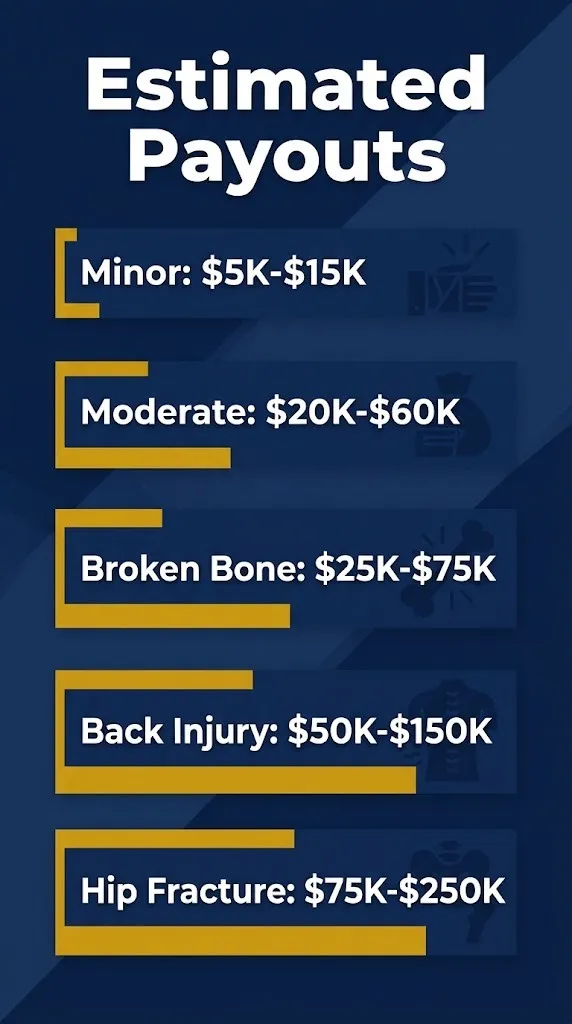
Here’s how verified 2026 ranges break down by injury type:
| Injury Type | Settlement Range | Typical Multiplier |
|---|---|---|
| Bruises, minor sprains | $5,000 to $15,000 | 1.5x to 2x |
| Torn ligaments (ACL, MCL) | $20,000 to $60,000 | 2.5x to 3.5x |
| Broken wrist or ankle | $25,000 to $75,000 | 2.5x to 3.5x |
| Back or spinal disc injury | $50,000 to $150,000 | 3x to 4.5x |
| Hip fracture | $75,000 to $250,000 | 3.5x to 5x |
| Traumatic brain injury | $150,000 to $1,000,000+ | 4x to 8x |
| Spinal cord injury | $300,000 to $2,000,000+ | 5x to 10x+ |
Not yet determined is the honest answer for any individual case before the medical records and liability evidence are reviewed. A calculator that spits out a number without those inputs is guessing.
What does the calculator miss about your slip and fall case?
The calculator misses the two factors that decide most slip and fall cases: liability strength and your own fault percentage. It also can’t see the insurance policy limit, which often caps the recovery regardless of what the damages are worth.
Liability in a slip and fall case hinges on notice. You have to show the property owner knew or should have known about the hazard and failed to fix or warn about it . A spill that happened five minutes before your fall is a weak case. A spill that sat for two hours with employees walking past it is a strong one. The calculator doesn’t know the difference.
Your fault percentage matters just as much. In pure comparative fault states like California and New York, your recovery is reduced by your share of fault, even if you were mostly responsible . In contributory negligence states (Alabama, Maryland, North Carolina, Virginia, and DC), even 1% fault can bar recovery entirely . A calculator that ignores fault allocation is giving you a number that may not exist.
Insurance limits are the third blind spot. If the at-fault party has a $50,000 policy and your damages are $200,000, the calculator’s estimate is fantasy unless there’s additional coverage available .
Who may qualify for a slip and fall settlement?
You may qualify for a slip and fall settlement if you were injured on someone else’s property because of a hazardous condition they knew about or should have known about, and you were not primarily at fault under your state’s rules. The property owner’s duty depends on your legal status on the property.
Here’s how duty breaks down:
| Visitor Status | Duty Owed | Typical Example |
|---|---|---|
| Invitee | Highest duty: inspect, repair, warn | Customer in a store |
| Licensee | Warn of known hazards | Social guest |
| Trespasser | Minimal duty, no willful harm | Uninvited entrant |
Most slip and fall cases involve invitees, which means the property owner had a duty to inspect for hazards and fix them. If you were a customer in a grocery store and slipped on a wet floor with no warning sign, you were likely an invitee owed the highest duty.
The evidence matters more than the label. Photos of the hazard, surveillance video, incident reports, and witness statements are what prove the owner knew or should have known . Without that evidence, even a clear injury may not support a claim.
Key Takeaway: Notice and fault allocation decide slip and fall cases, and the calculator can’t measure either one.
Reality Check: No one texts you settlement money after a slip and fall. Filing a claim is free, and legitimate personal injury lawyers work on contingency, meaning they get paid from the settlement, not upfront. If someone asks for a fee to “process” your calculator estimate or “guarantee” a payout, it is not how this system works.
What is the deadline to file a slip and fall claim?
The deadline to file a slip and fall claim is typically two years from the date of injury in most states, but government property claims and minor-injury cases follow different rules. Missing the deadline can bar your claim entirely.
Here are verified state deadlines:
| State | General Deadline | Government Notice Deadline |
|---|---|---|
| California | 2 years | Often 6 months or shorter |
| New York | 3 years | 90 days for NYC |
| Florida | 2 years | Varies by entity |
| Texas | 2 years | Varies by entity |
| Illinois | 2 years | Varies by entity |
If you fell on government property (a city sidewalk, a public building, a school), the notice deadline is often 90 to 180 days, which is much shorter than the lawsuit deadline . Missing the notice deadline usually kills the claim even if the two-year window is still open.
Minors injured in a slip and fall may have longer to file under state tolling rules, but the rules vary . Don’t assume the clock starts at 18 in every state.
How do you use a slip and fall settlement calculator correctly?
You use a slip and fall settlement calculator correctly by treating it as a starting point, not an answer. The calculator’s output is a range, and the real settlement depends on liability evidence, fault allocation, and policy limits.
Here are the steps to use it well:
- Gather all medical bills from the date of injury through the present.
- Document lost wages with pay stubs or employer statements.
- Enter only verified expenses, not estimates you haven’t confirmed.
- Choose a conservative multiplier based on documented severity, not hope.
- Apply your state’s fault rule if you share any responsibility.
- Compare the estimate to policy limits before relying on it.
The calculator works best as a negotiation tool. If you know the formula the insurer uses, you can spot when an offer is low. But the calculator doesn’t replace the evidence that proves liability, and it doesn’t know what a jury would do.
What happens next after you get a calculator estimate?
After you get a calculator estimate, the next steps depend on whether you’re negotiating with an insurer or preparing to file a lawsuit. Most cases settle before trial, but the evidence you preserve early determines what’s possible later.
Here’s the expected sequence:
- Immediately: Document the scene, get photos, and request surveillance preservation in writing .
- Days 1 to 30: File an incident report and seek medical treatment to create a record.
- Weeks 1 to 8: Gather medical bills, wage loss proof, and witness statements.
- Months 2 to 6: Submit a demand package to the insurer and negotiate.
- If no settlement: File a lawsuit before the statute of limitations expires.
Surveillance footage is often overwritten in 24 to 72 hours, so requesting preservation immediately is critical . That single step can be the difference between a strong notice argument and a case that depends only on your memory.
Frequently Asked Questions
How accurate is a slip and fall settlement calculator?
It’s a rough estimate, not a prediction. The calculator misses liability strength, fault allocation, and policy limits, which are the factors that decide most settlements.
What is the average slip and fall settlement in 2026?
The median is around $26,000, with most cases settling between $10,000 and $80,000. Severe injuries with surgery or permanent impairment settle much higher.
What is the multiplier for pain and suffering in a slip and fall case?
Most calculators use a multiplier between 1.5x and 5x, applied to medical bills and lost wages. Higher multipliers are reserved for severe, permanent injuries .
Can I use a calculator if I was partially at fault?
Yes, but the calculator should reduce your estimate by your fault percentage. In contributory negligence states, any fault can bar recovery entirely.
What evidence do I need to prove a slip and fall claim?
Photos of the hazard, surveillance video, incident reports, witness statements, and maintenance logs showing how long the hazard existed .
How long do I have to file a slip and fall lawsuit?
Most states give two years, but government property claims often require notice within 90 to 180 days. Check your state’s rule immediately.
Does the calculator account for future medical costs?
A good calculator lets you enter future medical expenses, but you need a doctor’s projection to support them. Without documentation, the insurer won’t include future costs in an offer.
What You Should Do Now
Document the hazard before it disappears. Photos, the incident report, and a written request to preserve surveillance footage are the evidence that turns a calculator estimate into a real claim.
Then check your state’s deadline. Two years sounds like a long time until you realize the government notice window may be 90 days. The calculator gives you a number. The deadline decides whether you can use it.