ACH Settlement Time in 2026: How Long Transfers Really Take and Why Your Money Is Late
Quick Answer
- Is it legit? Yes. ACH is the real bank transfer network governed by Nacha and the Federal Reserve.
- How much? There is no payout. ACH settlement time is a banking speed question, not a lawsuit or compensation fund.
- Key deadline? Same Day ACH cutoffs are 10:30 a.m., 2:45 p.m., and 4:45 p.m. ET on business days .
“ACH settlement time” is not a legal claim. It is a banking question. But the confusion is understandable. The word “settlement” appears in both lawsuit payouts and bank transfers. If you searched this term hoping for claim money, you are in the wrong place.
What you will find here is the verified answer to a different question: how long does an ACH transfer actually take in 2026, and why does your paycheck or refund sometimes arrive late? The short answer is that standard ACH takes one to two business days to settle. Same Day ACH takes hours. The gap between those two speeds is where most consumer frustration lives.
This guide breaks down the Federal Reserve’s published processing windows, the 2026 rule changes that affect timing, and the real reasons transfers get delayed.
The Facts
| Item | Detail |
|---|---|
| Network | Automated Clearing House (ACH), governed by Nacha and the Federal Reserve |
| Standard Settlement | 1 to 2 business days |
| Same Day Settlement | Within hours, three daily windows |
| Latest Same Day Cutoff | 4:45 p.m. ET for 6:00 p.m. ET settlement |
| Weekend Processing | None. ACH runs on business days only. |
| Claim Deadline | Not applicable (banking process, not a legal claim) |
| Administrator | Federal Reserve Banks and Nacha |
Is ACH settlement time a real legal claim or just a banking term?
ACH settlement time is a banking term, not a legal claim. The Automated Clearing House is the electronic network U.S. banks use to move money for payroll, bill payments, tax refunds, and direct deposits. It has nothing to do with lawsuits, settlements, or compensation funds.
The confusion comes from the word “settlement.” In law, a settlement is an agreement that ends a dispute with a payment. In banking, settlement is the moment funds actually move between financial institutions. Same word, completely different worlds.
If you received a text or email promising “ACH settlement compensation,” delete it. No such program exists. The only real ACH deadlines are the Federal Reserve’s daily processing cutoffs.
How long does a standard ACH transfer take to settle?
A standard ACH transfer usually settles in one to two business days. Most people see the money post to their account within one to three business days of initiating the transfer, depending on their bank’s internal posting schedule .
The Federal Reserve’s FedACH schedule shows that standard entries submitted before the daily cutoff settle on the next business day at 8:30 a.m. ET. Entries submitted later roll to the following business day. That is the network’s design. ACH batches transactions and settles them in scheduled cycles, not in real time.
Think of it like a tax refund that says “allow 21 days.” The IRS could deposit it faster, but the system is built around batches and review windows. ACH works the same way. The money is not lost. It is queued.
How fast is Same Day ACH and what are the cutoff times?
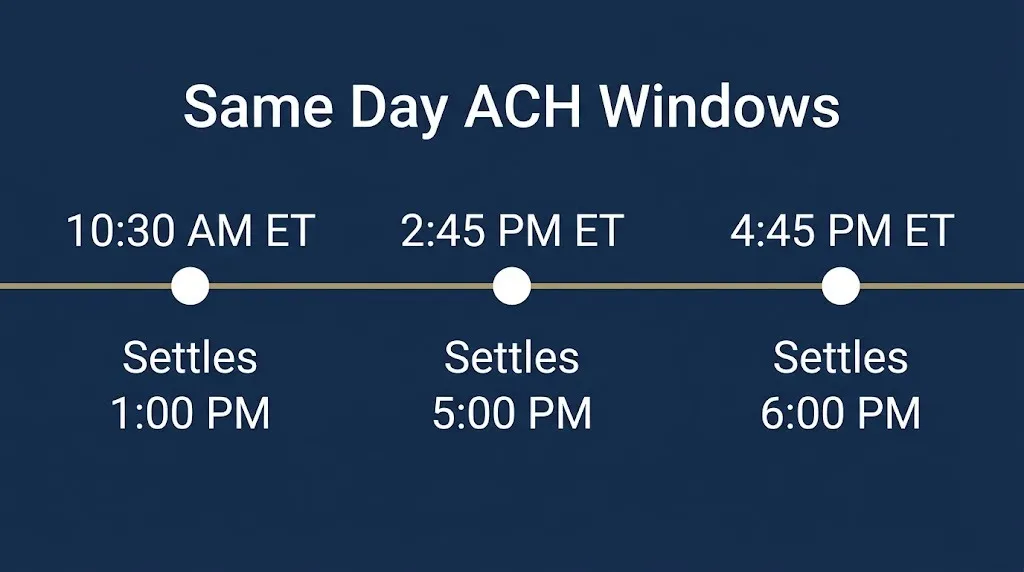
Same Day ACH settles within hours if you hit one of three daily processing windows. The Federal Reserve publishes the exact deadlines, and missing one by a few minutes pushes your transfer to the next day .
Here are the verified Same Day ACH windows for 2026:
| Window | ODFI Deadline (ET) | Settlement Time (ET) |
|---|---|---|
| First | 10:30 a.m. | 1:00 p.m. |
| Second | 2:45 p.m. | 5:00 p.m. |
| Third | 4:45 p.m. | 6:00 p.m. |
Your bank may set an earlier internal cutoff than the Federal Reserve’s deadline. Most banks publish cutoffs between 2:00 p.m. and 5:00 p.m. local time . If you submit at 4:40 p.m. ET but your bank’s cutoff was 3:00 p.m., you miss the window.
Same Day ACH volume reached 1.4 billion payments in 2025, up 16.7 percent from 2024, according to Nacha data cited by MoneyLion . The network is getting faster because more people are paying for speed.
Who may qualify for Same Day ACH processing?
You may qualify for Same Day ACH if your bank offers it and your payment meets the network’s rules. Most consumer and business payments under the current per-transaction cap are eligible. The cap is $1 million for Same Day ACH as of 2026, and it rises to $10 million in September 2027 .
- You use a bank or credit union that participates in Same Day ACH. Most major banks do.
- You submit before your bank’s Same Day cutoff. The network deadline is later than most bank deadlines.
- Your payment is under the cap. The current limit is $1 million per entry.
- The receiving bank can accept Same Day entries. Nearly all do, but verify with small institutions.
Reality Check: No one texts you “ACH settlement money.” There is no compensation fund. Filing nothing is required. Anyone charging a fee to “expedite” your ACH settlement is not legitimate. Your bank controls the speed.
How do you track an ACH transfer that has not settled?
You track an ACH transfer that has not settled by checking your bank’s pending transactions and confirming the transfer was submitted before the cutoff. There is no public ACH tracking number like a package. The network is invisible to consumers.
- Check your bank app for pending activity. Pending ACH entries often show before settlement.
- Confirm the sender submitted before cutoff. A payment sent at 5:01 p.m. ET waits until the next business day.
- Ask the sender for the trace number. Your bank can use it to locate the entry in the ACH system.
- Wait one full business day past the expected settlement date. Bank posting delays are common.
- Call your bank if nothing appears after three business days. A return or rejection may have occurred.
Why is my ACH transfer taking so long in 2026?
Your ACH transfer is taking longer than expected because of a missed cutoff, a weekend or holiday, a bank hold, or a 2026 rule change affecting funds availability. The network itself is not broken. The delays happen at the edges.
The most common cause is timing. A Friday afternoon transfer and a Monday morning transfer often settle on the same day because the weekend blocks processing . Federal Reserve holidays also stop ACH entirely. The Fed’s 2026 holiday schedule lists every date when processing pauses .
Bank holds are the second cause. First-time recipients, large amounts, or unusual activity can trigger fraud review. The receiving bank may hold funds even after settlement. That is a bank policy, not an ACH rule.
Key Takeaway: Standard ACH takes one to two business days, Same Day ACH takes hours, and most delays come from missed cutoffs or bank holds, not the network itself.
What changed in ACH rules for 2026?
ACH rules changed in 2026 in three ways that affect timing and fraud protection. Nacha’s annual rulebook updates took effect on specific dates, and two of them touch settlement speed directly.
The first change was fraud monitoring, phased in during March and June 2026. Originators and receiving banks must now run risk-based monitoring on ACH entries. That added review can slow some payments, especially first-time transfers .
The second change was standard entry descriptions, effective March 20, 2026. Originators must use clear labels like “PURCHASE” or “PAYROLL,” which makes ACH lines easier to recognize on statements .
The third change affects funds availability for standard credits. Nacha amended the rules effective September 18, 2026, so check with your bank on when incoming payroll or payouts become usable. The network floor still requires credits by 9:00 a.m. on settlement date, but exceptions exist .
What happens next for ACH settlement speeds?
ACH settlement speeds will not change dramatically in the near term. The Federal Reserve has proposed a fourth daily Same Day window for September 2026, but it was not confirmed as active as of October 2026 . The next major shift is the Same Day ACH cap rising to $10 million in September 2027 .
Ongoing: Nacha’s 2026 fraud monitoring rules remain in effect and may add review time to some transfers.
Expected September 2027: Same Day ACH per-transaction cap rises to $10 million, opening the door to larger same-day payments.
TBD: A fourth daily Same Day window. Proposed but not confirmed active.
TBD: Real-time payment adoption through FedNow and RTP. These networks run 24/7 but are separate from ACH.
Frequently Asked Questions
How long does an ACH transfer take?
A standard ACH transfer settles in one to two business days. Same Day ACH settles within hours if you meet the cutoff.
What time do ACH transfers post to my account?
Most banks post incoming ACH batches by 6:00 a.m. local time on the settlement date. Nacha rules require credits to be available by 9:00 a.m. at the latest .
Do ACH transfers go through on weekends?
No. The ACH network only settles on business days. Transfers initiated on Saturday or Sunday process on Monday .
What is the cutoff time for Same Day ACH?
The Federal Reserve’s latest cutoff is 4:45 p.m. ET for 6:00 p.m. ET settlement. Your bank may set an earlier internal deadline .
Can I cancel an ACH transfer after I send it?
You can request a cancellation, but the network does not guarantee it. If the entry has already settled, you need the recipient to return the funds.
Why is my direct deposit late?
Your direct deposit is late because the sender missed a cutoff, a weekend or holiday delayed processing, or your bank placed a hold. Check with your employer or payer first.
Is Same Day ACH the same as instant transfer?
No. Same Day ACH settles in hours, but it is not instant. Real-time networks like FedNow and RTP settle in seconds, but they are separate from ACH.