AG1 Lawsuit 2026: Subscription Scam Claims, Payout Status, and What You Need to Know
Quick Answer
- Is it legit? Yes, a real class action was filed against AG1 in February 2026 over hidden subscription renewals.
- How much? Not yet determined. No settlement exists, so no payout amounts are set.
- Key deadline? None yet. The case is still in early litigation, not the claims stage.
The AG1 lawsuit is a pending class action that accuses Athletic Greens of secretly enrolling customers in expensive monthly subscriptions, then making it nearly impossible to cancel. The case was filed on February 3, 2026, in the U.S. District Court for the Central District of California. No money is available right now, and no claim form exists yet.
If you bought AG1 expecting a one-time purchase and got charged again and again, you are exactly who this case is about. The lead plaintiff says he paid $169 per month without realizing he had signed up for a subscription. That is the core allegation: AG1 took money people never agreed to spend.
This article breaks down what the lawsuit actually claims, who it covers, what the court record shows versus what AG1 says publicly, and what you should do with your receipts right now. One detail that surprises most readers: the complaint does not just accuse AG1 of confusing billing. It accuses the company of using deliberate website design tricks called “dark patterns” to trap people in subscriptions they never wanted.
The Facts
| Case | Hoke v. AG1 (USA), Inc. |
|---|---|
| Status | Pending, filed February 3, 2026 |
| Fund Size | Not yet confirmed |
| Est. Per Person | Not yet determined |
| Claim Deadline | TBD, watch official court notices |
| Administrator | Not yet appointed |
| Proof Needed | Check complaint details; no claims process exists |
Is the AG1 lawsuit real or a scam?
The AG1 lawsuit is real. A class action complaint was filed against AG1 (USA), Inc. on February 3, 2026, in the Central District of California. The case number is 2:26-cv-01110, and the plaintiff is Samuel Hoke, a Los Angeles resident who bought AG1 products in March 2025.
This is a lawsuit, not a settlement. That distinction matters. A lawsuit means someone filed a complaint and a judge will decide what happens next. A settlement means the company agreed to pay and a claims process opens. AG1 has not settled. There is no claims administrator, no settlement website, and no money set aside.
Scammers often piggyback on real lawsuits. If you see a text, email, or social media post promising AG1 settlement money right now, treat it as fake. The court docket shows the case is still in its early stages. No judge has approved any payout.
What is the AG1 lawsuit about?
The AG1 lawsuit claims AG1 violated California’s Automatic Renewal Law by enrolling customers in subscriptions without clear consent. The complaint says AG1 failed to disclose renewal terms “in a clear and conspicuous manner” and did not provide a simple way to cancel.
California’s Automatic Renewal Law requires companies to do three things before charging you recurring fees: show you the renewal terms clearly, get your affirmative consent, and give you an easy way to cancel. The AG1 complaint alleges the company did none of these properly.
The lawsuit describes AG1’s checkout flow as misleading. According to the complaint, the only reference to automatic renewal during checkout is a tiny “every 30 days” notation buried under a product on the order summary page. There is no checkbox to agree to subscription terms. There is no obvious disclosure that clicking the payment button enrolls you in recurring charges.
The complaint also alleges AG1 makes cancellation “exceedingly difficult and unnecessarily confusing.” The plaintiff says he tried to cancel after his second charge and accidentally enrolled in a bi-monthly subscription instead.
Who may qualify to be part of the AG1 class action?
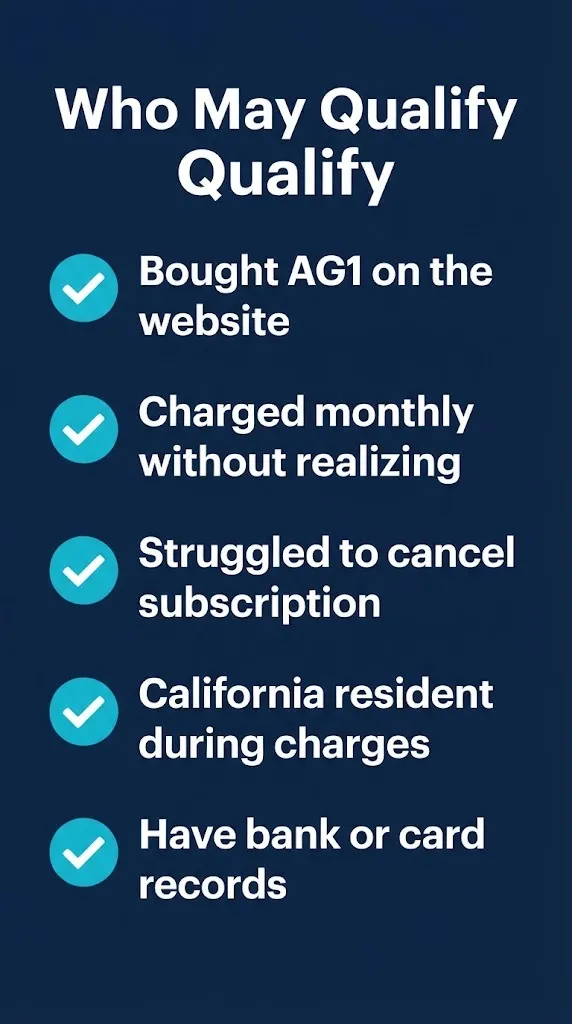
You may qualify to be part of the proposed class if you bought AG1 products on the AG1 website and were charged renewal fees without giving clear consent. The complaint seeks to cover all California residents who were charged an AG1 subscription renewal fee within the applicable statute of limitations period.
The class definition focuses on California because the lawsuit was filed under California law. If you live elsewhere and bought AG1 online, you might still be affected, but the current complaint is narrower. Class definitions often expand or change as cases move forward.
The key fact is your purchase method. If you bought AG1 through the website or a social media ad and got charged more than once without realizing you had agreed to a subscription, your experience matches the allegations. If you knowingly signed up for a subscription and simply forgot to cancel, that is a different situation.
Key Takeaway: No one can claim AG1 settlement money today because no settlement exists. The case is still fighting over whether AG1’s subscription practices broke the law.
How much could the AG1 lawsuit payout be?
There is no confirmed payout amount for the AG1 lawsuit. No settlement fund has been established, and the court has not approved any compensation figures. Any dollar amount you see online right now is speculation or a scam.
If the case settles later, the payout structure will depend on what AG1 agrees to pay. Common class action payouts for subscription violations often range from small refund amounts to larger sums if the evidence shows widespread harm. The complaint mentions damages under California’s Consumers Legal Remedies Act, which can include actual damages and potentially statutory damages.
The complaint alleges the class includes “at least millions of consumers.” If that estimate holds and the case settles, the total fund could be substantial. But that is a big “if.” Most class actions settle for less than plaintiffs initially demand, and many settle for injunctive relief (changing company practices) with modest cash payments.
Your best move right now is to document what you paid. Check your bank statements and credit card records for every AG1 charge. That history becomes your proof if a claims process opens.
How do you file a claim in the AG1 lawsuit?
You cannot file a claim in the AG1 lawsuit because no claims process exists yet. There is no settlement website, no claim form, and no administrator appointed. Any website asking for your information to “file an AG1 claim” is not legitimate.
Here is what the process will look like if the case settles:
- A judge approves a settlement agreement.
- A settlement administrator is appointed.
- A claims website goes live with a deadline.
- You submit proof of purchase or a claim form.
- The administrator reviews claims.
- Payments go out by check or digital transfer.
For now, the only action you can take is to preserve your records. Save those bank statements. Screenshot any AG1 emails. Do not delete anything related to your purchases.
Reality Check: Nobody texts you settlement money before a court approves a settlement. No legitimate administrator asks for a fee to file a claim. Filing is always free, and real notices come from court-approved sources, not random social media accounts.
What does AG1 say about the lawsuit?
AG1 has not issued a public statement addressing the specific allegations in the Hoke complaint. The company continues to market and sell its subscription products, and its website still presents AG1 as a wellness brand.
That silence is not unusual. Companies typically avoid commenting on pending litigation beyond boilerplate statements. But it means consumers have only one side of the story in the court record so far.
The complaint cites public research and news reports to support its claims, including a Washington Post article about subscription dark patterns. That outside sourcing strengthens the plaintiff’s argument that AG1’s practices are part of a broader industry problem, not a one-off mistake.
What are the key dates in the AG1 lawsuit?
The AG1 lawsuit has one confirmed date: the filing on February 3, 2026. Everything else is pending.
There is no final approval hearing scheduled. No opt-out deadline has been set. No trial date appears in the public docket yet. The case is in its earliest phase, which means motions and discovery will likely take months.
Here is what the timeline looks like:
- February 3, 2026: Complaint filed in C.D. Cal.
- 2026 (ongoing): AG1 responds, motions filed, class certification debated
- Expected 2027 or later: Possible class certification ruling
- Expected 2027–2028: Possible settlement talks or trial
- TBD: Claims process if settlement reached
Class actions move slowly. A subscription case filed in 2026 might not reach a resolution until 2028. If you are waiting for money, patience is required.
Key Takeaway: The AG1 lawsuit has no verified payout date and no claims deadline. Any site telling you otherwise is guessing or scamming.
What proof do you need to claim money if AG1 settles?
If AG1 settles and a claims process opens, you will likely need proof that you were charged for a subscription renewal without consent. That proof could include bank statements, credit card records, or email receipts showing recurring charges.
The complaint describes charges of $169 per month. If your statements show that pattern, keep them. Even without a formal claims process, those records are your evidence.
A receipt for a single purchase probably will not be enough to prove you were enrolled in a subscription without consent. The harm alleged in this case is recurring charges, not the initial sale. Focus on the renewal fees.
If you do not have records, check your email for order confirmations and shipping notifications. Check your bank’s online portal for transaction history. Most banks keep records for years.
What happens next in the AG1 lawsuit?
The next stage is AG1’s formal response to the complaint. The company must either answer the allegations or file a motion to dismiss. That response will shape how quickly the case moves.
If the judge denies a motion to dismiss, the case moves toward discovery. Discovery is the phase where both sides exchange documents and question witnesses. That is often when settlement talks begin.
- Expected late 2026: AG1 responds to complaint
- Expected 2027: Class certification briefing and hearing
- Expected 2027–2028: Settlement negotiations or trial preparation
- TBD: Final approval and claims process if settlement reached
You do not need to do anything during these stages. The plaintiff and his lawyers represent the class. Your role, if the class is certified, comes when the claims process opens.
Frequently Asked Questions
Is the AG1 lawsuit a class action?
Yes. The AG1 lawsuit is a proposed class action filed on behalf of all California residents who were charged AG1 subscription renewal fees without clear consent.
Has AG1 settled the lawsuit?
No. AG1 has not settled. The case is pending in federal court, and no settlement agreement has been announced or approved.
How much will I get from the AG1 lawsuit?
No payout amount has been determined. Without a settlement or judgment, there is nothing to distribute. Any figure you see online is not official.
Do I need a lawyer to join the AG1 lawsuit?
No. Class action members do not need their own lawyers. The plaintiff’s attorneys represent the class. If the case settles, you would file a claim through the court-appointed administrator.
What is the deadline to file an AG1 claim?
No claim deadline exists because no settlement has been reached. Deadlines are set only after a judge approves a settlement.
Can I sue AG1 on my own?
You could consult a consumer protection attorney about your individual situation. This article is not legal advice. An attorney can review your records and explain your options.
What is California’s Automatic Renewal Law?
California’s Automatic Renewal Law requires companies to clearly disclose subscription terms, get affirmative consent before charging, and provide an easy cancellation method. The AG1 lawsuit alleges the company violated all three requirements.
What should you do right now?
Save every record of your AG1 purchases. Bank statements, credit card bills, emails, screenshots of the checkout page if you have them. Those documents are your proof if a claims process opens.
Check the official court docket periodically for updates. The case number is 2:26-cv-01110 in the Central District of California. You can search for it through PACER or a free docket tracker.
The single most important fact to remember: the AG1 lawsuit has no payout and no deadline yet. If someone contacts you promising money, it is a scam. Wait for a court-approved notice before taking any action.