Compensation Consultant 2026: What They Do, What They Charge, and How to Avoid the Wrong Kind
Quick Answer
- A compensation consultant advises companies or individuals on pay structures, severance, and incentive plans.
- Executive compensation consulting firms serve corporate boards, while consumer-facing “consultants” often sell services individuals can do themselves.
- No license or certification is required in most states, so vetting matters more than the title.
You heard the title. Maybe someone offered you a payout review. Maybe you are looking for a career path. Maybe a firm promised to get you more money from a settlement or an employer.
Here is the direct answer: compensation consultant is a broad, mostly unregulated title. It covers everything from high-end executive pay advisors to one-person shops selling salary negotiation help. The term itself tells you almost nothing.
This article explains what compensation consultants actually do, what they charge in 2026, how executive compensation consulting works, and how to tell a real expert from a sales pitch.
The Facts
| Topic | Compensation Consultant |
| Status | Unregulated title in most states, no license required |
| Typical Fees | $150 to $500 per hour for individuals, $50,000 to $500,000 per engagement for corporate clients |
| Certification | Some hold Certified Compensation Professional (CCP), many do not |
| Governing Body | No single licensing body, SEC oversees executive compensation disclosure |
| Best For | Corporate boards, executives, and complex pay disputes |
| Worst For | Simple salary questions or settlement paperwork you can file yourself |
Is a compensation consultant a real profession?
Yes, but the title is not protected. Anyone can call themselves a compensation consultant in most states.
No state licensing board oversees compensation consultants the way a medical board oversees doctors. No government agency certifies them. The title is a marketing label, not a credential.
Some compensation consultants hold the Certified Compensation Professional designation from WorldatWork. That is a real certification with education and experience requirements. But many people using the title have no such credential.
The practical takeaway: verify credentials before you pay for advice.
What does a compensation consultant actually do?
A compensation consultant analyzes pay structures and advises on how much money should be paid in specific situations.
For companies, the work includes:
- Designing salary bands and bonus plans
- Benchmarking executive pay against peer companies
- Advising boards on incentive plan design
- Preparing compensation committee materials
- Reviewing severance and change-in-control agreements
For individuals, the work is narrower. A consultant may review a job offer, help negotiate a severance package, or calculate what a claim or settlement might be worth.
What is executive compensation consulting?
Executive compensation consulting is a specialized corporate service. It advises boards of directors on how to pay top executives.
The work is regulated indirectly through SEC disclosure rules. Public companies must disclose their compensation consultant relationships in proxy statements. The SEC requires boards to consider conflicts of interest.
Major executive compensation consulting firms include large HR advisory companies and specialized boutiques. Fees for a full engagement often run from $50,000 to $500,000 or more depending on company size.
Key Takeaway: Executive compensation consulting is a high-dollar corporate service with SEC oversight. It has almost nothing in common with consumer-facing salary advice.
What do compensation consulting companies charge in 2026?
Fees vary wildly depending on the client and the scope.
| Client Type | Typical Fee Range | What You Get |
|---|---|---|
| Individual salary review | $150 to $500 per hour | Job offer review, negotiation coaching |
| Severance package review | $500 to $2,500 flat fee | Analysis of severance terms and negotiation strategy |
| Small business pay structure | $5,000 to $25,000 | Salary bands, bonus plan design |
| Mid-size company engagement | $25,000 to $100,000 | Full compensation program review |
| Public company executive pay | $50,000 to $500,000 or more | Board-level compensation advisory |
The individual services are often the least regulated and the most variable in quality. The corporate services are expensive but usually delivered by credentialed professionals.
Do you need a compensation consultant for a lawsuit settlement?
Usually not. If you are trying to calculate what a lawsuit settlement might be worth, a compensation consultant is not the right professional.
You need a lawyer who handles your type of case. A personal injury attorney, an employment lawyer, or a consumer class action attorney can tell you what similar cases have paid.
Compensation consultants focus on pay structures and employment compensation, not lawsuit settlement valuation. The overlap is small. If someone selling “compensation consulting” promises to get you settlement money, walk away.
What is the difference between a compensation consultant and a lawyer?
A lawyer is licensed, regulated, and can represent you in court or negotiations. A compensation consultant is none of those things unless they hold a separate license.
Lawyers must follow state bar rules. They have a fiduciary duty to act in your interest. They can be disciplined for misconduct.
Compensation consultants have no such obligations. They can give advice, but they cannot represent you in a legal proceeding. They cannot file documents on your behalf. They cannot give legal advice.
Reality Check: No legitimate compensation consultant will promise you a specific settlement amount or claim they can get the court to pay you. That is lawyer work. If a consultant makes those promises, they are either practicing law without a license or running a scam.
How do you verify a compensation consultant’s credentials?
The title means nothing without verification. Here is how to check.
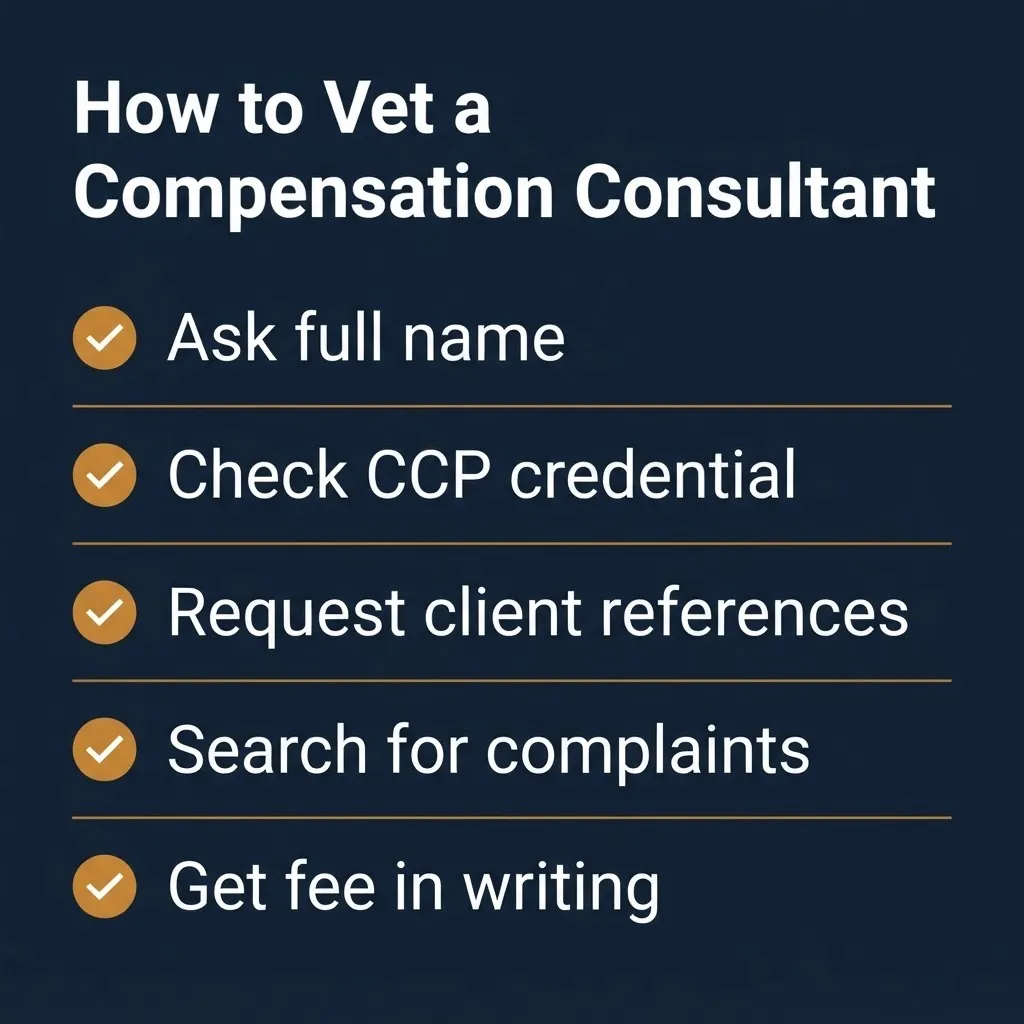
- Ask for the consultant’s full name and company name.
- Search for a Certified Compensation Professional credential through WorldatWork.
- Check LinkedIn and ask for client references.
- Search for any disciplinary actions, lawsuits, or complaints.
- Ask what specific experience they have with your type of situation.
- Get the fee in writing before any work begins.
A real consultant will answer these questions directly. A salesperson will deflect or pressure you to sign.
What should you do if someone calls themselves a compensation consultant and promises a settlement?
Treat it as a red flag. Settlement money comes from a court, a claims administrator, or a negotiated legal agreement. It does not come from a consultant.
Real settlements have official websites and court dockets. Claims are free to file. You never need to pay a third party to “release” settlement money to you.
If someone calls, texts, or emails promising compensation consulting services for a settlement, report it to the Federal Trade Commission and your state attorney general.
Key Takeaway: Any compensation consultant who promises settlement money is not a consultant. They are a lead generator or a scammer.
What certifications exist for compensation consultants?
The main certification is the Certified Compensation Professional, or CCP, from WorldatWork. It requires coursework and exams in compensation design, market pricing, and regulatory compliance.
Other relevant credentials include:
- Certified Executive Compensation Professional, a specialized CCP track
- SHRM Certified Professional for broader HR work
- Certified Employee Benefits Specialist from the International Foundation of Employee Benefit Plans
None of these are legally required. But they separate trained professionals from people who bought a website and a business card.
What is the job outlook for compensation consulting in 2026?
Demand for compensation consultants remains steady, driven by regulatory pressure on executive pay and the complexity of modern pay structures.
The SEC’s pay-versus-performance disclosure rules and proxy advisory firm guidelines keep compensation committees nervous. Boards hire consultants to stay compliant and defend their decisions.
For individual consultants, the market is more fragmented. Salary negotiation coaching, severance review, and job offer analysis remain the main services. Demand rises during economic uncertainty when layoffs increase.
What should you expect to pay for an individual compensation review?
For an individual review, expect to pay $150 to $500 per hour. Some consultants offer flat packages.
A job offer review might cost $300 to $800. A severance package analysis might run $500 to $2,500. These fees are usually not worth it for early-career jobs but can pay off for executive-level packages worth hundreds of thousands.
The comparison is like hiring a home inspector before buying a house. The fee is small relative to the value of what is at stake, but only if the consultant is actually qualified.
What happens next if you engage a compensation consultant?
The engagement follows a standard pattern.
| Timing | Expected Stage |
|---|---|
| Week 1 | Initial consultation and scope definition |
| Week 2 | Data gathering: pay history, job offers, or company data |
| Weeks 3 to 4 | Analysis and benchmarking |
| Week 5 | Recommendations and negotiation strategy |
| Ongoing | Support during negotiations or board review |
For corporate engagements, the timeline stretches to months. For individual work, it is usually weeks.
Frequently Asked Questions
Is compensation consultant a licensed profession?
No.
Most states do not require a license to call yourself a compensation consultant.
What does an executive compensation consultant do?
They advise corporate boards on executive pay packages.
The work is regulated indirectly through SEC disclosure rules.
How much does a compensation consultant charge?
Individuals pay $150 to $500 per hour.
Companies pay $50,000 to $500,000 or more per engagement.
Do I need a compensation consultant for my lawsuit?
Usually not.
You need a lawyer who handles your type of case, not a pay advisor.
What is the CCP certification?
It is the Certified Compensation Professional credential from WorldatWork.
It requires coursework and exams, but it is not legally required.
Can a compensation consultant negotiate my severance?
They can advise you, but they cannot represent you legally.
A lawyer can negotiate on your behalf and review legal terms.
How do I report a fake compensation consultant?
File a complaint with the Federal Trade Commission.
Report the person to your state attorney general if they promised settlement money.
The title compensation consultant is real, but unregulated. For corporate pay work, the field is professional and expensive. For individual salary questions, it is hit or miss.
If someone using this title promises you settlement money, stop. That is not consulting. That is a scam. For legal claims, hire a lawyer. For salary questions, verify credentials and get the fee in writing first.