Average Lemon Law Settlement in California 2026: Real Numbers, Ranges, and What You Actually Keep
Quick Answer
- California lemon law settlements are private negotiations under the Song-Beverly Act, not a class action fund with a fixed payout.
- Published ranges run $5,000 to $100,000, with a common average of $40,000 to $50,000 for qualifying vehicles .
- The deadline is generally four years from when the defect accrued, but some manufacturers now carry a one-year post-warranty limit .
If you searched for the average lemon law settlement in California, you are probably staring at a repair order that says “could not duplicate” for the third time. The number you find online will not match your case exactly, because lemon law settlements are not published by any court. They are private agreements between you and the manufacturer, and the amount depends on your car’s price, your miles, your repair history, and how hard your lawyer negotiates . The closest thing to a verified figure comes from lemon law firms that publish their own case ranges, and those ranges are wide for a reason.
What matters more than the average is what you actually keep. California’s Song-Beverly Act includes a fee-shifting provision, which means the manufacturer pays your attorney fees on a successful claim, not you . That changes the math entirely. A $40,000 settlement does not become a $28,000 settlement after a 30% contingency cut, because the fee comes from the manufacturer on top of your recovery.
This article breaks down the real ranges, the factors that move your number up or down, the deadline that can kill your claim, and the scam ads that promise amounts no lawyer can guarantee. One detail worth knowing up front: the mileage offset is the only deduction the manufacturer can legally take from a buyback refund, and it is calculated from the miles you drove before your first repair attempt, not your current odometer .
The Facts
| Item | What to Know |
|---|---|
| Case Type | Private Song-Beverly Act claim, not a class action |
| Typical Settlement Range | $5,000 to $100,000, with common average $40,000 to $50,000 |
| Attorney Fees | Paid by the manufacturer on a successful claim, not deducted from your recovery |
| Filing Deadline | Generally 4 years from accrual; some manufacturers now 1 year after warranty expires |
| Administrator | Not applicable, this is a direct claim against the manufacturer |
| Proof Needed | Repair orders, warranty documents, and records of each dealership visit |
Is the Average Lemon Law Settlement in California a Real Number or a Marketing Pitch?
The average lemon law settlement in California is a real but unofficial figure, compiled by law firms from their own case results, not published by any court or state agency. No government database tracks lemon law payouts. The California Department of Consumer Affairs handles arbitration certifications, not settlement reporting. That means every “average” you see comes from a law firm with an incentive to make its own results look strong .
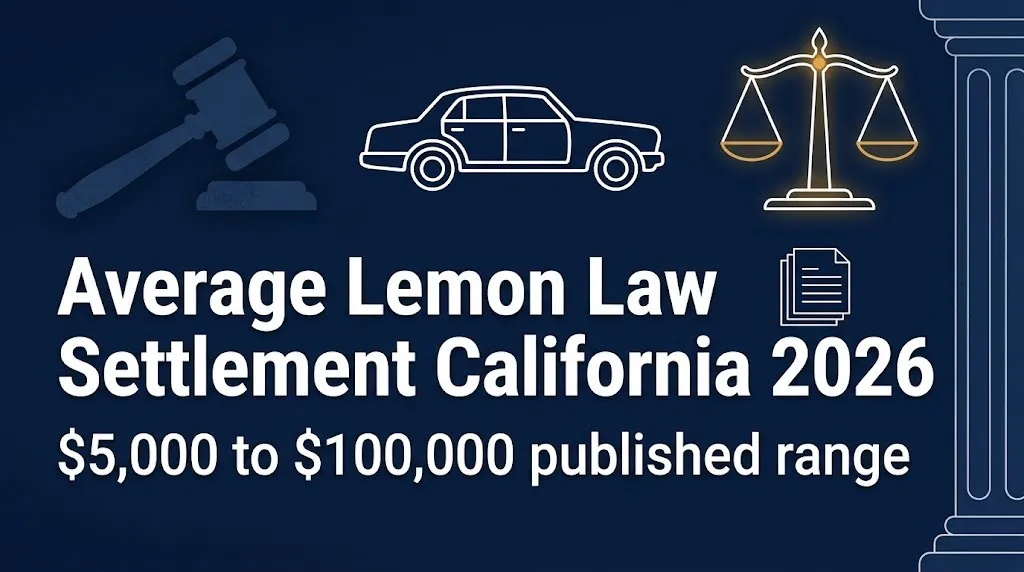
The most commonly cited range is $5,000 to $100,000, with a working average of $40,000 to $50,000 . Another source puts economy car payouts at $10,000 to $25,000 and luxury or EV payouts at $35,000 to over $240,000 . The gap between those two ranges is not a contradiction. It reflects different case mixes. A firm that handles mostly Honda Civics will report lower averages than a firm that handles Teslas and Range Rovers.
What you should not trust is any ad that promises a specific dollar amount before reviewing your documents. A real lemon law attorney will ask for your repair orders first.
Key Takeaway: The “average” is a firm-reported range, not a court figure, so use it as a benchmark, not a promise.
How Much Can You Actually Get From a California Lemon Law Claim?
You can get one of three remedies under California lemon law: a buyback refund, a replacement vehicle, or a cash settlement to keep the car. The buyback is the most common measure people mean when they ask about settlement amounts. It refunds your purchase price, taxes, registration, and finance charges, minus a mileage offset . A $45,000 vehicle with a $1,575 mileage offset returns $43,425 before add-backs, according to the statutory formula .
A cash-and-keep settlement pays you a lump sum and you keep the defective car. That number is negotiated, not formula-driven, and it is typically lower than a full buyback because the manufacturer avoids taking the vehicle back . The trade-off is speed and simplicity. You get cash faster, but you keep the problem.
| Remedy Type | How the Amount Is Set | Typical Range |
|---|---|---|
| Buyback (refund) | Purchase price minus mileage offset, plus taxes and fees | $35,000 to $60,000+ for mid-range vehicles |
| Replacement | Comparable vehicle of equal or greater value | Vehicle-dependent |
| Cash and keep | Negotiated lump sum, no vehicle return | $10,000 to $30,000 typical first offers |
Not yet determined for your specific case until an attorney reviews your repair history and calculates the mileage offset.
Who Qualifies for a California Lemon Law Settlement?
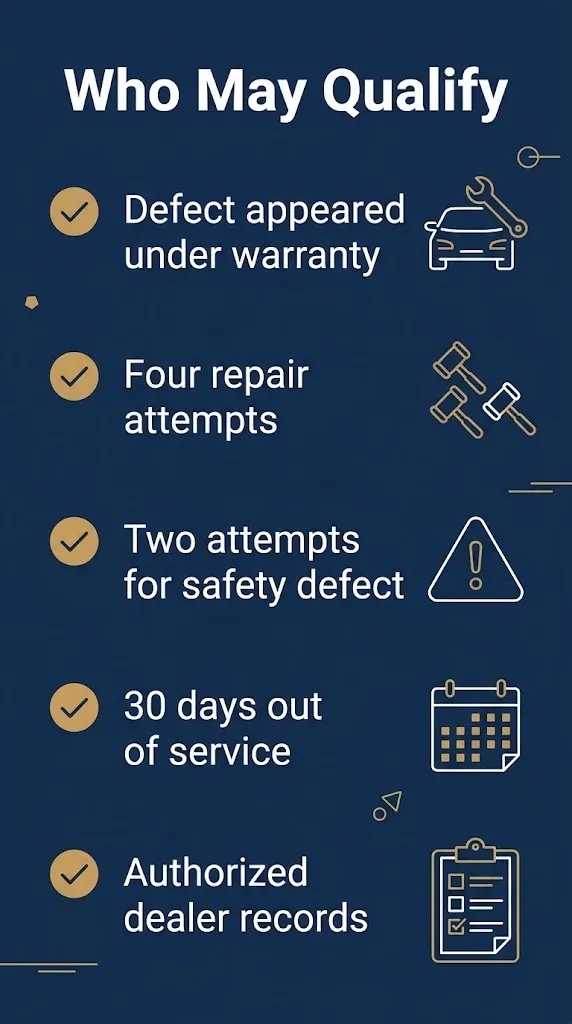
You may qualify for a California lemon law settlement if your vehicle had a substantial defect that manifested during the warranty period and the manufacturer could not fix it after a reasonable number of attempts. The threshold is usually four repair attempts for the same non-safety issue, or two attempts for a safety defect that could cause injury or death . The vehicle must also have been out of service for 30 days or more cumulatively for repairs.
Used cars can qualify if they are still under the manufacturer’s original warranty or a dealer warranty at the time the defect appeared . The defect must substantially impair the vehicle’s use, value, or safety. A squeaky dashboard does not qualify. A transmission that slips on the highway does.
Here is the practical checklist:
- The defect appeared while the vehicle was under warranty.
- You took it to an authorized dealer, not a general mechanic.
- The dealer had a reasonable number of chances to fix it.
- You have the repair orders showing each visit.
- The problem still exists or the car was out of service for 30+ days.
Reality Check: No one texts you a lemon law settlement offer. Manufacturers send formal letters or their lawyers call your lawyer. If a random number texts you a dollar figure and asks for your bank details, it is a scam. Real lemon law claims start with your repair records, not a payment link.
What Factors Change Your California Lemon Law Settlement Amount?
Five factors move your settlement number up or down, and you control some of them more than you think. The first is vehicle value. A $70,000 truck has more room to settle high than a $22,000 sedan, because the buyback formula starts with what you paid . The second is defect severity. Safety defects draw higher offers and can support civil penalties. The third is documentation. If your repair orders are complete and consistent, the manufacturer has less room to argue .
The fourth factor is mileage at first repair. That number sets your offset. If you brought the car in at 3,000 miles instead of 15,000, your refund is larger . The fifth is whether your lawyer pushes for civil penalties. Under Song-Beverly, a willful violation can support a penalty of up to two times your actual damages, and that leverage changes negotiation dynamics .
| Factor | How It Moves the Number | What You Can Do |
|---|---|---|
| Vehicle purchase price | Higher price, higher refund ceiling | Nothing now, it is set |
| Defect type | Safety defects support higher offers | Document symptoms clearly |
| Repair records | Complete records strengthen your position | Keep every repair order |
| Mileage at first repair | Lower miles, lower offset, higher refund | Act fast when symptoms appear |
| Civil penalty exposure | Can multiply recovery in strong cases | Ask your attorney about willfulness |
Key Takeaway: Your repair records and the mileage at your first dealership visit are the two numbers you can still influence, so protect them.
How Do You File a California Lemon Law Claim?
You file a California lemon law claim by sending a demand letter to the manufacturer and, if that fails, filing a lawsuit or going to arbitration. Since January 1, 2025, AB 1755 added a structured pre-litigation step for manufacturers that opted into the new process. Most major automakers, including Toyota, Ford, General Motors, Honda, BMW, Volkswagen, and Tesla, have opted in . For those manufacturers, you must send a written demand with your VIN and repair history, and the manufacturer has 30 days to respond with an offer .
Here are the steps:
- Gather every repair order from every dealership visit.
- Confirm your vehicle is still within the warranty or the defect appeared during warranty.
- Send a written demand letter to the manufacturer, or have your attorney send it.
- Wait for the manufacturer’s response, which is 30 days for opted-in manufacturers.
- If no acceptable offer comes, file a lawsuit or enter mediation.
- Attend mandatory mediation if the manufacturer opted into AB 1755, typically within 90 to 150 days of the answer .
- Settle or proceed to trial if mediation fails.
What Is the Deadline to File a California Lemon Law Claim?
The deadline to file a California lemon law claim is generally four years from the date your cause of action accrued, which is usually when the manufacturer had a reasonable number of repair attempts and failed to fix the defect . But a newer, shorter deadline applies to manufacturers that opted into AB 1755 and SB 26. For those manufacturers, you must file suit within one year after the express warranty expires, and never more than six years after the vehicle was originally delivered .
This is the most dangerous detail in California lemon law right now. The deadline now depends on which manufacturer built your car. A Toyota may follow the opted-in timeline. A smaller manufacturer that did not opt in may still follow the four-year rule. The California Department of Consumer Affairs publishes the opt-in list, updated each December 15 .
If you are anywhere near the one-year post-warranty mark, do not wait for the four-year window. Confirm your manufacturer’s status first.
How Long Does a California Lemon Law Settlement Take?
A California lemon law settlement typically takes 3 to 6 months for cases against opted-in manufacturers, and 6 to 18 months or longer for cases against manufacturers that did not opt in . The opted-in track moves faster because AB 1755 imposed deadlines: a 30-day response window, then mandatory mediation within 90 to 150 days of the manufacturer’s answer . Most cases settle at or before mediation.
The non-opted-in track looks more like ordinary civil litigation. There is no mandatory mediation deadline, and the case can sit in a court queue. The difference is like the gap between a tax refund filed electronically and one filed on paper with a missing form. One moves through a system with deadlines. The other waits.
Delays happen for avoidable reasons too. Using a general mechanic instead of an authorized dealer complicates your repair record. Skipping the pre-suit notice for an opted-in manufacturer forces a restart . Selling the car before the claim resolves can weaken your case.
What Happens Next
Immediate: Pull every repair order and confirm the dates and mileage of each dealership visit.
Within days: Check whether your manufacturer opted into AB 1755, because that decides whether you have one year or four years.
Within weeks: Send a demand letter or have an attorney send one; the clock on the 30-day response starts then.
Expected 3 to 6 months: Most opted-in cases settle at or before mediation.
Expected 6 to 18 months: Non-opted-in cases follow standard litigation timelines.
Frequently Asked Questions
What is the average lemon law settlement in California?
Published firm ranges put it at $5,000 to $100,000, with a common average of $40,000 to $50,000. No court publishes official averages because settlements are private .
Do I have to pay my lawyer out of the settlement?
No. Under Song-Beverly, the manufacturer pays your reasonable attorney fees on a successful claim, in addition to what you recover . The fee is not deducted from your check.
How many repair attempts do I need before I can file?
Generally four attempts for the same non-safety defect, or two attempts for a safety defect. A cumulative 30 days out of service also qualifies .
Can I file a lemon law claim for a used car in California?
Yes, if the used car was still under the manufacturer’s original warranty or a dealer warranty when the defect appeared . The same repair attempt thresholds apply.
What is the mileage offset and how much will it reduce my refund?
The offset is (purchase price times miles at first repair) divided by 120,000. A $45,000 car with 4,200 miles at first repair carries a $1,575 offset .
What happens if my warranty already expired?
You may still have a claim if the defect first appeared during the warranty period. The law focuses on when the problem manifested, not when you filed .
How long does a California lemon law case take?
Most opted-in manufacturer cases settle in 3 to 6 months. Non-opted-in cases can take 6 to 18 months or longer .