Current Class Action Settlements 2026: How to Find Real Cases, Check Deadlines, and File Claims
Quick Answer
- Class action settlements are real cases where consumers may file claims for small payouts.
- Deadlines vary by case, and missing a deadline means you get nothing.
- You can find legitimate settlements through court records and official settlement websites, not social media ads.
Class action settlements are happening right now. Real companies are paying real money into funds that real consumers can claim from.
But the landscape is scattered. Some settlements are in California, some in Illinois, some in federal courts. Each has its own deadline, its own administrator, and its own proof requirements.
The people who get paid are the ones who find the settlement, file the claim form, and meet the deadline. The people who get nothing are the ones who never knew the case existed.
This article explains how class actions work, how to find current settlements, how to check if a notice is real, and what to expect when you file.
The Facts
| Item | Details |
|---|---|
| Legal Area | Class action litigation |
| Payout Range | Typically $5 to $500 per person |
| Claim Deadline | Varies by case |
| Filing Cost | Free |
| Proof Requirements | Usually purchase receipts or basic info |
| 2026 Law Change | None confirmed federally |
What Are Current Class Action Settlements?
Current class action settlements are cases where a court has approved a settlement fund and class members can file claims.
The settlement fund is the money the defendant agreed to pay. The claims administrator divides that money among everyone who files a valid claim.
Here is how a settlement reaches the claim stage:
| Stage | What Happens |
|---|---|
| Class action filed | Lawsuit begins |
| Settlement reached | Parties agree on a fund |
| Preliminary approval | Judge signs off tentatively |
| Notice sent | Administrator contacts class members |
| Claim period | Class members file claims |
| Final approval | Judge approves the settlement |
| Payment | Checks or electronic payments issued |
How Do I Find Class Action Lawsuits in California?
California has more class action settlements than any other state. The best sources are official settlement websites and court records.
You can also search the California courts’ online case system. But the easiest path is to look for settlement notices from administrators.
Here are the best ways to find California settlements:
- Search official settlement websites by product or company name.
- Check the California courts’ case lookup system.
- Review legal news sites that track active settlements.
- Watch your mail and email for legitimate notices.
- Avoid third-party “claim finder” sites that charge fees.
What Class Action Suits Can I Join Right Now?
You can join any class action settlement where you meet the class definition and the claim deadline has not passed.
You do not “join” in the traditional sense. If you fall within the class definition, you are automatically a member unless you opt out. To get paid, you must file a claim form.
Here is what to check before filing:
| Question | Why It Matters |
|---|---|
| Am I in the class? | You must meet the definition |
| Is the deadline open? | Late claims are usually rejected |
| What proof is needed? | Receipts or basic info |
| Is there a fee? | Real claims are free |
What Is the Illinois Class Action Lawsuit List?
Illinois has its own set of active class action settlements, filed in both state and federal courts.
The Northern District of Illinois is one of the busiest federal courts for class actions. Many consumer, privacy, and employment cases settle there.
To find Illinois cases, check the federal PACER system or the Illinois state court website. Settlement notices name the specific court.
Is There a Class Action Lawsuit I Qualify For?
You may qualify for a class action if you bought a product, used a service, or had your data exposed in a way that matches an active settlement.
The class definition is the key. It describes exactly who is included. Read it carefully before filing.
Here are common class definitions:
| Category | Example Class Definition |
|---|---|
| Product purchase | Anyone who bought Product X between 2020 and 2024 |
| Data breach | Anyone whose data was exposed in the breach |
| Service fee | Anyone charged a specific fee |
| Employment | Employees in a certain role during a time period |
Key Takeaway: The class definition controls everything. If you do not fit it, your claim will be rejected no matter how much you think you should get paid.
How Much Do Class Action Settlements Pay?
Class action payouts are usually small. Most settlements pay between $5 and $500 per person.
The exact amount depends on the size of the fund, the number of claims filed, and the payment formula. More claims mean smaller individual checks.
Here is how the math works:
| Fund Size | Claims Filed | Average Payout |
|---|---|---|
| $1 million | 10,000 | $100 |
| $5 million | 50,000 | $100 |
| $10 million | 200,000 | $50 |
| $500,000 | 5,000 | $100 |
Reality Check: No legitimate class action settlement asks you to pay a fee to file a claim. If someone demands money to process your claim, it is a scam.
How Do I File a Class Action Claim?
Filing is usually simple. Most settlements accept online claim forms.
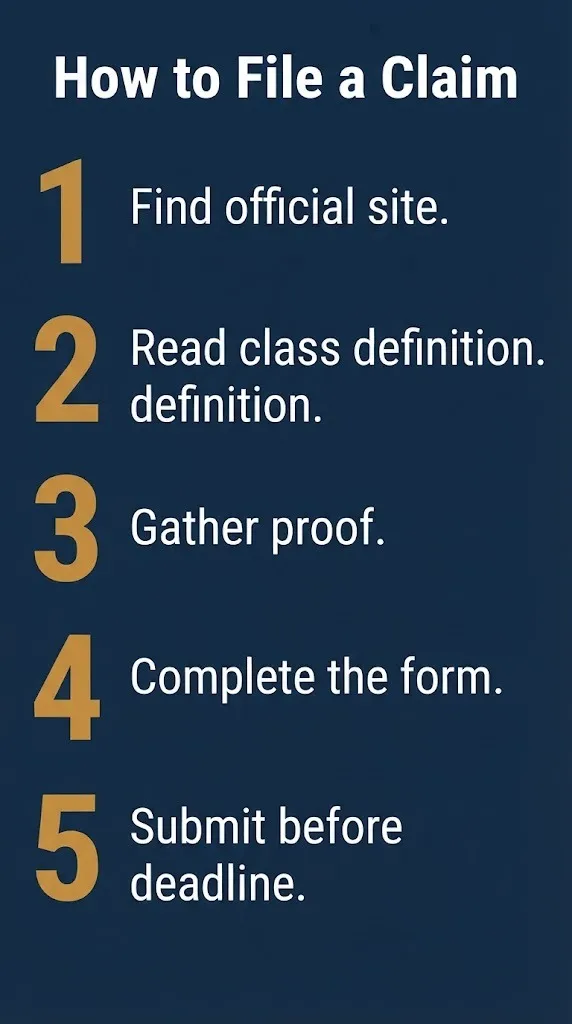
You provide your name, contact information, and whatever proof the settlement requires. Then you wait for the deadline to pass and the court to give final approval.
Here is the filing process:
- Find the official settlement website.
- Read the class definition carefully.
- Confirm you are in the class.
- Gather your proof of purchase or other documents.
- Complete the claim form online or by mail.
- Submit before the deadline.
- Save your confirmation number.
- Wait for final approval and payment.
What Happens After I File a Class Action Claim?
After the claim deadline, the administrator reviews every claim.
Valid claims are counted, and the payout per person is calculated. The court then holds a final approval hearing. If approved, payments go out after any appeals period.
Here is the timeline:
| Stage | Typical Timing |
|---|---|
| Claim deadline | Set in the notice |
| Claim review | 1 to 3 months |
| Final approval hearing | 1 to 3 months after deadline |
| Appeals period | 30 days or more |
| Payment | 1 to 6 months after approval |
What Happens Next
Expected 2026: New class action settlements will continue to be announced throughout the year.
Ongoing: Settlement administrators process claims on rolling schedules.
Your move: Check official settlement websites regularly. File claims before deadlines. Keep receipts.
Class action settlements are real, but they are scattered. No single list captures every active case.
The people who get paid are the ones who verify the case, check the deadline, and file the claim form. Everyone else gets nothing.
Your job is simple: find legitimate cases, meet the deadlines, and never pay a fee to file.