Hernia Mesh Lawsuit Update 2026: Bard Settlements, MDL Status, and Compensation Ranges
Quick Answer:
- The Bard hernia mesh lawsuits are real, with over 20,000 cases consolidated in federal MDL 2846 in Ohio.
- No global settlement exists. Individual settlement amounts are not publicly disclosed by the court.
- No claim deadline applies. These are individual personal injury lawsuits, not a class action with a claims window.
Thousands of people who received polypropylene hernia mesh implants experienced complications including chronic pain, infection, mesh erosion, and bowel obstruction. Many of those people sued the manufacturers. The litigation is now in its sixth year in federal court, and 2026 is shaping up as a decisive year for the Bard cases specifically.
This article covers every verified development in the hernia mesh litigation as of mid-2026. It explains the difference between the Bard and Johnson & Johnson cases, what settlement progress looks like, how much compensation plaintiffs may receive, and how to find out if you still have time to file. The information here comes from federal court dockets, MDL filings, and FDA adverse event records. It does not come from manufacturer press releases.
The Facts
| Detail | Value |
|---|---|
| Case | In re: Davol, Inc./C.R. Bard, Inc. Polypropylene Hernia Mesh Products Liability Litigation, MDL No. 2846 |
| Court | U.S. District Court, Southern District of Ohio |
| Judge | Chief Judge Edmund A. Sargus Jr. and Magistrate Judge Kimberly A. Jolson |
| Status | Active litigation; bellwether trials underway; no global settlement |
| Number of Cases | Over 20,000 in the Bard MDL as of mid-2026 |
| Other Major MDL | Johnson & Johnson/Ethicon Physiomesh, MDL No. 2782 (separate proceeding) |
| Claim Deadline | None (individual lawsuits, not a class action) |
| Settlement Fund | No global settlement fund established; individual settlements not publicly reported |
Is the Hernia Mesh Lawsuit Real?
Yes. The hernia mesh lawsuits are real, extensive, and well-documented in federal court records. This is not a clickbait ad or a scam. The largest consolidated proceeding is In re: Davol, Inc./C.R. Bard, Inc. Polypropylene Hernia Mesh Products Liability Litigation, MDL No. 2846, pending in the Southern District of Ohio.
The Bard MDL alone contains more than 20,000 individual cases as of mid-2026. Each case represents a real person who alleges that Bard’s polypropylene mesh products caused serious injuries after hernia repair surgery. The cases are consolidated for pretrial purposes, meaning they share discovery and bellwether trials, but each plaintiff retains their own individual claim.
A second major MDL targets Johnson & Johnson and its Ethicon subsidiary over Physiomesh and other mesh products. That MDL, numbered 2782, is also active. Both litigations are real. Both involve thousands of plaintiffs. Neither is a class action where you join a list and wait for a check. These are individual product liability lawsuits that require specific medical and surgical records to pursue.
If you saw an ad asking if you qualify for a hernia mesh lawsuit, the underlying litigation is legitimate. The question is whether your specific facts, your implant type, your injury, and your state’s statute of limitations support a viable claim.
What Is the Bard Hernia Mesh Lawsuit About?
The Bard hernia mesh lawsuit centers on allegations that C.R. Bard’s polypropylene-based hernia mesh products were defectively designed and caused predictable, serious complications in a significant percentage of patients. Plaintiffs claim Bard knew about the risks and failed to warn doctors or patients.
The specific products involved include the Bard PerFix Plug, the Bard Kugel Patch, the Bard 3DMax, the Bard Ventralex, the Bard Composix, and the Bard Sepramesh. All use polypropylene, a plastic polymer that plaintiffs’ experts allege can degrade, shrink, and cause chronic inflammation when implanted in the human body.
Complications alleged in the lawsuits include mesh erosion into surrounding tissue and organs, mesh shrinkage causing chronic pain and bowel obstruction, infection requiring surgical removal, hernia recurrence, adhesions, and in severe cases, perforation of the bowel or other organs requiring emergency surgery. The FDA maintains a public database of adverse event reports for surgical mesh. That database contains thousands of reports linked to the products at issue in this litigation.
Bard denies the allegations. The company maintains its mesh products are safe when used as directed and that complications are a known risk of any hernia repair surgery. The litigation is about whether Bard knew the risks were higher than disclosed and whether the product design itself contributed to the injury rate.
Do I Qualify for a Hernia Mesh Lawsuit?
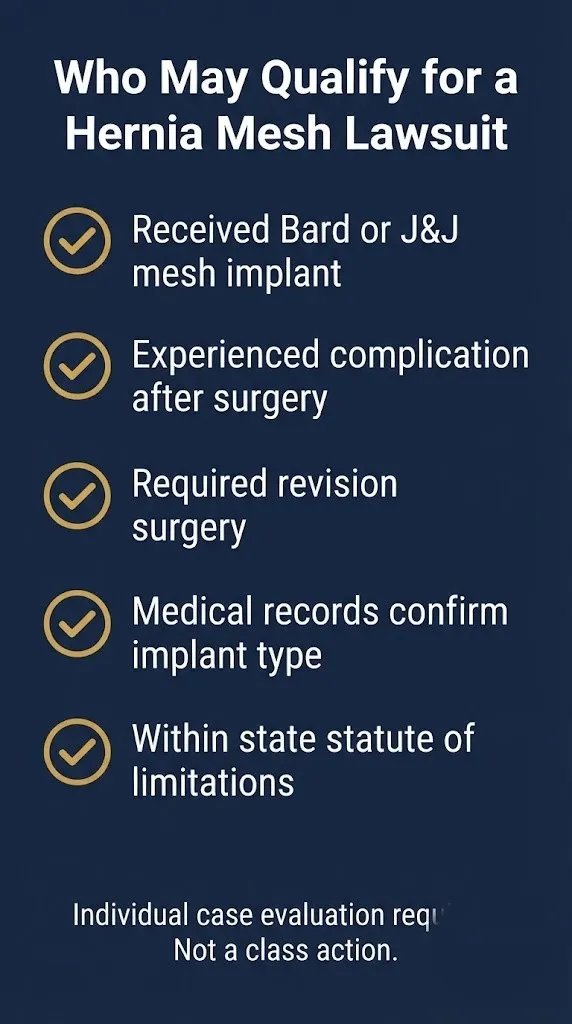
You may qualify to file a hernia mesh lawsuit if you received a Bard or Johnson & Johnson mesh implant, experienced a qualifying complication, and are within your state’s statute of limitations. This is an individual case evaluation, not a checklist you can self-certify.
The core criteria that attorneys typically look for include:
- You underwent hernia repair surgery that used a Bard, Davol, or Ethicon/Johnson & Johnson mesh product.
- You experienced a complication requiring revision surgery, such as mesh removal, infection treatment, or bowel repair.
- You have medical records documenting the implant type and the complication.
- The surgery and complication occurred within the time frame allowed by your state’s statute of limitations.
- The mesh product has not been recalled, but FDA adverse event data and internal company documents are being used to support failure-to-warn claims.
You do not qualify simply because you received a hernia mesh implant. Most hernia mesh patients recover without serious complications. The litigation is for people who suffered specific injuries that required additional medical treatment. Think of it like a product recall on a car part. Not every owner gets a check. Only those whose brakes actually failed have a claim.
The best way to determine if you qualify is to contact a law firm handling hernia mesh cases and provide your surgical records. The consultation is typically free. The firm will review the implant type, your medical history, and the timing to assess whether your case is viable.
Key Takeaway: You need three things to qualify: a qualifying mesh implant, a documented complication, and a case filed within your state’s deadline. The implant alone is not enough.
How Much Is the Average Hernia Mesh Settlement?
There is no publicly confirmed average settlement figure for hernia mesh lawsuits in 2026. The court has not ordered a global settlement, and individual settlement amounts are confidential. Any number you see in an ad is an estimate based on past mass tort settlements, not a guarantee.
What is known comes from comparable medical device mass torts. These cases typically settle in tiers based on injury severity, the strength of causation evidence, and the plaintiff’s age and earning history. Based on past mesh litigations, including the transvaginal mesh settlements that resolved for billions of dollars, and on reports from legal analysts tracking the Bard MDL, here is a rough framework. These are estimates, not confirmed offers.
| Injury Tier | Typical Settlement Range (Estimated) | Description |
|---|---|---|
| Tier 1: Minor | $50,000 to $150,000 | Mesh removal with full recovery, no lasting complications |
| Tier 2: Moderate | $150,000 to $500,000 | Revision surgery, chronic pain, ongoing treatment |
| Tier 3: Severe | $500,000 to $1,000,000+ | Multiple revision surgeries, permanent bowel or organ damage, significant lost income |
These ranges come from legal analyst projections reported in outlets like Reuters and Law360, not from court filings. No settlement grid has been published by the court. No claims administrator has issued payment schedules. The actual amount any plaintiff receives depends on the specific facts of their case, the defendant’s assessment of trial risk, and the outcomes of bellwether trials that set settlement benchmarks.
Reality Check: Settlement ads promising “$250,000 average payout” are marketing, not reporting. Until a global settlement is announced and a claims grid is published, any dollar figure is speculation. The bellwether trials happening in 2026 will provide the first real data points for what juries think these cases are worth.
What Is the Status of the Bard Mesh Lawsuit in 2026?
The Bard MDL is in the bellwether trial phase as of mid-2026. Bellwether trials are test cases. Both sides pick a small number of representative cases, try them to verdict, and use the outcomes to gauge the value of the remaining cases. This is the stage where settlement pressure builds.
Judge Edmund Sargus has overseen this MDL since its creation in 2018. The court has completed fact discovery and expert discovery. Several bellwether trials have been scheduled. The outcomes of these trials will heavily influence whether Bard agrees to a global settlement and at what amount.
Prior bellwether trials in this MDL have produced mixed results. Some resulted in plaintiff verdicts with significant damages. Some resulted in defense verdicts. Mixed results tend to push both sides toward settlement because neither side wants to risk a catastrophic loss in front of a jury. But mixed results can also delay settlement because the defendant believes it can win cases.
No global settlement has been announced as of July 2026. Bard has resolved some individual cases through private settlements, but the terms are confidential. The court has not issued an order establishing a settlement program, a claims administrator, or a filing deadline for the broader MDL.
What About the Johnson & Johnson Hernia Mesh Lawsuit?
The Johnson & Johnson hernia mesh litigation is a separate MDL from the Bard cases. The J&J cases involve Ethicon Physiomesh and other J&J mesh products. The MDL is pending in the U.S. District Court for the Northern District of Georgia under MDL No. 2782.
Johnson & Johnson has taken a different litigation strategy than Bard. In some related mesh litigations, J&J has negotiated large-scale settlements. In the transvaginal mesh cases, J&J agreed to settlements exceeding $4 billion. But in the hernia mesh MDL, J&J has not announced a global settlement as of mid-2026.
The J&J cases involve different products with different design features than the Bard mesh. The Physiomesh product was voluntarily pulled from the market in 2016, which plaintiffs cite as evidence the company knew the product was defective. J&J maintains the withdrawal was a business decision, not a safety recall. The distinction matters in court, but for patients who experienced complications, the outcome is the same: revision surgery, pain, and mounting medical bills.
If you received a J&J mesh product, your case is not part of the Bard MDL. You need an attorney handling the J&J litigation specifically. The two MDLs are in different courts before different judges with different settlement dynamics.
Key Takeaway: Bard and J&J are separate MDLs. Bard is further along with bellwether trials in 2026. J&J has no global settlement. Know which mesh you received before contacting an attorney.
What Complications Are Linked to Hernia Mesh Lawsuits?
The lawsuits focus on a specific set of complications that plaintiffs allege are caused by defective mesh design, not ordinary surgical risk. These complications are well-documented in the FDA’s Manufacturer and User Facility Device Experience (MAUDE) database.
The most common injuries alleged in the litigation include:
- Chronic pain requiring long-term pain management or additional surgery.
- Mesh erosion where the mesh wears through surrounding tissue or organs.
- Mesh shrinkage causing pulling, pain, and hernia recurrence.
- Infection that antibiotics cannot clear, requiring surgical mesh removal.
- Bowel obstruction caused by mesh adhering to the intestines.
- Organ perforation requiring emergency surgery.
- Seroma or fluid buildup at the surgical site.
- Mesh migration where the implant moves from the original placement site.
The key legal argument is that these complications are not random bad luck. Plaintiffs’ experts contend the polypropylene material itself is unsuitable for permanent implantation and that Bard knew or should have known about the failure rate. Internal company documents, including emails and design review records, are central to the failure-to-warn claims.
The FDA has not issued a recall for most of the Bard mesh products named in the litigation. Some older products like the Kugel Patch were recalled years ago for ring breakage issues, but the current MDL covers a broader range of products and alleged defects.
How Do I File a Hernia Mesh Lawsuit?
Filing a hernia mesh lawsuit is not like filing a class action claim form. You cannot do it yourself through a website. You need an attorney to file an individual complaint in the appropriate court.
The process works like this:
- Gather your medical records from the hospital where your hernia repair was performed.
- Identify the mesh product used. The operative report should name the manufacturer and product.
- Gather records from any revision surgery or complication treatment you received.
- Contact a law firm with experience in mass tort medical device litigation.
- Provide your records for a free case evaluation.
- If the firm accepts your case, they file a complaint on your behalf in the appropriate MDL or state court.
- Your case proceeds through discovery alongside the other consolidated cases.
- If a global settlement is reached, your case is evaluated under the settlement criteria.
- If no settlement materializes, your case may proceed to trial individually.
The entire process can take years. MDL litigation moves slowly by design. Cases filed in 2026 may not resolve until 2028 or later. Attorneys work on contingency, meaning they only get paid if you recover compensation. Typical fees range from 33% to 40% of the recovery plus case costs.
What Is the Statute of Limitations for a Hernia Mesh Lawsuit?
The statute of limitations is the legal deadline to file your lawsuit. It varies by state, and it is the single most common reason people with valid claims get shut out of the litigation.
Most states allow two to three years from the date you discovered the injury. In hernia mesh cases, the “discovery rule” often applies. The clock does not start the day you got the implant. It starts the day you knew or reasonably should have known the mesh caused your complication. That is typically the date of your revision surgery or the date a doctor told you the mesh was the problem.
If you had revision surgery in 2023, your two-year statute of limitations may expire in 2025, which means your window is already closed. If you had surgery in 2024 or 2025, you may still have time. The exact deadline depends on your state’s laws. Some states give three years. Some give only one. A few allow claims to be tolled while an FDA investigation is ongoing.
Do not rely on general information. Call an attorney and give them your surgery date. They can tell you within minutes whether your deadline has passed. Waiting to call is the only mistake you cannot fix later.
Key Takeaway: The statute of limitations varies by state, typically two to three years from the date you discovered the injury. If you had revision surgery, the clock likely started that day.
What Happens Next in the Hernia Mesh Litigation?
The hernia mesh litigation is entering a critical phase in 2026 and 2027. Bellwether trial outcomes will drive the next steps for thousands of pending cases.
- Mid to late 2026: Additional Bard bellwether trials proceed in the Southern District of Ohio. Verdicts and any post-trial rulings will set settlement benchmarks.
- Late 2026 to early 2027: If bellwether outcomes strongly favor plaintiffs, expect renewed settlement negotiations. Bard may establish a formal settlement program to resolve the MDL cases.
- 2027: If a global settlement is reached, a claims administrator would be appointed to process individual cases under a tiered compensation grid.
- 2027 to 2028: Individual case evaluations, lien resolution, and payment distribution for cases included in any settlement.
- Ongoing: The Johnson & Johnson MDL continues on a separate track. No bellwether trials have been scheduled as of mid-2026, but that could change.
These are projections based on the pace of past medical device MDLs. The process is not fast. The transvaginal mesh litigation took over a decade from first filing to final payment. Hernia mesh is moving faster, but “faster” in mass tort terms still means years, not months.
Frequently Asked Questions
Is there a class action lawsuit for hernia mesh?
No. The hernia mesh cases are individual lawsuits consolidated into multidistrict litigation (MDL).
MDL is not a class action. Each plaintiff has their own case with their own facts and their own potential recovery.
You must file your own claim with your own attorney.
Has anyone received a hernia mesh settlement check?
Yes. Some individual Bard cases have settled privately, and plaintiffs have received payments.
The settlement amounts are confidential and not part of a public claims program.
Most plaintiffs in the MDL are still waiting for a global resolution.
How long do I have to file a hernia mesh claim?
It depends on your state’s statute of limitations, typically two to three years from discovery of the injury.
If you had revision surgery, the clock likely started on that date.
Contact an attorney immediately to check your deadline.
What Bard mesh products are included in the lawsuit?
The litigation covers Bard’s polypropylene mesh products including PerFix Plug, Kugel Patch, 3DMax, Ventralex, Composix, and Sepramesh.
Not all Bard mesh products are polypropylene-based. Confirm your implant type through your surgical records.
Can I file a hernia mesh lawsuit on behalf of a deceased family member?
Yes, if the mesh complication contributed to their death and you are an authorized representative of their estate.
Wrongful death claims have their own statute of limitations, often shorter than personal injury deadlines.
An attorney can advise on whether you have standing to bring a claim.
Do I need to have revision surgery to qualify?
In most cases, yes. Revision surgery is the strongest evidence of a serious mesh complication.
Cases without revision surgery are harder to prove but not impossible if there is clear documentation of mesh-related injury.
Attorneys prioritize cases with surgical intervention because they carry higher settlement value.
How much does a hernia mesh attorney cost?
Hernia mesh attorneys work on contingency. You pay nothing unless you recover compensation.
Typical fees are 33% to 40% of the recovery amount, plus case costs.
Always review the fee agreement before signing.
What if I don’t know which mesh product I received?
Request your surgical records from the hospital where your hernia repair was performed.
The operative report will name the manufacturer and product.
An attorney can help you obtain these records if you have difficulty getting them yourself.
The hernia mesh litigation is real, active, and entering a pivotal phase. The Bard bellwether trials in 2026 will shape settlement prospects for more than 20,000 plaintiffs. If you had hernia repair surgery with mesh and later needed revision surgery for complications, your time to act is limited by your state’s statute of limitations. Get your surgical records. Find out which mesh product you received. Contact an attorney who handles medical device cases. The consultation is free, and the information you get will tell you whether you still have a viable claim.